2016年英语专业四级考试真题及答案解析
2016年英语专业四级考试真题 · 完整收录
- 年份考次
- 2016 年
- 命题归属
- 全国统一命题
- 省份
- 全国
- 题量
- 37 题
- 满分
- 70 分
- 限时
- 130 分钟
- 题型结构
- PART III 语言知识 20 题 20 分 · PART IV 完形填空 10 题 10 分 · PART V 阅读 Section A 选择题 10 题 10 分 · PART V 阅读 Section B 简答题 5 题 10 分 · PART VI 写作 1 题 20 分
- 收录格式
开始考试(微信)

微信扫一扫 · 小程序内开始考试
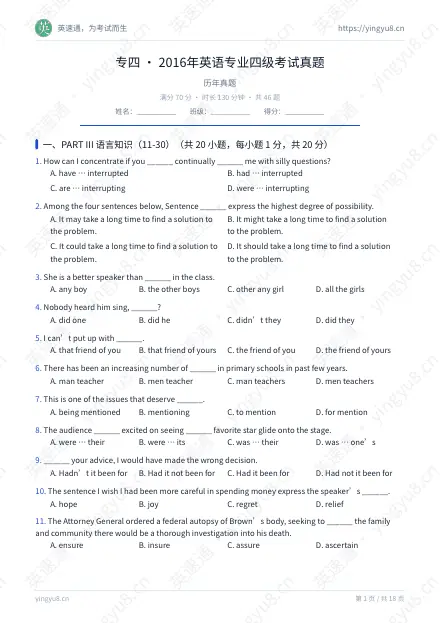
第 1 部分 · PART III 语言知识(11-30)20 题 · 20 分
- A.have … interrupted
- B.had … interrupted
- C.are … interrupting
- D.were … interrupting
参考答案与解析
答案:C
解析:识别题干为现在进行时语境 → 分析选项时态与语态 → 选择现在进行时被动语态
考点:现在进行时被动语态时态与语态
译文:如果你一直用愚蠢的问题打断我,我怎么能集中注意力?
- A.It may take a long time to find a solution to the problem.
- B.It might take a long time to find a solution to the problem.
- C.It could take a long time to find a solution to the problem.
- D.It should take a long time to find a solution to the problem.
参考答案与解析
答案:D
解析:识别题干要求最高可能性 → 分析各情态动词表示可能性的强度 → 选择表示可能性最高的should
考点:情态动词辨析可能性强度
译文:在下面四个句子中,句子______表达了最高的可能性。
- A.any boy
- B.the other boys
- C.other any girl
- D.all the girls
参考答案与解析
答案:A
解析:识别比较级结构 → 分析比较对象的一致性 → 选择与主语she同类且符合语法的比较对象
考点:比较级结构比较对象一致性
译文:她比班上任何男孩都更擅长演讲。
- A.did one
- B.did he
- C.didn’t they
- D.did they
参考答案与解析
答案:D
解析:识别反意疑问句结构 → 分析主语nobody的否定含义 → 选择与主语一致的反意疑问部分
考点:反意疑问句主谓一致
译文:没有人听到他唱歌,是吗?
- A.that friend of you
- B.that friend of yours
- C.the friend of you
- D.the friend of yours
参考答案与解析
答案:B
解析:识别双重所有格结构 → 分析that friend of yours的固定搭配 → 选择正确的所有格形式
考点:双重所有格固定搭配
译文:我受不了你的那个朋友。
- A.man teacher
- B.men teacher
- C.man teachers
- D.men teachers
参考答案与解析
答案:D
解析:分析名词短语结构 → 判断中心词与修饰语的数 → 确定正确搭配形式
考点:名词复数形式复合名词构成
译文:在过去几年里,小学里的男教师数量一直在增加。
- A.being mentioned
- B.mentioning
- C.to mention
- D.for mention
参考答案与解析
答案:B
解析:分析动词deserve的用法 → 判断其后接动名词还是不定式 → 确定正确形式
考点:动词deserve的用法动名词作宾语
译文:这是值得提及的问题之一。
- A.were … their
- B.were … its
- C.was … their
- D.was … one’s
参考答案与解析
答案:A
解析:分析主语audience的数 → 判断其后谓语动词的数 → 确定代词指代的一致性
考点:集合名词的数代词指代一致
译文:观众们在看到他们最喜欢的明星滑上舞台时都很兴奋。
- A.Hadn’t it been for
- B.Had it not been for
- C.Had it been for
- D.Had not it been for
参考答案与解析
答案:B
解析:分析虚拟语气结构 → 判断省略if后的倒装形式 → 确定正确语序
考点:虚拟语气倒装固定短语if it were not for
译文:要不是你的建议,我就会做出错误的决定了。
- A.hope
- B.joy
- C.regret
- D.relief
参考答案与解析
答案:C
解析:分析虚拟语气结构 → 理解wish后接过去完成时的含义 → 推断说话者的情感态度
考点:虚拟语气表遗憾语境推断情感
译文:句子‘我希望我在花钱时更谨慎些’表达了说话者的______。
- A.ensure
- B.insure
- C.assure
- D.ascertain
参考答案与解析
答案:C
解析:识别固定搭配 assure sb (that)... → 辨析 ensure/insure/assure/ascertain 词义与搭配 → 得出答案
考点:assure sb (that)...ensure sthinsure sthascertain sth
译文:司法部长下令对布朗的遗体进行联邦尸检,旨在向家人和社区______将对其死亡进行彻底调查。
- A.consequence
- B.outcome
- C.result
- D.aftermath
参考答案与解析
答案:D
解析:分析语境“事件的处理” → 辨析 consequence/outcome/result/aftermath 的语义侧重 → 得出答案
考点:aftermath 指(灾难性事件的)后果,余波consequence 指(负面)结果outcome 指(最终)结果result 指(直接)结果
译文:警察局因其对一名手无寸铁者的死亡及其对该事件的______处理而受到强烈批评。
- A.dispel
- B.expel
- C.repel
- D.quell
参考答案与解析
答案:A
解析:分析语境“消除疑虑” → 辨析 dispel/expel/repel/quell 的语义搭配 → 得出答案
考点:dispel doubts/rumorsexpel sb from sthrepel an attackquell unrest/suspicions
译文:外交大臣试图______对其处理危机方式的疑虑。
- A.deprive
- B.lack
- C.yearn
- D.attain
参考答案与解析
答案:B
解析:分析语境“不想花时间研究股票或______资源建立投资组合” → 根据逻辑关系(or连接并列否定条件)选择动词 → 得出答案
考点:lack resources 缺乏资源
译文:因此,共同基金最适合那些不想花时间详细研究股票,或者______资源来建立投资组合的投资者。
- A.into…up
- B.on…into
- C.across…on
- D.against…into
参考答案与解析
答案:A
解析:识别固定搭配 run into sb (偶遇) 和 strike up a rapport (建立融洽关系) → 匹配选项 → 得出答案
考点:run into sbstrike up a rapport
译文:克里斯在一次体育用品展销会上______约翰,两人很快______了融洽的关系。
- A.especially
- B.particularly
- C.specially
- D.specifically
参考答案与解析
答案:C
解析:识别固定搭配 → 辨析副词词义与用法 → 选择表示“特意”的副词
考点:specially convened副词辨析
译文:“我很快就要离开这个国家了,”他告诉一群特意召集的记者。
- A.contemporary
- B.makeshift
- C.spontaneous
- D.temporary
参考答案与解析
答案:D
解析:分析语境(停火协议) → 辨析形容词词义 → 选择表示“临时的”形容词
考点:ceasefire形容词辨析
译文:以色列和哈马斯已就将临时停火延长24小时至周二午夜达成协议。
- A.Due
- B.Prior
- C.Related
- D.Thanks
参考答案与解析
答案:B
解析:识别固定搭配 → 分析句子逻辑关系(建议) → 选择表示“在…之前”的介词
考点:Prior to固定搭配
译文:在完全拔掉闹钟并相信自己能按时自然醒来之前,你可能应该通过保持几周非常规律的作息来让自己适应新的安排。
- A.valiant
- B.variable
- C.vigilant
- D.vigorous
参考答案与解析
答案:D
解析:分析语境(运动员、肌肉) → 辨析形容词词义 → 选择表示“强壮的”形容词
考点:strong abdominal muscles形容词辨析
译文:如果你是一名运动员,强壮的腹肌有助于你在上半身运动时确保背部强壮并免受伤害。
- A.reality
- B.truth
- C.practice
- D.skill
参考答案与解析
答案:C
解析:分析语境(残忍的行为、割鳍) → 辨析名词词义 → 选择表示“做法、行为”的名词
考点:cruel practice名词辨析
译文:割鳍是一种残忍的做法,鲨鱼的鳍被割掉,活鲨鱼被扔回海里。
第 2 部分 · PART IV 完形填空(15选10)1 题 · 10 分
A. ampleB. combinationsC. directlyD. disseminatedE. generationsF. genuinelyG. insteadH. listsI. promulgatedJ. publicizedK. scantL. shapedM. sophisticatedN. transplantedO. virtual
参考答案与解析
答案:31-H 32-L 33-I 34-E 35-D 36-K 37-O 38-C 39-M 40-G
解析:31 空 定位空格前 'such' 指代前文列举的大量事物 → 分析空格后 'of subjects' 构成搭配 → 结合 'almost miss the point' 判断此处需一个表示‘列举、清单’的名词 → 从选项中筛选符合语境与搭配的词
32 空 分析句子结构,空格位于逗号后,作状语修饰主句 → 判断主语 'The world' 与动词 'mark' 的被动关系 → 选择表示被动与完成的非谓语形式
33 空 定位空格前 'proclaimed their authority and' → 分析空格后 'their laws in writing' → 判断此处需一个与 'laws' 搭配的动词,且与 'proclaimed' 并列 → 从选项中筛选符合法律语境的动词
34 空 定位空格前 'Religious traditions were passed on through' → 分析空格后 'and spread to others, in writing' → 判断此处需一个表示‘传承’或‘记录’的名词,且与 'writing' 相关 → 从选项中筛选符合宗教传承语境的词
35 空 定位空格前 'Scientific and technological progress was achieved and' → 分析空格后 'through writing' → 判断此处需一个与 'achieved' 并列的动词,表示进步被‘记录’或‘保存’ → 从选项中筛选符合科技史语境的词
36 空 定位空格所在句 → 分析句意(没有书写的世界与现在世界的相似度)→ 结合前文强调的差异性 → 选择表示“几乎没有”的否定词
37 空 定位空格所在句 → 分析句意(书写对文明社会的必要性)→ 结合前文对书写重要性的论述 → 选择表示“绝对的、根本的”形容词
38 空 定位空格所在句 → 分析句意(文明社会成员与食物获取/生产的关系)→ 结合前文对社会分工的描述 → 选择表示“直接地”副词
39 空 定位空格所在句 → 分析句意(文明社会对记录保存系统的要求)→ 结合前文对税收、贸易等复杂系统的描述 → 选择表示“复杂的”形容词
40 空 定位空格所在句 → 分析句意(科学与技术进步通过书写被记录和传播)→ 结合前文对书写功能的论述 → 选择表示“记录、保存”的动词
考点:语境选词名词搭配非谓语动词被动语态动词搭配近义词辨析
译文:题干:但这样的______几乎忽略了重点。正确项:列举(list)
第 3 部分 · PART V 阅读 Section A 选择题(41-50)10 题 · 10 分
(1) When I was twenty-seven years old, I was a mining-broker’s clerk in San Francisco, and an expert in all the details of stock traffic. I was alone in the world, and had nothing to depend upon but my wits and a clean reputation; but these were setting my feet in the road to eventual fortune, and I was content with the prospect. My time was my own after the afternoon board, Saturdays, and I was accustomed to putting it in on a little sail-boat on the bay. One day I ventured too far, and was carried out to sea. Just at nightfall, when hope was about gone, I was picked up by a small ship which was bound for London. It was a long and stormy voyage, and they made me work my passage without pay, as a common sailor. When I stepped ashore in London my clothes were ragged and shabby, and I had only a dollar in my pocket. This money fed and sheltered me twenty-four hours. During the next twenty-four I went without food and shelter. (2) About ten o’clock on the following morning, dirty and hungry, I was dragging myself along Portland Place, when a child that was passing, towed by a nurse-maid, tossed a big pear—minus one bite—into the gutter. I stopped, of course, and fastened my desiring eye on that muddy treasure. My mouth watered for it, my stomach craved it, my whole being begged for it. But every time I made a move to get it some passing eye detected my purpose, and of course I straightened up then, and looked indifferent and pretended that I hadn’t been thinking about the pear at all. This same thing kept happening and happening, and I couldn’t get the pear. (3) I was just getting desperate enough to brave all the shame, and to seize it, when a window behind me was raised, and a gentleman spoke out of it, saying: “ Step in here, please.” (4) I was admitted by a man servant, and shown into a sumptuous room where a couple of elderly gentlemen were sitting. They sent away the servant, and made me sit down. They had just finished their breakfast, and the sight of the remains of it almost overpowered me. I could hardly keep my wits together in the presence of that food, but as I was not asked to sample it, I had to bear my trouble as best as I could. (5) Now, something had been happening there a little before, which I did not know anything about until a good many days afterwards, but I will tell you about it now. Those two old brothers had been having a pretty hot argument a couple of days before, and had ended by agreeing to decide it by a bet, which is the English way of settling everything. (6) You will remember that the Bank of England once issued two notes of a million pounds each, to be used for a special purpose connected with some public transaction with a foreign country. For some reason or other only one of these had been used and canceled; the other still lay in the vaults of the Bank. Well, the brothers chatting along, happened to get to wondering what might be the fate of a perfectly honest and intelligent stranger who should be turned adrift in London without a friend, and with no money but that million-pound bank-note, and no way to account for his being in possession of it. Brother A said he would starve to death; Brother B said he wouldn’t. Brother A said he couldn’t offer it at a bank or anywhere else, because he would be arrested on the spot. So they went on disputing till Brother B said he would bet twenty thousand pounds that the man would live thirty days, anyway, on that million, and keep out of jail, too. Brother A took him up. Brother B went down to the Bank and bought that note. Then he dictated a letter, which one of his clerks wrote out in a beautiful round hand, and then the two brothers sat at the window a whole day watching for the right man to give it to. (7) I finally became the pick of them.
- A.put me aside
- B.prepare me
- C.let me walk
- D.start my journey
参考答案与解析
答案:B
解析:定位短语所在句 → 分析上下文逻辑(wits and reputation是基础) → 推断短语意为“为…打下基础/做好准备”
考点:熟词僻义语境推断
译文:题干:第一段中短语“set my feet”可能的意思是。正确项B:为我做好准备。
- A.the man wanted to maintain dignity though starved
- B.the man could not get a proper chance to eat the pear
- C.the man did not really want the pear since it was dirty
- D.it was very difficult for the man to get the pear
参考答案与解析
答案:A
解析:定位第二段描述 → 分析人物行为(每次有人看就装作不在乎) → 推断其核心动机是维护尊严
考点:推理判断观点态度
译文:题干:从第二段可以得出结论。正确项A:这个人虽然饥饿,但想保持尊严。
- A.neutral
- B.negative
- C.reserved
- D.positive
参考答案与解析
答案:D
解析:定位Brother A和Brother B的对话 → 对比两人对百万英镑影响的预测 → 推断Brother B态度更积极
考点:推理判断观点态度
译文:题干:与A兄弟相比,B兄弟对百万英镑对一个陌生人产生的影响更持____态度。正确项D:积极的。
(1) The concept of peace is a very important one in cultures all over the world. Think about how we greet people. In some language, the phrases for greetings contain the word for peace. In some cultures we greet people by shaking hands or with another gesture to show that we are not carrying weapons —that we come in peace. And there are certain symbols which people in very different cultures recognize as representing peace. Let’s look at a few of them. The dove (2) The dove has been a symbol of peace and innocence for thousands of years in many different cultures. In ancient Greek mythology it was a symbol of love and the renewal of life. In ancient Japan a dove carrying a sword symbolized the end of war. (3) There was a tradition in Europe that if dove flew around a house where someone was dying then their soul would be at peace. And there are legends which say that devil can turn himself into any bird except for a dove. In Christian art, the dove was used to symbolized the Holy Ghost and was often painted above Christ’s head. (4) But it was Pablo Picasso who made the dove a modern symbol of peace when he used it on a poster for the World Peace Congress in 1949. The rainbow (5) The rainbow is another ancient and universal symbol, often representing the connection between human beings and their gods. In Greek mythology it was associated with Iris, the goddess who brought messages from the gods on Mount Olympus. In Scandinavian mythology the rainbow was a bridge between the gods and the earth. In the Bible a rainbow showed Noah that the Biblical flood was finally over, and that God had forgiven his people. In the Chinese tradition, the rainbow is a common symbol for marriage because the colours represent the union of yin and yang. Nowadays the rainbow is used by many popular movements for peace and the environment, representing the possibility of a better world in the future and promising sunshine after rain. Mistletoe (6) This plant was sacred in many cultures, generally representing peace and love. Most people know of the tradition of kissing under the mistletoe at Christmas time, which probably comes from Scandinavian mythology. The goddess Freya’s son was killed by an arrow made of mistletoe, so, in honour of him, she declared that it would always be a symbol of peace. It was often hung in doorways as a sign of friendship. (7) The ancient Druids believed that hanging mistletoe in your doorway could protect you from evil spirits. Tribes would stop fighting for a period of time if they found a tree with mistletoe. But you will never see mistletoe in a Christian church — it is banned because of its associations with pagan religion and superstition. The olive branch (8) The olive tree has always been a valuable source of food and oil. In Greek mythology, the goddess Athena gave the olive tree to the people of Athens, who showed their gratitude by naming the city after her. But no one knows for sure when or why it began to symbolize peace. There is probably a connection with ancient Greece. Wars between states were suspended during the Olympics Games, and the winners were given crowns of olive branches. The symbolism may come from the fact that the olive tree takes a long time to produce fruit, so olives could only be cultivated successfully in long periods of peace. Whatever the history, the olive branch is a part of many modern flags symbolizing peace and unity. One well-known example is the United Nations symbol. The ankh (9) The ankh is an ancient symbol which was adopted by the hippie movement in the 1960s to represent peace and love. It was found in many Asian cultures, but is generally associated with ancient Egypt. It represented life and immortality. Egyptians were buried with an ankh, so that they could continue to live in the “afterworld”. The symbol was also found along the sides of the Nile, which gave life to the people. They believed that the ankh could control the flow of the river and make sure that there was always enough water.
- A.Concept of Peace.
- B.Popular Peace Symbols.
- C.Origin of Peace Symbols.
- D.Cultural Difference of Peace.
参考答案与解析
答案:B
解析:通览全文结构(引言+三个具体符号) → 概括各段核心(介绍不同文化中的和平象征) → 选择最全面的标题
考点:主旨大意篇章结构
译文:题干:以下哪项是本文的最佳标题?正确项B:流行的和平象征。
- A.Sweden
- B.Greece
- C.Finland
- D.China
参考答案与解析
答案:D
解析:定位彩虹象征段落 → 逐一核对选项国家在文中的描述 → 找出未提及“人神连接”的国家
考点:细节定位与捕捉
译文:题干:彩虹在以下所有国家中都代表人与神的联系,除了。正确项D:中国。
- A.friendship
- B.love
- C.kinship
- D.honour
参考答案与解析
答案:A
解析:定位到 Mistletoe 段落 → 识别 'representing peace and love' 与 'kissing' 的语境关联 → 推断 'hung in doorways' 的社交功能为 'friendship'
考点:细节定位语境推断
译文:题干:在北欧,槲寄生常被挂在门廊上以表示______。正确项:友谊。
- A.the Nile
- B.the “afterword”
- C.the hippie movement
- D.ancient Egypt
参考答案与解析
答案:D
解析:定位到 Ankh 段落(语篇截断,但根据常识与选项推断) → 识别 'ankh' 与 'ancient Egypt' 的关联 → 得出答案
考点:细节定位常识关联
译文:题干:安卡符号的起源可以追溯到______。正确项:古埃及。
(1) Two sides almost never change: That you can manipulate people into self-sufficiency and that you can punish them into good citizenship. (2) The first manifests itself in our tireless search for the magical level at which welfare grants are big enough to meet basic needs but small enough to make low-paid work attractive. The second has us looking to the criminal justice system to cure behavior that is as much as anything the result of despair. (3) The welfare example is well known. We don’t want poor people to live in squalor or their children to be malnourished. But we also don’t want to subsidize the indolence of people who are too lazy to work. The first impulse leads us to provide housing, food stamps, medical care and a cash stipend for families in need. The second gets us to think about “workforce”. (4) We’ve been thinking about it for two reasons: the “nanny” problems of two high-ranking government officials (who hired undocumented foreigners as household helpers, presumably because they couldn’t find Americans to do the work) and President Clinton’s proposal to put a two-year limit on welfare. (5) Maybe something useful will come of Clinton’s idea, but I’m not all that hopeful. It looks to me like one more example of trying to manipulate people into taking care of themselves. (6) On the criminal justice side, we hope to make punishment tough enough to discourage crime but not so tough as to clog our prisons with relatively minor offenders. Too short a sentence, we fear, will create contempt for the law. Too long a sentence will take up costly space better used for the violent and unremorseful. (7) Not only can we never find the “perfect” punishment, our search for optimum penalties is complicated by our desire for fairness: to let the punishment fit the crime. The problem is that almost any punishment—even the disgrace of being charged with a crime—is sufficient to deter the middle class, while for members of the underclass, probation may be translated as “I beat it” . (8) So how can you use the system — welfare or criminal justice — to produce the behavior we want? The answer, I suspect is: You can’t. (9) We keep trying to use welfare and prison to change people—to make them think and behave the way we do —when the truth is the incentives work only for those who already think the way we do: who view today’s action with an eye on the future. (10) We will take lowly work (if that is all that’s available) because we believe we can make bad jobs work for us. We avoid crime not because we are better people but because we see getting caught as a future-wrecking disaster. We are guided by a belief that good things will happen for us in the future if we take proper care of the present. Even under the worst of circumstances, we believe we are in control of our lives. (11) And we have trouble understanding that not everybody believes as we believe. The welfare rolls, the prison and the mean street of our cities are full of people who have given up on their future. Without hope for the future, hard work at a low-paid job makes no sense. Working hard in school, or pleasing a boss, or avoiding pregnancy makes no sense. The deadly disease is hopelessness. The lawlessness and poverty are only the obvious symptoms. (12) I’m not advocating that we stop looking for incentives to move poor people toward self-sufficiency or that we stop punishing people for criminal behavior. There will always be some people who need help and some who deserve to be in jail. (13) All I’m saying is that the long-term answer both to welfare and the crime that plagues our communities is not to fine tune the welfare and criminal justice systems but to prevent our children from getting the disease of despair. (14) If we encourage our young people to believe in the future, and give them solid evidence for believing, we’ll find both crime and poverty shrinking to manageable proportions.
- A.Pessimistic.
- B.Optimistic.
- C.Suspicious.
- D.Sarcastic.
参考答案与解析
答案:A
解析:定位到作者评价 Clinton 提案的段落 → 识别 'not all that hopeful' 与 'one more example of trying to manipulate' 的负面评价 → 推断态度为悲观
考点:观点态度推断情感色彩识别
译文:题干:作者对克林顿福利提案的态度是什么?正确项:悲观的。
- A.hopeless
- B.useless
- C.frightening
- D.humiliating
参考答案与解析
答案:B
解析:定位到第7段关于 underclass 的描述 → 识别 'probation may be translated as “I beat it”' 的含义 → 推断惩罚对他们无效
考点:推理判断语境含义推断
译文:题干:从第7段可以推断,最佳惩罚对底层阶级是______。正确项:无用的。
- A.Lawlessness and Poverty.
- B.Criminal Justice System.
- C.Welfare Grants.
- D.Disease of Despair.
参考答案与解析
答案:D
解析:通览全文结构 → 识别首段 'despair' 与末段 'welfare and pr...' 的呼应 → 概括核心论点为 'Disease of Despair'
考点:主旨大意篇章结构
译文:题干:以下哪项最适合作为本文的标题?正确项:绝望之疾。
第 4 部分 · PART V 阅读 Section B 简答题(51-55)5 题 · 10 分
参考答案与解析
答案:He had to endure his hunger without eating.
解析:定位短语 'bear my trouble' → 结合上下文语境(饥饿)进行同义替换推理 → 得出答案
考点:短语 'bear my trouble' 的语境义上下文信息关联
译文:题干:在第4段,男士说“I had to bear my trouble”是什么意思? 正确项:他不得不忍受饥饿而不吃东西。
参考答案与解析
答案:The two brothers made a bet to settle their argument.
解析:定位文章末句 → 分析其逻辑功能(总结前文争论) → 推断其隐含的解决方案(打赌) → 得出答案
考点:末句的逻辑功能从争论到解决方案的推理
译文:题干:从文章最后一句可以推断出什么? 正确项:两兄弟打了个赌来解决他们的争论。
参考答案与解析
答案:To represent peace and the UN's mission.
解析:定位文中关于联合国标志与橄榄枝的描述 → 提取其象征意义(和平与使命) → 得出答案
考点:细节信息定位象征意义提取
译文:题干:为什么联合国在其标志中使用橄榄枝? 正确项:为了代表和平与联合国的使命。
参考答案与解析
答案:Balance meeting basic needs and encouraging work.
解析:定位作者关于福利制度的论述 → 提炼其核心观点(平衡基本需求与鼓励工作) → 得出答案
考点:作者观点提炼平衡关系的识别
译文:题干:根据作者的观点,我们在福利方面应该保持什么平衡? 正确项:平衡满足基本需求和鼓励工作。
参考答案与解析
答案:We believe we control our future actions.
解析:定位第10段引语 → 分析其在段落中的逻辑作用(强调人的主观能动性) → 结合上下文进行同义替换推理 → 得出答案
考点:引语的语境义主观能动性的推理
译文:题干:作者说“Even under the worst of circumstances, we believe we are in control of our lives”(第10段)是什么意思? 正确项:我们相信我们能控制自己未来的行动。
第 5 部分 · PART VI 写作1 题 · 20 分
参考答案与解析
参考范文
The excerpt discusses the UK government's decision to ban parents from taking their children out of school during term time for holidays, even to save money. The core message is that any absence from school, even if authorized by head teachers, can harm a child's education. This measure is part of a broader effort to reduce truancy and make education more rigorous, with stricter penalties for non-compliance. The head teachers' association supports this, emphasizing that a child's education should take priority over holiday savings. In my opinion, while the financial burden of holiday costs is understandable, parents should not take children out of school during term time. Education is a fundamental right and a critical foundation for a child's future. Missing school disrupts learning continuity, affects academic progress, and may lead to gaps in knowledge. Moreover, it sets a poor example about the value of commitment and responsibility. Instead of compromising education, parents could explore alternative ways to manage costs, such as planning holidays during official breaks or seeking more affordable options. Schools and governments should also consider measures to make holidays more accessible without sacrificing educational integrity. Ultimately, investing in a child's education yields long-term benefits that far outweigh short-term financial savings.
常见问题
2016年英语专业四级考试真题的答案和解析在哪看?
答案与解析就在本页:每道题下方「参考答案与解析」展开即看,含参考答案、解题思路与考点,免登录直接阅读。
2016年英语专业四级考试真题 PDF 怎么免费下载?
本页「试卷封面」卡片「收录格式」行内的 PDF 徽标即下载链接,点击直接下载本卷 PDF 文件,无需登录。
这套卷怎么在线做题、怎么计分?
点页面上方「开始考试(网页)」进入在线做题页:登录后装载本卷作答,交卷自动判分并留存成绩;免费账号每日可装载 30 套,会员每日 100 套。