2017年英语专业四级考试真题及答案解析
2017年英语专业四级考试真题 · 完整收录
- 年份考次
- 2017 年
- 命题归属
- 全国统一命题
- 省份
- 全国
- 题量
- 37 题
- 满分
- 70 分
- 限时
- 130 分钟
- 题型结构
- PART III 语言知识 20 题 20 分 · PART IV 完形填空 10 题 10 分 · PART V 阅读 Section A 选择题 10 题 10 分 · PART V 阅读 Section B 简答题 5 题 10 分 · PART VI 写作 1 题 20 分
- 收录格式
开始考试(微信)

微信扫一扫 · 小程序内开始考试
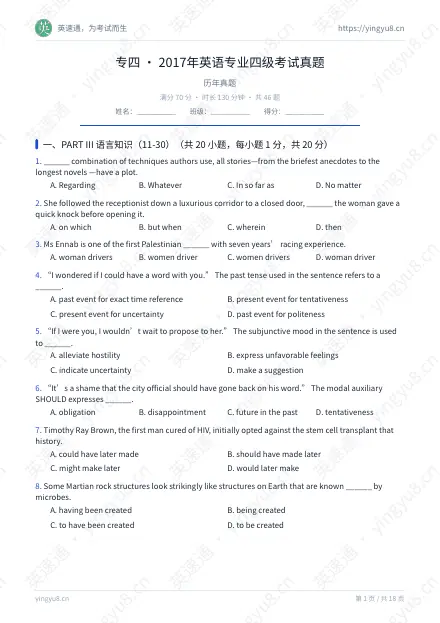
第 1 部分 · PART III 语言知识(11-30)20 题 · 20 分
- A.Regarding
- B.Whatever
- C.In so far as
- D.No matter
参考答案与解析
答案:B
解析:分析句子结构 → 识别空格后为名词短语 → 判断需要引导名词性从句的连词 → 选择能引导让步状语从句的Whatever
考点:名词性从句让步状语从句语境选词
译文:题干:无论作者使用何种技巧组合,所有故事——从最简短的轶事到最长的小说——都有一个情节。正确项B:Whatever(无论什么)
- A.on which
- B.but when
- C.wherein
- D.then
参考答案与解析
答案:C
解析:分析句子结构 → 识别空格前为完整句子 → 判断需要关系副词引导定语从句 → 选择表示'在其中'的wherein
考点:定语从句关系副词介词+which结构
译文:题干:她跟着接待员走过一条豪华的走廊,来到一扇紧闭的门前,那位女士在门前快速敲了一下然后打开了它。正确项C:wherein(在其中)
- A.woman drivers
- B.women driver
- C.women drivers
- D.woman driver
参考答案与解析
答案:C
解析:识别名词短语结构 → 判断woman作为定语修饰driver → 确定复数形式 → 选择正确的名词复数搭配
考点:名词复数复合名词主谓一致
译文:题干:恩纳布女士是首批拥有七年赛车经验的巴勒斯坦女司机之一。正确项C:women drivers(女司机们)
- A.past event for exact time reference
- B.present event for tentativeness
- C.present event for uncertainty
- D.past event for politeness
参考答案与解析
答案:B
解析:分析句子时态 → 识别过去时在间接引语中的功能 → 判断表示委婉请求的语用功能 → 选择表示现在事件的委婉表达
考点:时态语用功能委婉表达间接引语
译文:题干:'我想知道是否可以和你谈谈。'句子中使用的过去时指的是______。正确项B:present event for tentativeness(表示试探性的现在事件)
- A.alleviate hostility
- B.express unfavorable feelings
- C.indicate uncertainty
- D.make a suggestion
参考答案与解析
答案:D
解析:识别虚拟语气结构 → 分析If I were you的假设条件 → 判断后句wouldn't wait的建议功能 → 选择表示建议的选项
考点:虚拟语气条件状语从句建议功能
译文:题干:'如果我是你,我不会等著向她求婚。'句子中的虚拟语气用于______。正确项D:make a suggestion(提出建议)
- A.obligation
- B.disappointment
- C.future in the past
- D.tentativeness
参考答案与解析
答案:B
解析:识别情态动词should在特定句型“It's a shame that... should...”中的特殊用法 → 判断其表达说话人情感而非字面义务或将来 → 得出答案
考点:should的熟词僻义情感表达
译文:题干:真遗憾,那位市政官员竟然食言了。正确项:失望。
- A.could have later made
- B.should have made later
- C.might make later
- D.would later make
参考答案与解析
答案:D
解析:分析句子结构,确定空格处为定语从句的谓语 → 根据主句时态(opted)和从句时间关系(later)判断从句时态 → 选择表示过去将来时的正确形式
考点:过去将来时定语从句时态呼应
译文:题干:蒂莫西·雷·布朗,首位被治愈的艾滋病患者,最初拒绝了后来改变历史的干细胞移植。正确项:后来会改变。
- A.having been created
- B.being created
- C.to have been created
- D.to be created
参考答案与解析
答案:C
解析:识别固定搭配“be known to do sth.” → 判断动作(create)与逻辑主语(structures)的被动关系 → 选择正确的非谓语形式
考点:be known to do固定搭配非谓语动词的被动完成式
译文:题干:一些火星岩石结构看起来与地球上已知由微生物创造的结构惊人地相似。正确项:被创造。
- A.would have been...had been
- B.should be...had been
- C.could be...were
- D.might have been...were
参考答案与解析
答案:A
解析:识别句子为与过去事实相反的虚拟条件句 → 判断主句和从句的时态要求 → 选择正确的虚拟语气形式
考点:与过去事实相反的虚拟语气主句用would have been,从句用had been
译文:题干:那一刻,在人群的注视下,我并不像独自一人时那样害怕。正确项:我会是...如果我曾是。
- A.the
- B.an
- C.that
- D.whichever
参考答案与解析
答案:C
解析:分析句子结构,识别“incompetent assistant of yours”为特指 → 判断定冠词、不定冠词、指示代词和关系代词在特指语境下的适用性 → 选择最符合语境和语法的选项
考点:定语从句引导词特指与泛指of yours所有格结构
译文:题干:你必须解雇你那个不称职的助手。正确项:那个。
- A.charisma
- B.characters
- C.characteristics
- D.characterizations
参考答案与解析
答案:B
解析:根据句意“作家通过对话让______展现自身” → 识别“allow their ______ to reveal themselves”为固定表达 → 结合“narratives”(叙事)与“dialogue”(对话)语境 → 选择最符合文学创作语境的“characters”(角色)
考点:语境选词近义词辨析
译文:有些叙事作品更像戏剧,充满了对话,作家借此让他们的______展现自身。
- A.assure
- B.insure
- C.reassure
- D.ensure
参考答案与解析
答案:D
解析:根据句意“通过咖啡滤纸可以______额外的纯净度” → 识别“______ extra purity”为动宾搭配 → 辨析四个近义动词在“确保(纯净度)”这一语境下的固定搭配 → 选择“ensure”
考点:动词搭配近义词辨析
译文:如果你打算融化雪水饮用,可以通过咖啡滤纸来______额外的纯净度。
- A.decline
- B.relieve
- C.quench
- D.suppress
参考答案与解析
答案:B
解析:根据句意“洋甘菊被用于______焦虑和失眠” → 识别“______ anxiety and insomnia”为动宾搭配 → 结合“洋甘菊”的药用常识 → 选择最符合“缓解”语义的“relieve”
考点:语境选词近义词辨析
译文:几个世纪以来,洋甘菊的雏菊状花朵一直被用来______焦虑和失眠。
- A.releases
- B.appearances
- C.publications
- D.presentations
参考答案与解析
答案:A
解析:根据句意“2014年涌现了大量专辑______” → 识别“album ______”为名词搭配 → 结合“delivered a great crop of”(大量产出)语境 → 选择音乐行业术语“releases”(发行)
考点:语境选词近义词辨析
译文:尽管人们担心流行音乐中专辑的消失,但2014年涌现了大量专辑______。
- A.revealing
- B.confirming
- C.indicative
- D.evident
参考答案与解析
答案:C
解析:根据句意“该党在选举中得票减少______其政策缺乏支持” → 识别“be ______ of”为固定搭配 → 辨析四个形容词/分词在“表明、象征”语义下的搭配 → 选择“indicative”
考点:固定搭配近义词辨析
译文:该党在大选中得票减少,______其政策缺乏支持。
- A.vision
- B.eye
- C.view
- D.sight
参考答案与解析
答案:D
解析:固定搭配识别 → to one's sight 为固定短语,意为‘在某人看来/视野中’ → 得出答案
考点:固定搭配 to one's sight
译文:他闭上眼睛,将两版地图放在脑海中进行比较,以分析它们的差异。
- A.critically
- B.enormously
- C.greatly
- D.hard
参考答案与解析
答案:A
解析:语境分析 → 事件为枪击袭击,伤亡描述需符合严重程度 → critically(严重地)最符合语境 → 得出答案
考点:语境选词近义词辨析
译文:枪手在午餐时间袭击学校,造成12名学生死亡,5人重伤。
- A.over
- B.with
- C.on
- D.for
参考答案与解析
答案:D
解析:固定搭配识别 → be arrested for (doing) sth 为固定搭配,意为‘因…被逮捕’ → 得出答案
考点:固定搭配 arrested for
译文:一名15岁女孩因被指控使用Instagram匿名威胁其高中而被捕。
- A.bounded
- B.binded
- C.boundary
- D.bound
参考答案与解析
答案:D
解析:形近词辨析 → bound 为形容词,意为‘开往…的’,符合航班目的地描述 → 得出答案
考点:形近词混淆组词根词缀
译文:据报道,一名73岁男子在从阿布扎比飞往德国的阿提哈德航空航班上死亡。
- A.invariably
- B.immovably
- C.unalterably
- D.unchangeably
参考答案与解析
答案:A
解析:近义词辨析 → invariably 意为‘总是、一贯地’,符合后文‘总是听起来清晰’的普遍性描述 → 得出答案
考点:近义词辨析语境选词
译文:在这个地区情况总是如此;一个故事在远处听起来总是足够清晰,但你越接近事件现场,它就变得越模糊。
第 2 部分 · PART IV 完形填空(15选10)1 题 · 10 分
A. alwaysB. barelyC. demiseD. emergenceE. gainedF. implicationsG. leafH. lostI. naturallyJ. objectK. oneL. onlineM. risingN. singleO. value
参考答案与解析
答案:31-F 32-N 33-B 34-L 35-C 36-M 37-I 38-G 39-H 40-O
解析:31 空 定位空格前‘disruptive, new-economy’ → 分析空格处需名词,且与‘analyzed for’搭配,表示分析其‘影响/含义’ → 结合后文三个‘What will it mean for...’的排比句,确定答案为‘implications’
32 空 定位空格前‘combine many markets into a...’ → 分析‘long tail’商业模式的核心是将众多小众市场整合成一个‘巨大的’目标受众 → 结合‘many markets’的提示,确定答案为‘massive’
33 空 定位空格后‘been mentioned’及转折词‘But’ → 分析前文已详尽分析其影响,此处转折指出‘另一个主要影响’却‘很少被提及’ → 确定答案为‘rarely’
34 空 定位空格后‘pharmacies, eBay vendors, Amazon.com and other businesses that did not exist before the Internet’ → 分析这些是‘互联网催生的’新型企业 → 确定答案为‘online’
35 空 定位空格后‘of “snail mail” in the age of electronic communication’及‘has been predicted’ → 分析‘snail mail’(蜗牛邮件)在电子通信时代被预测会‘消亡/终结’ → 结合‘predicted at least as often as the coming of the paperless office’的类比,确定答案为‘death’
36 空 定位空格所在句 → 分析并列结构与语义对比 → 选择表示“失去”的动词过去分词
37 空 定位空格所在句 → 分析主句时态与从句逻辑关系 → 选择表示“确实/确实会”的副词
38 空 定位空格所在句 → 分析不定式结构与宾语搭配 → 选择表示“翻阅/检查”的动词原形
39 空 定位空格所在句 → 分析现在完成时的被动语态结构 → 选择表示“失去”的过去分词
40 空 定位空格所在句 → 分析并列结构与语义对比 → 选择表示“实体/有形之物”的名词
考点:语境选词近义词辨析时态与语态动词搭配
译文:Netflix模式因其颠覆性的、新经济的‘影响’而被详尽分析。
第 3 部分 · PART V 阅读 Section A 选择题(41-50)10 题 · 10 分
(1) When I was a young girl living in Ireland, I was always pleased when it rained, because that meant I could go treasure hunting. What’s the connection between a wet day and a search for buried treasure? Well, it’s quite simple. Ireland, as some of you may already know, is the home of Leprechauns—little men who possess magic powers and, perhaps more interestingly, pots of gold. (2) Now, although Leprechauns are interesting characters, I have to admit that I was more interested in the stories of their treasure hoard. This, as all of Ireland knows, they hide at the end of the rainbow. Leprechauns can be fearsome folk but if you can discover the end of the rainbow, they have to unwillingly surrender their gold to you. So whenever it rained, I would look up in the sky and follow the curve of the rainbow to see where it ended. I never did unearth any treasure, but I did spend many happy, showery days dreaming of what I could do with the fortune if I found it. (3) As I got older, and started working, rainy days came to be just another nuisance and my childhood dreams of finding treasure faded. But for some people the dream of striking it lucky never fades, and for a fortunate few, the dream even comes true! Such is the case of Mel Fisher. His dream of finding treasure also began in childhood, while reading the great literature classics “Treasure Island” and “Moby Dick”. However, unlike me, he chased his dream and in the end managed to become one of the most famous professional treasure hunters of all time, and for good reason. In 1985, he fished up the priceless cargo of the sunken Spanish ship Atocha, which netted him an incredible 400 million dollars! (4) After the ship sank in 1622 off the coast of Florida, its murky waters became a treasure- trove (埋藏的宝 藏) of precious stones, gold bars and silver coins known as “pieces of eight”. The aptly-named Fisher, who ran a commercial salvaging operation, had been trying to locate the underwater treasure for over 16 years when he finally hit the jackpot! His dreams had come true but finding and keeping the treasure wasn’t all plain sailing. After battling with hostile conditions at sea, Fisher then had to battle in the courts. In fact, the State of Florida took Fisher to court over ownership of the find and the Federal government soon followed suit. After more than 200 hearings, Fisher agreed to donate 20% of his findings for public display, and so now there is a museum in Florida which displays hundreds of the objects which were salvaged from the Atocha. (5) This true story seems like a modern-day fairytale: a man pursues his dream through hardship and in the end, he triumphs over the difficulties—they all live happily ever after, right? Well, not exactly. Archaeologists object to the fact that with commercial salvaging operations like Fisher’s, the objects are sold and dispersed, and UNESCO are also worried about protecting our underwater heritage from what it describes as “pillaging”( 抢 劫 、 掠 夺 ) . (6) The counter-argument is that in professional, well-run operations such as Fisher’s, each piece is accurately and minutely recorded and that it is this information which is more important than the actual object, and that such operations help increase our wealth of archaeological knowledge.indeed, as in Fisher’s case, they make history more accessible to people through museum donations and information on web sites. (7) The distinction of whether these treasure hunters are salvaging or pillaging our underwater heritage may not be clear, but what is clear is that treasure hunting is not just innocent child’s play anymore but profitable big business. I have learnt that the end of the rainbow is beyond my reach, but in consolation, with just a click of the mouse, I too can have a share in the riches that the Atocha has revealed. As Friedrich Nietzsche so wisely said: “Our treasure lies in the beehive of our knowledge.”
- A.discovered the jackpot
- B.found the treasure
- C.broke one of the objects
- D.ran a salvaging operation
参考答案与解析
答案:B
解析:定位第四段 → 分析‘hit the jackpot’所在句的语境(Fisher寻找宝藏16年) → 结合下文‘His dreams had come true’推断其意为‘找到宝藏’
考点:熟词僻义语境推断
译文:题干:根据上下文,第四段中短语‘hit the jackpot’的意思是。正确项B:找到了宝藏。
- A.UNESCO’s view is different from archaeologists’
- B.all salvaging operations should be prohibited
- C.attention should be paid to the find’s educational value
- D.people hold entirely different views on the issue
参考答案与解析
答案:C
解析:定位第五、六段 → 比较UNESCO与考古学家的观点 → 推断作者认为应关注宝藏的教育价值
考点:观点对比推理判断
译文:题干:从第五、六段可以得出结论。正确项C:应关注发现的教育价值。
- A.She was glad that people can have a chance to see the treasure.
- B.She was sad that she was unable to discover and salvage treasure.
- C.She was angry that treasure hunters were pillaging heritage.
- D.She was unconcerned about where the treasure came from.
参考答案与解析
答案:A
解析:定位第七段 → 捕捉作者对宝藏被公开展示的积极评价(‘glad’) → 推断其态度为高兴
考点:观点态度细节推断
译文:题干:作者对阿托查号宝藏的感受如何(第七段)?正确项A:她很高兴人们有机会看到这些宝藏。
(1) Paul was dissatisfied with himself and with everything. The deepest of his love belonged to his mother. When he felt he had hurt her, or wounded his love for her, he could not bear it. Now it was spring and there was battle between him and Miriam, his girlfriend. This year he had a good deal against her. She was vaguely aware of it. The old feeling that she was to be sacrifice to this love, which she had had when she prayed, was mingled in all her emotions. She did not at the bottom believe she ever would have him. She did not believe in herself primarily: doubted whether she could ever be what he would demand of her. Certainly she never saw herself living happily through a lifetime with him. She saw tragedy, sorrow, and sacrifice ahead. And in sacrifice she was proud, in renunciation she was strong, for she did not trust herself to support everyday life. She was prepared for the big things and the deep things, like tragedy. It was the sufficiency of the small day-life she could not trust. (2) The Easter holidays began happily. Paul was his own frank self. Yet she felt it would go wrong. On the Sunday afternoon she stood at her bedroom window, looking across at the oak trees of the wood, in whose branches a twilight was tangled, below the bright sky of the afternoon. Grey-green rosettes of honeysuckle leaves hung before the window, some already, she fancied, showing bud. It was spring, which she loved and dreaded. (3) Hearing the clack of the gate she stood in suspense. It was a bright grey day. Paul came into the yard with his bicycle, which glittered as he walked. Usually he rang his bell and laughed towards the house. Today he walked with shut lips and cold, cruel bearing, that had something of a slouch and a sneer in it. She knew him well by now, and could tell from keen-looking what was happening inside him. There was a cold correctness in the way he put his bicycle in its place, that made her heart sink. (4) She came downstairs nervously. She was wearing a new net blouse that she thought became her. It had a high collar with a tiny ruff, making her, she thought, look wonderfully a woman, and dignified. At twenty she was full-breasted and luxuriously formed. Her face was still like a soft rich mask, unchangeable. But her eyes, once lifted, were wonderful. She was afraid of him. He would notice her new blouse. (5) He, being in a hard, ironical mood, was entertaining the family to a description of a service given in the Primitive Methodist Chapel. He sat at the head of the table, his mobile face, with the eyes that could be so beautiful, shining with tenderness or dancing with laughter, now taking on one expression and then another, in imitation of various people he was mocking. His mockery always hurt her; it was too near the reality. He was too clever and cruel. She felt that when his eyes were like this, hard with mocking hate, he would spare neither himself nor anybody else. But Miriam’s mother was wiping her eyes with laughter, and her father, just awake from his Sunday nap, was rubbing his head in amusement. The three brothers sat with ruffled, sleepy appearance in their shirt-sleeves, giving a guffaw from time to time. The whole family loved a “take-off” more than anything.
- A.indifferent
- B.desperate
- C.pessimistic
- D.ambiguous
参考答案与解析
答案:C
解析:定位第一段 → 提取Miriam对爱情的预期(‘saw tragedy, sorrow, and sacrifice ahead’) → 推断其态度为悲观
考点:观点态度细节推断
译文:题干:从开头可以得知,Miriam对她与Paul之间爱情的态度是。正确项C:悲观的。
- A.delight
- B.expectation
- C.uncertainty
- D.foreboding
参考答案与解析
答案:A
解析:定位第三段 → 逐一核对选项情感与原文描述(suspense, heart sink) → 排除文中未提及的‘delight’
考点:细节定位情感排除
译文:题干:第三段的叙述告诉我们,Miriam有以下所有感受,除了。正确项A:喜悦。
- A.Only the parents found it entertaining.
- B.Every member except Miriam was amused.
- C.The brothers found it hard to appreciate.
- D.Miriam also thought it was amusing.
参考答案与解析
答案:B
解析:定位家庭成员对Paul嘲讽的反应描述 → 对比Miriam与其他成员的反应差异 → 得出答案
考点:细节定位与捕捉指代与衔接
译文:题干:关于家人对Paul嘲讽的反应,以下哪项陈述是正确的?正确项:除了Miriam,每个家庭成员都觉得有趣。
(1) I’ve written this article and you’re reading it. So we are members of the same club. We’re both literate — we can read and write. And we both probably feel that literacy is essential to our lives. But millions of people all over the world are illiterate. Even in industrialised Western countries, such as the UK and the the USA, approximately 20% of the population have “low literacy levels”. But what exactly does that mean? (2) My parents both left school at 14. They could read and write, but except for a quick look at the daily newspaper, reading and writing didn’t play a big part in their lives. There were very few books in the house. My mother was amazed because the woman who lived next door always wrote a list of what she needed before she went to the supermarket. Why couldn’t she remember? We laughed about that for weeks. Our family didn’t write lists! And when I was only 14 years old my father gave me an important letter that he’d written to the bank and asked me to check it for grammar and spelling mistakes. And there were quite a lot. He never usually wrote letters or postcards or even Christmas cards. So when he had to write he wasn’t comfortable or confident. Does that mean that my father had a “low level of literacy”? I don’t think so. (3) There are lots of different definitions of literacy. Some experts define it as having the reading and writing skills that you need to be independent in your everyday life. So, for example, if you can read instructions, write a cheque, fill in a form—anything that you need to do in everyday life—then you are “functionally literate”. (4) Other people say that you are illiterate if you think that you are illiterate. In other words, if you feel that you can’t read or write as well as you would like to. (5) If you live in a society where most people are literate, then you will feel ashamed or embarrassed and avoid situations in which you have to read or write. The father of a friend of mine finally admitted to his family that he couldn’t read when he was 45 years old. He bought the newspaper every day and pretended to read it —and believe it or not, his family had no idea. (6) We often forget that writing is a recent invention. Many years ago, the word “literate” meant being able to communicate well in speaking, in other words what we now call “articulate” . Story telling was an important activity in the past and still is today in some societies. Reading was often a co-operative activity—someone would read aloud to a group, often from a religious text such as the Koran or the Bible. (7) Only a hundred years ago, in the United States, you were considered to be literate if you could sign your name to a piece of paper. It was an important skill. You were not allowed to vote if you couldn’t sign the voting register, so literacy was connected with political rights, and many people were excluded from the democratic process. (8) Nowadays we see reading and writing as being connected, but that wasn’t so in the past. Many people could read, but not write. Writing was a skilled profession. If you needed something written then you paid an expert to write it for you. (9) And of course, rich and important people have always employed people to write things for them. Important company bosses dictated letters to their secretaries or personal assistants. And now with new computer software you can dictate directly to your computer. (10) Being illiterate can have a big effect on people’s lives. For example, a study in the UK showed that people who write and spell badly are seen as careless, immature and unreliable, and often unintelligent. So it is more difficult for them to find jobs, even when reading and writing are not necessary for the work. (11) World wide statistics show that literacy problems are associated with poverty and a lack of political power. More women than men are illiterate. Illiterate people have worse health, bigger families and are more likely to go to prison. So literacy campaigns must be a good thing. But don’t forget that an illiterate person, or someone with a low level o literacy, isn’t necessarily stupid or ignorant, and may not be unhappy at all. Knowledge and wisdom isn’t only found in writing.
- A.To show that literacy is interpreted in different ways.
- B.To show that Father was more literate than Mother.
- C.To indicate how important reading and writing are.
- D.To compare the level of literacy between neighbours.
参考答案与解析
答案:A
解析:定位第二段两个例子(母亲对邻居写清单的惊讶、父亲请作者检查信件) → 归纳例子共同说明的观点 → 得出答案
考点:主旨大意篇章结构与写作目的
译文:题干:作者在第二段给出两个例子的目的是什么?正确项:为了展示读写能力有不同的解读方式。
- A.psychological
- B.functional
- C.social
- D.independent
参考答案与解析
答案:D
解析:定位文中关于读写能力定义的段落(第3、4段) → 提取并归纳定义特征(功能性、心理性、社会性) → 排除未提及的选项
考点:细节定位与捕捉推理判断
译文:题干:根据作者,以下哪项不是读写能力的定义特征?正确项:独立的。
- A.Reading and writing have always been regarded as equally difficult.
- B.People had to read and write well in order to be allowed to vote.
- C.Reading often requires more immediate interaction than writing.
- D.Reading and writing have always been viewed as being connected.
参考答案与解析
答案:C
解析:定位关于阅读与写作关系的论述(第6段及之后) → 对比选项与原文信息 → 推理判断正确陈述
考点:推理判断细节定位与捕捉
译文:题干:关于阅读和写作,以下哪项陈述是正确的?正确项:阅读通常比写作需要更多的即时互动。
- A.Effects of illiteracy and employment problems.
- B.Effects of illiteracy and associated problems.
- C.Effects of illiteracy on one’s personality development.
- D.Effects of illiteracy on women’s career development.
参考答案与解析
答案:B
解析:定位最后两段(第10、11段) → 归纳段落核心内容(文盲的影响及伴随问题) → 得出答案
考点:主旨大意篇章结构与写作目的
译文:题干:最后两段主要讨论什么?正确项:文盲的影响及相关问题。
第 4 部分 · PART V 阅读 Section B 简答题(51-55)5 题 · 10 分
参考答案与解析
答案:The stories of Leprechauns' treasure hoard.
解析:定位代词This → 回溯前文指代对象 → 匹配选项同义替换
考点:指代与衔接
译文:题干:第2段中的“This”指代什么?正确项:关于小妖精宝藏的传说故事。
参考答案与解析
答案:Ownership disputes with Florida and Federal government.
解析:定位关键词battle in the courts → 捕捉原因细节 → 匹配选项同义改写
考点:细节定位与捕捉
译文:题干:为什么Fisher在发现宝藏后必须在法庭上斗争?正确项:与佛罗里达州和联邦政府的所有权纠纷。
参考答案与解析
答案:She thought it made her look dignified and womanly.
解析:定位人物行为(wear a new net blouse) → 推断其心理动机 → 匹配选项同义表述
考点:推理判断
译文:题干:为什么Miriam在周日下午穿了一件新的网眼罩衫?正确项:她认为这让她看起来端庄而有女人味。
参考答案与解析
答案:He would be harsh to himself and others.
解析:定位目标句 → 分析spare neither...nor...的语境含义 → 匹配选项释义
考点:词义猜测
译文:题干:第5段中“... he would spare neither himself nor anybody else”这句话是什么意思?正确项:他对自己和别人都会很严厉。
参考答案与解析
答案:Reading was often done together with others.
解析:定位段落末句 → 结合上下文语境推断其隐含意义 → 匹配选项同义转述
考点:推理判断
译文:题干:根据上下文解释第11段最后一句话的含义。正确项:阅读通常是与他人一起进行的。
第 5 部分 · PART VI 写作1 题 · 20 分
参考答案与解析
参考范文
The excerpt highlights a paradox of modern technology: while intelligent machines can stimulate our brains and increase intelligence when they challenge us, their increasing capability to perform complex tasks—from flying planes to composing poetry—may ultimately render our own cognitive efforts unnecessary. The author suggests that as AI takes over more thinking and planning, humans might become like Bertie Wooster, relying entirely on a "better brain" and losing the mental exercise that keeps us sharp. I believe this concern is valid but not inevitable. It is true that over-reliance on technology can lead to cognitive laziness. For example, constant use of GPS navigation has been shown to reduce our spatial memory and orientation skills. Similarly, if we delegate all planning and decision-making to AI assistants, we may lose the ability to think critically and solve problems independently. However, the outcome depends on how we choose to use these tools. Technology can be a double-edged sword. Instead of letting machines do all the thinking, we can use them as partners to augment our own intelligence. For instance, AI can handle routine tasks, freeing us to focus on more creative and complex challenges. Students can use AI for research but must still analyze and synthesize information themselves. Professionals can leverage AI for data analysis but should apply human judgment to interpret results. Therefore, the key lies in maintaining a balance. We should embrace intelligent machines as tools that enhance our capabilities, not replace them. By consciously engaging in mental activities that require critical thinking, creativity, and problem-solving, we can ensure that our brains remain active and sharp. In this way, we can enjoy the benefits of AI without falling into the trap of cognitive laziness.
常见问题
2017年英语专业四级考试真题的答案和解析在哪看?
答案与解析就在本页:每道题下方「参考答案与解析」展开即看,含参考答案、解题思路与考点,免登录直接阅读。
2017年英语专业四级考试真题 PDF 怎么免费下载?
本页「试卷封面」卡片「收录格式」行内的 PDF 徽标即下载链接,点击直接下载本卷 PDF 文件,无需登录。
这套卷怎么在线做题、怎么计分?
点页面上方「开始考试(网页)」进入在线做题页:登录后装载本卷作答,交卷自动判分并留存成绩;免费账号每日可装载 30 套,会员每日 100 套。