2025年英语专业八级考试真题及答案解析
2025年英语专业八级考试真题 · 完整收录
- 年份考次
- 2025 年
- 命题归属
- 全国统一命题
- 省份
- 全国
- 题量
- 25 题
- 满分
- 75 分
- 限时
- 125 分钟
- 题型结构
- PART II 阅读 Section A 选择题 14 题 14 分 · PART II 阅读 Section B 简答题 8 题 16 分 · 改错 · 每个标号行各有一处错误 10 题 10 分 · PART IV 汉译英 1 题 15 分 · PART V 写作 1 题 20 分
- 收录格式
开始考试(微信)

微信扫一扫 · 小程序内开始考试
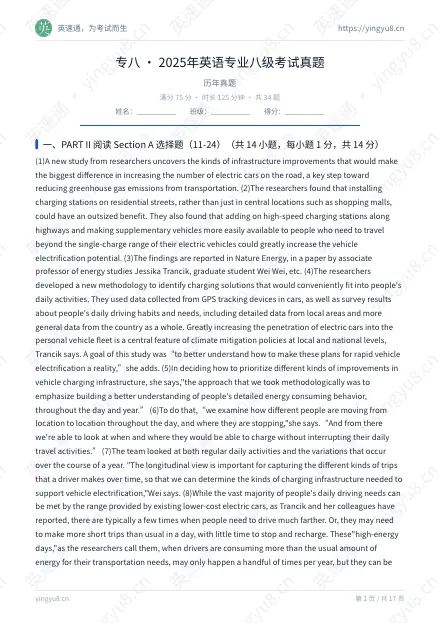
第 1 部分 · PART II 阅读 Section A 选择题(11-24)14 题 · 14 分
(1)A new study from researchers uncovers the kinds of infrastructure improvements that would make the biggest difference in increasing the number of electric cars on the road, a key step toward reducing greenhouse gas emissions from transportation. (2)The researchers found that installing charging stations on residential streets, rather than just in central locations such as shopping malls, could have an outsized benefit. They also found that adding on high-speed charging stations along highways and making supplementary vehicles more easily available to people who need to travel beyond the single-charge range of their electric vehicles could greatly increase the vehicle electrification potential. (3)The findings are reported in Nature Energy, in a paper by associate professor of energy studies Jessika Trancik, graduate student Wei Wei, etc. (4)The researchers developed a new methodology to identify charging solutions that would conveniently fit into people's daily activities. They used data collected from GPS tracking devices in cars, as well as survey results about people's daily driving habits and needs, including detailed data from local areas and more general data from the country as a whole. Greatly increasing the penetration of electric cars into the personal vehicle fleet is a central feature of climate mitigation policies at local and national levels, Trancik says. A goal of this study was“to better understand how to make these plans for rapid vehicle electrification a reality,”she adds. (5)In deciding how to prioritize different kinds of improvements in vehicle charging infrastructure, she says,"the approach that we took methodologically was to emphasize building a better understanding of people's detailed energy consuming behavior, throughout the day and year.” (6)To do that,“we examine how different people are moving from location to location throughout the day, and where they are stopping,"she says.“And from there we're able to look at when and where they would be able to charge without interrupting their daily travel activities.” (7)The team looked at both regular daily activities and the variations that occur over the course of a year. "The longitudinal view is important for capturing the different kinds of trips that a driver makes over time, so that we can determine the kinds of charging infrastructure needed to support vehicle electrification,"Wei says. (8)While the vast majority of people's daily driving needs can be met by the range provided by existing lower-cost electric cars, as Trancik and her colleagues have reported, there are typically a few times when people need to drive much farther. Or, they may need to make more short trips than usual in a day, with little time to stop and recharge. These"high-energy days,"as the researchers call them, when drivers are consuming more than the usual amount of energy for their transportation needs, may only happen a handful of times per year, but they can be the deciding factor in people's decision making about whether to go electric. (9)Even though battery technology is steadily improving and extending the maximum range of electric cars, that alone will not be enough to meet all drivers’needs and achieve rapid emissions reductions. So, addressing the range issue through infrastructure is essential, Wei says. The highest-capacity batteries tend to be the most expensive, and are not affordable to many, he points out, so getting infrastructure right is also important from an equity perspective. (10)“There are various ways to incentivize the expansion of such charging infrastructures,”he says. “There's a role for policymakers at the national level, for example, for incentives to encourage private sector competition in this space, and demonstration sites for testing out, through public-private partnerships, the rapid expansion of the charging infrastructure.”Governments at different levels can also play an important part in driving innovation by businesses, he says, and a number of them have already signaled their support for vehicle electrification. (11)Providing easy access to alternative transportation for those high-energy days could also play a role, the study found. Vehicle companies may even find it advantageous to provide or partner with convenient rental services to help drive their electric car sales. (12)In their analysis of driving habits, for example, the team found that the impact of either adding highway fast-charging stations or increasing availability of supplementary long-range vehicles for up to four days a year meant that the number of homes that could meet their driving needs with a lower cost electric vehicle increased from 10 percent to 40 percent. This number rose to above 90 percent of households when fast-charging stations, workplace charging, overnight public charging, and up to 10 days of access to supplementary vehicles were all available. Importantly, charging options at residential locations(on or off-street)is key across all of these scenarios. (13)The study's findings highlight the importance of making overnight charging capabilities available to more people. While those who have their own garages or off-street parking can often already easily charge their cars at home, many people do not have that option and use public parking.“It's really important to provide access—reliable, predictable access—to charging for people, wherever they park for longer periods of time near home, often overnight,”Trancik says. (14)That includes locations such as hotels as well as residential neighborhoods, she says.“I think it's so critical to emphasize these high-impact approaches, such as figuring out ways to do that on public streets, rather than haphazardly putting a charger at the grocery store or at the mall or any other public location.” (15)The study should help to provide some guidance to policymakers at all levels who are looking for ways to facilitate the reduction of greenhouse gas emissions, since the transportation sector accounts for about a third of those emissions overall.“If you have limited funds, which you typically always do, then it's just really important to prioritize,”Trancik says, noting that this study could indicate the areas that could provide the greatest return for those investments.
- A.people's everyday movements
- B.daily charging venues
- C.greenhouse gas emissions
- D.people's driving needs
参考答案与解析
答案:C
解析:定位题干关键词 → 逐项比对语篇信息 → 排除提及项,锁定未提及项
考点:细节定位与捕捉排除法
译文:题干:团队的调查涉及以下所有方面,除了哪一项? 正确项:温室气体排放
- A.recharge their cars more frequently
- B.drive faster than they usually do
- C.plan more routes to their workplaces
- D.use more lower-cost electric cars
参考答案与解析
答案:A
解析:定位题干关键词 → 推断高能耗日的行为模式 → 匹配语篇中关于充电频率的描述
考点:推理判断语境推断
译文:题干:在高能耗的日子里,人们倾向于…… 正确项:更频繁地给汽车充电
- A.fail to tackle the distance issue
- B.are still at the trial stage
- C.are available in few stores
- D.result in increasing cost
参考答案与解析
答案:D
解析:定位题干关键词 → 推断高容量电池非最佳方案的原因 → 匹配语篇中关于成本的描述
考点:推理判断因果推断
译文:题干:最高容量的电池不是实现电动化的最佳解决方案,因为它们…… 正确项:导致成本增加
- A.Ways to promote the expansion of charging infrastructure.
- B.Agencies responsible for building charging infrastructure.
- C.Sites for demonstration of charging infrastructure.
- D.Roles of private businesses in improving charging infrastructure.
参考答案与解析
答案:A
解析:定位第十段 → 概括段落核心内容 → 匹配选项中的主旨概括
考点:主旨大意段落概括
译文:题干:第10段主要讨论什么? 正确项:推广充电基础设施扩展的方法
- A.Providing easily accessible car rental services.
- B.Building charging stations in residential areas.
- C.Installing fast-charging stations along highways.
- D.Setting up charging stations at shopping malls.
参考答案与解析
答案:B
解析:定位题干关键词 → 比对语篇中关于不同充电方案的效益描述 → 选出效益最大的方案
考点:细节定位与捕捉比较级理解
译文:题干:以下哪项对实现电动化最可取? 正确项:在住宅区建设充电站
(1)I had been hanging around for a few years with a very party-time crowd, and my life was on a downward slide. I had gotten a Ph. D.and a divorce simultaneously. The fancy academic job never materialized. Soon I was playing flute in a street band, eating donated sandwiches, and spending every night in clubs dancing the night away. In a few years I was living in the mountains in a shack, and none of my friends worked. (2)When I saw the ad in the Sunday paper—BRAKEMEN WANTED—I thought of it as a chance to clean up my act and to get away. I felt that by doing work this dangerous, I would have to make a decision to live, to protect myself. I would have to choose to stay alive every day, to hang on to the sides of those freight cars for dear life. The railroad transformed the metaphor of my life. Nine thousand tons moving at sixty miles an hour into the fearful night. I now would ride that image, trying to stay alive within it. I know that later, when I sat behind the moving train in the darkness of the caboose( 供列车 员休息的车 厢), window open and the unknown fragrances of the land filling the space, the blackness of the night was my friend. It felt good to be powerless and carried along by the destiny of that motion. I felt happy and at peace. I was where I belonged. (3)The railroad didn't believe in lengthy formal training. They offered a two-week class which covered the book of rules, a three-hundred-page document with a dual purpose—to keep trains from running into one another and to prevent any situation in which the company might get sued. Rules of the road which you had to learn were mixed in with rules which you had to ignore in order to get the work done. But you had to know that you were ignoring a rule so that in the winter, when company officials had time to sneak around testing, you could work by the book. (4)The rulebook was also in a continuous state of revision. Revisions appeared in the timetable which you carried with you at all times. Further revisions appeared in regular timetable bulletins which were posted at work. Soon your rulebook resembled a scrapbook, with paragraphs crossed out, pages pasted in, and notes on changes which were then crossed out and changed weeks later. It drove you crazy. You always had to be on the lookout for a company official hiding in the bushes while you did your work. This individual would pop out and ask you questions about the latest rule revisions. A notation of failure would then appear in your personal file. These notations were referred to as“Brownies,”named after the official who devised the railroad demerit system. As trainmen were fond of pointing out, however, there was no merit system to go with it. (5)Out of seventeen student brakemen three of us were women. This was a large percentage, comparatively. The first women had been hired two years before, and they were around to give us advice. The point was to get through the class, and get over the probationary period known as the“derail.”Then you were in the union and a railroader for life. Getting over the derail took sixty days, and if either the crews you worked with or the company officers had a complaint, you were out. At the end of two weeks of classroom instruction, you bought a railroad watch, they gave you switch keys and a two-dollar lantern, and you marked up as extra board brakemen. (6)On the last day of class, they took us down to the freightyard to grapple with the equipment. We practiced getting on and off moving cars, climbing the ladders and cranking down the handbrakes, changing thee eighty-five-pound knuckles that joined the cars together, and hand and lantern signals. These signals were the way members of the crew talked to each other, and they were an art form. An old head could practically order a pizza from a half mile away. You would see lights, arcs and circles, stabs of light. It would repeat. You would stand there confused. Finally you would walk down the track and find the foreman in a deep state of disgust. (7)“I told you to hang three cars, let two go to the runaround, one to the main, go through the crossovers, and line behind. Now can't you read a signal, dummy?” (8)The day after our practice session, I got into my car and tried to roll the window down. My arms didn’'t work. This was my first moment of doubt about being able to do the job. It was hard to get the upper- body strength required to hang on and ride for long distances on the side of cars. Terror at falling beneath the wheels was a big motivator, however. Terror and ridicule. There was a lot of both during the probationary period and the student trips. On student trips we tagged along with a regular crew and tried to learn something. To me, what we were doing made no sense whatsoever. Just getting used to the equipment had me so disorientated that I had no idea where we had gone or how the crew did anything. One of the crew suggested to me that I go to a toy store and look at the model trains, to see how switches work. They say, though, that whatever you start out doing railroading, it gets imprinted, and that's what you are most comfortable doing from then on. I couldn’t have picked a better place to break in than Watsonville Junction. It was old-time, local- freight, full-crew switching. Kicking cars and passing signs. The basic stuff that you have to learn at first or you never get no matter how long you're out here.
- A.She was fascinated by the job.
- B.She had liked trains all along.
- C.She loved to be on night shifts.
- D.She wanted to make a fresh start.
参考答案与解析
答案:D
解析:定位第2段首句 → 提取‘clean up my act and to get away’ → 同义替换为‘make a fresh start’
考点:推理判断细节定位
译文:题干:作者为什么想成为一名制动员?正确项D:她想重新开始。
- A.Portable.
- B.Practical.
- C.Self-contradictory.
- D.Multi-purpose.
参考答案与解析
答案:C
解析:定位第3段对规则手册的描述 → 提取‘Rules...mixed in with rules which you had to ignore’ → 推理出其‘自相矛盾’的特性
考点:推理判断细节定位
译文:题干:根据作者,以下哪个词最能描述规则手册?正确项C:自相矛盾的。
- A.critical
- B.ironical
- C.serious
- D.angry
参考答案与解析
答案:B
解析:定位第3段末句 → 分析‘you could work by the book’在‘sneak around testing’语境下的含义 → 推断出作者的讽刺语气
考点:观点态度
译文:题干:作者在第3段最后一句的语气是?正确项B:讽刺的。
- A.The probationary period was crucial for getting the job.
- B.Revisions and further revisions appeared in the timetable.
- C.The railroad company had both demerit and merit systems.
- D.Student brakemen would be asked about the latest rule revisions.
参考答案与解析
答案:A
解析:定位第4、5段(注:原文仅提供4段,推测第5段内容涉及试用期) → 对比选项与原文细节 → 排除B、C、D,确认A
考点:细节定位推理判断
译文:题干:根据第4、5段,以下哪项陈述是正确的?正确项A:试用期对获得这份工作至关重要。
- A.confident of her skills
- B.calm and brave
- C.confused about what to do
- D.disappointed in herself
参考答案与解析
答案:C
解析:定位第2段描述作者心理活动的句子 → 提取‘make a decision to live’、‘choose to stay alive’、‘hang on...for dear life’ → 推断出其‘困惑’与挣扎的状态
考点:观点态度推理判断
译文:题干:作者在她的学员旅行中感觉如何?正确项C:对要做什么感到困惑。
(1)The storm came on slowly one afternoon. The clouds looked as if they were stumbling along before the wind, frightened. The sea took its cue. It started rising and falling in a manner that made my heart sink. I took in the net. Oh, you should have seen that landscape!What I had seen up till now were mere hillocks of water. These swells were truly mountains. The valleys we found ourselves in were so deep they were gloomy. Their sides were so steep the lifeboat started sliding down them, nearly surfing. The raft was getting exceptionally rough treatment, being pulled out of the water and dragged along bouncing. I deployed both sea anchors fully, at different lengths so that they would not interfere with each other. (2)Climbing the giant swells, the boat clung to the sea anchors like a mountain climber to a rope. We would rush up until we reached a snow-white crest in a burst of light and foam and a tipping forward of thee lifeboat. The view would be clear for miles around. But the mountain would shift, and the ground beneath us would start sinking in a most stomach-sickening way. In no time we would be sitting once again at the bottom of a dark valley, different from the last but the same, with thousands of tons of water hovering above us and with only our flimsy lightness to save us. The land would move once more, the sea-anchor ropes would snap to tautness, and the roller coaster would start again. (3)The sea anchors did their job well—in fact, nearly too well. Every swell at its crest wanted to take us for a tumble, but the anchors, beyond the crest, heaved mightily and pulled us through, but at the expense of pulling the front of the boat down. The result was an explosion of foam and spray at the bow. I was soaked through and through each time. (4)Then a swell came up that was particularly intent on taking us along. This time the bow vanished underwater. I was shocked and chilled and scared witless. I barely managed to hold on. The boat was swamped. I heard Richard Parker roar. I felt death was upon us. The only choice left to me was death by water or death by animal. I chose death by animal. (5)While we sank down the back of the swell, I jumped onto the tarpaulin (防水布) and unrolled it towards the stern, closing in Richard Parker. If he protested, I did not hear him. Faster than a sewing machine working a piece of cloth, I hooked down the tarpaulin on both sides of the boat. We were climbing again. Thee boat was lurching upwards steadily. It was hard to keep my balance. The lifeboat was now covered and the tarpaulin battened ( 用 压 条 固 定 ) down, except at my end. I squeezed in between the side bench and the tarpaulin and pulled the remaining tarpaulin over my head. I did not have much space. Between bench and gunnel (船舷边缘) there was twelve inches, and the side benches were only one and a half feet wide. But I was not so foolhardy, even in the face of death, as to move onto the floor of the boat. There were four hooks left to catch. I slipped a hand through the opening and worked the rope. With each hook done, it was getting harder to get the next. I managed two. Two hooks left. The boat was rushing upwards in a smooth and unceasing motion. The incline was over thirty degrees. I could feel myself being pulled down towards the stern. Twisting my hand frantically, I succeeded in catching one more hook with the rope. It was the best I could do. This was not a job meant to be done from the inside of the lifeboat but from the outside. I pulled hard on thee rope, something made easier by the fact that holding on to it was preventing me from sliding down the length of the boat. The boat swiftly passed a forty-five-degree incline. (6)We must have been at a sixty-degree incline when we reached the summit of the swell and broke through its crest onto the other side. The smallest portion of the swell's supply of water crashed down on us. I felt as if I were being pummelled(反复猛击)by a great fist. The lifeboat abruptly tilted forward and everything was reversed: I was now at the lower end of the lifeboat, and the water that had swamped it, with a tiger soaking in it, came my way. I did not feel the tiger—I had no precise idea of where Richard Parker was; it was pitch-black beneath the tarpaulin—but before we reached the next valley I was half-drowned. (7)For the rest of that day and into the night, we went up and down, up and down, up and down, until terror became monotonous and was replaced by numbness and a complete giving-up. I held on to the tarpaulin rope with one hand and the edge of the bow bench with the other, while my body lay flat against the side bench. In this position—water pouring in, water pouring out—the tarpaulin beat me to a pulp, I was soaked and chilled, and I was bruised and cut by bones and turtle shells. The noise of the storm was constant, as was Richard Parker's snarling. (8)Sometime during the night my mind noted that the storm was over. We were bobbing on the sea in a normal way. Through a tear in the tarpaulin I glimpsed the night sky. Starry and cloudless. I undid the tarpaulin and lay on top of it.
- A.metaphor
- B.personification
- C.simile
- D.understatement
参考答案与解析
答案:D
解析:定位段落 → 识别修辞手法 → 排除已出现的修辞 → 确定未出现的修辞
考点:修辞手法识别细节定位与排除
译文:题干:在第1、2段中,以下写作技巧被用来描述风暴和大海,除了哪一项?正确项:D. 轻描淡写(understatement)
- A.was at the bottom of the swells
- B.was climbing up the swells
- C.was at the top of the swells
- D.was sliding down the swells
参考答案与解析
答案:C
解析:定位引文 → 分析上下文动作序列 → 推断船只位置
考点:细节定位上下文推理
译文:题干:当作者说“the view would be clear for miles around”(第2段)时,船……正确项:C. 正处于浪顶(was at the top of the swells)
- A.By staying under the tarpaulin.
- B.By lying on the floor of the boat.
- C.By fortifying the boat with a rope.
- D.By catching the hooks all at once.
参考答案与解析
答案:A
解析:定位段落 → 提取作者保护自己的具体动作 → 匹配选项
考点:细节定位与捕捉
译文:题干:作者在第5段中如何保护自己免受风暴侵袭?正确项:A. 通过待在防水油布下(By staying under the tarpaulin)
- A.dizzy
- B.numb
- C.frightened
- D.oblivious
参考答案与解析
答案:B
解析:定位段落 → 分析作者在风暴后的状态描述 → 推断其感受
考点:推理判断观点态度
译文:题干:我们从第6、7段得知,风暴最终使作者……正确项:B. 麻木(numb)
第 2 部分 · PART II 阅读 Section B 简答题(25-32)8 题 · 16 分
参考答案与解析
答案:To understand how to make rapid vehicle electrification a reality.
解析:定位研究目的相关表述 → 识别核心目标(理解如何实现快速车辆电气化) → 匹配选项
考点:主旨大意研究目的
译文:题干:这项研究的主要目的是什么?正确答案:理解如何使快速车辆电气化成为现实。
参考答案与解析
答案:Using data from GPS tracking devices in cars.
解析:定位第四段关于研究方法的描述 → 识别除调查外的另一方法(使用汽车GPS追踪设备数据) → 匹配选项
考点:细节定位研究方法
译文:题干:除了调查,研究中还采用了什么方法(第四段)?正确答案:使用汽车GPS追踪设备的数据。
参考答案与解析
答案:Her life was on a downward slide.
解析:定位作者成为制动员之前的生活描述 → 识别关键状态(生活走下坡路) → 匹配选项
考点:细节定位人物状态
译文:题干:作者在成为制动员之前的生活是怎样的?正确答案:她的生活正在走下坡路。
参考答案与解析
答案:I now would ride that image, trying to stay alive within it.
解析:定位第二段中解释“铁路改变了我的人生隐喻”的句子 → 识别具体解释(我将驾驭那个形象,试图在其中生存) → 匹配选项
考点:指代衔接句意解释
译文:题干:从第二段中找出一句解释“铁路改变了我的人生隐喻”的句子。正确答案:我将驾驭那个形象,试图在其中生存。
参考答案与解析
答案:It was a good place to start.
解析:定位第八段作者对Watsonville Junction的看法 → 识别评价(一个开始的好地方) → 匹配选项
考点:观点态度地点评价
译文:题干:作者认为Watsonville Junction对一个新制动员来说怎么样(第八段)?正确答案:这是一个开始的好地方。
参考答案与解析
答案:The sea reacted to the storm's approach.
解析:定位短语所在句 → 分析上下文逻辑关系(风暴逼近与海面反应) → 推断短语含义
考点:语境推断短语含义
译文:题干:第一段中“The sea took its cue”是什么意思?正确项:大海对风暴的逼近做出了反应。
参考答案与解析
答案:They pulled the boat through crests, pulling the bow down.
解析:定位第三段关于锚功能的描述 → 提取具体动作(拉船、压低船头) → 匹配选项
考点:细节定位动作描述
译文:题干:根据第三段,锚是如何执行其功能的?正确项:它们将船拉过浪峰,同时压低船头。
参考答案与解析
答案:Calm and peaceful.
解析:定位风暴后对海面的描述 → 提取形容词(平静、安宁) → 匹配选项
考点:细节捕捉状态描述
译文:题干:用两个词/短语描述风暴后的海面。正确项:平静而安宁。
第 3 部分 · 改错 · 每个标号行各有一处错误(错词填正确词 · 缺词填所缺词 · 多词填多余词)1 题 · 10 分
参考答案与解析
答案:1-to 2-nor 3-being 4-effect 5-While/Although 6-especially 7-their 8-a 9-on 10-creates
解析:1 空 分析句子结构 → 判断空格处需要非谓语动词作目的状语 → 得出答案
2 空 识别否定词前置的句型 → 判断需要部分倒装 → 得出答案
3 空 分析介词后的语法成分 → 判断需要动名词形式 → 得出答案
4 空 分析句子语境 → 辨析名词effect与动词affect → 得出答案
5 空 分析两个分句的逻辑关系 → 判断为让步关系 → 得出答案
6 空 分析句子逻辑关系 → 判断空格处需要表示强调或递进的副词 → 选择 especially
7 空 分析句子主语与所有格关系 → 判断空格处需要与主语保持一致的物主代词 → 选择 their
8 空 分析句子结构 → 判断空格处需要引导名词性从句的连词 → 选择 a
9 空 分析动词搭配 → 判断空格处需要与动词构成固定搭配的介词 → 选择 on
10 空 分析句子时态语境 → 判断空格处需要与主语和时态一致的动词形式 → 选择 creates
考点:非谓语动词作目的状语否定词前置倒装介词后接动名词近义词辨析语境选词让步状语从句副词用法主谓一致物主代词名词性从句冠词用法动词搭配介词用法时态与语态
译文:题干与正确项的中文译文:为了(to)
第 4 部分 · PART IV 汉译英1 题 · 15 分
参考答案与解析
参考译文
Folk literature embodies the vivid and rich thoughts and emotions of the people, serving as a powerful manifestation of a nation's core values. Chinese folk literature has always affirmed qualities such as integrity, kindness, loyalty, and honesty, while praising collectivism, patriotism, and the spirit of courage and struggle. It nurtures the ideological concepts, humanistic spirit, and moral norms of the Chinese nation.
第 5 部分 · PART V 写作1 题 · 20 分
参考答案与解析
参考范文
The two excerpts present a nuanced discussion on the virtues and challenges of humility and ambition. Excerpt 1 highlights humility as a core virtue, associated with conflict avoidance, reconciliation, and peaceful coexistence. It emphasizes that humble individuals often lead happier lives, appreciating daily experiences and valuing relationships. Their respect is earned through actions rather than self-promotion. In contrast, Excerpt 2 acknowledges the tension between humility and the competitive nature of modern society, where ambition and self-promotion are often rewarded. It notes that humility can be perceived as a weakness, leading individuals to strive for recognition and status. However, it concludes that balancing both is possible through compromise and wise choices. In my future career development, I believe balancing humility with ambition is essential for sustainable success and personal fulfillment. Humility allows me to remain open to learning, collaborate effectively with others, and build genuine relationships based on mutual respect. It fosters a growth mindset, where I can acknowledge my limitations and seek feedback without defensiveness. On the other hand, ambition drives me to set meaningful goals, strive for excellence, and make a positive impact in my field. Without ambition, I might lack the motivation to push boundaries or innovate. To achieve this balance, I plan to adopt a humble yet confident approach. I will celebrate my achievements without arrogance, recognizing that success often involves teamwork and external support. At the same time, I will advocate for my ideas and contributions when appropriate, ensuring that my efforts are visible and valued. For instance, in collaborative projects, I can highlight the team's collective efforts while also taking ownership of my specific role. This way, I avoid the pitfalls of excessive self-promotion while still advancing my career. Moreover, I will cultivate self-awareness to discern when ambition becomes excessive or misaligned with my values. By regularly reflecting on my motivations, I can ensure that my pursuits are driven by a desire for growth and contribution rather than mere recognition or material gain. This mindful approach will help me maintain humility even as I achieve success, preventing the arrogance that can sometimes accompany ambition. In conclusion, humility and ambition are not mutually exclusive but complementary forces. By integrating both, I can navigate my career with integrity, resilience, and a focus on long-term fulfillment. As the excerpts suggest, the key lies in making wise choices that honor both virtues, allowing me to thrive professionally while remaining grounded and connected to others.
常见问题
2025年英语专业八级考试真题的答案和解析在哪看?
答案与解析就在本页:每道题下方「参考答案与解析」展开即看,含参考答案、解题思路与考点,免登录直接阅读。
2025年英语专业八级考试真题 PDF 怎么免费下载?
本页「试卷封面」卡片「收录格式」行内的 PDF 徽标即下载链接,点击直接下载本卷 PDF 文件,无需登录。
这套卷怎么在线做题、怎么计分?
点页面上方「开始考试(网页)」进入在线做题页:登录后装载本卷作答,交卷自动判分并留存成绩;免费账号每日可装载 30 套,会员每日 100 套。