2017年英语专业八级考试真题及答案解析
2017年英语专业八级考试真题 · 完整收录
- 年份考次
- 2017 年
- 命题归属
- 全国统一命题
- 省份
- 全国
- 题量
- 25 题
- 满分
- 75 分
- 限时
- 125 分钟
- 题型结构
- PART II 阅读 Section A 选择题 14 题 14 分 · PART II 阅读 Section B 简答题 8 题 16 分 · 改错 · 每个标号行各有一处错误 10 题 10 分 · PART IV 汉译英 1 题 15 分 · PART V 写作 1 题 20 分
- 收录格式
开始考试(微信)

微信扫一扫 · 小程序内开始考试
第 1 部分 · PART II 阅读 Section A 选择题(11-24)14 题 · 14 分
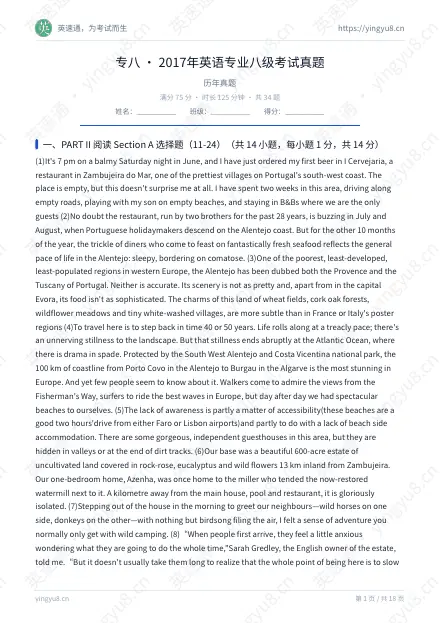
(1)It's 7 pm on a balmy Saturday night in June, and I have just ordered my first beer in I Cervejaria, a restaurant in Zambujeira do Mar, one of the prettiest villages on Portugal's south-west coast. The place is empty, but this doesn't surprise me at all. I have spent two weeks in this area, driving along empty roads, playing with my son on empty beaches, and staying in B&Bs where we are the only guests (2)No doubt the restaurant, run by two brothers for the past 28 years, is buzzing in July and August, when Portuguese holidaymakers descend on the Alentejo coast. But for the other 10 months of the year, the trickle of diners who come to feast on fantastically fresh seafood reflects the general pace of life in the Alentejo: sleepy, bordering on comatose. (3)One of the poorest, least-developed, least-populated regions in western Europe, the Alentejo has been dubbed both the Provence and the Tuscany of Portugal. Neither is accurate. Its scenery is not as pretty and, apart from in the capital Evora, its food isn't as sophisticated. The charms of this land of wheat fields, cork oak forests, wildflower meadows and tiny white-washed villages, are more subtle than in France or Italy's poster regions (4)To travel here is to step back in time 40 or 50 years. Life rolls along at a treacly pace; there's an unnerving stillness to the landscape. But that stillness ends abruptly at the Atlantic Ocean, where there is drama in spade. Protected by the South West Alentejo and Costa Vicentina national park, the 100 km of coastline from Porto Covo in the Alentejo to Burgau in the Algarve is the most stunning in Europe. And yet few people seem to know about it. Walkers come to admire the views from the Fisherman's Way, surfers to ride the best waves in Europe, but day after day we had spectacular beaches to ourselves. (5)The lack of awareness is partly a matter of accessibility(these beaches are a good two hours'drive from either Faro or Lisbon airports)and partly to do with a lack of beach side accommodation. There are some gorgeous, independent guesthouses in this area, but they are hidden in valleys or at the end of dirt tracks. (6)Our base was a beautiful 600-acre estate of uncultivated land covered in rock-rose, eucalyptus and wild flowers 13 km inland from Zambujeira. Our one-bedroom home, Azenha, was once home to the miller who tended the now-restored watermill next to it. A kilometre away from the main house, pool and restaurant, it is gloriously isolated. (7)Stepping out of the house in the morning to greet our neighbours—wild horses on one side, donkeys on the other—with nothing but birdsong filing the air, I felt a sense of adventure you normally only get with wild camping. (8)“When people first arrive, they feel a little anxious wondering what they are going to do the whole time,"Sarah Gredley, the English owner of the estate, told me.“But it doesn't usually take them long to realize that the whole point of being here is to slow down, to enjoy nature." (9)We followed her advice, walking down to the stream in search of terrapins and otters, or through clusters of cork oak trees. On some days, we tramped uphill to the windmill, now a romantic house for two, for panoramic views across the estate and beyond. (10)When we ventured out, we were always drawn back to the coast—the gentle sands and shallow bay of Farol beach. At the end of the day, we would head, sandy-footed, to the nearest restaurant, knowing that at every one there would be a cabinet full of fresh seafood to choose from—bass, salmon, lobster, prawns, crabs, goose barnacles, clams...We never ate the same thing twice. (11)A kilometre or so from I Cervejaria, on Zambujeira's idyllic natural harbour is O Sacas, originally built to feed the fishermen but now popular with everyone. After eating platefuls of seafood on the terrace, we wandered down to the harbour where two fishermen, in wetsuits, were setting out by boat across the clear turquoise water to collect goose barnacles. Other than them the place was deserted-just another empty beauty spot where I wondered for the hundredth time that week how this pristine stretch of coast has remained so undiscovered.
- A.life there is quiet and slow
- B.the place is little known
- C.the place is least populated
- D.there are stunning views
参考答案与解析
答案:A
解析:定位第四段首句 → 识别指代关系('To travel here'指代前文描述的Alentejo地区) → 提取该段对生活节奏的描述('treacly pace', 'stillness') → 同义替换为'quiet and slow'
考点:指代关系识别细节信息提取与同义替换
译文:题干:第四段第一部分指的是……的事实。正确项A:那里的生活安静而缓慢。
- A.different holidaying preferences
- B.difficulty of finding accommodation
- C.little knowledge of the beauty of the beach
- D.long distance from the airports
参考答案与解析
答案:C
解析:定位第五段首句 → 分析指代词'awareness'的指代对象 → 回溯第四段末尾('few people seem to know about it') → 确定指代内容为对海岸线美景的不了解 → 同义替换为'little knowledge of the beauty of the beach'
考点:指代词回溯上下文语义衔接
译文:题干:第五段中的'the lack of awareness'指的是……。正确项C:对海滩美景知之甚少。
- A.describe the scenery outside the house
- B.show appreciation of the surroundings
- C.contrast greenery with isolation
- D.praise the region's unique feature
参考答案与解析
答案:B
解析:定位第六段'gloriously'所在语境 → 分析其修饰对象('green')及上下文情感色彩('beautiful 600-acre estate') → 推断作者使用该词表达对周围环境的赞赏 → 匹配选项B
考点:语境情感色彩分析作者态度推断
译文:题干:作者在第六段使用'gloriously'是为了……。正确项B:表达对周围环境的赞赏。
- A.freshness
- B.delicacy
- C.taste
- D.variety
参考答案与解析
答案:D
解析:定位第十段句子 → 分析字面含义('never ate the same thing twice') → 推断其隐含意义(海鲜种类丰富) → 同义替换为'variety'
考点:句子隐含意义推断同义替换
译文:题干:第十段中'我们从未吃过同样的东西'这句话反映了那里海鲜的……。正确项D:多样性。
- A.Publicity.
- B.Landscape.
- C.Seafood.
- D.Accommodation.
参考答案与解析
答案:C
解析:分别定位第一段和第十一段 → 提取两段的核心信息(第一段:空荡的餐厅、海滩;第十一段:空荡的海滩) → 识别共同主题(人少、空旷) → 匹配选项C(海鲜)为干扰,实际共同主题是'空旷',但选项中无此主题,需重新审视 → 重新分析:第一段提及海鲜餐厅,第十一段提及海鲜晚餐,共同提及'海鲜'这一主题
考点:跨段落信息比对共同主题识别
译文:题干:以下哪个主题在第一段和第十一段中重复出现?正确项C:海鲜。
(1)I can stillremember the faces when I suggested a method of dealing with what most teachers of English considered one of their pet horrors, extended reading. The room was full of tired teachers, and many were quite cynical about the offer to work together to create a new and dynamic approach to the place of stories in the classroom. (2)They had seen promises come and go and mere words weren't going to convince them, which was a shame as it was mere words that we were principally dealing with. Most teachers were unimpressed by the extended reading challenge from the Ministry, and their lack of enthusiasm for the rather dry list of suggested tales was passed on to their students and everyone was pleased when that part of the syllabus was over. It was simply a box ticking exercise. We needed to do something more. We needed a very different approach. (3)That was ten years ago. Now we have a different approach, and it works. Here's how it happened (or, like most good stories, here are the main parts. You have to fill in some of yourself employing that underused classroom device, the imagination.).We started with three main precepts: (4)First, it is important to realize that all of us are storytellers, tellers of tales. We all have our own narratives—the real stories such as what happened to us this morning or night, and the ones we have been told by others and we haven't experienced personally. We could say that our entire lives are constructed as narratives. As a result, we all understand and instinctively feel narrative structure. Binary opposites—for example, the tension created between good and bad together with the resolution of that tension through the intervention of time, resourcefulness and virtue—is a concept understood by even the youngest children. Professor Kieran Egan, in his seminal book“Teaching as Storytelling”warns us not to ignore this innate skill, for it is a remarkable tool for learning. (5)We need to understand that writing and reading are two sides of the same coin: an author has not completed the task if the book is not read: the creative circle is not complete without the reader, who willsupply their own creative input to the process. Samuel Johnson said: A writer only begins a book. A reader finishes it. In teaching terms, we often forget that reading itself can be a creative process, just as writing is, and we too often relegate it to a means of data colection. We frequently forget to make that distinction when presenting narratives or poetry, and often ask comprehension questions which relate to factual information—who said what and when, rather than speculating on"why", for example, or examining the context of the action. (6)The third part of the reasoning that we adopted relates to the need to engage the students as readers in their own right, not simply as language learners; learning the language is part of the process, not the reason for reading. What they read must become theirs and have its own special and secret life in their heads, a place where teachers can only go if invited. (7)We quickly found that one of the most important ways of making all the foregoing happen was to engage the creative talents of the class before they read a word of the text. The pre-reading activities become the most important part of the teaching process; the actual reading part can almost be seen as the cream on the cake, and the principal aim of pre-reading activities is to get students to want to read the text. We developed a series of activities which use clues or fragments from the text yet to be read, and which rely on the students'innate knowledge of narrative, so that they can build their own stories before they read the key text. They have enough information to generate ideas but not so much that it becomes simply an exercise in guided writing; releasing a free imagination is the objective. (8)Moving from pre-reading to reading, we may introduce textual intervention activities.“Textual Intervention”is a term used by Rob Pope to describe the process of questioning a text not simply as a guide to comprehension but as a way of exploring the context of the story at any one time, and examining points at which the narrative presents choices, points of divergence, or narrative crossroads. We don't do this for all texts, however, as the shorter ones do not seem to gain much from this process and it simply breaks up the reading pleasure. (9)Follow-up activities are needed, at the least, to round off the activity, to bring some sense of closure but they also offer an opportunity to link the reading experience more directly to the requirements of the syllabus. Indeed, the story may have been chosen in the first place because the context supports one of the themes that teachers are required to examine as part of the syllabus—for example,“families”,“science and technology”, “communications”,“the environment”and all the other familiar themes. For many teachers this is an essential requirement if they are to engage in such extensive reading at all. (10)The whole process—pre-, while and post reading—could be just an hour's activity, or it could last for more than one lesson. When we are designing the materials for exploring stories clearly it isn't possible for us to know how much time any teacher willhave available, which is why we construct the activities into a series of independent units which we call kits. They are called kits because we expect teachers to build their own lessons out of the materials we provide, which implies that large amounts may be discarded. What we do ask, though, is that the pre-reading activities be included, if nothing else. That is essential for the process to engage the student as a creative reader. (11)One of the purposes of encouraging a creative reading approach in the language classroom is to do with the dynamics we perceive in the classroom. Strategic theorists tell us of the social trinity, whereby three elements are required to achieve a dynamic in any social situation. In the language classroom these might be seen as consisting of the student, the teacher and the language. Certainly from the perspective of the student—and usually from the perspective of the teacher—the relationship is an unequal one, with the language being perceived as placed closer to the teacher than the student. This will result in less dynamic between language and student than between language and teacher. However, if we replace“language”with narrative and especially if that is approached as a creative process that draws the student in so that they feel they“own”the relationship with the text. Then this will shift the dynamic in the classroom so that the student, who has now become a reader, is much closer to the language—or narrative—than previously. This creates a much more effective dynamic of learning. However, some teachers feel threatened by this apparent loss of overall control and mastery. Indeed, the whole business of open ended creativity and a lack of boxes to tick for the correct answer is quite unsettling territory for some to find themselves in.
- A.oppose strongly the teaching of extended reading
- B.be confused over how to teach extended reading
- C.be against adopting new methods of teaching
- D.teach extended reading in a perfunctory way
参考答案与解析
答案:D
解析:定位Para.1-2描述教师对扩展阅读的态度 → 提取‘cynical’、‘unimpressed’、‘lack of enthusiasm’、‘box ticking exercise’等关键信息 → 推断其教学方式敷衍了事 → 匹配选项D
考点:态度推断细节支撑
译文:题干:从第1、2段可以推断出,老师们过去常常…… 正确项D:以敷衍的方式教授扩展阅读。
- A.we are good at telling stories
- B.we all like telling stories
- C.we are born story-tellers
- D.we all like listening to stories
参考答案与解析
答案:C
解析:定位Para.4中目标句 → 结合前文‘all of us are storytellers’及后文‘innate skill’(天生技能)进行语境推断 → 理解‘understand and instinctively feel’强调与生俱来的特性 → 匹配选项C
考点:语境词义推断同义替换
译文:题干:第4段中‘we all understand and instinctively feel narrative structure’这句话表明…… 正确项C:我们天生就是讲故事的人。
- A.independent
- B.collaborative
- C.contradictory
- D.reciprocal
参考答案与解析
答案:B
解析:定位Para.5中Samuel Johnson的观点 → 提取‘writing and reading are two sides of the same coin’、‘creative circle is not complete without the reader’、‘supply their own creative input’等关键信息 → 推断作者与读者是相互协作、共同完成创作的关系 → 匹配选项B
考点:观点推断比喻理解
译文:题干:塞缪尔·约翰逊认为作者与读者的关系是(第5段)。 正确项B:协作的。
- A.it encourages students'imagination
- B.it lays a good foundation for reading
- C.it can attract students'attention
- D.it provides clues to the text to be read
参考答案与解析
答案:A
解析:定位Para.7中关于‘pre-reading’的论述 → 提取‘most important part’及具体原因描述 → 理解其核心在于激发学生想象力以参与文本构建 → 匹配选项A
考点:细节定位因果推理
译文:题干:在第7段中,作者认为‘预读’是阅读中最重要的部分,因为…… 正确项A:它能激发学生的想象力。
- A.exploring the context
- B.interpreting ambiguities
- C.stretching the imagination
- D.examining the structure
参考答案与解析
答案:B
解析:定位Para.8中Rob Pope提出的‘Textual Intervention’ → 逐一核对选项功能是否在原文中被提及或暗示 → 发现‘解释歧义’(interpreting ambiguities)未被提及 → 确定为例外项
考点:细节排查否定信息定位
译文:题干:罗布·波普(第8段)提出的‘文本干预’旨在实现以下所有功能,除了…… 正确项B:解释歧义。
(1)Once again, seething, residual anger has burst forth in an American city. And the riots that overtook Los Angeles were a reminder of what knowledgeable observers have been saving for a quarter-century: America will continue paying a high price in civil and ethnic unrest unless the nation commits itself to programs that help the urban poor lead productive and respectable lives. (2)Once again, a proven program is worth pondering: national service. (3)Somewhat akin to the military training that generations of American males received in the armed forces, a 1990s version would prepare thousands of unemployable and undereducated young adults for quality lives in our increasingly global and technology-driven economy. National service opportunities would be available to any who needed it and, make no mistake, the problems are now so structural, so intractable, that any solution will require massive federal intervention. (4)In his much-quoted book,“The Truly Disadvantaged”, sociologist William Julius Wilson wrote that “only a major program of economic reform”will prevent the riot-prone urban underclass from being permanently locked out of American economic life. Today, we simply have no choice. The enemy within and among our separate ethnic selves is as daunting as any foreign foe. (5)Families who are rent apart by welfare dependency, job discrimination and intense feelings of alienation have produced minority teenagers with very little self-discipline and little faith that good grades and the American work ethic will pay off. A military-like environment for them with practical domestic objectives could produce startling results. (6)Military service has been the most successful career training program we've ever known, and American children born in the years since the all-volunteer Army was instituted make up a large proportion of this targeted group. But this opportunity may disappear forever if too many of our military bases are summarily closed and converted or sold to the private sector. The facilities, manpower, traditions, and capacity are already in place. (7)Don't dismantle it: rechannel it. (8)Discipline is a cornerstone of any responsible citizen's life. I was taught it by my father, who was a policeman. Many of the rioters have never had any at all. As an athlete and former Army officer, I know that discipline can be learned. More importantly, it must be learned or it doesn't take hold. (9)A precedent for this approach was the Civilian Conservation Corps that worked so well during the Great Depression. My father enlisted in the CCC as a young man with an elementary school education and he learned invaluable skills that served him well throughout his life. The key was that a job was waiting for him when he finished. The certainty of that first entry-level position is essential if severely alienated young minority men and women are to keep the faith. (10)We all know these are difficult times for the public sector, but here's a chance to add energetic and able manpower to America's workforce. They could be prepared for the world of work or college—an offer similar to that made to returning GIs after World War Ⅱ.It would be a chance for 16-to 2l-year-olds to live among other cultures, religions, races and in different geographical areas. And these young people could be taught to rally around common goals and friendships that evolve out of pride in one's squad, platoon, company, battalion—or commander. (11)We saw such images during the Persian Gulf War and during the NACC Final Four basketball games. In military life and competitive sports, this camaraderie doesn't just happen; it is taught and learned n an atmosphere of discipline and earned mutual respect for each other's capabilities. (12)A national service program would also help overcome two damaging perceptions held by America's disaffected youth: that society just doesn't care about minority youngsters and that one's personal best efforts will not be rewarded in our discriminatory job market. Harvard professor Robert Reich's research has shown that urban social ills are so pervasive that the upper 20 percent of Americans—that“fortunate fifth”as he calls them—have decided quietly to“secede”from the bottom four-fifths, and the lowest fifth in particular. We cannot accept such estrangement on a permanent basis. And what better way to answer skeptics from any group than by certifying the technical skills of graduates from a national service training program? (13)Now, we must act decisively to forestall future urban unrest. Republicans must put aside their aversion to funding programs aimed at certain cultural groups. Democrats must forget labels and recognize that a geographically isolated subgroup of Americans—their children in particular—need systematic and substantive assistance for at least another 20 years. (14)The ethnic taproots of minority Americans are deeply buried in a soil of faith and loyalty to traditional values. With its emphasis on discipline, teamwork, conflict resolution, personal responsibility and marketable skills development, national service can provide both the training and that vital first job that will reconnect these Americans to the rest of us. Let's do it now before the fire next time.
- A.good grades
- B.self discipline
- C.mutual trust
- D.work ethic
参考答案与解析
答案:B
解析:定位题干关键词 'national service' 和 'military training' → 在第(3)段找到类比关系 'Somewhat akin to' → 定位第(5)段对目标群体的描述 'very little self-discipline' → 推断培养目标为 'self-discipline'
考点:细节定位指代与衔接同义替换
译文:题干:根据作者,'国民服务'与'军事训练'具有可比性,因为它们都培养年轻人的______。正确项B:自律。
- A.the importance of discipline
- B.the importance of education
- C.the necessity of having strong faith
- D.the effectiveness of the program
参考答案与解析
答案:D
解析:定位题干关键词 'his father' → 在第(6)段找到 'Military service has been the most successful career training program' → 结合上下文,作者以父亲经历(军事服务)为例,旨在证明该类项目的有效性 → 得出答案
考点:推理判断篇章结构例证目的
译文:题干:作者引用他父亲的例子是为了说明______。正确项D:该项目的有效性。
- A.increase in income
- B.a sense of responsibility
- C.confidence and hope
- D.practical work skills
参考答案与解析
答案:A
解析:定位题干关键词 'benefits' 和 'EXCEPT' → 在第(3)段找到 'prepare... for quality lives',第(5)段找到 'practical domestic objectives',第(8)段找到 'Discipline' → 综合推断出责任、信心、技能均为益处 → 对比选项,'收入增加'未提及
考点:细节定位推理判断排除法
译文:题干:根据作者,国民服务项目可以给美国年轻人带来以下益处,除了______。正确项A:收入增加。
- A.Discrimination.
- B.Anger.
- C.Riots.
- D.Aversion.
参考答案与解析
答案:C
解析:定位第(14)段 'the fire' → 回溯前文,第(1)段提到 'seething, residual anger has burst forth' 和 'riots' → 第(14)段 'the fire' 是对前文 'riots' 的比喻性指代 → 得出答案
考点:词义猜测指代与衔接上下文推断
译文:题干:根据上下文,'the fire'(第14段)指的是什么?正确项C:骚乱。
第 2 部分 · PART II 阅读 Section B 简答题(25-32)8 题 · 16 分
参考答案与解析
答案:It is busy only in July and August.
解析:定位Para.2关于餐厅生意的描述 → 提取时间限定信息 → 匹配正确选项
考点:细节定位时间限定
译文:题干:第2段告诉我们关于阿连特茹海岸全年餐厅生意的什么信息?正确项:它只在七月和八月繁忙。
参考答案与解析
答案:Distance from airports and lack of accommodation.
解析:定位Para.5关于阿连特茹难以到达的原因 → 提取并列的两个原因 → 匹配正确选项
考点:细节定位原因列举
译文:题干:根据第5段,阿连特茹难以到达的主要原因是什么?正确项:距离机场远且住宿缺乏。
参考答案与解析
答案:It was a mere formality without real engagement.
解析:定位Para.2中短语所在句 → 结合上下文语境推断其比喻义 → 匹配正确选项
考点:语境推断习语理解
译文:题干:第2段中“It was simply a box ticking exercise”是什么意思?正确项:它只是一种没有真正参与的例行公事。
参考答案与解析
答案:1. Humans are innate storytellers. 2. Reading is creative. 3. Engage students as readers.
解析:定位Paras.4-6关于新方法的三个主要原则 → 分别概括每段核心观点 → 匹配正确选项
考点:段落主旨概括信息整合
译文:题干:第4-6段提出了新方法的三个主要原则。请用一个短语总结每个原则。正确项:1. 人类天生是讲故事的人。2. 阅读是创造性的。3. 让学生成为读者参与进来。
参考答案与解析
答案:Engage students' creativity before reading the text.
解析:定位Para.11关于改变课堂动态的建议 → 提取作者提出的具体方法 → 匹配正确选项
考点:推理判断建议提取
译文:题干:作者建议如何改变课堂的动态(第11段)?正确项:在阅读文本之前激发学生的创造力。
参考答案与解析
答案:To prepare unemployable young adults for quality lives.
解析:定位作者在第1-3段提出的项目核心目的 → 识别其针对‘unemployable young adults’并旨在‘prepare them for quality lives’ → 同义替换匹配正确选项
考点:主旨大意细节定位
译文:题干:作者在第1-3段提出的项目目的是什么?正确答案:为无法就业的年轻人做好过上优质生活的准备。
参考答案与解析
答案:The military service or its facilities and capacity.
解析:定位第7段‘Don't dismantle it: rechannel it’ → 分析‘it’的指代对象 → 结合上下文逻辑,‘it’指代前文讨论的军事服务及其设施和能力 → 匹配正确选项
考点:指代与衔接逻辑衔接词
译文:题干:第7段中‘Don't dismantle it: rechannel it’的‘it’指代什么?正确答案:军事服务或其设施和能力。
参考答案与解析
答案:Society doesn't care; efforts won't be rewarded.
解析:定位第12段Robert Reich的研究发现 → 理解其核心观点(社会不关心,努力不会得到回报) → 推断其隐含的悲观态度 → 匹配正确选项
考点:推理判断观点态度
译文:题干:Robert Reich的研究发现暗示了什么?正确答案:社会不关心;努力不会得到回报。
第 3 部分 · 改错 · 每个标号行各有一处错误(错词填正确词 · 缺词填所缺词 · 多词填多余词)1 题 · 10 分
参考答案与解析
答案:1-that 2-and 3-that 4-the 5-especially 6-dominant 7-conduct 8-the 9-specialize 10-of
解析:1 空 识别空格位于动词后,需引导宾语从句 → 从句结构完整,缺引导词 → 选择 that
2 空 识别空格连接两个并列成分 → 需要并列连词 → 选择 and
3 空 识别空格位于动词后,需引导宾语从句 → 从句结构完整,缺引导词 → 选择 that
4 空 识别空格位于名词前,需限定词 → 根据语境判断特指 → 选择 the
5 空 识别空格位于句中,需副词修饰 → 根据语境判断强调 → 选择 especially
6 空 分析句子结构与语义 → 判断空格处需要形容词修饰名词 → 根据语境选择表示‘主导的’含义的形容词
7 空 分析句子结构与语义 → 判断空格处需要动词与‘research’构成动宾搭配 → 根据语境选择表示‘进行’含义的动词
8 空 分析句子结构 → 判断空格处需要定冠词特指 → 根据语境选择定冠词
9 空 分析句子结构与语义 → 判断空格处需要动词原形 → 根据语境选择表示‘专攻’含义的动词
10 空 分析句子结构与语义 → 判断空格处需要介词与‘consist’构成固定搭配 → 根据语境选择介词
考点:宾语从句引导词并列连词冠词用法副词用法语境选词形容词修饰名词动词搭配动宾搭配定语从句定冠词特指动词原形固定搭配介词搭配
译文:题干与正确项的中文译文:(无)
第 4 部分 · PART IV 汉译英1 题 · 15 分
参考答案与解析
参考译文
When I was a child, I always looked forward to the Chinese New Year with great anticipation. As soon as the twelfth lunar month began, I would start counting the days on my fingers. Adults, however, would often sigh deeply at our eager impatience, as if they not only disliked the New Year but even dreaded it. Their attitude left me disappointed and puzzled at the time, but now I fully understand it. I believe there are two main reasons why the older generation feels so ambivalent about the New Year: first, it means a significant financial expense; second, the rapid passage of time exerts immense pressure on them. Children can excitedly exclaim, "The New Year is here—I'm a year older!" while the elderly sigh, "Alas, another year has passed." For children, the New Year signifies progress toward the glorious stages of life, whereas for adults, it marks a slide into the twilight years of decline.
第 5 部分 · PART V 写作1 题 · 20 分
参考答案与解析
参考范文
The debate surrounding job hopping has evolved significantly in recent years, reflecting shifting economic landscapes and employer expectations. Excerpt 1 presents a positive view, arguing that job hopping can be advantageous, particularly in fast-paced fields like technology. It cites data showing shorter average tenures, especially among younger workers, and suggests that changing jobs allows individuals to acquire diverse technical knowledge and maintain skill relevance in competitive markets. Employers, it notes, are increasingly open to this trend. In contrast, Excerpt 2 offers a cautionary perspective, indicating that job hopping is becoming more difficult as employers prioritize stability and solid credentials. It highlights that many companies now automatically reject candidates with frequent job changes, expecting a tenure of four to six years to demonstrate progress and skill mastery. This excerpt emphasizes the importance of adaptability and persistence developed through longer-term employment. From my perspective, while job hopping can offer short-term benefits, it is not a universally beneficial strategy for long-term career development. The advantages highlighted in Excerpt 1—such as skill diversification and market adaptability—are valid, especially in dynamic industries where technological obsolescence is a real concern. However, the risks outlined in Excerpt 2 are equally compelling. Frequent job changes can signal a lack of commitment or depth to potential employers, potentially limiting access to senior roles that require demonstrated leadership and project continuity. Moreover, the process of constantly adapting to new environments may hinder the development of deep expertise and professional networks, which are often built over time within an organization. Ultimately, the decision to hop jobs should be strategic rather than habitual. For early-career professionals, a few calculated moves might accelerate learning and salary growth. However, as one advances, prioritizing roles that offer substantial growth opportunities and aligning with long-term career goals becomes more critical. In my view, a balanced approach—where job changes are purposeful and spaced appropriately—can mitigate the downsides while leveraging the benefits. This ensures that one's career narrative reflects both adaptability and stability, qualities highly valued in today's competitive job market.
常见问题
2017年英语专业八级考试真题的答案和解析在哪看?
答案与解析就在本页:每道题下方「参考答案与解析」展开即看,含参考答案、解题思路与考点,免登录直接阅读。
2017年英语专业八级考试真题 PDF 怎么免费下载?
本页「试卷封面」卡片「收录格式」行内的 PDF 徽标即下载链接,点击直接下载本卷 PDF 文件,无需登录。
这套卷怎么在线做题、怎么计分?
点页面上方「开始考试(网页)」进入在线做题页:登录后装载本卷作答,交卷自动判分并留存成绩;免费账号每日可装载 30 套,会员每日 100 套。