2018年英语专业八级考试真题及答案解析
2018年英语专业八级考试真题 · 完整收录
- 年份考次
- 2018 年
- 命题归属
- 全国统一命题
- 省份
- 全国
- 题量
- 25 题
- 满分
- 75 分
- 限时
- 125 分钟
- 题型结构
- PART II 阅读 Section A 选择题 14 题 14 分 · PART II 阅读 Section B 简答题 8 题 16 分 · 改错 · 每个标号行各有一处错误 10 题 10 分 · PART IV 汉译英 1 题 15 分 · PART V 写作 1 题 20 分
- 收录格式
开始考试(微信)

微信扫一扫 · 小程序内开始考试
第 1 部分 · PART II 阅读 Section A 选择题(11-24)14 题 · 14 分
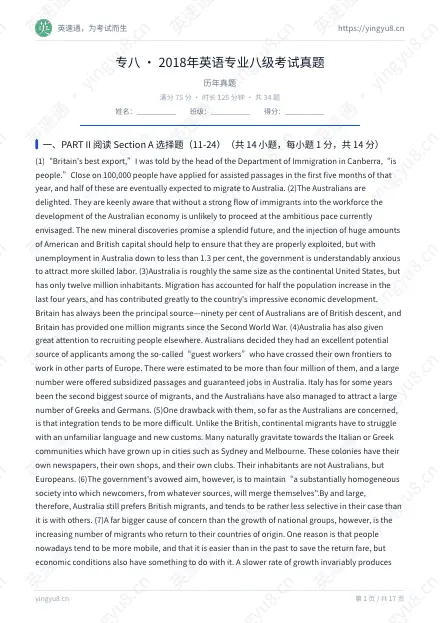
(1)“Britain's best export,”I was told by the head of the Department of Immigration in Canberra,“is people.”Close on 100,000 people have applied for assisted passages in the first five months of that year, and half of these are eventually expected to migrate to Australia. (2)The Australians are delighted. They are keenly aware that without a strong flow of immigrants into the workforce the development of the Australian economy is unlikely to proceed at the ambitious pace currently envisaged. The new mineral discoveries promise a splendid future, and the injection of huge amounts of American and British capital should help to ensure that they are properly exploited, but with unemployment in Australia down to less than 1.3 per cent, the government is understandably anxious to attract more skilled labor. (3)Australia is roughly the same size as the continental United States, but has only twelve million inhabitants. Migration has accounted for half the population increase in the last four years, and has contributed greatly to the country's impressive economic development. Britain has always been the principal source—ninety per cent of Australians are of British descent, and Britain has provided one million migrants since the Second World War. (4)Australia has also given great attention to recruiting people elsewhere. Australians decided they had an excellent potential source of applicants among the so-called“guest workers”who have crossed their own frontiers to work in other parts of Europe. There were estimated to be more than four million of them, and a large number were offered subsidized passages and guaranteed jobs in Australia. Italy has for some years been the second biggest source of migrants, and the Australians have also managed to attract a large number of Greeks and Germans. (5)One drawback with them, so far as the Australians are concerned, is that integration tends to be more difficult. Unlike the British, continental migrants have to struggle with an unfamiliar language and new customs. Many naturally gravitate towards the Italian or Greek communities which have grown up in cities such as Sydney and Melbourne. These colonies have their own newspapers, their own shops, and their own clubs. Their inhabitants are not Australians, but Europeans. (6)The government's avowed aim, however, is to maintain“a substantially homogeneous society into which newcomers, from whatever sources, will merge themselves".By and large, therefore, Australia still prefers British migrants, and tends to be rather less selective in their case than it is with others. (7)A far bigger cause of concern than the growth of national groups, however, is the increasing number of migrants who return to their countries of origin. One reason is that people nowadays tend to be more mobile, and that it is easier than in the past to save the return fare, but economic conditions also have something to do with it. A slower rate of growth invariably produces discontent—and if this coincides with greater prosperity in Europe, a lot of people tend to feel that perhaps they were wrong to come here after all. (8)Several surveys have been conducted recently into the reasons why people go home. One noted that “flies, dirt, and outside lavatories”were on the list of complaints from British immigrants, and added that many people also complained about“the crudity, bad manners, and unfriendliness of the Australians”.Another survey gave climate conditions, homesickness, and“the stark appearance of the Australian countryside”as the main reasons for leaving. (9)Most British migrants miss council housing, the National Health scheme, and their relatives and former neighbors. Loneliness is a big factor, especially among housewives. The men soon make new friends at work, but wives tend to find it much harder to get used to a different way of life. Many are housebound because of inadequate public transport in most outlying suburbs, and regular correspondence with their old friends at home only serves to increase their discontent. One housewife was quoted recently as saying:“I even find I miss the people I used to hate at home." (10)Rents are high, and there are long waiting lists for Housing Commission homes. Sickness can be an expensive business and the climate can be unexpectedly rough. The gap between Australian and British wage packets is no longer big, and people are generally expected to work harder here than they do at home. Professional men over forty often have difficulty in finding a decent job. Above all, perhaps, skilled immigrants often find a considerable reluctance to accept their qualifications. (11)According to the journal Australian Manufacturer, the attitude of many employers and fellow workers is anything but friendly.“We Australians,"it stated in a recent issue,“are just too fond of painting the rosy picture of the big, warm-hearted Aussie. As a matter of fact, we are so busy blowing our own trumpets that we have not got time to be warm-hearted and considerate. Go down'heart-break alley'among some of the migrants and find out just how expansive the Aussie is to his immigrants."
- A.immigrants speed up economic expansion
- B.unemployment is down to a low figure
- C.immigrants attract foreign capital
- D.Australia is as large as the United States
参考答案与解析
答案:A
解析:定位题干关键词 'strong flow of immigrants' → 在第(2)段找到原因 'without a strong flow... development... is unlikely to proceed' → 同义替换为 'speed up economic expansion'
考点:细节定位因果推理同义替换
译文:题干:澳大利亚人希望有大量移民流入,因为______。正确项A:移民加速经济扩张。
- A.they are selected carefully before entry
- B.they are likely to form national groups
- C.they easily merge into local communities
- D.they are fond of living in small towns
参考答案与解析
答案:C
解析:定位题干关键词 'prefers immigrants from Britain' → 在第(5)段找到对比 'Unlike the British, continental migrants have to struggle...' → 推断英国移民的优势是语言文化适应快,即 'easily merge into local communities'
考点:对比推理细节推断同义替换
译文:题干:澳大利亚更喜欢来自英国的移民,因为______。正确项C:他们容易融入当地社区。
- A.stresses their economic motives
- B.emphasizes the variety of their motives
- C.stresses loneliness and homesickness
- D.emphasizes the difficulties of men over forty
参考答案与解析
答案:B
解析:定位题干关键词 'why some migrants return to Europe' → 在第(6)段找到作者列举的多种原因('loneliness', 'homesickness', 'men over forty', 'economic motives')→ 归纳为 'variety of their motives'
考点:主旨归纳段落结构分析
译文:题干:在解释为什么一些移民返回欧洲时,作者______。正确项B:强调了他们动机的多样性。
- A.“flow”(Para.2).
- B.“injection”(Para.2).
- C."gravitate"(Para.5).
- D."selective"(Para.6).
参考答案与解析
答案:D
解析:逐一分析选项词汇在原文中的用法 → 'flow'(移民流)、'injection'(资本注入)、'gravitate'(被吸引)均为比喻用法 → 'selective'(有选择性的)为字面意义 → 得出答案
考点:熟词僻义语境判断比喻与字面义辨析
译文:题干:下列哪个词是字面使用,而非比喻使用?正确项D:'selective'(第6段)。
- A.unsympathetic
- B.ungenerous
- C.undemonstrative
- D.unreliable
参考答案与解析
答案:A
解析:定位第(11)段 → 分析作者描述澳大利亚人对移民态度的措辞(如 'anxious to attract', 'keenly aware')→ 推断作者认为澳大利亚人态度功利、缺乏同情心 → 得出 'unsympathetic'
考点:观点态度推断措辞分析语境推理
译文:题干:第(11)段将澳大利亚人描绘为______。正确项A:缺乏同情心的。
(1)Some of the advantages of bilingualism include better performance at tasks involving“executive function”(which involves the brain's ability to plan and prioritize), better defense against dementia in old age and—the obvious—the ability to speak a second language. One purported advantage was not mentioned, though. Many multilinguals report different personalities, or even different worldviews, when they speak their different languages. (2)It's an exciting notion, the idea that one's very self could be broadened by the mastery of two or more languages. In obvious ways(exposure to new friends, literature and so forth)the self really is broadened. Yet it is different to claim—as many people do—to have a different personality when using a different language. A former Economist colleague, for example, reported being ruder in Hebrew than in English. So what is going on here? (3)Benjamin Lee Whorf, an American linguist who died in 1941, held that each language encodes a worldview that significantly influences its speakers. Often called“Whorfianism”, this idea has its sceptics, but there are still good reasons to believe language shapes thought. (4)This influence is not necessarily linked to the vocabulary or grammar of a second language. Significantly, most people are not symmetrically bilingual. Many have learned one language at home from parents, and another later in life, usually at school. So bilinguals usually have different strengths and weaknesses in their different languages—and they are not always best in their first language. For example, when tested in a foreign language, people are less likely to fall into a cognitive trap(answering a test question with an obvious- seeming but wrong answer)than when tested in their native language. In part this is because working in a second language slows down the thinking. No wonder people feel different when speaking them. And no wonder they feel looser, more spontaneous, perhaps more assertive or funnier or blunter, in the language they were reared in from childhood. (5)What of“crib”bilinguals, raised in two languages?Even they do not usually have perfectly symmetrical competence in their two languages. But even for a speaker whose two languages are very nearly the same in ability, there is another big reason that person will feel different in the two languages. This is because there is an important distinction between bilingualism and biculturalism. (6)Many bilinguals are not bicultural. But some are. And of those bicultural bilinguals, we should be little surprised that they feel different in their two languages. Experiments in psychology have shown the power of"priming"—small unnoticed factors that can affect behavior in big ways. Asking people to tell a happy story, for example, will put them in a better mood. The choice between two languages is a huge prime. Speaking Spanish rather than English, for a bilingual and bicultural Puerto Rican in New York, might conjure feelings of family and home. Switching to English might prime the same person to think of school and work. (7)So there are two very good reasons(asymmetrical ability, and priming)that make people feel different speaking their different languages. We are still left with a third kind of argument, though. An economist recently interviewed here at Prospero, Athanasia Chalari, said for example that: Greeks are very loud and they interrupt each other very often. The reason for that is the Greek grammar and syntax. When Greeks talk they begin their sentences with verbs and the form of the verb includes a lot of information so you already know what they are talking about after the first word and can interrupt more easily. (8)Is there something intrinsic to the Greek language that encourages Greeks to interrupt?People seem to enjoy telling tales about their languages'inherent properties, and how they influence their speakers. A group of French intellectual worthies once proposed, rather self-flatteringly, that French be the sole legal language of the EU, because of its supposedly unmatchable rigor and precision. Some Germans believe that frequently putting the verb at the end of a sentence makes the language especially logical. But language myths are not always self- flattering: many speakers think their languages are unusually illogical or difficult—witness the plethora of books along the lines of“Only in English do you park on a driveway and drive on a parkway; English must be the craziest language in the world!”We also see some unsurprising overlap with national stereotypes and self- stereotypes: French, rigorous; German, logical; English, playful. Of course. (9)In this case, Ms Chalari, a scholar, at least proposed a specific and plausible line of causation from grammar to personality: in Greek, the verb comes first, and it carries a lot of information, hence easy interrupting. The problem is that many unrelated languages all around the world put the verb at the beginning of sentences. Many languages all around the world are heavily inflected, encoding lots of information in verbs. It would be a striking finding if all of these unrelated languages had speakers more prone to interrupting each other. Welsh, for example, is also both verb-first and about as heavily inflected as Greek, but the Welsh are not known as pushy conversationalists.
- A.Personality improvement.
- B.Better task performance.
- C.Change of worldviews.
- D.Avoidance of old-age disease.
参考答案与解析
答案:B
解析:定位段落(1)列举的公认优势 → 识别“better performance at tasks”与选项B的同义替换 → 得出答案
考点:细节定位同义替换
译文:题干:根据作者,双语的以下哪项优势是普遍接受的?正确项B:更好的任务表现。
- A.the vocabulary of a second language
- B.the grammar of a second language
- C.the improved test performance in a second language
- D.the slowdown of thinking in a second language
参考答案与解析
答案:D
解析:定位段落(4)中“language influences thought”的解释 → 识别“working in a second language slows down the thinking”与选项D的同义替换 → 得出答案
考点:细节定位因果推理
译文:题干:根据文章,语言影响思维可能与什么有关?正确项D:第二语言中思维的减慢。
- A.It's just one of the popular tales of national stereotypes.
- B.Some properties inherent can make a language logical.
- C.German and French are good examples of Whorfianism.
- D.There is adequate evidence to support a positive answer.
参考答案与解析
答案:A
解析:定位段落(2)末尾的问题“So what is going on here?” → 结合段落(3)对Whorfianism的介绍及“sceptics”的提及,以及段落(4)的解释 → 推断作者对“不同语言塑造不同人格”这一流行说法持怀疑态度 → 得出答案
考点:推理判断观点态度
译文:题干:作者对第8段开头问题的回应是什么?正确项A:这只是关于民族刻板印象的流行故事之一。
- A.Ms Chalari's theory about the Greek language is well grounded.
- B.Speakers of many other languages are also prone to interrupting.
- C.Grammar is unnecessarily a condition for change in personality.
- D.Many unrelated languages don't have the same features as Greek.
参考答案与解析
答案:C
解析:定位段落(9)(根据上下文推断为讨论语法与人格变化关系的部分) → 识别作者对“grammar is a condition for change in personality”这一观点的否定态度 → 得出答案
考点:细节定位推理判断
译文:题干:关于第9段,以下哪项陈述是正确的?正确项C:语法不一定是人格变化的条件。
- A.satirical
- B.objective
- C.critical
- D.ambivalent
参考答案与解析
答案:B
解析:通览全文,分析作者对“语言影响思维/人格”这一议题的论述方式 → 识别作者既介绍理论又提出质疑、既举例又分析的平衡论述风格 → 得出答案
考点:观点态度篇章理解
译文:题干:在讨论这个问题时,作者的态度是?正确项B:客观的。
(1)Once across the river and into the wholesale district, she glanced about her for some likely door at which to apply. As she contemplated the wide windows and imposing signs, she became conscious of being gazed upon and understood for what she was—a wage-seeker. She had never done this thing before and lacked courage. To avoid conspicuity and a certain indefinable shame she felt at being caught spying about for some place where she might apply for a position, she quickened her steps and assumed an air of indifference supposedly common to one upon an errand. In this way she passed many manufacturing and wholesale houses without once glancing in. At last, after several blocks of walking, she felt that this would not do, and began to look about again, though without relaxing her pace. A little way on she saw a great door which for some reason attracted her attention. It was ornamented by a small brass sign, and seemed to be the entrance to a vast hive of six or seven floors."Perhaps,"she thought,"they may want someone"and crossed over to enter, screwing up her courage as she went. When she came within a score of feet of the desired goal, she observed a young gentleman in a grey clerk suit, fumbling his watch-chain and looking out. That he had anything to do with the concern she could not tell, but because he happened to be looking in her direction, her weakening heart misgave her and she hurried by, too overcome with shame to enter in. After several blocks of walking, in which the uproar of the streets and the novelty of the situation had time to wear away the effect of her first defeat, she again looked about. Over the way stood a great six-story structure labeled“Storm and King,”which she viewed with rising hope. It was a wholesale dry goods concern and employed women. She could see them moving about now and then upon the upper floors. This place she decided to enter, no matter what. She crossed over and walked directly toward the entrance. As she did so two men came out and paused in the door. A telegraph messenger in blue dashed past her and up the few steps which graced the entrance and disappeared. Several pedestrians out of the hurrying throng which flled the sidewalks passed about her as she paused, hesitating. She looked helplessly around and then, seeing herself observed, retreated. It was too difficult a task. She could not go past them. (2)So severe a defeat told sadly upon her nerves. She could scarcely understand her weakness and yet she could not think of gazing inquiringly about upon the surrounding scene. Her feet carried her mechanically forward, every foot of her progress being a satisfactory portion of a flight which she gladly made. Block after block passed by. Upon street lamps at the various corners she read names such as Madison, Monroe, La Salle, Clark, Dearborn; and still she went, her feet beginning to tire upon the broad stone flagging. She was pleased in part that the streets were bright and clean. The morning sun shining down with steadily increasing warmth made the shady side of the streets pleasantly cool. She looked at the blue sky overhead with more realization of its charm than had ever come to her before. (3)Her cowardice began to trouble her in a way. She turned back along the street she had come, resolving to hunt up Storm and King and enter in. On the way she encountered a great wholesale shoe company, through the broad plate windows of which she saw an enclosed executive department, hidden by frosted glass. Without this enclosure, but just within the street entrance, sat a grey-haired gentleman at a small table, with a large open ledger of some kind before him. She walked by this institution several times hesitating, but finding herself unobserved she eventually gathered sufficient courage to falter past the screen door and stood humbly waiting. (4)“Well, young lady,"observed the old gentleman, looking at her somewhat kindly—“what is it you wish? ” (5)“I am, that is, do you—I mean, do you need any help?”she stammered. (6)“Not just at present,"he answered smiling.“Not just at present. Come in sometime next week. Occasionally we need someone.” (7)She received the answer in silence and backed awkwardly out. The pleasant nature of her reception rather astonished her. She had expected that it would be more difficult, that something cold and harsh would be said—she knew not what. That she had not been put to shame and made to feel her unfortunate position seemed remarkable. She did not realize that it was just this which made her experience easy, but the result was the same. She felt greatly relieved. (8)Somewhat encouraged, she ventured into another large structure. It was a clothing company, and more people were in evidence. (9)An office boy approached her. (10)“Who is it you wish to see?”he asked. (11)"I want to see the manager,"she returned. (12)He ran away and spoke to one of a group of three men who were conferring together. One broke off and came towards her. (13)“Well?”he said, coldly. The greeting drove all courage from her at once. (14)“Do you need any help?”she stammered. (15)"No,"he replied abruptly and turned upon his heel. (16)She went foolishly out, the office boy deferentially swinging the door for her, and gladly sank into the obscuring crowd. It was a severe set-back to her recently pleased mental state.
- A.was afraid of being seen as a stranger
- B.was in a hurry to leave the district
- C.wanted to look like someone working there
- D.wanted to apply at more factories that day
参考答案与解析
答案:C
解析:定位题干关键词 → 在语篇中定位到‘assumed an air of indifference supposedly common to one upon an errand’ → 同义替换为‘wanted to look like someone working there’
考点:细节定位同义替换
译文:题干:她加快脚步是因为她______。正确项C:想让自己看起来像在那里工作的人。
- A.She was too timid to enter the building.
- B.Two men stopped her at the entrance.
- C.Several pedestrians had found her strange.
- D.The messenger had closed the door behind him.
参考答案与解析
答案:A
解析:定位题干关键词 → 在语篇中定位到‘her weakening heart misgave her and she hurried by, too overcome with shame to enter in’ → 推理出她因胆怯而未进入
考点:细节定位推理判断
译文:题干:她第一次为什么没有进入Storm and King?正确项A:她太胆怯而不敢进入大楼。
- A.She thought she was making progress in job search.
- B.She was glad that she was looking for a job.
- C.She found her experience satisfactory.
- D.She just wanted to leave the place.
参考答案与解析
答案:D
解析:定位题干短语 → 结合上下文‘she felt that this would not do’和‘the effect of her first defeat’ → 推断出‘flight’在此处指‘逃离’,而非‘进展’
考点:词义猜测语境推理
译文:题干:根据上下文(第2段),‘every foot of her progress being a satisfactory portion of a flight which she gladly made’是什么意思?正确项D:她只想离开那个地方。
- A.She eventually managed to enter the building.
- B.She was kindly received by the clerk.
- C.She had the courage to make an inquiry.
- D.She was promised a work position.
参考答案与解析
答案:B
解析:定位题干关键词 → 在语篇中定位到‘she was kindly received by the clerk’ → 同义替换为‘She was kindly received by the clerk’
考点:细节定位同义替换
译文:题干:她为什么感到如释重负(第7段)?正确项B:她受到了职员的友善接待。
第 2 部分 · PART II 阅读 Section B 简答题(25-32)8 题 · 16 分
参考答案与解析
答案:Optimistic but uncertain future for Australia's economy.
解析:定位关键词'promise'和'should' → 分析其在语境中的情态含义 → 推断作者对经济前景的态度
考点:情态动词推断观点态度判断
译文:题干:第2段中的“promise”和“should”暗示了作者对澳大利亚经济前景的何种看法? 正确项:对澳大利亚经济持乐观但不确定的未来展望。
参考答案与解析
答案:Growth of non-British immigrant communities in Australia.
解析:定位第7段'national groups' → 结合上下文(移民、非英语背景)推断其具体所指 → 进行同义替换
考点:语境词义猜测同义替换
译文:题干:根据上下文(第7段),解释“the growth of national groups”的含义。 正确项:澳大利亚非英国裔移民社区的增长。
参考答案与解析
答案:Choosing a language strongly influences thoughts and behavior.
解析:定位第6段'The choice between two languages is a huge prime.' → 分析'prime'在此语境下的引申义(影响、塑造) → 推断整句含义
考点:熟词僻义推断语境推理
译文:题干:根据上下文(第6段),解释“The choice between two languages is a huge prime.”的含义。 正确项:选择一种语言会强烈影响思维和行为。
参考答案与解析
答案:Asymmetrical ability and priming from cultural associations.
解析:定位问题核心'why people feel different' → 在文中寻找解释原因的段落 → 概括并整合'能力不对称'与'文化联想启动'两个要点
考点:细节定位与概括多要点整合
译文:题干:作者给出了哪些原因来解释为什么人们在说不同语言时感觉不同? 正确项:能力不对称以及文化联想的启动效应。
参考答案与解析
答案:Reasons why bilinguals feel different in different languages.
解析:通览全文结构 → 识别各段落共同围绕的核心议题(双语者在不同语言中的感受差异) → 概括主旨
考点:主旨大意概括篇章结构分析
译文:题干:作者在文章中主要关注什么? 正确项:双语者在不同语言中感觉不同的原因。
参考答案与解析
答案:conscious of being gazed upon, lacked courage, felt shame, weakening heart misgave her
解析:定位段落 → 识别描述心理状态的形容词/短语 → 提取并归纳
考点:细节定位词义猜测
译文:题干:从第一段中选出至少三个描述女孩在街上找工作时内心感受的词语或短语。正确答案:意识到被注视、缺乏勇气、感到羞耻、内心动摇不安。
参考答案与解析
答案:The severe defeat deeply upset her nerves and weakened her resolve.
解析:定位句子 → 分析'told sadly upon'在语境中的含义 → 推断其对'nerves'的影响
考点:词义猜测推理判断
译文:题干:根据上下文(第二段),解释“So severe a defeat told sadly upon her nerves.”的含义。正确答案:这次惨败严重地扰乱了她的神经,削弱了她的决心。
参考答案与解析
答案:Her hopeful and optimistic mood after seeing the bright, clean streets.
解析:定位指代对象 → 回溯前文寻找'her recently pleased mental state'的来源 → 推断其具体所指
考点:指代与衔接推理判断
译文:题干:在“It was a severe set-back to her recently pleased mental state.”(第16段)中,根据上下文,“her recently pleased mental state”指的是什么?正确答案:她看到明亮、干净的街道后产生的充满希望和乐观的情绪。
第 3 部分 · 改错 · 每个标号行各有一处错误(错词填正确词 · 缺词填所缺词 · 多词填多余词)1 题 · 10 分
参考答案与解析
答案:1-as in the case of 2-such as 3-smaller 4-and 5-rise 6-but 7-nature 8-as 9-While 10-understanding
解析:1 空 识别固定搭配 take on → 匹配选项 as in the case of → 得出答案
2 空 识别列举关系 → 匹配选项 such as → 得出答案
3 空 识别比较级语境 → 匹配选项 smaller → 得出答案
4 空 识别并列结构 → 匹配选项 and → 得出答案
5 空 识别语境需要动词原形 → 匹配选项 rise → 得出答案
6 空 分析句子逻辑关系 → 识别前后分句为转折关系 → 选择转折连词
7 空 分析句子语境 → 理解空格处需要名词 → 根据语义选择最贴合语境的名词
8 空 分析句子逻辑关系 → 识别前后分句为时间或原因关系 → 选择相应连词
9 空 分析句子逻辑关系 → 识别前后分句为让步或对比关系 → 选择让步连词
10 空 分析句子成分 → 识别空格处需要动名词作主语或宾语 → 选择动名词形式
考点:固定搭配 take on固定搭配 such as形容词比较级并列连词动词原形转折连词状语从句语境选词名词状语从句连词时间/原因状语让步状语从句对比关系非谓语动词动名词
译文:题干:______(例如)新挑战。正确项:as in the case of(例如)
第 4 部分 · PART IV 汉译英1 题 · 15 分
参考答案与解析
参考译文
Literary books at least enable our hearts to achieve three kinds of sensitivity: sensitivity to goodness, sensitivity to the world, and sensitivity to beauty. When life is difficult, literature offers us a realm that surpasses reality—where the water may be clearer and the sky bluer than in our actual world. While perfect love may not exist in reality, literature preserves eternal tales like 'The Butterfly Lovers' and 'Romeo and Juliet.' Reading helps to mend the imperfections and coarseness of our real lives.
第 5 部分 · PART V 写作1 题 · 20 分
参考答案与解析
参考范文
The concept of perfection, as presented in the two excerpts, offers a fascinating dichotomy. The first excerpt, featuring Headmistress Judith Carlisle, advocates for a rejection of harmful perfectionism, particularly in academic settings. She argues that an obsessive pursuit of flawless results is counterproductive, undermining self-esteem and failing to reflect true character. Her initiative, "Death of Little Miss Perfect," promotes the idea that high standards are distinct from, and healthier than, an unattainable quest for 100 percent. In contrast, the second excerpt presents the "pursuit of perfection" as a powerful and positive strategic tool. It cites industrial leaders like Paul O'Neill, who used the goal of perfection—such as zero workplace injuries—as a catalyst for innovation, safety, and unprecedented success. Here, perfection is not a paralyzing endpoint but a motivating direction for continuous improvement. These perspectives are not necessarily contradictory but rather highlight the critical importance of context and mindset. I believe that aiming for perfection matters profoundly, but its value is determined by how we define and pursue it. In personal and academic realms, as the headmistress suggests, a rigid, all-or-nothing perfectionism can be destructive. It fosters fear of failure, stifles creativity, and reduces complex human beings to a single metric. The pressure to be "Little Miss Perfect" can indeed "destroy" one's sense of self if a goal is not met. However, when perfection is framed as an aspirational ideal rather than a mandatory outcome, it becomes a transformative force. As demonstrated in the corporate examples, aiming for perfection can drive teams to question the status quo, innovate boldly, and achieve remarkable leaps in performance. The key is to pursue perfection as a process of relentless improvement, not as a final destination. It is about setting audacious goals that stretch capabilities, while accepting that the journey itself—with its inevitable setbacks and learning—is where true growth occurs. Therefore, in whatever we do, aiming for perfection matters, but only if we detach it from self-worth and attach it to purpose and progress. We should strive for excellence with passion and high standards, yet hold our outcomes with flexibility and self-compassion. Perfection, when used as a compass to guide us forward rather than a yardstick to measure our value, can indeed lead to extraordinary achievements without sacrificing our well-being.
常见问题
2018年英语专业八级考试真题的答案和解析在哪看?
答案与解析就在本页:每道题下方「参考答案与解析」展开即看,含参考答案、解题思路与考点,免登录直接阅读。
2018年英语专业八级考试真题 PDF 怎么免费下载?
本页「试卷封面」卡片「收录格式」行内的 PDF 徽标即下载链接,点击直接下载本卷 PDF 文件,无需登录。
这套卷怎么在线做题、怎么计分?
点页面上方「开始考试(网页)」进入在线做题页:登录后装载本卷作答,交卷自动判分并留存成绩;免费账号每日可装载 30 套,会员每日 100 套。