2019年英语专业八级考试真题及答案解析
2019年英语专业八级考试真题 · 完整收录
- 年份考次
- 2019 年
- 命题归属
- 全国统一命题
- 省份
- 全国
- 题量
- 25 题
- 满分
- 75 分
- 限时
- 125 分钟
- 题型结构
- PART II 阅读 Section A 选择题 14 题 14 分 · PART II 阅读 Section B 简答题 8 题 16 分 · 改错 · 每个标号行各有一处错误 10 题 10 分 · PART IV 汉译英 1 题 15 分 · PART V 写作 1 题 20 分
- 收录格式
开始考试(微信)

微信扫一扫 · 小程序内开始考试
第 1 部分 · PART II 阅读 Section A 选择题(11-24)14 题 · 14 分
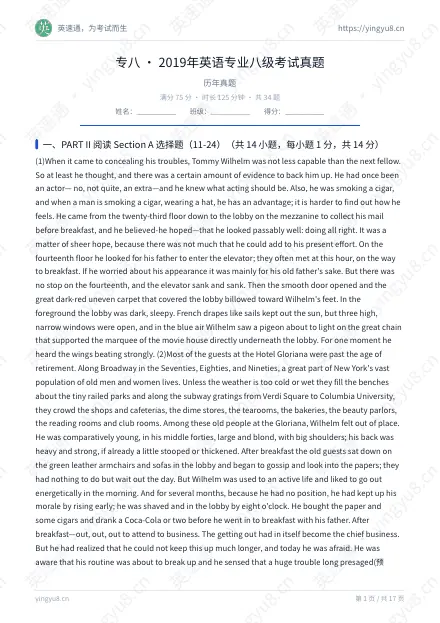
(1)When it came to concealing his troubles, Tommy Wilhelm was not less capable than the next fellow. So at least he thought, and there was a certain amount of evidence to back him up. He had once been an actor— no, not quite, an extra—and he knew what acting should be. Also, he was smoking a cigar, and when a man is smoking a cigar, wearing a hat, he has an advantage; it is harder to find out how he feels. He came from the twenty-third floor down to the lobby on the mezzanine to collect his mail before breakfast, and he believed-he hoped—that he looked passably well: doing all right. It was a matter of sheer hope, because there was not much that he could add to his present effort. On the fourteenth floor he looked for his father to enter the elevator; they often met at this hour, on the way to breakfast. If he worried about his appearance it was mainly for his old father's sake. But there was no stop on the fourteenth, and the elevator sank and sank. Then the smooth door opened and the great dark-red uneven carpet that covered the lobby billowed toward Wilhelm's feet. In the foreground the lobby was dark, sleepy. French drapes like sails kept out the sun, but three high, narrow windows were open, and in the blue air Wilhelm saw a pigeon about to light on the great chain that supported the marquee of the movie house directly underneath the lobby. For one moment he heard the wings beating strongly. (2)Most of the guests at the Hotel Gloriana were past the age of retirement. Along Broadway in the Seventies, Eighties, and Nineties, a great part of New York's vast population of old men and women lives. Unless the weather is too cold or wet they fill the benches about the tiny railed parks and along the subway gratings from Verdi Square to Columbia University, they crowd the shops and cafeterias, the dime stores, the tearooms, the bakeries, the beauty parlors, the reading rooms and club rooms. Among these old people at the Gloriana, Wilhelm felt out of place. He was comparatively young, in his middle forties, large and blond, with big shoulders; his back was heavy and strong, if already a little stooped or thickened. After breakfast the old guests sat down on the green leather armchairs and sofas in the lobby and began to gossip and look into the papers; they had nothing to do but wait out the day. But Wilhelm was used to an active life and liked to go out energetically in the morning. And for several months, because he had no position, he had kept up his morale by rising early; he was shaved and in the lobby by eight o'clock. He bought the paper and some cigars and drank a Coca-Cola or two before he went in to breakfast with his father. After breakfast—out, out, out to attend to business. The getting out had in itself become the chief business. But he had realized that he could not keep this up much longer, and today he was afraid. He was aware that his routine was about to break up and he sensed that a huge trouble long presaged(预感)but till now formless was due. Before evening, he'd know. (3)Nevertheless he followed his daily course and crossed the lobby. (4)Rubin, the man at the newsstand, had poor eyes. They may not have been actually weak but they were poor in expression, with lacy lids that furled down at the corners. He dressed well. It didn't seem necessary—he was behind the counter most of the time—but he dressed very well. He had on a rich brown suit; the cuffs embarrassed the hairs on his small hands. He wore a Countes Mara painted necktie. As Wilhelm approached, Rubin did not see him; he was looking out dreamily at the Hotel Ansonia, which was visible from his corner, several blocks away. The Ansonia, the neighborhood's great landmark, was built by Stanford White. It looks like a baroque palace from Prague or Munich enlarged a hundred times, with towers, domes, huge swells and bubbles of metal gone green from exposure, iron fretwork and festoons. Black television antennae are densely planted on its round summits. Under the changes of weather it may look like marble or like sea water, black as slate in the fog, white as tufa in sunlight. This morning it looked like the image of itself reflected in deep water, white and cumulous above, with cavernous distortions underneath. Together, the two men gazed at it. (5)Then Rubin said,“Your dad is in to breakfast already, the old gentleman.” “Oh, yes?Ahead of me today?” “That's a real knocked-out shirt you got on,"said Rubin.“Where's it from, Saks?” “No, it's a Jack Fagman—Chicago.” (6)Even when his spirits were low, Wilhelm could still wrinkle his forehead in a pleasing way. Some of the slow, silent movements of his face were very attractive. He went back a step, as if to stand away from himself and get a better look at his shirt. His glance was comic, a comment upon his untidiness. He liked to wear good clothes, but once he had put it on each article appeared to go its own way. Wilhelm, laughing, panted a little; his teeth were small; his cheeks when he laughed and puffed grew round, and he looked much younger than his years. In the old days when he was a college freshman and wore a beanie(无檐小帽)on his large blonde head his father used to say that, big as he was, he could charm a bird out of a tree. Wilhelm had great charm still. (7)“I like this dove-gray color,"he said in his sociable, good-natured way.“It isn't washable. You have to send it to the cleaner. It never smells as good as washed. But it's a nice shirt. It cost sixteen, eighteen bucks."
- A.leave a good impression
- B.give his father a surprise
- C.show his acting potential
- D.disguise his low spirit
参考答案与解析
答案:D
解析:定位首段关于 Wilhelm 隐藏烦恼的描述 → 提取其行为(抽烟、戴帽)与目的(让人难以察觉感受) → 推断其希望外表得体是为了掩饰低落情绪
考点:细节定位推理判断
译文:题干:Wilhelm 在去大堂的路上希望自己看起来不错,因为他想要______。正确项 D:掩饰他的低落情绪。
- A.lived a luxurious life
- B.liked to swap gossips
- C.idled their time away
- D.liked to get up early
参考答案与解析
答案:D
解析:定位第二段关于酒店老客人的描述 → 提取他们“fill the benches... crowd the shops...”等日常活动 → 推断这些活动表明他们虚度光阴
考点:细节定位推理判断
译文:题干:Wilhelm 与老客人的共同点在于他们都______。正确项 C:虚度光阴。
- A.He felt something ominous was coming.
- B.He was worried that his father was late.
- C.He was feeling at ease among the old.
- D.He was excited about a possible job offer.
参考答案与解析
答案:A
解析:定位第二段 Wilhelm 穿过大堂时的环境描写(dark, sleepy)与个人感受(felt out of place) → 结合首段其“隐藏烦恼”的背景 → 推断其感到不祥预感
考点:环境描写分析人物心理推断
译文:题干:Wilhelm 穿过大堂时感觉如何?正确项 A:他感觉不祥之事即将发生。
- A.The necktie.
- B.The cuffs.
- C.The suit.
- D.The shirt.
参考答案与解析
答案:B
解析:定位第四段关于 Rubin 衣着的描述 → 直接提取“the cuffs of his shirt were frayed and dirty”这一具体细节
考点:细节定位
译文:题干:Rubin 衣服的哪个部分让他看起来特别笨拙?正确项 B:袖口。
- A.His shirt made him look better.
- B.He cared much about his clothes.
- C.He looked like a comedian in his shirt.
- D.The clothes he wore never quite matched.
参考答案与解析
答案:D
解析:定位第四段对 Wilhelm 衣着的综合描述(如“the cuffs... frayed and dirty”,“the suit... was too small”) → 推断作者通过这些细节暗示其衣着不协调、不得体
考点:细节综合作者意图推断
译文:题干:从作者对 Wilhelm 衣着的描述中我们可以了解到什么?正确项 D:他穿的衣服从不怎么搭配。
(1)By the 1840s New York was the leading commercial city of the United States. It had long since outpaced Philadelphia as the largest city in the country, and even though Boston continued to be venerated as the cultural capital of the nation, its image had become somewhat languid; it had not kept up with the implications of the newly industrialized economy, of a diversified ethnic population, or of the rapidly rising middle class. New York was the place where the“new”America was coming into being, so it is hardly surprising that the modern newspaper had its birth there. (2)The penny paper had found its first success in New York. By the mid-1830s Ben Day's Sun was drawing readers from all walks of life. On the other hand, the Sun was a scanty sheet providing little more than minor diversions; few today would call it a newspaper at all. Day himself was an editor of limited vision, and he did not possess the ability or the imagination to climb the slopes to loftier heights. If real newspapers were to emerge from the public's demand for more and better coverage, it would have to come from a youthful generation of editors for whom journalism was a totally absorbing profession, an exacting vocational ideal rather than a mere offshoot ofjob printing. (3)By the 1840s two giants burst into the field, editors who would revolutionize journalism, would bring the newspaper into the modern age, and show how it could be influential in the national life. These two giants, neither of whom has been treated kindly by history, were James Gordon Bennett and Horace Greeley. Bennett founded his New York Herald in 1835, less than two years after the appearance of the Sun. Horace Greeley founded his Tribune in 1841.Bennett and Greeley were the most innovative editors in New York until after the Civil War. Their newspapers were the leading American papers of the day, although for completely different reasons. The two men despised each other, although not in the ways that newspaper editors had despised one another a few years before. Neither was a political hack bonded to a political party. Greeley fancied himself a public intellectual. He had strong political views, and he wanted to run for office himself, but party factotum he could never be; he bristled with ideals and causes of his own devising. Officially he was a Whig(and later a Republican), but he seldom gave comfort to his chosen party. Bennett, on the other hand, had long since cut his political ties, and although his paper covered local and national politics fully and he went after politicians with hammer and tongs, Bennett was a cynic, a distruster of all settled values. He did not regard himself as an intellectual, although in fact he was better educated than Greeley. He thought himself only a hard-boiled newspaperman. Greeley was interested in ideas and in what was happening to the country. Bennett was only interested in his newspaper. He wanted to find out what the news was, what people wanted to read. And when he found out he gave it to them. (4)As different as Bennett and Greeley were from each other they were also curiously alike. Both stood outside the circle of polite society, even when they became prosperous, and in Bennett's case, wealthy. Both were incurable eccentrics. Neither was a gentleman. Neither conjured up the picture of a successful editor. Greeley was unkempt, always looking like an unmade bed. Even when he was nationally famous in the 1850s he resembled a clerk in a third-rate brokerage house, with slips of paper—marked-up proofs perhaps—hanging out of his pockets or stuck in his hat. He became fat, was always nearsighted, always peering over spectacles. He spoke in a high-pitched whine(哀号) .Not a few people suggested that he looked exactly like the illustrations of Charles Dickens's Mr. Pickwick. Greeley provided a humorous description of himself, written under the pretense that it had been the work of his long-time adversary James Fenimore Cooper. The editor was, according to the description, a half-bald, long-legged, slouching individual“so rocking in gait( 步 态 )that he walks down both sides of the street at once." (5)The appearance of Bennett was somewhat different but hardly more reassuring. A shrewd, wiry( 瘦 而 结实的)Scotsman, who seemed to repel intimacy, Bennett looked around at the world with a squinty glare of suspicion. His eyes did not focus right. They seemed to fix themselves on nothing and everything at the same time. He was as solitary as an oyster, the classic loner. He seldom made close friendships and few people trusted him, although nobody who had dealings with him, however brief, doubted his abilities. He, too, could have come out of a book of Dickensian eccentrics, although perhaps Ebenezer Scrooge or Thomas Gradgrind comes to mind rather than the kindly old Mr. Pickwick. Greeley was laughed at but admired; Bennett was seldom laughed at but never admired; on the other hand, he had a hard professional competence and an encyclopedic knowledge of his adopted country, an in-depth learning uncorrupted by vague idealisms. All of this perfectly suited him for the journalism of this confusing age. (6)Both Greeley and Bennett had served long, humiliating and disappointing apprenticeships in the newspaper business. They took a long time getting to the top, the only reward for the long years of waiting being that when they had their own newspapers, both knew what they wanted and firmly set about getting it When Greeley founded the Tribune in 1841 he had the strong support of the Whig party and had already had a short period of modest success as an editor. Bennett, older by sixteen years, found solid commercial success first, but he had no one behind him except himself when he started up the Herald in 1835 in a dingy cellar room at 20 Wall Street. Fortunately this turned out to be quite enough.
- A.Sun had once been a popular newspaper.
- B.Sun failed to be a high-quality newspaper.
- C.Ben Day lacked innovation and imagination.
- D.Ben Day had striven for better coverage.
参考答案与解析
答案:D
解析:定位第二段关于Ben Day和Sun的描述 → 对比选项与原文信息 → 识别与原文相悖的选项
考点:细节定位观点辨析否定题干
译文:题干:以下哪项不是作者对Ben Day及其《太阳报》的看法(第二段)?正确项:Ben Day曾努力追求更好的报道。
- A.Greeley and Bennett were both strong supporters of their party.
- B.Greeley, as a Whig member, believed in his party's ideals.
- C.Bennett, as an independent, loathed established values.
- D.Greeley and Bennett possessed different political values.
参考答案与解析
答案:D
解析:定位第三段关于Greeley和Bennett政治立场的描述 → 对比选项与原文信息 → 识别与原文相悖或无依据的选项
考点:细节定位观点辨析对比推理
译文:题干:以下哪项关于Greeley或Bennett政治立场的陈述是正确的(第三段)?正确项:Greeley和Bennett持有不同的政治价值观。
- A.Exaggeration.
- B.Paradox.
- C.Analogy.
- D.Personification.
参考答案与解析
答案:A
解析:定位第四段描述Greeley走路方式的句子 → 识别修辞手法 → 对比选项
考点:细节定位修辞识别词义推断
译文:题干:以下哪种修辞手法被用来描述Greeley的走路方式(第四段)?正确项:夸张。
- A.had stronger capabilities than Greeley
- B.possessed a great aptitude for journalism
- C.was in pursuit of idealism in journalism
- D.was knowledgeable about his home country
参考答案与解析
答案:B
解析:定位第五段关于Bennett的描述 → 对比选项与原文信息 → 识别与原文相符或相悖的选项
考点:细节定位人物特征概括对比推理
译文:题干:在第五段中,Bennett被描绘为一个怎样的人?正确项:对新闻业有极高的天赋。
- A.He had achieved business success first.
- B.He started his career earlier than Bennett.
- C.He got initial support from a political party.
- D.He had a more humiliating apprenticeship.
参考答案与解析
答案:C
解析:定位第六段关于Greeley与Bennett差异的描述 → 对比选项与原文信息 → 识别与原文相符或相悖的选项
考点:细节定位差异对比推理判断
译文:题干:根据第六段,Greeley与Bennett有何不同?正确项:他得到了一个政党的初步支持。
(1)Why make a film about Ned Kelly?More ingenious crimes than those committed by the reckless Australian bandit are reported every day. What is there in Ned Kelly to justify dragging the mesmeric Mick Jagger so far into the Australian bush and away from his natural haunts?The answer is that the film makers know we always fall for a bandit, and Jagger is set to do for bold Ned Kelly what Brando once did for the arrogant Emiliano Zapata. (2)A bandit inhabits a special realm of legend where his deeds are embroidered by others; where his death rather than his life is considered beyond belief; where the men who bring him to“justice”are afflicted with doubts about their role. (3)The bandits had a role to play as definite as that of the authorities who condemned them. These were men in conflict with authority, and, in the absence of strong law or the idea of loyal opposition, they took to the hills. Even there, however, many of them obeyed certain unwritten rules. (4)These robbers, who claimed to be something more than mere thieves, had in common, firstly, a sense of loyalty and identity with the peasants they came from. They didn't steal the peasant's harvest; they did steal the lord's. (5)And certain characteristics seem to apply to“social bandits”whether they were in Sicily or Peru. They were generally young men under the age of marriage, predictably the best age for dissidence. Some were simply the surplus male population who had to look for another source of income; others were runaway serfs or ex- soldiers; a minority, though the most interesting, were outstanding men who were unwilling to accept the meek and passive role of peasant. (6)They usually operated in bands between ten and twenty strong and relied for survival on difficult terrain and bad transport. And bandits prospered best where authority was merely local—over the next hill and they were free. Unlike the general run of peasantry they had a taste for flamboyant dress and gesture; but they usually shared the peasants'religious beliefs and superstitions. (7)The first sign of a man caught up in the Robin Hood syndrome was when he started out, forced into outlawry as a victim of injustice; and when he then set out to“right wrongs”, first his own and then other people's. The classic bandit then"takes from the rich and gives to the poor"in conformity with his own sense of social injustice; he never kills except in self-defense or justifiable revenge; he stays within his community and even returns to it if he can to take up an honorable place; his people admire and help to protect him; he dies through the treason of one of them; he behaves as if invisible and invulnerable; he is a“loyalist”, never the enemy of the king but only of the local oppressors. (8)None of the bandits lived up fully to this image of the"noble robber"and for many the claim of larger motives was often a delusion. (9)Yet amazingly, many of these violent men did behave at least half the time in accordance with this idealist pattern. Pancho Villa in Mexico and Salvatore Giuliano in Italy began their careers harshly victimized Many of their charitable acts later became legends. (10)Far from being defeated in death, bandits'reputation for invincibility was often strengthened by the manner of their dying. The“dirty little coward”who shot Jesse James in the back is in every ballad about him, and the implication is that nothing else could have brought Jesse down. Even when the police claimed the credit, as they tried to do at first with Giuliano's death, the local people refused to believe it. And not just the bandit's vitality prompts the people to refuse to believe that their hero has died; his death would be in some way the death of hope. (11)For the traditional"noble robber"represents an extremely primitive form of social protest, perhaps the most primitive there is. He is an individual who refuses to bend his back, that is all. Most protesters will eventually be bought over and persuaded to come to terms with the official power. That is why the few who do not, or who are believed to have remained uncontaminated, have so great and passionate a burden of admiration and longing laid upon them. They cannot abolish oppression. But they do prove that justice is possible, that poor men need not be humble, helpless and meek. (12)The bandit in the real world is rooted in peasant society and when its simple agricultural system is left behind so is he. But the tales and legends, the books and films continue to appear for an audience that is neither peasant nor bandit. In some ways the characters and deeds of the great bandits could so readily be the stuff of grand opera—Don Jose in“Carmen”is based on the Andalusian bandit El Empranillo. But they are perhaps more at home in folk songs, in popular tales and the ritual dramas of films. When we sit in the darkness of the cinema to watch the bold deeds of Ned Kelly we are caught up in admiration for their strong individuality, their simple gesture of protest, their passion for justice and their confidence that they cannot be beaten. This sustains us nearly as much as it did the almost hopeless people from whom they sprang.
- A.Bold(Para.1).
- B.Claimed(Para.4).
- C.Legend(Para.2).
- D.Loyalty(Para.4).
参考答案与解析
答案:B
解析:定位题干关键词 'NOT intended to suggest approval' → 逐项分析各词在原文语境中的情感色彩与功能 → 判断哪个词不带有赞许意味
考点:语境选词词义猜测观点态度
译文:题干:下列哪个词并非意在表达对土匪的赞许?正确答案:B. Claimed (声称)。
- A.They liked theatrical clothes and behavior.
- B.They wanted to help the poor country folk.
- C.They were unwilling to accept injustice.
- D.They had very few careers open to them.
参考答案与解析
答案:A
解析:定位题干关键词 'bandits' → 逐段扫描关于土匪特征的描述 → 对比选项与原文细节,识别出与原文描述不符的选项
考点:细节定位与比对同义替换识别
译文:题干:以下原因中,哪一项最不可能是成为土匪的原因?正确项A:他们喜欢戏剧化的服装和行为。
- A.had received excessive ill-treatment
- B.were severely punished for their crimes
- C.took to violence through a sense of injustice
- D.were misunderstood by their parents and friends
参考答案与解析
答案:C
解析:定位至第7段首句 → 分析‘forced into outlawry as a victim of injustice’的因果逻辑 → 推断‘began their careers harshly victimized’意为因不公而被迫诉诸暴力
考点:词义猜测因果逻辑推断
译文:题干:‘……began their careers harshly victimized’(第9段)意为他们……。正确项C:因不公感而诉诸暴力。
- A.are sure they are invincible
- B.possess a theatrical quality
- C.retain the virtues of a peasant society
- D.protest against injustice and inequality
参考答案与解析
答案:D
解析:定位题干关键词'suitable as film heroes' → 在语篇第(1)段找到'we always fall for a bandit'及后续解释 → 结合第(7)段'forced into outlawry as a victim of injustice'进行同义替换与推理 → 得出答案
考点:细节定位同义替换推理判断
译文:题干:使土匪适合成为电影英雄的原因是他们______。正确项D:抗议不公与不平等。
第 2 部分 · PART II 阅读 Section B 简答题(25-32)8 题 · 16 分
参考答案与解析
答案:His acting experience and smoking a cigar.
解析:定位Para.1中‘evidence’所在句 → 分析其指代的上文具体事例 → 得出答案
考点:指代与衔接细节定位与捕捉
译文:题干:在“…., and there was a certain amount of evidence to back him up (Para.1)”中,“evidence”指代什么? 正确答案:他的表演经验和抽雪茄的行为。
参考答案与解析
答案:He was always a good actor.
解析:定位Para.6中描述Wilhelm特质的句子 → 提取‘never changed’对应的核心描述 → 得出答案
考点:细节定位与捕捉
译文:题干:根据Para.6,Wilhelm多年来从未改变的特质是什么? 正确答案:他一直是个好演员。
参考答案与解析
答案:Journalism was a demanding career, not just a printing side job.
解析:定位Para.2末句斜体部分 → 结合上下文(新闻业的艰辛与印刷工作的对比)进行语义推断 → 得出答案
考点:推理判断词义猜测
译文:题干:用自己的话总结Para.2末句斜体部分的含义。 正确答案:新闻业是一个要求很高的职业,而不仅仅是一份印刷的副业。
参考答案与解析
答案:He rarely supported or agreed with his own party.
解析:定位Para.3中‘…., but he seldom gave comfort to his chosen party’ → 结合‘but’转折及‘comfort’的语境义进行推理 → 得出答案
考点:推理判断词义猜测
译文:题干:根据上下文(Para.3),“…., but he seldom gave comfort to his chosen party”是什么意思? 正确答案:他很少支持或同意他自己的政党。
参考答案与解析
答案:Both were eccentric outsiders, not gentlemen.
解析:定位Para.4和5中对Bennett和Greeley的描述 → 对比两人的共同点(古怪、非绅士) → 得出答案
考点:推理判断细节定位与捕捉
译文:题干:根据Para.4和5,Bennett和Greeley的相似之处是什么? 正确答案:两人都是古怪的局外人,不是绅士。
参考答案与解析
答案:Charitable acts and victimized beginnings.
解析:定位段落9 → 提取并列特征描述 → 匹配正确选项
考点:细节定位与捕捉
译文:题干:写下理想主义模式的两个特征(第9段)。正确答案:慈善行为与受害的开端。
参考答案与解析
答案:Hope for social justice and resistance.
解析:定位段落10 → 分析'hope'的语境含义 → 推断其具体指向
考点:词义猜测
译文:题干:根据上下文,'hope'是什么意思(第10段)?正确答案:对社会正义和抵抗的希望。
参考答案与解析
答案:He refuses to submit to oppression.
解析:定位段落11 → 解析比喻性表达'refuses to bend his back' → 推断其象征意义
考点:推理判断
译文:题干:'He is an individual who refuses to bend his back'是什么意思(第11段)?正确答案:他拒绝屈服于压迫。
第 3 部分 · 改错 · 每个标号行各有一处错误(错词填正确词 · 缺词填所缺词 · 多词填多余词)1 题 · 10 分
参考答案与解析
答案:1-that 2-its 3-is 4-depth 5-requires 6-of 7-about 8-from 9-only 10-its
解析:1 空 识别空格位于动词后,需引导宾语从句 → 从句结构完整,缺引导词 → 选择 that
2 空 识别空格位于名词前,需限定词 → 主语为单数名词 → 选择 its
3 空 识别空格为谓语动词 → 主语为单数名词 → 时态为一般现在时 → 选择 is
4 空 识别空格位于冠词 a 后,需名词 → 根据形容词 deep 的词根推导名词形式 → 选择 depth
5 空 识别空格为谓语动词 → 主语为单数名词 → 时态为一般现在时 → 选择 requires
6 空 识别固定搭配 be of + 抽象名词 → 确定介词 of
7 空 识别固定搭配 be about to do → 确定介词 about
8 空 识别固定搭配 differ from → 确定介词 from
9 空 分析句子逻辑关系 → 识别限定/强调含义 → 确定副词 only
10 空 分析句子主语 → 确定指代对象 → 选择物主代词 its
考点:宾语从句引导词物主代词与名词单复数一致主谓一致一般现在时词性转换词根词缀固定搭配 be of + importance/value/significance固定搭配 be about to do固定搭配 differ from语境选词副词限定主谓一致与指代一致物主代词
译文:(题干与正确项的中文译文因无具体语篇而无法提供)
第 4 部分 · PART IV 汉译英1 题 · 15 分
参考答案与解析
参考译文
Baiyangdian was once known as the 'Jiangnan of the North,' yet its village dwellings possess a distinctive architectural style, entirely different from those in the south. In the rain-heavy south, roofs are sloped; here, however, the roofs serve as spaces for drying grain. Historically, whenever floods rose, villagers had to move their belongings up to the rooftops. The houses are built close together, with some roofs nearly touching.
第 5 部分 · PART V 写作1 题 · 20 分
参考答案与解析
参考范文
The two excerpts present contrasting perspectives on consumption in modern society. Excerpt 1, drawing from UNDP data and BBC documentaries, highlights the exponential growth of global consumption and its psychological and social consequences. It argues that consumption has become a defining element of identity, leading to increased stress, debt, and a perpetual cycle of social comparison that fails to guarantee lasting satisfaction. In contrast, Excerpt 2, through the lens of sociologist George Simmel, posits consumption as a vital process for personal cultivation and social integration. It suggests that through interacting with consumption objects, individuals develop self-reflection, refine their identities, and become well-socialized members of society. These excerpts compel us to consider the dual role of consumption in human society. On one hand, consumption undeniably drives economic growth, innovation, and can be a vehicle for personal expression and cultural participation. As Simmel suggests, the act of choosing and using goods can be a reflective process that helps shape our subjectivity and connect us to broader social narratives. In this idealized view, consumption is a path to self-actualization and social cohesion. However, the reality depicted in Excerpt 1 reveals a more troubling dimension. When consumption becomes the primary metric of success and identity, it can lead to a hedonic treadmill where material gains do not translate into well-being. The "keeping up with the Joneses" syndrome fosters anxiety and erodes social trust, as individuals are trapped in a competitive cycle of acquisition. Furthermore, the environmental and resource implications of unchecked consumerism pose a severe threat to sustainable development, a consequence not explicitly mentioned but logically extending from the reported unprecedented expansion of consumption. Therefore, the role of consumption is profoundly ambivalent. Its results—desirable or undesirable—hinge on the cultural and economic frameworks within which it operates. Consumption as a conscious, reflective practice aligned with personal values and social responsibility can indeed be a force for cultivation and connection. Yet, when it is driven by external pressures, marketing, and social comparison, it risks becoming a source of discontent and societal strain. The challenge for modern societies is to harness the potential of consumption for human development while mitigating its excesses, perhaps by fostering a culture that values intrinsic fulfillment over perpetual material accumulation.
常见问题
2019年英语专业八级考试真题的答案和解析在哪看?
答案与解析就在本页:每道题下方「参考答案与解析」展开即看,含参考答案、解题思路与考点,免登录直接阅读。
2019年英语专业八级考试真题 PDF 怎么免费下载?
本页「试卷封面」卡片「收录格式」行内的 PDF 徽标即下载链接,点击直接下载本卷 PDF 文件,无需登录。
这套卷怎么在线做题、怎么计分?
点页面上方「开始考试(网页)」进入在线做题页:登录后装载本卷作答,交卷自动判分并留存成绩;免费账号每日可装载 30 套,会员每日 100 套。