2022年英语专业八级考试真题及答案解析
2022年英语专业八级考试真题 · 完整收录
- 年份考次
- 2022 年
- 命题归属
- 全国统一命题
- 省份
- 全国
- 题量
- 25 题
- 满分
- 75 分
- 限时
- 125 分钟
- 题型结构
- PART II 阅读 Section A 选择题 14 题 14 分 · PART II 阅读 Section B 简答题 8 题 16 分 · 改错 · 每个标号行各有一处错误 10 题 10 分 · PART IV 汉译英 1 题 15 分 · PART V 写作 1 题 20 分
- 收录格式
开始考试(微信)

微信扫一扫 · 小程序内开始考试
第 1 部分 · PART II 阅读 Section A 选择题(11-24)14 题 · 14 分
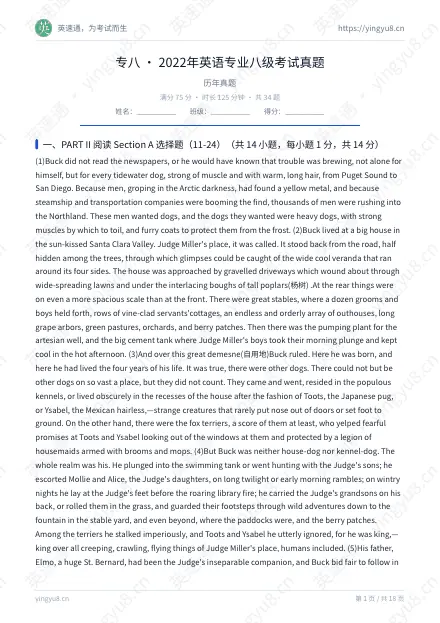
(1)Buck did not read the newspapers, or he would have known that trouble was brewing, not alone for himself, but for every tidewater dog, strong of muscle and with warm, long hair, from Puget Sound to San Diego. Because men, groping in the Arctic darkness, had found a yellow metal, and because steamship and transportation companies were booming the find, thousands of men were rushing into the Northland. These men wanted dogs, and the dogs they wanted were heavy dogs, with strong muscles by which to toil, and furry coats to protect them from the frost. (2)Buck lived at a big house in the sun-kissed Santa Clara Valley. Judge Miller's place, it was called. It stood back from the road, half hidden among the trees, through which glimpses could be caught of the wide cool veranda that ran around its four sides. The house was approached by gravelled driveways which wound about through wide-spreading lawns and under the interlacing boughs of tall poplars(杨树) .At the rear things were on even a more spacious scale than at the front. There were great stables, where a dozen grooms and boys held forth, rows of vine-clad servants'cottages, an endless and orderly array of outhouses, long grape arbors, green pastures, orchards, and berry patches. Then there was the pumping plant for the artesian well, and the big cement tank where Judge Miller's boys took their morning plunge and kept cool in the hot afternoon. (3)And over this great demesne(自用地)Buck ruled. Here he was born, and here he had lived the four years of his life. It was true, there were other dogs. There could not but be other dogs on so vast a place, but they did not count. They came and went, resided in the populous kennels, or lived obscurely in the recesses of the house after the fashion of Toots, the Japanese pug, or Ysabel, the Mexican hairless,—strange creatures that rarely put nose out of doors or set foot to ground. On the other hand, there were the fox terriers, a score of them at least, who yelped fearful promises at Toots and Ysabel looking out of the windows at them and protected by a legion of housemaids armed with brooms and mops. (4)But Buck was neither house-dog nor kennel-dog. The whole realm was his. He plunged into the swimming tank or went hunting with the Judge's sons; he escorted Mollie and Alice, the Judge's daughters, on long twilight or early morning rambles; on wintry nights he lay at the Judge's feet before the roaring library fire; he carried the Judge's grandsons on his back, or rolled them in the grass, and guarded their footsteps through wild adventures down to the fountain in the stable yard, and even beyond, where the paddocks were, and the berry patches. Among the terriers he stalked imperiously, and Toots and Ysabel he utterly ignored, for he was king,—king over all creeping, crawling, flying things of Judge Miller's place, humans included. (5)His father, Elmo, a huge St. Bernard, had been the Judge's inseparable companion, and Buck bid fair to follow in the way of his father. He was not so large,—he weighed only one hundred and forty pounds,—for his mother, Shep, had been a Scotch shepherd dog. Nevertheless, one hundred and forty pounds, to which was added the dignity that comes of good living and universal respect, enabled him to carry himself in right royal fashion. During the four years since his puppyhood he had lived the life of a sated(饱享的)aristocrat; he had a fine pride in himself, was even a trifle egotistical, as country gentlemen sometimes become because of their insular situation. But he had saved himself by not becoming a mere pampered house-dog. Hunting and kindred outdoor delights had kept down the fat and hardened his muscles; and to him, as to the cold-tubbing races, the love of water had been a tonic and a health preserver. (6)And this was the manner of Buck in the fall of 1897, when the Klondike strike dragged men from all the world into the frozen North. But Buck did not read the newspapers, and he did not know that Manuel, one of the gardener's helpers, was an undesirable acquaintance. Manuel had one besetting sin. He loved to play lottery. Also, in his gambling, he had one besetting weakness—faith in a system; and this made his damnation certain. For to play a system requires money, while the wages of a gardener's helper do not lap over the needs of a wife and numerous progeny.
- A.the social background of the story
- B.the layout of Judge Miller's place
- C.the good living conditions of Buck
- D.the contrast between Buck and others
参考答案与解析
答案:B
解析:定位第二段 → 识别段落核心内容为庄园布局描述 → 匹配选项B
考点:细节定位与捕捉
译文:题干:第二段的描述旨在介绍______。正确项:米勒法官庄园的布局。
- A.Buck lived in the house longer than other dogs.
- B.Kennel-dogs were not allowed to walk around.
- C.Buck was the favorite dog of the house owner.
- D.House-dogs were well protected by housemaids.
参考答案与解析
答案:C
解析:定位第三段关于Buck与其他狗的对比 → 推断其优越性源于地位与归属 → 匹配选项C
考点:推理判断
译文:题干:以下哪项最能解释Buck优于其他狗的原因?正确项:Buck是房子主人最喜欢的狗。
- A.humorous
- B.sarcastic
- C.critical
- D.friendly
参考答案与解析
答案:D
解析:通读全文,捕捉描述Buck的词汇(如ruled, great demesne)与语境 → 推断作者态度为正面、亲切 → 匹配选项D
考点:观点态度
译文:题干:作者在描述Buck时的语气是______。正确项:友好的。
- A.how the lottery system worked in 1897
- B.what was written in the newspapers
- C.how Manuel managed to win lottery
- D.the troubles Manuel brought to Buck
参考答案与解析
答案:D
解析:分析篇章结构:第一段铺垫危机,第二、三段描绘Buck的安逸生活 → 推断下文将叙述危机如何降临到Buck身上 → 匹配选项D
考点:推理判断篇章结构与写作目的
译文:题干:文章最后一段之后最可能叙述______。正确项:曼努埃尔给Buck带来的麻烦。
(1)Early this winter, the hundreds of climbers making plans for spring-summit attempts on Mount Qomolangma suddenly faced a new set of rules. In December, the Nepalese government decreed that it would no longer issue permits to blind, solo, or double-amputee mountaineers for any of its high peaks. Furthermore, all expeditions would have to employ at least one Sherpa(夏尔巴人向导)and would be forbidden from using helicopters to reach high camps. (2)The regulations fit a pattern established by Nepal's Ministry of Tourism, which in the past few years has issued a series of proclamations—climbers must announce plans to set records, trekkers must carry location beacons—that suggest improved management of its high-altitude peaks. Each new declaration generates a rush of international news reports about authorities making strides toward addressing safety at the top of the world. The truth is a lot more complicated. (3)Mountaineering is big business in Nepal. Industry experts estimate that it generates some $26.5 million in tourism income each year, with around $11 million of that coming from Qomolangma climbers alone. The enduring obsession of the Western media with tragic deaths on these far-off snowy peaks has resulted in a lot of free marketing. Nepal's Ministry of Tourism, perhaps concerned that all the morbid tales might drive climbers to Qomolangma's less used Chinese side, has gained some control of that narrative by broadcasting more positive developments through the Nepalese press. But the rules announced to date would do nothing to mitigate the dangers of climbing Qomolangma even if Nepal had the resources and conviction to enforce them, which it doesn't. (4)Making a huge, hugely popular mountain safer is possible. On Alaska's Denali, fulltime climbing rangers conduct safety checks of many teams and are mobilized for rescue operations. On Argentina's Aconcagua, rangers patrol all high camps, and until recently, permit fees included the cost of helicopter rescues. Adopting similar policies in Nepal would be a good start. A longer list of true reforms would include ordering all climbers to have previously summited a 7,000-meter peak, requiring non-guides working above Base Camp to take a course at the Khumbu Climbing Center(hundreds have done so since it was founded in 2003), and capping the total number of climbers on the mountain at 500 per season, including support staff. That last policy would both reduce dangerous crowding and help keep the mountain clean. (5)Unfortunately, these kinds of rules are less likely than ever to be instituted on Qomolangma, owing to the rise of budget guiding companies. Beginning in the early 1990s, Western outfitters established commercial mountaineering on the Nepal side of the peak by attracting clients willing to pay as much as $65,000 to be guided to the summit. That business model dominated for more than two decades, bringing an estimated 9,000 paying climbers to Base Camp. Consequently, Qomolangma earned a reputation as a magnet for the rich, ambitious, and inexperienced. (6)As in many markets, savvy entrepreneurs saw opportunities for disruption. Lower-cost guiding companies, some founded by Westerners and others by Nepalese, slowly gained attraction by offering Qomolangma climbs for as little as a third of the going rate among high-end outfitters. Then came 2014, when 16 Sherpas died after a serac (冰塔)collapsed onto the Khumbu Icefall, part of the main route from Base Camp to Camp I.In the wake of that tragedy, a small group of Sherpas demanded that the Nepalese government establish regulations that would improve working conditions, increase pay, boost life-insurance coverage, and provide a funeral stipend. Ultimately, Sherpas received a bit more insurance—the minimum payout was doubled from $5,500 to $11,000—but not much else. (7)Partly in response to media attention of these events, Nepali-owned guiding companies have continued to gain influence and market share on Qomolangma. The shift away from foreign control of the mountain is welcomed by many in the climbing community. Another positive development: lower-cost operators are increasing diversity on Qomolangma, attracting climbers from China's and India's burgeoning middle classes with aggressive pricing. Based on numbers from the Himalayan Database, in 2010, four Indian and eight Chinese climbers attempted the mountain, just 6 percent of the total. Last year, Chinese and Indian clients accounted for 60 of the 199 Nepal-side summits. (8)Unfortunately, in the absence of substantive government oversight, some of the budget companies are making Qomolangma more dangerous by flooding the already overcrowded route with novice climbers led by inexperienced guides. Any operators charging less for guided climbs are prone to bolster profits through scale, booking dozens of clients on expeditions.(The most respected outfiters set a maximum of ten.)Putting aside 2014's tragedy and 2015's earthquake-induced avalanche, which killed at least 17 people at Base Camp,12 of the 17 climber deaths on the South Col route between 2011 and 2017 appear to have been clients of budget outfitters. (9)During last year's peak season, Kathmandu-based Seven Summit Treks, known for bringing large groups of climbers to Qomolangma, allegedly promoted a young support staffer named Sange to guide Qomolangma and assigned him to an older Pakistani client. The pair reached the summit late in the day and got into trouble on their descent. They had to be rescued by experienced Sherpas from another Nepalese outfiter. Sange later had all his fingers amputated due to severe frostbite. (10)Veteran guides are reacting to all this in different ways. Adrian Ballinger, founder of the California outiter Alpenglow, has abandoned the Nepal side of Qomolangma and is instead leading teams from China. As he explained it, the higher risk from natural dangers(avalanches, seracs, crevasses), the low standards of other outiters, and Nepal's mismanagement add up to an unacceptable environment. Several other prominent guides have come to the same conclusion, including Austrian Lukas Furtenbach. Others are staying put. International Mountain Guides co-owner Eric Simonson, whose first expedition on Qomolangma was in 1982, insists that upgrades in route-making through the Khumbu Icefall, and the establishment of dual ropes in areas prone to bottlenecks, have made the Nepal side safer, even as the crowds have grown. (11)Qomolangma remains the ultimate conquest for many climbers. And while most embrace the risk of high-altitude mountaineering, few understand that the biggest dangers are all too often the result of economics, not the forces of nature. Ultimately, the top priority of many tourism officials and outfitters isn't safety. It's the bottom line.
- A.Employment of Sherpas on all expeditions.
- B.Use of helicopters to get to high camps.
- C.Announcement of climbers'plans.
- D.Permits issued to able-bodied trekkers.
参考答案与解析
答案:B
解析:定位第一、二段关于新规的内容 → 逐项比对选项与原文描述 → 识别B项为被禁止的行为而非安全措施 → 匹配选项B
考点:细节定位与捕捉
译文:题干:根据第1和第2段,以下哪项不是安全措施?正确项:使用直升机到达高营地。
- A.To list the necessary conditions.
- B.To show the policies in other regions.
- C.To make recommendations with examples.
- D.To emphasize the importance of training.
参考答案与解析
答案:C
解析:定位段落首句(主题句)→ 识别举例论证结构(Denali, Aconcagua)→ 归纳段落目的为提出建议并举例
考点:段落主旨识别举例论证功能
译文:题干:第4段的主要目的是什么?正确项C:通过例子提出建议。
- A.Budget guiding companies may fail to ensure climbers'safety.
- B.Western outfitters are more reliable than Nepalese companies.
- C.Working conditions for Sherpas have been much improved.
- D.Cost of climbing business has been greatly reduced recently.
参考答案与解析
答案:A
解析:定位第5、6段关于预算向导公司和夏尔巴人工作条件的细节 → 推断预算公司可能无法保障安全 → 得出答案
考点:细节定位推理判断
译文:题干:从第5、6段可以推断出什么?正确项A:预算向导公司可能无法确保登山者的安全。
- A.the importance of guides
- B.the complexity of climbing
- C.the required health conditions
- D.the problems of budget outfitters
参考答案与解析
答案:D
解析:定位第9段Sange的案例 → 分析案例内容(预算公司、安全问题)→ 推断其例证目的 → 得出答案
考点:例证目的推断细节理解
译文:题干:第9段引用Sange的案例是为了说明什么?正确项D:预算装备公司的问题。
- A.list factors
- B.show contrast
- C.introduce a point
- D.provide an example
参考答案与解析
答案:B
解析:定位第10段‘Others are staying put’ → 分析其与前文(Some are leaving)的对比关系 → 判断其篇章功能 → 得出答案
考点:篇章结构分析逻辑关系识别
译文:题干:第10段中‘Others are staying put’的功能是什么?正确项B:显示对比。
(1)Vast stretches of central Asia feel eerily uninhabited. Fly at 30,000 feet over the southern part of the former Soviet Union and there are long moments when no town or road or field is visible from your window. The landscape of stark desert, trackless steppe( 大 草 原 ) , and rugged mountains seems to swallow up anything human. It is little surprise, then, that this region remains largely unknown to most archaeologists. (2)Wandering bands and tribes roamed this immense area for 5,000 years, herding goat, sheep, cattle, and horses across immense steppes, through narrow valleys, and over high snowy passes. They left occasional tombs that survived the ages, and on rare occasions settled down and built towns or even cities. But for the most part, these peoples left behind few physical traces of their origins, beliefs, or ways of life. What we know of these nomadic pastoralists comes mainly from their periodic forays into India, the Middle East, and China, where they often wreaked havoc and earned a fearsome reputation as enemies of urban life. (3)In the past century, scholars criticized these people as destructive, dismissed them as marginal, or, at best, cast them as a harsh tonic for restoring vigor to decaying and soft agricultural societies from ancient Mesopotamia to Imperial Rome to Han China. In the 1950's, a British archaeologist Mortimer Wheeler blamed the aggressive, chariot-driving Aryans who swept in from the steppes for the demise of the peaceful Indus River civilization after 1800 B.C., though later archaeologists dismissed that claim. (4)But Michael Frachetti, a young archaeologist at Washington University in St. Louis, takes the radical view that Central Asians were early midwives in the birth of civilization rather than a destructive force. Frachetti argues that ancient pastoralists living in the third millennium B.C., at the time of the first great cities of Mesopotamia, Egypt, and the Indus, created a network stretching across thousands of miles that passed along goods, technologies, and ideas central to urban life. He believes they helped create civilization rather than hindering it. (5)Most archaeological work in Central Asia during the past century has focused on the open and rolling plains that stretch from the Black Sea to Manchuria. These steppes only came to life after 2000 B.C., when horse domestication and riding suddenly turned a forbidding landscape for pedestrians into a natural highway of grass. (6)By contrast, the areas to the south of the steppes have long been dismissed as backwaters of history. In the past, these southern mountains and deserts were considered too remote, rugged, and inhospitable to have played a role in early migrations or the emergence of urban life. The Karakum Desert, where it might rain once in a decade, covers nearly two-thirds of today's Turkmenistan, while the perpetually snow-covered Tian Shan Mountains of western China and eastern Kyrgyzstan soar 24,000 feet into the thin air. It is there that Frachetti and a new generation of archaeologists from the United States and Central Asian nations are discovering evidence of a network of pastoralists who thrived centuries before hooves resounded on the steppes to the north. These forgotten peoples may have carried such markers of civilization as ceramics and grains across thousands of miles, two millennia before the Silk Road linked the Roman Empire with Han China. Frachetti argues that the new data emerging from the region force archaeologists to rethink their ideas about trade across Eurasia during the Bronze Age, when the first civilizations were taking form to the east, south, and west. (7)Frachetti, who has studied modern-day pastoralists in such unforgiving landscapes as the Sahara and Scandinavia, was drawn to the southern region of Central Asia for its environmental diversity of desert, grassland, and meadows. Instead of a wasteland, he saw an ideal landscape for enterprising herders who wanted to pasture their animals in all seasons. Together with his colleagues, Frachetti began digging a decade ago in the Dzhungar Mountains of Kazakhstan. Covering nearly 500 square miles, this region lies between the Tian Shan and Altai mountain ranges, and boasts sharp peaks topping 12,000 feet, as well as harsh desert. At a site near a village called Begash, on a flat terrace enclosed by steep canyon walls alongside a small stream, the team uncovered the foundations of simple stone structures along with an array of potsherds(陶瓷碎片)and bronze and stone artifacts in stone-lined oval and rectangular tombs. The earliest layers at Begash date to at least as early as 2500 B.C., based on alpha magnetic spectrometry dating of organic remains, says Frachetti. One woman was laid to rest with a bell-shaped hooked bronze earring around 1700 B.C., according to electron spin resonance dating. Similar earrings are only found several centuries later some 600 miles to the north on the Siberian steppes, hinting at styles that moved north over time. (8)More surprisingly, the excavators found wheat, which was first domesticated in the Fertile Crescent of the Middle East, and broomcorn millet that was first widely grown in northern China. The grains were used ritually in a burial, and radiocarbon dating of the remains dates them to about 2200 B.C., making them the oldest known domesticated grains in Central Asia. The people of Begash may not have grown either grain—there are no grinding stones, a sign of grain preparation—but instead received it via trade networks stretching from the Near East to China. (9)Dorian Fuller, a leading expert in ancient grains based at University College London, calls the finds "important and well dated."He adds that Chinese crops such as millet began to appear in southwest Asia around 1900 B.C., a few centuries after they reached Begash, which could mean the passage through the mountain regions was a means of gradual transmission from east to west. Frachetti speculates that the grains may have been acquired from other tribes and used for ritual purposes, and then perhaps were passed on in turn to other pastoral peoples. (10)What makes the Begash discoveries so important is that previously this region was assumed to have been a land of scattered foragers ( 狩 猎 者 ) until steppe peoples trickled down into the area's valleys and mountain ranges after 2000 B.C.But it is becoming evident that the people of Begash were not simple foragers, but sophisticated pastoralists who tended their flocks, much as people in the area still do today. The inhabitants did not begin to use horses until well into the second millennium B.C., and the varieties of sheep and goat found here today appear to be related to the varieties first domesticated thousands of years before in western Iran, near ancient Mesopotamia. This indicates that Begash was“at the crossroads of extremely wide networks among Eurasian communities by the third millennium B.C.,"asserts Frachetti. That doesn't mean that traders traversed thousands of miles in this early period. Instead, the archaeologist envisions pastoralists taking their flocks to higher pastures in the summer, where they encountered neighbors from other valleys doing the same. Thus, ideas and technologies might have passed gradually through the mountain corridors of southern Central Asia. This corridor, Frachetti believes, may have been a key conduit for Bronze Age developments farther into East Asia and Mongolia.
- A.peace-loving
- B.mysterious
- C.urban
- D.friendly
参考答案与解析
答案:B
解析:定位第1、2段对游牧民的描述 → 提取关键信息(未知、留下痕迹少、声誉可怕)→ 匹配选项 → 得出答案
考点:细节定位词义在语境中的理解
译文:题干:根据第1、2段,游牧民被描绘成什么样的人?正确项B:神秘的。
- A.Horse domestication.
- B.Emergence of towns.
- C.Climate change.
- D.Population movement.
参考答案与解析
答案:A
解析:定位段落(2)中描述游牧民族活动的句子 → 提取其跨越草原、山谷、雪山的交通方式 → 识别‘horses’为关键使能因素 → 同义替换为‘Horse domestication’
考点:细节定位与捕捉同义替换
译文:题干:根据文章,是什么使草原对旅行者变得可通行?正确项:马的驯化。
- A.their harsh climate and terrain
- B.their role in the emergence of urban life
- C.their varied geographical features
- D.their location in the trade route to the north
参考答案与解析
答案:C
解析:定位段落(4)中Frachetti的观点 → 提取其认为中亚人是‘early midwives in the birth of civilization’ → 推断其研究兴趣源于该地区在文明诞生中的角色 → 同义替换为‘their role in the emergence of urban life’
考点:推理判断观点态度
译文:题干:Frachetti最初对草原以南地区感兴趣是因为……正确项:它们在城市生活出现中的作用。
- A.They were early signs of agriculture there.
- B.They were the result of trading with China.
- C.They were mainly used in religious rituals.
- D.They were probably given by other tribes.
参考答案与解析
答案:D
解析:定位段落(10)中关于Begash小麦和小米的描述 → 提取‘probably given by other tribes’这一推断 → 识别为正确陈述
考点:细节定位与捕捉推理判断
译文:题干:关于在Begash发现的小麦和小米,以下哪项陈述是正确的?正确项:它们可能是由其他部落赠送的。
- A.People in the area lived basically as hunters.
- B.New views about the region came into being.
- C.Begash was at the center of the trading network.
- D.Begash was part of the Eurasian community.
参考答案与解析
答案:B
解析:定位段落(10)关于Begash发现意义的总结句 → 提取‘challenged the old view’ → 推断其意义在于引发新观点 → 同义替换为‘New views about the region came into being’
考点:主旨大意推理判断
译文:题干:根据第10段,Begash发现的意义是什么?正确项:关于该地区的新观点产生了。
第 2 部分 · PART II 阅读 Section B 简答题(25-32)8 题 · 16 分
参考答案与解析
答案:For heavy toil and protection from frost.
解析:定位题干关键词 'Northland' → 在语篇中定位到相关段落 → 提取并概括原因 'heavy toil' 和 'protection from frost' → 同义替换为正确选项
考点:细节定位信息概括
译文:题干:为什么北方地区需要狗?正确答案:为了繁重的劳作和抵御霜冻。
参考答案与解析
答案:Physical: strong, muscular. Personality: proud, royal.
解析:定位题干关键词 'Buck's physical appearance and personality' → 在语篇中定位到描述Buck的段落 → 提取并概括其外貌和性格特征 → 匹配正确选项中的形容词
考点:细节定位信息提取与概括
译文:题干:用形容词描述Buck的外貌和性格。你应为每项至少写两个形容词。正确答案:外貌:强壮,肌肉发达。性格:骄傲,高贵。
参考答案与解析
答案:They do nothing to mitigate climbing dangers.
解析:定位题干关键词 'author think' 和 'rules' → 在语篇中定位到作者评论规则的段落 → 识别作者态度(负面) → 同义替换为正确选项 'do nothing to mitigate'(未能缓解)
考点:观点态度识别同义替换
译文:题干:作者对目前宣布的规则有何看法?正确答案:它们未能缓解攀登的危险。
参考答案与解析
答案:To reduce crowding and keep the mountain clean.
解析:定位题干关键词 'limit on the total number of climbers' → 在语篇中定位到相关段落 → 提取并概括限制人数的目的 'reduce crowding' 和 'keep the mountain clean' → 同义替换为正确选项
考点:细节定位目的概括
译文:题干:为什么每个季节的登山者总数有限制?正确答案:为了减少拥挤并保持山体清洁。
参考答案与解析
答案:To increase profits by handling more climbers.
解析:定位题干关键词 'bolster profits through scale' 和 'Para.8' → 在语篇第8段定位该短语 → 根据上下文(处理更多登山者)推断 'scale' 指规模/数量 → 同义替换为正确选项 'increase profits by handling more climbers'
考点:词义猜测上下文推断
译文:题干:第8段中“to bolster profits through scale”是什么意思?正确答案:通过处理更多登山者来增加利润。
参考答案与解析
答案:They helped create civilization, not hinder it.
解析:定位比喻表达 → 分析语境中‘midwives’与‘birth of civilization’的隐喻关系 → 推断其核心含义为‘促进而非阻碍’
考点:比喻理解语境推断
译文:题干:第4段中‘中亚人是文明诞生时期的早期助产士’这句话是什么意思? 正确项:他们帮助创造了文明,而不是阻碍它。
参考答案与解析
答案:Karakum Desert and Tian Shan Mountains.
解析:定位描述‘harsh environment’的段落 → 识别用于例证的具体地理名称 → 匹配选项
考点:细节定位例证识别
译文:题干:第6段中使用了哪些例子来说明草原南部的恶劣环境? 正确项:卡拉库姆沙漠和天山山脉。
参考答案与解析
答案:They indicate a long-distance trade network.
解析:定位关于耳环发现的描述 → 关联‘tombs’与‘found later’的对比 → 推断其共同指向‘长途贸易网络’的结论
考点:细节关联推理判断
译文:题干:在坟墓中发现的耳环以及后来发现的那些耳环表明了什么(第7段)? 正确项:它们表明存在一个长途贸易网络。
第 3 部分 · 改错 · 每个标号行各有一处错误(错词填正确词 · 缺词填所缺词 · 多词填多余词)1 题 · 10 分
参考答案与解析
答案:1-though 2-interpret 3-are 4-when 5-Interestingly 6-looked 7-noted 8-out 9-that 10-when
解析:1 空 分析句子逻辑关系 → 判断前后分句为让步关系 → 选择让步连词
2 空 分析句子主语与宾语的语义搭配 → 判断需要表示‘解释、阐释’的动词 → 选择最符合语境的词
3 空 分析句子主语的单复数 → 判断主谓一致关系 → 选择正确的动词形式
4 空 分析从句与主句的时间关系 → 判断从句表示时间点 → 选择时间连词
5 空 分析句子结构 → 判断需要副词置于句首表示强调 → 选择合适的副词形式
6 空 根据时间状语(如 yesterday, last week)或上下文时态线索 → 判断动作发生在过去 → 选择一般过去时
7 空 根据时间状语或上下文时态线索 → 判断动作发生在过去 → 选择一般过去时
8 空 识别固定搭配 take on → 根据语境判断需要介词 out → 选择 out 构成短语
9 空 分析句子结构 → 识别从句类型(如宾语从句、表语从句) → 根据从句是否缺成分判断连接词 → 选择 that
10 空 分析句子结构 → 识别从句类型(如时间状语从句) → 根据从句逻辑关系判断连接词 → 选择 when
考点:让步状语从句连词辨析语境选词近义词辨析主谓一致一般现在时时间状语从句句式变化副词作状语一般过去时动词搭配 take on out名词性从句连接词状语从句连接词
译文:题干:______ 他很累,他还是继续工作。正确项:though(尽管)
第 4 部分 · PART IV 汉译英1 题 · 15 分
参考答案与解析
参考译文
The wilderness and the city are fundamentally opposed. The city has displaced the wilderness's original inhabitants, destroyed its ancient landscapes, and increasingly replaced its untamed natural scenery with orderly prosperity. Today, the wilderness is steadily retreating, yet people should not ignore or disregard it; instead, they must seek the best intervals to live in harmony with it. To treat the wilderness kindly is to treat humanity itself with kindness. For we must remember that humanity can never conquer the wilderness with the city.
第 5 部分 · PART V 写作1 题 · 20 分
参考答案与解析
参考范文
The two excerpts present distinct yet complementary perspectives on achieving happiness. Excerpt 1, drawing from Roman Stoic philosophy, particularly Epictetus, argues that happiness stems from cultivating an excellent mental state through virtue and rationality. It emphasizes two core principles: first, distinguishing between what is within our control (our judgments and thoughts) and what is not (external events, others' actions, our bodies); and second, recognizing that it is not events themselves but our interpretations of them that cause emotional distress. In contrast, Excerpt 2 advocates for happiness through actively managing one's mind and body. It posits that while external control is limited, we can master our minds to eliminate negativity and focus on solutions, and we must care for our bodies as essential tools for experiencing the world, through proper nutrition and exercise. I find the view of happiness in Excerpt 1 particularly compelling and practically applicable. The Stoic dichotomy of control offers a powerful framework for navigating modern life's uncertainties. By internalizing that our emotional well-being depends on our judgments rather than external circumstances, we gain a profound sense of agency. For instance, in a professional setback, instead of spiraling into frustration over factors beyond our control—like a colleague's remark or a market shift—we can focus on our response: learning from the experience, adjusting our approach, or maintaining our integrity. This shift from external blame to internal reflection fosters resilience and inner peace. Furthermore, Excerpt 1's insight that "things in themselves are value neutral" is liberating. It reminds us that our suffering often arises from the stories we tell ourselves about events. A rainy day might ruin a picnic but be a blessing for a drought-stricken farmer. By consciously choosing our interpretations, we can reduce unnecessary anxiety and cultivate equanimity. While Excerpt 2's emphasis on mind and body management is valuable, it risks implying that happiness is solely a product of personal effort, potentially overlooking the role of acceptance. The Stoic approach balances proactive mental training with a serene acceptance of life's uncontrollable aspects, offering a more holistic and sustainable path to contentment. In essence, Excerpt 1 teaches us that true happiness is an inside job, rooted in the wisdom to discern what we can change and the grace to accept what we cannot.
常见问题
2022年英语专业八级考试真题的答案和解析在哪看?
答案与解析就在本页:每道题下方「参考答案与解析」展开即看,含参考答案、解题思路与考点,免登录直接阅读。
2022年英语专业八级考试真题 PDF 怎么免费下载?
本页「试卷封面」卡片「收录格式」行内的 PDF 徽标即下载链接,点击直接下载本卷 PDF 文件,无需登录。
这套卷怎么在线做题、怎么计分?
点页面上方「开始考试(网页)」进入在线做题页:登录后装载本卷作答,交卷自动判分并留存成绩;免费账号每日可装载 30 套,会员每日 100 套。