2023年英语专业八级考试真题及答案解析
2023年英语专业八级考试真题 · 完整收录
- 年份考次
- 2023 年
- 命题归属
- 全国统一命题
- 省份
- 全国
- 题量
- 25 题
- 满分
- 75 分
- 限时
- 125 分钟
- 题型结构
- PART II 阅读 Section A 选择题 14 题 14 分 · PART II 阅读 Section B 简答题 8 题 16 分 · 改错 · 每个标号行各有一处错误 10 题 10 分 · PART IV 汉译英 1 题 15 分 · PART V 写作 1 题 20 分
- 收录格式
开始考试(微信)

微信扫一扫 · 小程序内开始考试
第 1 部分 · PART II 阅读 Section A 选择题(11-24)14 题 · 14 分
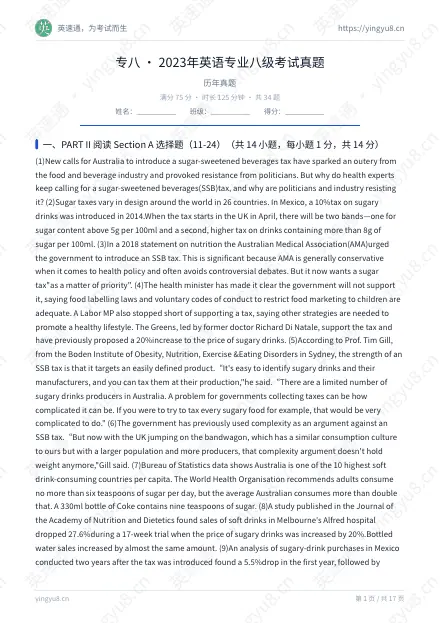
(1)New calls for Australia to introduce a sugar-sweetened beverages tax have sparked an outery from the food and beverage industry and provoked resistance from politicians. But why do health experts keep calling for a sugar-sweetened beverages(SSB)tax, and why are politicians and industry resisting it? (2)Sugar taxes vary in design around the world in 26 countries. In Mexico, a 10%tax on sugary drinks was introduced in 2014.When the tax starts in the UK in April, there will be two bands—one for sugar content above 5g per 100ml and a second, higher tax on drinks containing more than 8g of sugar per 100ml. (3)In a 2018 statement on nutrition the Australian Medical Association(AMA)urged the government to introduce an SSB tax. This is significant because AMA is generally conservative when it comes to health policy and often avoids controversial debates. But it now wants a sugar tax"as a matter of priority". (4)The health minister has made it clear the government will not support it, saying food labelling laws and voluntary codes of conduct to restrict food marketing to children are adequate. A Labor MP also stopped short of supporting a tax, saying other strategies are needed to promote a healthy lifestyle. The Greens, led by former doctor Richard Di Natale, support the tax and have previously proposed a 20%increase to the price of sugary drinks. (5)According to Prof. Tim Gill, from the Boden Institute of Obesity, Nutrition, Exercise &Eating Disorders in Sydney, the strength of an SSB tax is that it targets an easily defined product.“It's easy to identify sugary drinks and their manufacturers, and you can tax them at their production,"he said.“There are a limited number of sugary drinks producers in Australia. A problem for governments collecting taxes can be how complicated it can be. If you were to try to tax every sugary food for example, that would be very complicated to do." (6)The government has previously used complexity as an argument against an SSB tax.“But now with the UK jumping on the bandwagon, which has a similar consumption culture to ours but with a larger population and more producers, that complexity argument doesn't hold weight anymore,"Gill said. (7)Bureau of Statistics data shows Australia is one of the 10 highest soft drink-consuming countries per capita. The World Health Organisation recommends adults consume no more than six teaspoons of sugar per day, but the average Australian consumes more than double that. A 330ml bottle of Coke contains nine teaspoons of sugar. (8)A study published in the Journal of the Academy of Nutrition and Dietetics found sales of soft drinks in Melbourne's Alfred hospital dropped 27.6%during a 17-week trial when the price of sugary drinks was increased by 20%.Bottled water sales increased by almost the same amount. (9)An analysis of sugary-drink purchases in Mexico conducted two years after the tax was introduced found a 5.5%drop in the first year, followed by a9.7%decline in the second. While two years is not enough to determine the long-term impact on health, the study found:“These reductions in consumption could have positive impacts on health outcomes and reductions in healthcare expenses." (10)Sugar-sweetened drinks and sugar generally have been associated with obesity, type 2 diabetes, cardiovascular disease, tooth decay and bone density problems. The Australian Healthcare and Hospitals Association says obesity is the leading cause of preventable death or illess in Australia—above smoking. But it will take longer term analysis to see clear evidence of any impact of a tax on obesity levels. (11)Lobby groups from the food and beverage industry are powerful. The Australian Beverages Council, the industry's lobby group, has been fighting against a tax for years. It says there is no evidence a tax will do anything to reduce obesity, and it will cost jobs, which is a frightening message for politicians. The Australasian Association of Convenience Stores(AACS)described the introduction of an SSB tax in the UK as“lazy,” “flawed,”“discriminatory”and“irrational”.It has ramped up its campaign to prevent such a tax in Australia. (12)Would introducing a sugar tax make Australia a nanny-state?It depends on whether you believe the food and beverage industry has too much power. Health experts argue that through advertising, product placement and political influence, the food and beverage industry has an unfair and non-transparent influence over consumer purchasing habits, and that children especially are sometimes powerless to recognise or resist it. They say an SSB tax would hold the industry to account. Others argue people need to take personal responsibility. (13)A Deakin University study used economic modelling to show the increase in annual spending on sugar-sweetened drinks under a 20%tax would average $30 a person, but those in the lowest socioeconomic groups would pay $5 a year more than those in the wealthiest groups. (14)Researchers concluded this was a modest price to pay given the benefits—and that Australia's lowest socioeconomic group would receive the greatest health benefits. Health experts and advocacy groups say governments could reduce the financial burden on disadvantaged people by using revenue from a tax to fund health initiatives.
- A.It says the tax is inadequate for food marketing.
- B.It argues that there is no such necessity.
- C.It regards the tax as one of the top priorities.
- D.It accepts medical professionals'advice.
参考答案与解析
答案:B
解析:定位政府立场段落 → 提取健康部长与工党议员的反对理由 → 归纳政府认为现有措施已足够,无需新税
考点:细节定位同义替换
译文:题干:澳大利亚政府对SSB税的回应是什么?正确项:B. 它认为没有这种必要。
- A.The Australian Healthcare and Hospitals Association.
- B.The Academy of Nutrition and Dietetics.
- C.The Australian Beverages Council.
- D.The Australian Medical Association.
参考答案与解析
答案:C
解析:定位各组织立场段落 → 识别食品饮料行业(industry)的反对立场 → 匹配选项中的具体组织名称
考点:细节定位同义替换
译文:题干:以下哪个组织反对SSB税?正确项:C. 澳大利亚饮料委员会。
- A.Neutral and objective.
- B.Partially supportive.
- C.Biased and worried.
- D.Completely doubtful.
参考答案与解析
答案:A
解析:定位第12段 → 分析作者呈现各方观点的语气与用词 → 判断作者未表达个人倾向,仅客观陈述
考点:观点态度语气分析
译文:题干:根据第12段,作者对SSB税的态度是什么?正确项:A. 中立客观。
- A.Widening the gap between socioeconomic groups.
- B.Imposing financial burden on common families.
- C.Promoting economy in a satisfactory way.
- D.Offsetting financial burden by funding healthcare.
参考答案与解析
答案:D
解析:定位第13-14段 → 提取关于税收收入用途的论述 → 同义替换为‘通过资助医疗保健来抵消经济负担’
考点:细节定位同义替换
译文:题干:第13和14段关于SSB税论述了什么?正确项:D. 通过资助医疗保健来抵消经济负担。
(1)I'd been living in Los Angeles just under a year when, in the spring of 1983, I answered an ad in the Hollywood Reporter for a receptionist and got the job. The pay wasn't much, but the work was in“the Business"—an apt Los Angeles euphemism for the entertainment industry. The location was within bicycling distance of my home, and they only wanted someone to work mornings. I'd get off by I p.m., which I thought would leave me plenty of time to do my own writing. I was wrong about that. The place was so frantic I'd come out wired and need the rest of the day to simply calm down. When, after about two weeks, I realized my afternoons were being spent in activities equivalent to running around the block twenty or thirty times, I asked to be put on full-time. Since I wasn't getting anything else, why not, I figured, jump in for the total experience. (2)The(still thriving)company I found myself a part of possessed the unlikely name of Breakdown Services, Ltd. During the six months I worked there, I learned to savor all of that phrase's more cynical reverberations, but in terms of the job it dealt with the dismantling or breakdown of television and film scripts. Scripts gathered from producers or studios would be regurgitated ( 回 流 )by Breakdown in the form of plot summaries, character descriptions, number of scenes per character, and the number of dialogue lines each speaks. These compilations were then xeroxed and distributed to hundreds of subscribing actors'agents who proceeded to submit their clients for likely parts. It was a process, as I was to discover by way of angry phone calls when“breakdowns”arrived late or not at all, that the agents regarded with a reverence others might reserve for morning prayer. (3)Breakdown Services, Ltd.was the brainchild of a young man named Gary Marsh. Gary was twenty- eight when I met him, but he'd founded Breakdown when he was eighteen and was considered something of an entrepreneurial prodigy. His mother was an agent and he'd observed the piles of scripts she and her agent pals had to plow through in order to match a given role with the talent they represented. He'd also observed how much they hated the reading part of their jobs and had cleverly devised breakdowns as a way of extracting the material they needed. (4)By the time I arrived, five full-time breakdown writers worked in a desk-lined back room overlooking a parking lot. I've heard the current crew has now advanced to computers, but when I was there typewriters were the norm. When they weren't typing, the writers would curl up on the office's worn stuffed couch and, with a script propped against one arm, fill legal-sized yellow pads with dialogue line numbers and comments which they'd then type up. It could be a complex job. For example, the breakdown for a film originally called Teenage Gambler lists over forty characters, ranging from the teenaged gambling leader to five waiters who sing"Happy Birthday"at a surprise party. (5)Perhaps because of the patience involved in this sort of extraction, women seemed to dominate the ranks of the break-downers(during my tenure the ratio was four to one).Although Gary knew I'd done a bit of writing, I was relegated to the front office and never received an invitation to try my hand at breakdowns. It wasn't something I really wanted to do. For one thing, the writers were a youthful bunch. The back room senior was in her early thirties, but none of the others had hit twenty-five. And I think Gary rightly surmised I'd be too openly cynical for the job or try to embellish too much. Breakdowns were produced anonymously and offered no artistic evaluations of the scripts. The writers might talk among themselves about a piece they felt was particularly good or bad, but such editorializing was not allowed to make its way into the final product. That this restriction was frustrating is indicated by the fact that two of the writers began venting opinions as moonlighting theater critics for small local papers. (6)For Gary, the most problematical aspect of the breakdown business was its limited market. This had nothing to do with his operating methodology; he did what he could to exploit the possibilities. Each weekday a hardy crew made predawn deliveries of breakdowns to agents'homes or offices, while a post-dawn quartet of pager-equipped Breakdown field workers haunted the big studios ready to pounce on an available script. For these studio prowlers speed was of the essence, not only because Hollywood tends to be crisis-prone and wants everything done quickly, but because a rival, spawned by the success of Breakdown Services, Ltd.and infuriatingly named BreakThrough Productions, Ltd., was also on the hunt. (7)Breakdown Services unquestionably dominated the field, but the field itself had immutable perimeters. Breakdown's subscribers had to be accredited agents, though there were some exceptions to this rule. For instance, specialized media organizations, such as the competitive, vulture-like companies that insured movie productions, could keep tabs on the industry by subscribing to the weekly Breakdown summaries. But the whole Breakdown operation was hard to monitor. When I was there, a Breakdown subscription was expensive, something like $500 a year. And though breakdowns were copyrighted and unauthorized reproduction was clearly prohibited, xerox machines are notoriously bad at picking up such distinctions and among the larger agencies breakdowns were undoubtedly duplicated and passed around. (8)Gary's response to these built-in economic dilemmas was to diversify. A separate department for commercials, for example, appeared as part of the Breakdown menu. Although Breakdown staffers were supposed to refrain from giving tips to potential talent, I did once tell a friend—who hoped to finance the college educations of her five-year-old identical twins by getting them on a commercial—that a juice company had put out a call for identical twin girls. Their agent submitted them, but they didn't get the job. The nightly Breakdown delivery system expanded to an all-day messenger service. Gary also made available an assortment of directories and mailing labels listing casting directors, talent agents, and literary agents in Los Angeles and New York. The current Breakdown brochure adds yet another Breakdown amenity; for fifteen dollars you can receive an“actors'relaxation”cassette tape“designed to maximize your abilities and stimulate your creative senses”.
- A.Convenient location.
- B.Decent income.
- C.Ideal work time.
- D.Reputable career image.
参考答案与解析
答案:B
解析:定位作者接受工作的段落 → 逐一核对选项与原文描述 → 找出与‘薪水不高’相悖的选项
考点:细节定位正反判断
译文:题干:以下哪项不是作者接受这份工作的原因?正确项:B. 体面的收入。
- A.They are patient for their late arrivals.
- B.They sometimes ignore their arrivals.
- C.They care less about breakdowns.
- D.They view breakdowns as essential.
参考答案与解析
答案:D
解析:定位第2段末句 → 提取‘regarded with a reverence’ → 同义替换为‘essential’
考点:观点态度细节定位与捕捉
译文:题干:经纪人对‘breakdowns’的态度是什么?正确项:他们视其为必不可少。
- A.Making comments.
- B.Writing editorials.
- C.Reproducing scripts.
- D.Typing scripts.
参考答案与解析
答案:A
解析:定位第5段‘editorializing’ → 结合上下文‘adding personal opinions’ → 同义替换为‘Making comments’
考点:词义猜测
译文:题干:根据上下文,第5段中的‘such editorializing’是什么意思?正确项:发表评论。
- A.Market competition.
- B.Breakdown restrictions.
- C.Copyright violations.
- D.Lack of subscribers.
参考答案与解析
答案:D
解析:定位第7段 → 概括段落核心内容(订阅者不足) → 匹配选项‘Lack of subscribers’
考点:主旨大意细节定位与捕捉
译文:题干:作者在第7段主要谈论什么问题?正确项:订阅者不足。
- A.Infuriated.
- B.Ironic.
- C.Frustrated.
- D.Indifferent
参考答案与解析
答案:B
解析:通读全文 → 捕捉‘unlikely name’、‘cynical reverberations’、‘reverence others might reserve for morning prayer’等反讽表达 → 推断作者语气为‘Ironic’
考点:观点态度
译文:题干:作者贯穿全文的语气是什么?正确项:讽刺的。
(1)It was delightful to be in such a place, after long weeks of daily and nightly familiarity with miners' cabins—with all which this implies of dirt floor, never-made beds, tin plates and cups, bacon and beans and black coffee, and nothing of ornament but war pictures from the Eastern illustrated papers tacked to the log walls. That was all hard, cheerless, materialistic desolation, but here was a nest which had aspects to rest the tired eyes and refresh that something in one's nature which, after long fasting, recognizes, when confronted by the belongings of art, howsoever cheap and modest they may be, that it has unconsciously been famishing and now has found nourishment. (2)I could not have believed that a rag carpet could feast me so, and so content me; or that there could be such solace to the soul in wall-paper and framed lithographs( 平 版 印 刷 画 ) , and bright-colored tidies and lamp- mats, and Windsor chairs, and varnished whatnots(陈设架), with sea-shells and books and china vases on them, and the score of little unclassifiable tricks and touches that a woman's hand distributes about a home, which one sees without knowing he sees them, yet would miss in a moment if they were taken away. The delight that was in my heart showed in my face, and the man saw it and was pleased; saw it so plainly that he answered it as if it had been spoken. (3)“All her work,"he said, caressingly;“she did it all herself—every bit,”and he took the room in with a glance which was full of affectionate worship. One of those soft Japanese fabrics with which women drape with careful negligence the upper part of a picture-frame was out of adjustment. He noticed it, and rearranged it with cautious pains, stepping back several times to gauge the effect before he got it to suit him. Then he gave it a light finishing pat or two with his hand, and said:“She always does that. You can't tell just what it lacks, but it does lack something until you've done that—you can see it yourself after it's done, but that is all you know; you can't find out the law of it. It's like the finishing pats a mother gives the child's hair after she's got it combed and brushed, I reckon. I've seen her fix allthese things so much that I can do them all just her way, though I don't know the law of any of them. But she knows the law. She knows the why and the how both; but I don't know the why; I only know the how." (4)He took me into a bedroom so that I might wash my hands; such a bedroom as I had not seen for years: white counterpane, white pillows, carpeted floor, papered walls, pictures, dressing-table, with mirror and pin-cushion and dainty toilet things; and in the corner a wash-stand, with real china-ware bowl and pitcher, and with soap in a china dish, and on a rack more than a dozen towels—towels too clean and white for one out of practice to use without some vague sense of profanation. So my face spoke again, and he answered with gratified words:“All her work; she did it all herself—every bit. Nothing here that hasn't felt the touch of her hand. Now you would think—But I mustn't talk so much.” (5)By this time I was wiping my hands and glancing from detail to detail of the room's belongings, as one is apt to do when he is in a new place, where everything he sees is a comfort to his eye and his spirit; and I became conscious, in one of those unaccountable ways, you know, that there was something there somewhere that the man wanted me to discover for myself. I knew it perfectly, and I knew he was trying to help me by furtive indications with his eye, so I tried hard to get on the right track, being eager to gratify him. I failed several times, as I could see out of the corner of my eye without being told; but at last I knew I must be looking straight at the thing—knew it from the pleasure issuing in invisible waves from him. He broke into a happy laugh, and rubbed his hands together, and cried out:“That's it!You've found it. I knew you would. It's her picture." (6)I went to the little black-walnut bracket on the farther wall, and did find there what I had not yet noticed—a picture case. It contained the sweetest girlish face, and the most beautiful, as it seemed to me, that I had ever seen. The man drank the admiration from my face, and was fully satisfied. (7)“Nineteen her last birthday,"he said, as he put the picture back;“and that was the day we were married. When you see her—ah, just wait till you see her!" (8)“Where is she?When will she be in?” (9)“Oh, she's away now. She's gone to see her people. They live forty or fifty miles from here. She's been gone two weeks today." (10)“When do you expect her back?” (11)“This is Wednesday. She'll be back Saturday, in the evening—about nine o'clock, likely.” (12)I felt a sharp sense of disappointment. (13)“I'm sorry, because I'll be gone then,”I said, regretfully. (14)“Gone?No—why should you go?Don't go. She'll be disappointed.” (15)She would be disappointed—that beautiful creature!If she had said the words herself, they could hardly have blessed me more. I was feeling a deep, strong longing to see her—a longing so supplicating, so insistent, that it made me afraid. I said to myself:“I will go straight away from this place, for my peace of mind's sake." (16)“You see, she likes to have people come and stop with us—people who know things, and can talk— people like you. She delights in it; for she knows—oh, she knows nearly everything herself, and can talk, oh, like a bird—and the books she reads, why, you would be astonished. Don't go; it's only a little while, you know, and she'll be so disappointed." (17)I heard the words, but hardly noticed them, I was so deep in my thinkings and strugglings. He left me, but I didn't know. Presently he was back, with the picture case in his hand, and he held it open before me and said:“There, now, tell her to her face you could have stayed to see her, and you wouldn't.”
- A.personification
- B.contrast
- C.metaphorization
- D.exaggeration
参考答案与解析
答案:B
解析:对比第1段(矿工小屋的简陋)与第2段(温馨家居的舒适) → 识别写作手法为‘对比’
考点:篇章结构与写作目的
译文:题干:作者通过何种方式在第1、2段中给人留下印象?正确项:对比。
- A.Despicable.
- B.Sentimental.
- C.Worshipping.
- D.Concerned.
参考答案与解析
答案:C
解析:定位描述丈夫言行的段落 → 提取关键情感词汇(affectionate worship) → 同义替换得出答案
考点:观点态度细节定位
译文:题干:以下哪个词最能描述这位男士对其妻子的感受?正确项:崇敬的。
- A.cares about details
- B.habitually assists his wife
- C.knows why something is done
- D.likes to do home decoration
参考答案与解析
答案:A
解析:定位描述丈夫调整织物的段落 → 分析其动作细节(cautious pains, stepping back, gauge) → 推断其性格特点
考点:推理判断细节定位
译文:题干:从男士重新调整画框上织物的描述中,我们可以了解到他。正确项:注重细节。
- A.The weird interior atmosphere.
- B.The man's insistence to see his wife.
- C.The man's strange words and behavior.
- D.The deep desire for seeing the man's wife.
参考答案与解析
答案:D
解析:定位第15段(未提供,需根据上下文推断) → 分析作者情感变化 → 推断恐惧来源
考点:推理判断细节定位
译文:题干:是什么让作者在第15段感到害怕?正确项:想见到这位男士妻子的强烈渴望。
- A.sociable
- B.shrewd
- C.beautiful
- D.intelligent
参考答案与解析
答案:B
解析:定位描述妻子特质的段落 → 逐一核对选项与原文信息 → 排除法找出例外项
考点:细节定位推理判断
译文:题干:从男士的叙述中,我们知道他的妻子具有以下所有特质,除了。正确项:精明的。
第 2 部分 · PART II 阅读 Section B 简答题(25-32)8 题 · 16 分
参考答案与解析
答案:It targets an easily defined product.
解析:定位Para.5中Prof. Tim Gill的观点 → 识别其对SSB税的评价核心 → 匹配“It targets an easily defined product”这一同义改写
考点:细节定位同义替换
译文:题干:根据第5段,Tim Gill教授对SSB税有何看法?正确项:它针对的是一种容易界定的产品。
参考答案与解析
答案:Price increase reduced soft drink sales.
解析:定位Para.8的研究结果描述 → 提取价格与销量关系的核心发现 → 概括为“Price increase reduced soft drink sales”
考点:细节概括因果关系
译文:题干:从第8段的研究结果中可以总结出什么?正确项:价格上涨减少了软饮料的销量。
参考答案与解析
答案:It will cost jobs and lacks evidence.
解析:定位Para.11中AACS的评论 → 提取其反对SSB税的两个核心论点(成本与证据) → 用自己的话概括为“It will cost jobs and lacks evidence”
考点:观点提取信息重组
译文:题干:用自己的话总结AACS对SSB税的评论(第11段)。正确项:它会耗费工作岗位且缺乏证据。
参考答案与解析
答案:The work was stressful and exhausting.
解析:定位Para.1中斜体部分的语境 → 分析其描述的工作状态(高强度、消耗性) → 推断作者暗示工作“压力大且令人精疲力竭”
考点:语境推断情感态度
译文:题干:第1段中斜体部分暗示了作者工作的什么特点?正确项:这份工作压力大且令人精疲力竭。
参考答案与解析
答案:niche market
解析:定位Para.6中“limited market”的语境 → 在Para.7中寻找语义对应的表达 → 识别“niche market”为同义替换
考点:词义猜测指代衔接
译文:题干:第7段中哪个词或短语与第6段的“limited market”意思相同?正确项:niche market(利基市场)。
参考答案与解析
答案:Young, entrepreneurial, and observant.
解析:定位描述Gary Marsh的形容词 → 结合语境理解词义 → 筛选符合商人身份的三个形容词
考点:细节定位语境选词
译文:题干:用三个形容词描述作为商人的Gary Marsh。正确答案:年轻的、有进取心的、有洞察力的。
参考答案与解析
答案:She is meticulous and takes great pride in her home.
解析:定位第四段斜体部分 → 分析其描述的行为 → 推断人物性格特征
考点:推理判断词义猜测
译文:题干:第四段斜体部分暗示了关于那个男人的妻子什么?正确答案:她一丝不苟,并且为她的家感到非常自豪。
参考答案与解析
答案:Find the correct thing he wanted me to see.
解析:定位第五段斜体短语 → 分析其上下文语境 → 推断短语在具体情境中的含义
考点:词义猜测推理判断
译文:题干:第五段斜体短语“get on the right track”是什么意思?正确答案:找到他想让我看到的正确的东西。
第 3 部分 · 改错 · 每个标号行各有一处错误(错词填正确词 · 缺词填所缺词 · 多词填多余词)1 题 · 10 分
参考答案与解析
答案:1-which 2-towards 3-of 4-the 5-equal 6-in 7-far 8-that 9-As for 10-hinder
解析:1 空 分析句子结构,识别先行词为物且在从句中作主语 → 选择关系代词 → 得出答案
2 空 识别固定搭配 'take on' → 确认介词搭配 → 得出答案
3 空 分析介词在名词短语中的固定搭配 → 确认所属关系 → 得出答案
4 空 分析名词的特指/泛指需求 → 确定冠词使用 → 得出答案
5 空 分析语境中形容词的语义需求 → 辨析近义词 → 得出答案
6 空 分析句子结构 → 判断空格处需非谓语动词作状语 → 根据逻辑主语与动词的主动关系确定形式
7 空 分析句子语义与逻辑 → 判断空格处需表达程度或比较含义 → 根据上下文语境选择最贴切的词
8 空 分析句子成分 → 判断空格处需引导词连接从句 → 根据从句类型(主语/宾语/表语从句)选择引导词
9 空 分析篇章结构与逻辑关系 → 判断空格处需过渡短语引出新话题或转换讨论对象 → 根据上下文逻辑选择恰当的过渡词
10 空 分析句子语义与词汇搭配 → 判断空格处需动词表达'阻碍'含义 → 根据语境与近义词辨析选择最贴切的动词
考点:定语从句关系代词选择动词搭配 take on固定搭配固定搭配(通用)主谓一致与指代一致语境选词近义词辨析非谓语动词作状语现在分词表主动程度副词名词性从句引导词that引导从句篇章结构逻辑衔接词话题转换动词辨析
译文:题干与正确项的中文译文:(无具体语境,但考查定语从句关系代词)
第 4 部分 · PART IV 汉译英1 题 · 15 分
参考答案与解析
参考译文
Traditional Chinese culture is a rich legacy passed down from our ancestors. It influences contemporary Chinese people at all times, providing both historical grounding and a practical foundation for the creation of new culture. While traditional culture shapes the present, it inevitably undergoes transformation within the atmosphere of the new era. Like a mighty river that has flowed for five thousand years without ever running dry, traditional Chinese culture is both old and new, constantly shedding the old to embrace the new and continuously innovating.
第 5 部分 · PART V 写作1 题 · 20 分
参考答案与解析
参考范文
The two excerpts present contrasting perspectives on the implementation of swimming requirements for university graduation. Excerpt 1 highlights a top Chinese university's decision to reinstate a mandatory swimming test, linking it to the acquisition of a vital survival skill and historical tradition. In contrast, Excerpt 2 details the University of Chicago's abolition of its nearly 60-year-old swim requirement, reflecting a broader trend among institutions to grant students greater autonomy in choosing their physical activities. The core message revolves around the tension between institutional mandates for holistic development and the principle of student choice. The Chinese university justifies its policy by emphasizing swimming's long-term health benefits and its status as a fundamental life skill, even reviving a century-old rule. Conversely, the University of Chicago and many others have moved away from such specific requirements, arguing that students should have the freedom to select exercise methods that best suit their interests and needs, thereby fostering personal responsibility. This debate prompts a critical examination of whether universities should impose non-academic requirements for graduation. On one hand, such mandates can ensure that graduates possess a baseline of essential life skills and physical fitness, contributing to their overall well-being and safety. Swimming, for instance, is a potentially life-saving ability. Furthermore, these requirements can expose students to new experiences they might not otherwise seek, promoting a well-rounded education. On the other hand, a rigid, one-size-fits-all approach may be outdated and impractical. As the University of Chicago spokesman noted, it is more empowering to provide students with options. Forcing a single activity ignores diverse physical abilities, personal preferences, and the availability of alternative, equally beneficial forms of exercise. It could also create unnecessary stress and barriers to graduation for students with specific fears or physical limitations. In my view, while the intention behind such requirements—to promote health and essential skills—is commendable, the method should evolve. Universities could adopt a more flexible model: perhaps offering a menu of approved physical education courses or skill-based tests (including but not limited to swimming) that fulfill a graduation credit. This approach balances the institution's role in guiding student development with respect for individual agency. Ultimately, the goal should be to cultivate a lifelong commitment to health, not to enforce a single, specific activity as a condition for earning a degree.
常见问题
2023年英语专业八级考试真题的答案和解析在哪看?
答案与解析就在本页:每道题下方「参考答案与解析」展开即看,含参考答案、解题思路与考点,免登录直接阅读。
2023年英语专业八级考试真题 PDF 怎么免费下载?
本页「试卷封面」卡片「收录格式」行内的 PDF 徽标即下载链接,点击直接下载本卷 PDF 文件,无需登录。
这套卷怎么在线做题、怎么计分?
点页面上方「开始考试(网页)」进入在线做题页:登录后装载本卷作答,交卷自动判分并留存成绩;免费账号每日可装载 30 套,会员每日 100 套。