2024年英语专业八级考试真题及答案解析
2024年英语专业八级考试真题 · 完整收录
- 年份考次
- 2024 年
- 命题归属
- 全国统一命题
- 省份
- 全国
- 题量
- 25 题
- 满分
- 75 分
- 限时
- 125 分钟
- 题型结构
- PART II 阅读 Section A 选择题 14 题 14 分 · PART II 阅读 Section B 简答题 8 题 16 分 · 改错 · 每个标号行各有一处错误 10 题 10 分 · PART IV 汉译英 1 题 15 分 · PART V 写作 1 题 20 分
- 收录格式
开始考试(微信)

微信扫一扫 · 小程序内开始考试
第 1 部分 · PART II 阅读 Section A 选择题(11-24)14 题 · 14 分
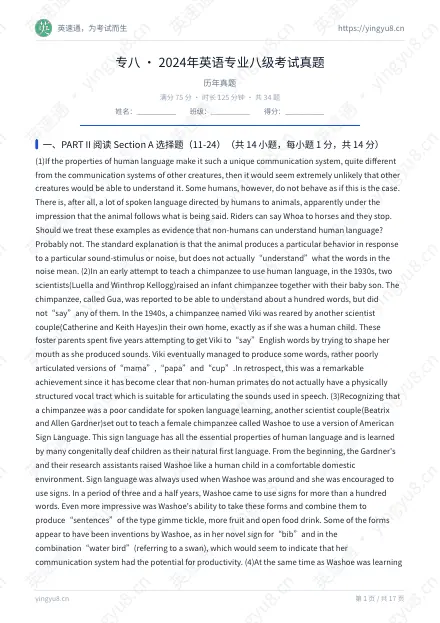
(1)If the properties of human language make it such a unique communication system, quite different from the communication systems of other creatures, then it would seem extremely unlikely that other creatures would be able to understand it. Some humans, however, do not behave as if this is the case. There is, after all, a lot of spoken language directed by humans to animals, apparently under the impression that the animal follows what is being said. Riders can say Whoa to horses and they stop. Should we treat these examples as evidence that non-humans can understand human language?Probably not. The standard explanation is that the animal produces a particular behavior in response to a particular sound-stimulus or noise, but does not actually“understand”what the words in the noise mean. (2)In an early attempt to teach a chimpanzee to use human language, in the 1930s, two scientists(Luella and Winthrop Kellogg)raised an infant chimpanzee together with their baby son. The chimpanzee, called Gua, was reported to be able to understand about a hundred words, but did not“say”any of them. In the 1940s, a chimpanzee named Viki was reared by another scientist couple(Catherine and Keith Hayes)in their own home, exactly as if she was a human child. These foster parents spent five years attempting to get Viki to“say”English words by trying to shape her mouth as she produced sounds. Viki eventually managed to produce some words, rather poorly articulated versions of“mama”,“papa”and“cup”.In retrospect, this was a remarkable achievement since it has become clear that non-human primates do not actually have a physically structured vocal tract which is suitable for articulating the sounds used in speech. (3)Recognizing that a chimpanzee was a poor candidate for spoken language learning, another scientist couple(Beatrix and Allen Gardner)set out to teach a female chimpanzee called Washoe to use a version of American Sign Language. This sign language has all the essential properties of human language and is learned by many congenitally deaf children as their natural first language. From the beginning, the Gardner's and their research assistants raised Washoe like a human child in a comfortable domestic environment. Sign language was always used when Washoe was around and she was encouraged to use signs. In a period of three and a half years, Washoe came to use signs for more than a hundred words. Even more impressive was Washoe's ability to take these forms and combine them to produce“sentences”of the type gimme tickle, more fruit and open food drink. Some of the forms appear to have been inventions by Washoe, as in her novel sign for“bib”and in the combination“water bird”(referring to a swan), which would seem to indicate that her communication system had the potential for productivity. (4)At the same time as Washoe was learning sign language, another chimpanzee named Sarah was being taught(by Ann and David Premack)to use a set of plastic shapes for the purpose of communicating with humans. These plastic shapes represented“words"that could be arranged in sequence to build“sentences”.The basic approach was quite different from that of the Gardner's. Sarah was systematically trained to associate these shapes with objects or actions 、She remained an animal in a cage, being trained with food rewards to manipulate a set of symbols. Once she had learned to use a large number of these plastic shapes, Sarah was capable of getting an apple by selecting the correct plastic shape(a blue triangle)from a large array. Sarah was also capable of producing“sentences”such as“Mary give chocolate Sarah”and had the impressive capacity to understand complex structures such as"If Sarah put red on green, Mary give Sarah chocolate". (5)A psychologist Herbert Terrace argued that chimpanzees simply produce signs in response to the demands of people and tend to repeat signs those people use, yet they are treated as if they are taking part in a “conversation”.As in many critical studies of animal learning, the chimpanzees'behavior is viewed as a type of conditioned response to cues provided by human trainers. (6)Important lessons have been learned from attempts to teach chimpanzees how to use forms of language. We have answered some questions. Were Washoe and Sarah capable of taking part in interaction with humans by using a symbol system chosen by humans and not chimpanzees?The answer is clearly“Yes.”Could Washoe and Sarah go on to perform linguistically on a level comparable to a two-year-old child?The answer is just as clearly“No.”In arriving at these answers, we have also had to face the fact that, even with our list of key properties, we still don't seem to have a non-controversial definition of what counts as“using language".It has to be fair to say that, in both cases, we observe the participants“using language”.However, there is a difference. Underlying the two-year-old's communicative activity is the capacity to develop a highly complex system of sounds and structures, plus a set of computational procedures, which will allow the child to produce extended discourse containing a potentially infinite number of novel utterances. No other creature has been observed"using language"in this ense. It is in this more fundamental or abstract sense that we say that language is uniquely human.
- A.Being raised with a human child is essential.
- B.Mouth shaping is crucial in language learning.
- C.Non-human creatures are different in vocal tracts.
- D.Time length is an important factor in experiments.
参考答案与解析
答案:C
解析:定位第二段两次尝试的描述 → 提取Viki实验的结论性语句 → 同义替换得出答案
考点:细节定位结论提取同义替换
译文:题干:从第二段的两次尝试中我们能学到什么?正确项:非人类生物的声道结构不同。
- A.They were taught in different approaches.
- B.They were raised in similar environments.
- C.They were somewhat innovative in expression.
- D.They were non-human primates for experiments.
参考答案与解析
答案:B
解析:定位Washoe和Sarah的实验描述 → 对比两者环境与方法 → 识别与原文相悖的选项
考点:细节对比事实核查识别相悖
译文:题干:关于Washoe和Sarah,以下哪项陈述是不正确的?正确项:它们在相似的环境中被抚养。
- A."Water bird"(Washoe).
- B.“Open food drink”(Washoe).
- C.“Mary give chocolate Sarah”(Sarah).
- D."Mama”and“cup"(Viki).
参考答案与解析
答案:D
解析:定位“conditioned response”的定义 → 匹配各选项在文中的描述 → 识别符合定义的选项
考点:概念匹配细节定位推理判断
译文:题干:以下哪项是对人类提示的条件反射?正确项:Viki发出的“Mama”和“cup”。
- A.Animals and human language.
- B.Animals and human behavior.
- C.Animal behavior and language.
- D.Animal communication system.
参考答案与解析
答案:A
解析:通览全文各段主题 → 归纳核心讨论对象 → 选择最全面概括的选项
考点:主旨归纳对象识别范围判断
译文:题干:这篇文章的主题是什么?正确项:动物与人类语言。
(1)It was well past midnight this past July and the round-the-clock Arctic sun was shining on Mercy Bay. Exhausted Parks Canada archaeologist Ryan Harris was experiencing a rare moment of rest on the rocky beach, looking out over the bay's dark, ice-studded water. Around him; a dozen red-and-yellow tents.lined the shoreline—the only signs of life. Every day for the previous two weeks, work had started by mid-morning and continued nonstop for 16 hours. Night and day had litle relevance in the murky, near-freezing waters. Along with Parks Canada's chief of underwater archaeology, Marc-Andre Bernier, Harris has overseen more than 100 dives at this remote inlet of Banks Island in Aulavik National Park, exploring the wreck of HMS Investigator, a British vessel that has sat on the bottom of the bay for more than 160 years. (2)Harris and a small team of archaeologists had discovered Investigator in 2010 and returned in 2011 with a larger team to dive, study, and document the wreck, which holds a critical place in the history of Arctic exploration. Twenty-five feet below the surface, Investigator sits upright, intact, and.remarkably well preserved. Silt covers everything below the main deck, entombing the officers'cabins, the ship's galey, and a full library. The archaeologists had intended to leave the wreck and its artifacts where they had lain since the polar ship was abandoned, trapped in ice, on June 3,1853.Artifact recovery was not part of their original plan, but that plan changed after their first few dives. (3)The team was instantly surprised by the number of artifacts they saw—muskets ( 火 枪 ) , shoes, and hunks of copper sheathing rested on Investigator's upper deck, dangled off the hull, or lay haphazardly on the sediment. Leaving these artifacts behind in Mercy Bay would have made them vulnerable to the icebergs that regularly scour the bay's floor, including the ones the six-man dive team had been dodging since their arrival. (4)Each piece fished from the water was a clue to life at sea aboard a ship during a period of British fervor for Arctic exploration. The captain of Investigator, Robert McClure, was originally sent to find and rescue two ships, HMS Erebus and HMS Terror, that Sir John Franklin had led into the Arctic in 1845 to discover the long- sought Northwest Passage connecting the Atlantic and Pacific oceans. Investigator's voyage ended, without sight or word of Franklin's ships or crew, when it was set upon by ice in Mercy Bay. After 39 months at sea, the listing ship sat, slowly being crushed on all sides, for three frigid years—with no Inuit encounters, no British search parties, and no relief. For much of that time, McClure and his crew of 60 were desperate and under constant threat of starvation, until a surprising rescue in the spring of 1853.Fifty-five men survived the ordeal. (5)In July 2010, after months of study to pinpoint Investigator's resting place, the actual discovery of the wreck took just a few minutes. Harris was in the bay in an inflatable boat testing sonar equipment when the ·wreck came into range. The four hours of video gathered on that trip.showed that the ship was, in essence, frozen in time, protected by the cold water and opaque, light-blocking ice cover. It would be a year before they could return with cold-water diving equipment to have a closer, more detailed look. Over that year, the Parks Canada team pored over photographs and examined glowing gold ultrasound images that showed timber from the wreck scattered across the upper deck like matchsticks. They sought and received the blessing for a more intensive exploration of the wreck site from the 136 residents of Sachs Harbour, an Inuvialuit(Inuit from the western Arctic)community on the southwestern tip of Banks Island, the closest permanent community, some 125 miles away. In addition to the underwater work to document the wreck, archaeologist Henry Cary led a land-based survey and excavation team of Inuvialuit archaeologists, conservation officers, and park staff. It fell upon Cary to shuttle the 8,820 pounds of equipment up to the 74th parallel, including tents, a three-week supply of food, two boats, diving gear, compressors, recording equipment, surveying tools, and 20 barrels for collecting fresh drinking water. (6)The archaeologists came prepared for delays, nasty weather, and polar bears—but they weren't prepared for the number of artifacts that needed recovery. Harris, Bernier, Cary, and their crews had packed cameras, lasers, and measuring tapes to document the sites but fewer items to help them retrieve, excavate, or transfer artifacts. Recovering the wreck's finds quickly used up their small toolkit for stabilizing artifacts: foam padding, tongue depressors, and gauze bandages. (7)“We had not really envisioned the number of artifacts that were visible and exposed on the deck. So, basically, we had to improvise,"says Bernier. (8)Someone ripped the lid of a large black storage case off its hinges to use as a cradle to lift a bent and corroded musket from the frigid waters. A large food cooler was loaded with a shredded, twisted, oxidized sample of the copper sheathing used by the British navy to reinforce their Arctic fleet for contact with icebergs. To protect a fragile rectangle of encrusted felt—a novel addition to Investigator that was intended to keep the ship watertight—Harris fashioned a cover out of absorbent chamois( 鹿 皮 ) , ripped up an old black T-shirt to place underneath it, and sandwiched the artifact between floorboards taken from the boat that had shuttled them between land and the wreck. The artifacts then made a more than 4,000-mile journey, by helicopter and commercial airliner, to the Parks Canada conservation lab in Ottawa, where they are being conserved and studied today.
- A.The team began exploring the ship wreck soon after its discovery.
- B.The original plan was to explore the ship and retrieve the artifacts.
- C.The team spent their nights near a local residents'community.
- D.Work started on the ship wreck during the team's second trip.
参考答案与解析
答案:D
解析:定位水下探索的细节描述 → 对比各选项与原文信息 → 识别与原文明确相悖的选项
考点:细节定位事实核查识别相悖
译文:题干:关于水下探索,以下哪项细节是正确的?正确项:团队在第二次行程中开始探索沉船残骸。
- A.It was sent to discover a new sea passage
- B.It got stuck in ice and was later abandoned.
- C.It got in touch with Erebus and Terror.
- D.Its actual discovery was time-consuming.
参考答案与解析
答案:B
解析:定位至第(2)段末句 → 提取‘abandoned, trapped in ice’关键信息 → 同义替换为‘got stuck in ice and was later abandoned’
考点:细节定位与捕捉同义替换
译文:题干:关于‘Investigator’号,我们能了解到什么?正确项:它被困在冰中,后来被遗弃了。
- A.They had to fight against the treacherous weather.
- B.They had little time to pack and stabilize those artifacts.
- C.They did not have proper tools to excavate so many artifacts.
- D.They had no idea what those artifacts were used for on board.
参考答案与解析
答案:C
解析:定位至第(3)段 → 分析‘improvise’(即兴发挥)的原因 → 推理出因未预料到大量文物暴露,缺乏相应工具和计划
考点:推理判断因果逻辑
译文:题干:为什么Bernier说他们必须即兴发挥(第7段)?正确项:他们没有合适的工具来挖掘如此多的文物。
- A.Incredible.
- B.Innovative.
- C.Imaginable.
- D.Inefficient.
参考答案与解析
答案:B
解析:通读全文,把握考古学家应对意外情况的行动 → 从‘improvise’、‘plan changed’等词推断其方法具有创新性 → 选择最贴切的形容词
考点:观点态度词义辨析
译文:题干:以下哪个词最能描述考古学家保护回收文物的方式?正确项:创新的。
- A.who made the artifacts
- B.where the artifacts were sent
- C.what artifacts were recovered
- D.how the artifacts were protected
参考答案与解析
答案:A
解析:定位至最后一段(第4段) → 逐一核对选项信息是否在段落中提及 → 找出未提及项
考点:细节定位与捕捉排除法
译文:题干:最后一段提到了以下所有内容,除了?正确项:谁制造了这些文物。
(1)My father was, I am sure, intended by nature to be a cheerful, kindly man. Until he was thirty-four years old he worked as a farmhand for a man named Thomas Butterworth whose place lay near the town of Bidwell. He had then a horse of his own.and on Saturday evenings drove into town to spend a few hours in social intercourse with other farmhands. In town he drank several glasses of beer and stood about in Ben Head's saloon—crowded on Saturday evenings with visiting farmhands. Songs were sung and glasses thumped on the bar. At ten o'clock father drove home along a lonely country road, made his horse comfortable for the night and himself went to bed, quite happy in his position in life. He had at that time no notion of trying to rise in the world. (2)It was in the spring of his thirty-fifth year that father married my mother, then a country school teacher, and in the following spring I came wriggling and crying into the world. Something happened to the two people. They became ambitious. The passion for getting up in the world took possession of them. (3)It may have been that mother was responsible. Being a school teacher she had no doubt read books and magazines. She had, I presume, read of how some people rose from poverty to fame and greatness and as I lay beside her—in the days of her lying-in—she may have dreamed that I would someday rule men and cities. At any rate she induced father to give up his place as a farmhand, sell his horse and embark on an independent enterprise of his own. She was a tall silent woman with a long nose and troubled grey eyes. For herself she wanted nothing. For father and myself she was incurably ambitious, (4)The first venture into which the two people went turned out badly. They rented ten acres of poor stony land on Griggs's Road, eight miles from Bidwell, and launched into chicken raising. I grew into boyhood on the place and got my first impressions of life there. From the beginning they were impressions of disaster and if, in my turn, I am a gloomy man inclined to see the darker side of life, I atribute it to the fact that what should have been for me the happy joyous days of childhood were spent on a chicken farm. (5)One unversed in such matters can have no notion of the many and tragic things that can happen to a chicken. It is born out of an egg, lives for a few weeks as a tiny fluffy thing such as you will see pictured on Easter cards, then becomes hideously naked, eats quantities of corn and meal bought by the sweat of your father's brow, gets diseases called pip, cholera, and other names, stands looking with stupid eyes at the sun, becomes sick and dies. A few hens and now and then a rooster, intended to serve God's mysterious ends, struggle through to maturity. The hens lay eggs out of which come other chickens and the dreadful cycle is thus made complete. It is all unbelievably complex. Most philosophers must have been raised on chicken farms. One hopes for so much from a chicken and is so dreadfully disillusioned. Small chickens, just setting out on the journey of life, look so bright and alert and they are in fact so dreadfully stupid. They are so much like people they mix one up in one's judgments of life.f disease does not kill them they wait until your.expectations are thoroughly aroused and then walk under the wheels of a wagon—to go squashed and dead back to their maker. Vermin infest their youth, and fortunes must be spent for curative powders. (6)For ten years my father and mother struggled to make our chicken farm pay and then they gave up that struggle and began another. They decided to move into the town of Bidwell, and embarked in the restaurant business. After ten years of worry with incubators that did not hatch, and with tiny—and in their own way lovely—balls of fluff that passed on into semi-naked pullerhood and from that into dead henhood, we threw all aside, packed our belongings on a wagon and drove down Griggs's Road toward Bidwell, a tiny caravan of hope looking for a new place from which to start on our upward journey through life. (7)We must have been a sad looking lot, not, I fancy, unlike refugees fleeing from a battlefield. Mother and I walked in the road. The wagon that contained our goods.had been borrowed for the day from Mr. Albert Griggs, a neighbor. Out of its sides stuck the legs of cheap chairs and at the back of the pile of beds, tables, and boxes filled with kitchen utensils was a crate of live chickens, and on top of that the baby carriage in which I had been wheeled about in my infancy. Why we stuck to the baby carriage I don't know. It was unlikely other children would be born and the wheels were broken. People who have few possessions cling tightly to those they have. That is one of the facts that make life so discouraging. (8)Father rode on top of the wagon. He was then a bald-headed man of forty-five, a little fat and from long association with mother and the chickens he had become habitually silent and discouraged. All during our ten years on the chicken farm he had worked as a laborer on neighboring farms and most of the money he had earned had been spent for remedies to cure chicken diseases. There were two little patches of hair on father's head just above his ears. I remember that as a child I used to sit looking at him when he had gone to sleep in a chair before the stove on Sunday afternoons in the winter. I had at that time already begun to read books and have notions of my own and the bald path that led over the top of his head was, I fancied, something like a broad road, such a road as Caesar might have made on which to lead his legions out of Rome and into the wonders of an unknown world. (9)One might write a book concerning our flight from the chicken farm into town. Mother and I walked the entire eight miles—she to be sure that nothing fell from the wagon and I to see the wonders of the world.
- A.knowledgeable
- B.responsible
- C.imaginative
- D.aspiring
参考答案与解析
答案:D
解析:定位至第(3)段对母亲的描述 → 提取‘incurably ambitious’(无可救药地有抱负)等关键词 → 同义替换为‘aspiring’(有抱负的)
考点:观点态度同义替换
译文:题干:作者将他的母亲描述为?正确项:有抱负的。
- A.The specific steps of chicken raising.
- B.The difficulties of chicken raising.
- C.The excitement of the family.
- D.The expectations of the family.
参考答案与解析
答案:B
解析:定位第五段 → 提取关键描述(disaster, gloomy, darker side) → 推断段落意图
考点:细节定位情感色彩推断
译文:题干:第5段旨在说明什么?正确项:养鸡的困难。
- A.Their ambition.
- B.Their struggle.
- C.Their worries.
- D.Their resourcefulness.
参考答案与解析
答案:A
解析:定位第六段短语 → 结合上下文(ambition, getting up in the world) → 推断其指代
考点:语境词义猜测指代推断
译文:题干:第6段中的“our upward journey”指什么?正确项:他们的雄心。
- A.Temporal.
- B.Illustrative.
- C.Causal.
- D.Additive.
参考答案与解析
答案:C
解析:定位第七段两个斜体句 → 分析句间逻辑关系(结果与原因) → 判断关系类型
考点:逻辑衔接词篇章结构
译文:题干:第7段中两个斜体句的关系是什么?正确项:因果关系。
- A."...I to see the wonders of the world".
- B.“I had at that time already begun to read books..”.
- C.“I walked the entire eight miles...”.
- D.“...a book concerning our flight from the chicken farm into town”.
参考答案与解析
答案:A
解析:定位第8、9段 → 筛选表达希望情感的句子 → 对比选项与原文
考点:细节定位观点态度
译文:题干:第8、9段中哪句话体现了作者的希望感?正确项:“...I to see the wonders of the world”。
第 2 部分 · PART II 阅读 Section B 简答题(25-32)8 题 · 16 分
参考答案与解析
答案:The animal understands human language.
解析:定位代词this → 回溯前文指代对象 → 匹配选项语义
考点:指代与衔接
译文:题干:第一段中的“this”指代什么?正确项:这只动物理解人类语言。
参考答案与解析
答案:By inventing new signs and combining words.
解析:定位关键词productivity → 定位第三段相关描述 → 提取具体行为
考点:细节定位与捕捉
译文:题干:Washoe如何展示了生产力的潜力(第三段)?正确项:通过发明新符号和组合词语。
参考答案与解析
答案:Icebergs that regularly scour the bay's floor.
解析:定位代词ones → 分析其语法功能(替代复数名词)→ 回溯前文寻找被替代的复数名词短语
考点:指代与衔接
译文:题干:第三段中的单词“ones”指代什么?正确项:定期刮擦海湾底部的冰山。
参考答案与解析
答案:To discover the Northwest Passage.
解析:定位人物Sir John Franklin → 寻找其mission的直接陈述或目的状语
考点:细节定位与捕捉
译文:题干:Sir John Franklin的任务是什么?正确项:发现西北航道。
参考答案与解析
答案:Studied photos, examined ultrasound images, sought community blessing.
解析:定位关键词preparations和Para.5 → 筛选第五段中团队为旅行所做的具体事项 → 列举至少两项
考点:细节定位与捕捉
译文:题干:列出团队为旅行所做的两项准备(第五段)。正确项:研究照片、检查超声波图像、寻求社区祝福。
参考答案与解析
答案:Cheerful, content, and unambitious.
解析:定位段落首句 → 提取描述性形容词 → 同义替换与概括
考点:cheerfulcontentunambitious
译文:题干:用你自己的话描述作者父亲婚前的性格(第1段)。正确答案:开朗、知足且胸无大志。
参考答案与解析
答案:It was filled with disaster and gloom.
解析:定位段落 → 提取关键事件与情感色彩 → 概括整体氛围
考点:disastergloom
译文:题干:用你自己的话描述作者在养鸡场的童年(第4段)。正确答案:充满了灾难与阴郁。
参考答案与解析
答案:Their efforts were often futile and disillusioning.
解析:定位鸡的命运描述 → 推断其象征意义 → 关联家庭整体境遇
考点:futiledisillusioning
译文:题干:鸡的命运暗示了作者家庭的什么?正确答案:他们的努力常常是徒劳且令人幻灭的。
第 3 部分 · 改错 · 每个标号行各有一处错误(错词填正确词 · 缺词填所缺词 · 多词填多余词)1 题 · 10 分
参考答案与解析
答案:1-contains 2-designed 3-providing 4-anomalous 5-so 6-which 7-aspect 8-not 9-Imagine 10-its
解析:1 空 识别主语为单数名词 → 判断句子时态为一般现在时 → 选择第三人称单数动词形式
2 空 分析句子结构 → 判断空格处为后置定语修饰名词 → 选择过去分词表被动或完成状态
3 空 分析句子逻辑关系 → 判断空格处为伴随状语或目的状语 → 选择现在分词表主动或伴随
4 空 分析句子语境 → 判断空格处需要形容词描述数据特征 → 根据上下文逻辑选择符合语义的形容词
5 空 分析前后分句逻辑关系 → 判断为因果关系 → 选择表示结果的连词
6 空 分析句子结构,识别先行词与从句的修饰关系 → 判断从句类型 → 选择关系代词
7 空 分析句子语境与空格处所需词性 → 结合上下文语义选择最贴切的名词 → 排除近义词干扰
8 空 识别句子中的省略结构或固定搭配 → 判断否定词位置 → 选择正确否定形式
9 空 分析句子时态与语态要求 → 判断动词形式 → 选择正确的祈使句或陈述句开头
10 空 分析代词指代对象 → 判断指代一致性 → 选择正确的物主代词
考点:主谓一致一般现在时第三人称单数过去分词作定语非谓语动词现在分词作状语语境选词形容词辨析状语从句因果逻辑连词定语从句关系代词选择近义词辨析省略结构否定词用法时态与语态SVO主干主谓一致与指代一致定语从句
译文:该研究包含/包含了对三种不同方法的比较。
第 4 部分 · PART IV 汉译英1 题 · 15 分
参考答案与解析
参考译文
Chinese science fiction is gaining increasing international popularity and has become a new mode of cross-cultural exchange. It is foreseeable that Chinese science fiction will produce more outstanding works that transcend national boundaries and exert global influence. To move toward the future, Chinese science fiction must embrace a sense of cultural mission. The challenge facing Chinese science fiction writers is how to profoundly present to the world the Chinese imagination of technology, the universe, and the future, while integrating the finest elements of traditional Chinese culture and offering deep reflections on building a community with a shared future for mankind.
第 5 部分 · PART V 写作1 题 · 20 分
参考答案与解析
参考范文
The two excerpts present contrasting perspectives on online learning. Excerpt 1 highlights its convenience and accessibility, noting that technology provides a personalized, flexible alternative to traditional classroom learning, with adaptive platforms catering to individual needs. In contrast, Excerpt 2 raises critical concerns about the limitations of online education, particularly for subjects requiring hands-on practice or face-to-face interaction, and questions its ability to foster social and disciplinary habits. Professor Smith, as cited in the second excerpt, advocates for a blended approach, arguing that online tools should complement, not replace, traditional teaching methods. I largely agree with Professor Smith's balanced view, as my own online learning experience has shown both the benefits and drawbacks of digital education. During the pandemic, I attended university lectures via video conferencing platforms. On one hand, the flexibility was invaluable—I could review recorded sessions at my own pace and access a wealth of digital resources. The adaptive quizzes on our learning platform helped me identify weak areas in grammar and vocabulary, much like the personalized approach described in Excerpt 1. However, the experience also revealed significant limitations. For instance, in my oral English class, the absence of real-time, in-person interaction made it difficult to practice nuanced conversational skills, such as interpreting body language or engaging in spontaneous debate. Furthermore, staying disciplined without the structure of a physical classroom was challenging; distractions at home often disrupted my focus, echoing the concerns about self-regulation raised in Excerpt 2. Therefore, while online learning offers unparalleled convenience and personalized tools, it cannot fully replicate the holistic environment of traditional education. Professor Smith's suggestion to use online resources as supplements is pragmatic. For example, language-learning apps can reinforce vocabulary and grammar, but they should be paired with classroom discussions to develop communicative competence. Similarly, virtual labs might introduce scientific concepts, but hands-on experiments remain essential for deep understanding. In conclusion, the ideal educational model likely integrates the strengths of both online and offline methods, leveraging technology to enhance accessibility while preserving the irreplaceable human and practical elements of traditional teaching.
常见问题
2024年英语专业八级考试真题的答案和解析在哪看?
答案与解析就在本页:每道题下方「参考答案与解析」展开即看,含参考答案、解题思路与考点,免登录直接阅读。
2024年英语专业八级考试真题 PDF 怎么免费下载?
本页「试卷封面」卡片「收录格式」行内的 PDF 徽标即下载链接,点击直接下载本卷 PDF 文件,无需登录。
这套卷怎么在线做题、怎么计分?
点页面上方「开始考试(网页)」进入在线做题页:登录后装载本卷作答,交卷自动判分并留存成绩;免费账号每日可装载 30 套,会员每日 100 套。