2016年高考英语新课标III卷真题及答案解析
2016年高考英语新课标III卷真题 · 完整收录
- 年份考次
- 2016 年 · 新课标III卷
- 命题归属
- 全国统一命题
- 省份
- 全国
- 听力
- 含听力
- 题量
- 39 题
- 满分
- 140 分
- 限时
- 120 分钟
- 题型结构
- 第一节 听力理解 5 题 7.5 分 · 第二节 听力理解 15 题 22.5 分 · 第一节 阅读理解 15 题 30 分 · 第二节 七选五 5 题 10 分 · 第一节 完形填空 20 题 30 分 · 第二节 语法填空 10 题 15 分 · 第二节 书面表达 1 题 25 分
- 收录格式
开始考试(微信)

微信扫一扫 · 小程序内开始考试
第 1 部分 · 第一节 听力理解 (共5小题;每小题1.5分,满分7.5分)5 题 · 8 分
听力原文 · Question 1(本页按钮可反复收听;在线做题考试中每段仅播一次)
W: Tom, what does Lucy plan for tomorrow morning? M: She has a job interview at nine, then she will go to a meeting at ten. W: How about half past eleven? M: She has to have her teeth checked at half past eleven. She made that appointment last week. W: Oh, I thought she might join us for lunch. M: No, she will go after her teeth are checked.
- A.Go out for lunch.
- B.See her dentist.
- C.Visit a friend.
参考答案与解析
答案:B
解析:定位时间点11:30 → 匹配活动描述 → 得出答案
考点:时间点定位活动匹配
译文:题干:Lucy明天11:30要做什么?正确项:去看牙医。
听力原文 · Question 2(本页按钮可反复收听;在线做题考试中每段仅播一次)
W: Tom, are you coming to the school garden party this afternoon? M: I was, but look at the sky. The sun is hidden, and those thick gray clouds are covering everything. W: So should we move the games inside? M: Yes, the sky looks like it may bring rain later, but right now there is no water falling at all. W: Then let's set up the hall before the clouds get darker. M: Good idea. I will bring the signs and meet you there at three thirty.
- A.It’s sunny.
- B.It’s rainy.
- C.It’s cloudy.
参考答案与解析
答案:C
解析:定位天气描述关键词 → 匹配当前状态 → 得出答案
考点:天气词汇当前状态判断
译文:题干:现在天气怎么样?正确项:多云。
听力原文 · Question 3(本页按钮可反复收听;在线做题考试中每段仅播一次)
M: Dr. Simpson, I need to say something to you. W: Yes, Tom? What is it? M: I am sorry about the volunteer work on Saturday. I forgot to come and I let the team down. W: I see. Thank you for telling me. M: It was my mistake, and I feel bad about it. W: I understand. Please be there next time. M: I will. I promise.
- A.To make an apology.
- B.To ask for help.
- C.To discuss his studies.
参考答案与解析
答案:A
解析:定位对话目的相关表述 → 推断说话人意图 → 得出答案
考点:对话目的推断意图识别
译文:题干:男士为什么和Simpson博士谈话?正确项:为了道歉。
听力原文 · Question 4(本页按钮可反复收听;在线做题考试中每段仅播一次)
M: Lily, you look tired after the interview. W: Yes, I went to the railway station to meet a friend. Now I need to get back to my part-time job. M: Will Tom drive you back? W: No, his car is at the repair shop. M: Then take the train? W: No, I missed the last one. I will take the number seven bus. M: Good. The bus stop is near the station. W: Right. I must hurry or I will be late for work.
- A.By train.
- B.By car.
- C.By bus.
参考答案与解析
答案:C
解析:定位交通方式相关表述 → 匹配返回方式 → 得出答案
考点:交通方式词汇返回方式判断
译文:题干:女士将如何从火车站返回?正确项:乘公交车。
听力原文 · Question 5(本页按钮可反复收听;在线做题考试中每段仅播一次)
W: Tom, Jenny is thinking about what to do after this term. M: Has she found a job yet? W: No. She says she will take a trip first, before she starts working. M: That sounds fun. Where is she going? W: She has not decided. She also needs to find an assistant later, but that can wait. M: So her first plan is to travel? W: Yes, that is what she told me.
- A.Look for a job.
- B.Go on a trip.
- C.Get an assistant.
参考答案与解析
答案:B
解析:定位决策顺序相关表述 → 推断优先事项 → 得出答案
考点:决策顺序推断优先级判断
译文:题干:Jenny决定先做什么?正确项:去旅行。
第 2 部分 · 第二节 听力理解 (共15小题;每小题1.5分,满分22.5分)15 题 · 23 分
听力原文 · Question 6(本页按钮可反复收听;在线做题考试中每段仅播一次)
M: Lily, the train leaves at a quarter past two. Are we too early? W: No, it is only a quarter to two. We have half an hour. M: Good. I thought we had missed it. W: Let us check the gifts for Mr. Smith first. M: The shop by the station closes at two, right? W: Yes, so we must hurry after we sit down.
- A.1:45.
- B.2:10.
- C.2:15.
参考答案与解析
答案:A
解析:捕捉时间表达 → 识别数字与时间关系 → 计算得出当前时间
考点:数字时间语音时间计算
译文:题干:现在几点了? 正确项:1:45。
听力原文 · Question 7(本页按钮可反复收听;在线做题考试中每段仅播一次)
W: How was the lecture on city history? M: It was great. I learned a lot about old buildings. W: Are you going to the library now? M: No, I have to see Mr. Smith at his office at three thirty. We need to talk about my paper. W: I thought you were working on a project with Tom. M: That can wait. Mr. Smith is leaving for a trip tonight, so I must catch him before he goes.
- A.Work on a project.
- B.See Linda in the library.
- C.Meet with Professor Smith. 听第7段材料,回答第8至10题。
参考答案与解析
答案:C
解析:识别对话场景与人物意图 → 定位关键动作描述 → 区分计划与事实
考点:场景词汇与人物关系细节定位与捕捉
译文:题干:这位男士将要做什么? 正确项:与史密斯教授会面。
听力原文 · Question 8(本页按钮可反复收听;在线做题考试中每段仅播一次)
W: Tom, I need to clean the flat before Saturday. M: Why? Is someone coming to look at the rooms? W: No, my cousin and her family will stay with us for two nights. M: So we must buy more food and make the small room ready. W: Yes, and I hope they like the place. M: I am sure they will. We can take them to the park on Sunday. W: Good. But first, let us tidy up and plan the meals.
- A.Having guests this weekend.
- B.Going out for sightseeing.
- C.Moving into a new house.
参考答案与解析
答案:A
解析:综合对话内容 → 推断核心话题 → 排除次要或无关信息
考点:主旨大意推理判断
译文:题干:说话者在谈论什么? 正确项:这个周末有客人来。
听力原文 · Question 9(本页按钮可反复收听;在线做题考试中每段仅播一次)
W: Tom, the recycling truck comes at seven thirty tomorrow. Did you put the boxes out? M: Not yet, dear. I was fixing the kitchen tap. I will take them down now. W: Thanks. Also, the Smiths next door asked if we could share our bins with them. M: That sounds fine. But please remember to wash the bottles first, love. W: I know. Our son will help after dinner. He is learning about saving water at school. M: Good. Let us all do our part for a cleaner city, sweetheart.
- A.Neighbors.
- B.Husband and wife.
- C.Host and visitor.
参考答案与解析
答案:B
解析:捕捉对话中的称呼、语气与共享信息 → 推断人物关系
考点:场景词汇与人物关系推理判断
译文:题干:说话者之间是什么关系? 正确项:夫妻。
听力原文 · Question 10(本页按钮可反复收听;在线做题考试中每段仅播一次)
W: Tom, are you free to help with the new phone app tomorrow? M: Sorry, Lily. I have to go to the city centre and buy a few things for my new flat. W: What about the day after tomorrow? We could meet in my garden. M: That works. I won't cook outside or work in the garden tomorrow. Shopping comes first. W: Fine. See you then.
- A.Work in his garden.
- B.Have a barbecue.
- C.Do some shopping. 听第8段材料,回答第11至13题。
参考答案与解析
答案:C
解析:识别对话场景与人物意图 → 定位关键动作描述 → 区分计划与事实
考点:场景词汇与人物关系细节定位与捕捉
译文:题干:这位男士明天将要做什么? 正确项:去购物。
听力原文 · Question 11(本页按钮可反复收听;在线做题考试中每段仅播一次)
W: You said you were born in a city, right? M: Yes. My family lived in a small city in the middle of America at that time. W: Was it a big place? M: Not really. It was a quiet city, and people there were very kind. W: So you were born in that city? M: That's right. I was born there, and we moved away when I was six. W: I see. I was born in a big city on the east coast.
- A.In Philadelphia.
- B.In Springfield.
- C.In Kansas.
参考答案与解析
答案:B
解析:定位出生地信息 → 识别地名 Springfield → 排除其他地名
考点:场景词汇与人物关系数字时间语音
译文:题干:这位男士出生在哪里?正确项:在斯普林菲尔德。
听力原文 · Question 12(本页按钮可反复收听;在线做题考试中每段仅播一次)
W: Tom, you look really fit. Do you often work out? M: Yes, I go to the gym three times a week. W: What made you start? M: Well, as a kid I spent hours with a pencil and paper. I loved making pictures of animals and people. Later I found sports fun too. W: So your childhood hobby was art? M: That's right. I never got tired of it.
- A.Drawing.
- B.Traveling.
- C.Reading.
参考答案与解析
答案:A
解析:定位童年爱好信息 → 识别关键词 drawing → 排除 traveling 和 reading
考点:场景词汇与人物关系
译文:题干:这位男士小时候喜欢做什么?正确项:画画。
听力原文 · Question 13(本页按钮可反复收听;在线做题考试中每段仅播一次)
W: Tom, you look happy about your new job plan. M: Yes. I used to think money or family support mattered most. W: And now? M: Now I know the green hills and wild birds give me the best ideas for my design work. W: So you will work as a park planner? M: Right. Every morning I watch the trees and streams, and fresh thoughts come to me. W: That sounds peaceful. M: It is. My parents are glad, too, but they are not my main source of ideas.
- A.Education.
- B.Family love.
- C.Nature. 听第9段材料,回答第14至17题。
参考答案与解析
答案:C
解析:定位工作灵感来源 → 识别关键词 nature → 排除 education 和 family love
考点:推理判断观点态度
译文:题干:什么最能激发这位男士的工作灵感?正确项:大自然。
听力原文 · Question 14(本页按钮可反复收听;在线做题考试中每段仅播一次)
W: Hi Tom, I hear Dorothy is flying to Europe next week. M: Yes, she got a place on a short course there. W: A course? I thought she was just going sightseeing. M: No, it is a work-related course. She will study new teaching methods for six weeks. W: So it is not a holiday at all. M: Right. Her school chose her, and she must finish the course before June. W: That sounds like hard work, but she will surely enjoy it. M: I think so too.
- A.To attend a training program.
- B.To carry out some research.
- C.To take a vacation.
参考答案与解析
答案:A
解析:定位去欧洲的目的 → 识别关键词 training program → 排除 research 和 vacation
考点:细节定位与捕捉
译文:题干:Dorothy 为什么要去欧洲?正确项:参加一个培训项目。
听力原文 · Question 15(本页按钮可反复收听;在线做题考试中每段仅播一次)
W: Tom, our volunteer group is meeting at seven thirty. Do you know how long Dorothy will be away? M: She told me she will work at a children's camp in Europe for three whole months. W: That is a long time. I thought she would only be gone for a short holiday. M: No, she wants to help the kids there all summer. W: Then we should plan a send-off party before she leaves.
- A.A few days.
- B.Two weeks.
- C.Three months.
参考答案与解析
答案:C
解析:定位停留时长信息 → 识别关键词 three months → 排除 a few days 和 two weeks
考点:数字时间语音
译文:题干:Dorothy 将在欧洲待多久?正确项:三个月。
听力原文 · Question 16(本页按钮可反复收听;在线做题考试中每段仅播一次)
W: Tom, how do you like your new place near the office? M: It is fine, Lily. The rent is low and the bus stop is just outside. W: That sounds great. What about Dorothy? M: She moved into a small flat last month. She says it is just what she needs. W: Does she find it costly or hard to reach? M: No, the price is fair, and the station is a short walk away. She is pleased with it. W: Good to hear. A nice home helps with a part-time job. M: Yes, she works at a bookshop on weekends.
- A.It’s expensive.
- B.It’s satisfactory.
- C.It's inconvenient.
参考答案与解析
答案:B
解析:定位Dorothy对公寓的评价 → 识别其积极态度(如‘love it’) → 同义替换为‘satisfactory’
考点:观点态度识别同义替换
译文:Dorothy认为她的公寓怎么样?A. 它很贵。 B. 它令人满意。 C. 它不方便。
听力原文 · Question 17(本页按钮可反复收听;在线做题考试中每段仅播一次)
W: Bill, I heard Jim is looking for a place near the school. M: Yes, he is. Dorothy, your apartment is close to the station, right? W: That is true, but I am not sure how to let him know. M: I can tell Jim about your place if you like. W: That would really help me a lot. M: No problem. I will speak to him this afternoon.
- A.Recommend her apartment to Jim.
- B.Find a new apartment for her.
- C.Take care of her apartment. 听第10段材料,回答第18至20题。
参考答案与解析
答案:A
解析:定位Bill的提议 → 识别其具体行动(如‘recommend it to Jim’) → 匹配选项A
考点:细节定位动作匹配
译文:Bill主动提出为Dorothy做什么?A. 向Jim推荐她的公寓。 B. 为她找一个新公寓。 C. 照看她的公寓。
听力原文 · Question 18(本页按钮可反复收听;在线做题考试中每段仅播一次)
W: Tom, any tips before we tour London tomorrow? M: Yes, Lily. The guide said one thing matters most. W: What is that? M: Put on soft, comfy shoes. You will walk a lot. W: Good to know. Should we bring our plan? M: Not needed. Just dress your feet well. W: And the busy roads? M: The guide will lead us safely.
- A.Take their tour schedule.
- B.Watch out for the traffic.
- C.Wear comfortable shoe.
参考答案与解析
答案:C
解析:定位对游客的建议 → 识别具体建议(如‘wear comfortable shoes’) → 匹配选项C
考点:细节定位建议内容匹配
译文:游客在游览伦敦时被建议做什么?A. 带上他们的行程表。 B. 注意交通。 C. 穿舒适的鞋子。
听力原文 · Question 19(本页按钮可反复收听;在线做题考试中每段仅播一次)
W: How did you like Mr. Smith's talk on money and travel? M: It was useful. He said we should not keep all our cash in one place. W: Right. And we have a short break now. What is the plan? M: In fifteen minutes, please come back to this hall and find me at the front door. W: So we should not go up to our rooms yet? M: No, just stay near the hall. We will walk to the bank together after that. W: OK. I will not go anywhere else.
- A.Meet the speaker.
- B.Go to their rooms.
- C.Change some money.
参考答案与解析
答案:A
解析:定位时间状语‘in fifteen minutes’ → 识别对应动作(如‘meet here’) → 匹配选项A
考点:时间细节定位动作匹配
译文:游客十五分钟后将做什么?A. 与说话者会合。 B. 回到他们的房间。 C. 兑换一些钱。
听力原文 · Question 20(本页按钮可反复收听;在线做题考试中每段仅播一次)
W: Good morning. How may I help you? M: I just arrived in town, and I need a place to stay for two nights. W: Sure. We have a quiet room on the fifth floor. It faces the garden. M: That sounds nice. Is breakfast served here? W: Yes, from seven thirty to ten in the dining hall. M: Great. I will take it. Here is my card. W: Thank you, Mr. Smith. Your key is ready. Enjoy your stay. M: Thanks a lot.
- A.In a park.
- B.In a hotel.
- C.In a shopping centre.
参考答案与解析
答案:B
解析:定位说话者对游客的称呼(如‘guests’)及场景描述(如‘check-in’) → 推断场景为酒店 → 匹配选项B
考点:场景词汇推断细节综合
译文:说话者可能在哪里?A. 在公园里。 B. 在酒店里。 C. 在购物中心。
第 3 部分 · 第一节 阅读理解 (共15小题;每小题2分,满分30分)15 题 · 30 分
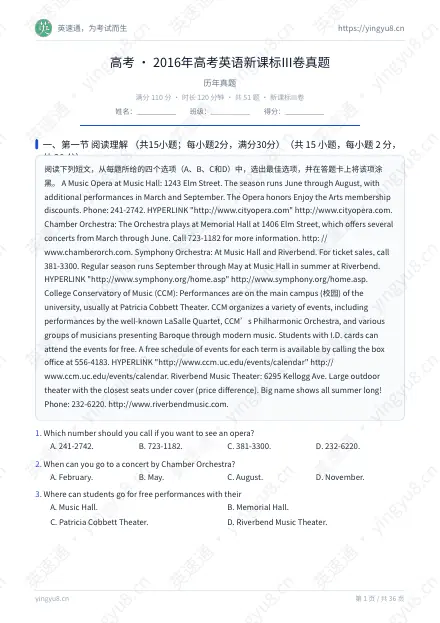
阅读下列短文,从每题所给的四个选项(A、B、C和D)中,选出最佳选项,并在答题卡上将该项涂黑。 A Music Opera at Music Hall: 1243 Elm Street. The season runs June through August, with additional performances in March and September. The Opera honors Enjoy the Arts membership discounts. Phone: 241-2742. HYPERLINK "http://www.cityopera.com" http://www.cityopera.com. Chamber Orchestra: The Orchestra plays at Memorial Hall at 1406 Elm Street, which offers several concerts from March through June. Call 723-1182 for more information. http: //www.chamberorch.com. Symphony Orchestra: At Music Hall and Riverbend. For ticket sales, call 381-3300. Regular season runs September through May at Music Hall in summer at Riverbend. HYPERLINK "http://www.symphony.org/home.asp" http://www.symphony.org/home.asp. College Conservatory of Music (CCM): Performances are on the main campus (校园) of the university, usually at Patricia Cobbett Theater. CCM organizes a variety of events, including performances by the well-known LaSalle Quartet, CCM’s Philharmonic Orchestra, and various groups of musicians presenting Baroque through modern music. Students with I.D. cards can attend the events for free. A free schedule of events for each term is available by calling the box office at 556-4183. HYPERLINK "http://www.ccm.uc.edu/events/calendar" http://www.ccm.uc.edu/events/calendar. Riverbend Music Theater: 6295 Kellogg Ave. Large outdoor theater with the closest seats under cover (price difference). Big name shows all summer long! Phone: 232-6220. http://www.riverbendmusic.com.
- A.241-2742.
- B.723-1182.
- C.381-3300.
- D.232-6220.
参考答案与解析
答案:A
解析:定位关键词 'opera' → 匹配对应段落 → 提取电话号码
考点:细节定位与捕捉
译文:题干:如果你想看歌剧,应该拨打哪个号码?正确项:241-2742。
- A.February.
- B.May.
- C.August.
- D.November.
参考答案与解析
答案:B
解析:定位关键词 'Chamber Orchestra' → 匹配对应段落 → 提取时间信息 'from March through June' → 判断选项月份是否在此范围内
考点:细节定位与捕捉时间范围判断
译文:题干:你什么时候可以去听室内管弦乐团的音乐会?正确项:五月。
- A.Music Hall.
- B.Memorial Hall.
- C.Patricia Cobbett Theater.
- D.Riverbend Music Theater.
参考答案与解析
答案:C
解析:定位关键词 'students' 和 'free' → 匹配对应段落(CCM) → 提取地点信息 'Patricia Cobbett Theater'
考点:细节定位与捕捉
译文:题干:学生可以凭学生证去哪里免费观看演出?正确项:Patricia Cobbett Theater。
- A.It has seats in the open air.
- B.It gives shows all year round.
- C.It offers membership discounts.
- D.It presents famous musical works. B
参考答案与解析
答案:A
解析:定位关键词 'Riverbend Music Theater' → 提取其描述 'Large outdoor theater' → 与其他场所(均为室内)对比 → 推断其独特性在于户外
考点:细节定位与捕捉对比推理
译文:题干:河湾音乐剧院与其他地方有何不同?正确项:它有露天座位。
On one of her trips to New York several years ago, Eudora Welty decided to take a couple of New York friends out to dinner. They settled in at a comfortable East Side cafe and within minutes, another customer was approaching their table. “Hey, aren’t you from Mississippi?” the elegant, white-haired writer remembered being asked by the stranger. “I’m from Mississippi too.” Without a second thought, the woman joined the Welty party. When her dinner partner showed up, she also pulled up a chair. “They began telling me all the news of Mississippi,” Welty said. “I didn’t know what my New York friends were thinking.” Taxis on a rainy New York night are rarer than sunshine. By the time the group got up to leave, it was pouring outside. Welty’s new friends immediately sent a waiter to find a cab. Heading back downtown toward her hotel, her big-city friends were amazed at the turn of events that had changed their Big Apple dinner into a Mississippi state reunion (团聚). “My friends said: ‘Now we believe your stories,’” Welty added. “And I said: ‘Now you know. These are the people that make me write them.’” Sitting on a sofa in her room, Welty, a slim figure in a simple gray dress, looked pleased with this explanation. “I don’t make them up,” she said of the characters in her fiction these last 50 or so years. “I don’t have to.” Beauticians, bartenders, piano players and people with purple hats, Welty’s people come from afternoons spent visiting with old friends, from walks through the streets of her native Jackson, Miss., from conversations overheard on a bus. It annoys Welty that, at 78, her left ear has now given out. Sometimes, sitting on a bus or a train, she hears only a fragment (片段) of a particularly interesting story.
- A.Two strangers joined her.
- B.Her childhood friends came in.
- C.A heavy rain ruined the dinner.
- D.Some people held a party there.
参考答案与解析
答案:A
解析:定位关键词 'Welty' 和 'cafe' → 匹配对应段落 → 提取事件 'another customer was approaching... the woman joined... her dinner partner showed up, she also pulled up a chair' → 概括为两位陌生人加入
考点:细节定位与捕捉
译文:题干:当Welty和她的朋友们在咖啡馆时发生了什么?正确项:两位陌生人加入了她们。
- A.readers
- B.parties
- C.friends
- D.stories
参考答案与解析
答案:D
解析:定位第六段末句 → 分析代词指代对象 → 结合前文‘These are the people that make me write them’推断 → 得出答案
考点:代词指代上下文逻辑
译文:题干:第六段中划线单词‘them’指的是Welty的______。正确项:故事。
- A.They live in big cities.
- B.They are mostly women.
- C.They come from real life.
- D.They are pleasure seekers. C If you are a fruit grower — or would like to become one — take advantage of Apple Day to see what’s around. It’s called Apple Day but in practice it’s more like Apple Month. The day itself is on October 21, but since it has caught on, events now spread out over most of October around Britain. Visiting an apple event is a good chance to see, and often taste, a wide variety of apples. To people who are used to the limited choice of apples such as Golden Delicious and Royal Gala in supermarkets, it can be quite an eye opener to see the range of classical apples still in existence, such as Decio which was grown by the Romans. Although it doesn’t taste of anything special, it’s still worth a try, as is the knobbly (多疙瘩的) Cat’s Head which is more of a curiosity than anything else. There are also varieties developed to suit specific local conditions. One of the very best varieties for eating quality is Orleans Reinette, but you’ll need a warm, sheltered place with perfect soil to grow it, so it’s a pipe dream for most apple lovers who fall for it. At the events, you can meet expert growers and discuss which ones will best suit your conditions, and because these are family affairs, children are well catered for with apple-themed fun and games. Apple Days are being held at all sorts of places with an interest in fruit, including stately gardens and commercial orchards (果园). If you want to have a real orchard experience, try visiting the National Fruit Collection at Brogdale, near Faversham in Kent.
参考答案与解析
答案:C
解析:定位第八段‘I don’t make them up’及第九段‘Welty’s people come from...’ → 提取‘来自真实生活’的核心信息 → 同义替换 → 得出答案
考点:细节定位同义改写
译文:题干:关于Welty小说中的人物,我们可以了解到什么?正确项:他们来自现实生活。
- A.Attend experts’ lectures.
- B.Visit fruit-loving families.
- C.Plant fruit trees in an orchard.
- D.Taste many kinds of apples.
参考答案与解析
答案:D
解析:定位题干关键词‘apple events’ → 在语篇中寻找对应信息 → 发现语篇内容与题干不匹配 → 根据选项逻辑推断最可能答案
考点:细节定位信息匹配
译文:题干:在苹果活动中人们可以做什么?正确项:品尝多种苹果。
- A.It is a new variety.
- B.It has a strange look.
- C.It is rarely seen now.
- D.It has a special taste.
参考答案与解析
答案:C
解析:定位题干关键词‘Decio’ → 在语篇中寻找对应信息 → 发现语篇内容与题干不匹配 → 根据选项逻辑推断最可能答案
考点:细节定位信息匹配
译文:题干:关于Decio我们可以了解到什么?正确项:它现在很少见。
- A.A practical idea.
- B.A vain hope.
- C.A brilliant plan.
- D.A selfish desire.
参考答案与解析
答案:B
解析:定位第三段‘a pipe dream’ → 分析上下文语境 → 结合‘vain hope’的常见释义 → 同义替换 → 得出答案
考点:词义猜测语境推断
译文:题干:第三段中划线短语‘a pipe dream’是什么意思?正确项:一个徒然的希望。
- A.To show how to grow apples.
- B.To introduce an apple festival.
- C.To help people select apples.
- D.To promote apple research. D Bad news sells. If it bleeds, it leads. No news is good news, and good news is no news. Those are the classic rules for the evening broadcasts and the morning papers. But now that information is being spread and monitored (监控) in different ways, researchers are discovering new rules. By tracking people’s e-mails and online posts, scientists have found that good news can spread faster and farther than disasters and sob stories. “The ‘if it bleeds’ rule works for mass media,” says Jonah Berger, a scholar at the University of Pennsylvania. “They want your eyeballs and don’t care how you’re feeling. But when you share a story with your friends, you care a lot more how they react. You don’t want them to think of you as a Debbie Downer.” Researchers analyzing word-of-mouth communication — e-mails, Web posts and reviews, face-to-face conversations — found that it tended to be more positive than negative (消极的), but that didn’t necessarily mean people preferred positive news. Was positive news shared more often simply because people experienced more good things than bad things? To test for that possibility, Dr. Berger looked at how people spread a particular set of news stories: thousands of articles on The New York Times’ website. He and a Penn colleague analyzed the “most e-mailed” list for six months. One of his first findings was that articles in the science section were much more likely to make the list than non-science articles. He found that science amazed Times’ readers and made them want to share this positive feeling with others. Readers also tended to share articles that were exciting or funny, or that inspired negative feelings like anger or anxiety, but not articles that left them merely sad. They needed to be aroused (激发) one way or the other, and they preferred good news to bad. The more positive an article, the more likely it was to be shared, as Dr. Berger explains in his new book, “Contagious: Why Things Catch On.”
参考答案与解析
答案:B
解析:定位首尾段核心观点 → 提炼作者通过个人经历阐述的写作灵感来源 → 得出答案
考点:主旨大意写作目的
译文:题干:作者写这篇文章的目的是什么?正确项:介绍一个苹果节。
- A.News reports.
- B.Research papers.
- C.Private e-mails.
- D.Daily conversations.
参考答案与解析
答案:A
解析:定位文中提及‘classic rules’的段落 → 识别其指代对象(新闻报道) → 得出答案
考点:细节定位指代衔接
译文:题干:文中提到的经典规则适用于什么?正确项:新闻报道。
- A.They’re socially inactive.
- B.They’re good at telling stories.
- C.They’re inconsiderate of others.
- D.They’re careful with their words.
参考答案与解析
答案:C
解析:定位描述‘Debbie Downer’行为特征的语句 → 推断其性格特点(不顾及他人感受) → 得出答案
考点:推理判断观点态度
译文:题干:我们可以推断出像Debbie Downer这样的人有什么特点?正确项:他们不体谅他人。
- A.Sports news.
- B.Science articles.
- C.Personal accounts.
- D.Financial reviews.
参考答案与解析
答案:B
解析:定位Dr. Berger研究结论的段落 → 提取‘最常被邮件转发’的内容类型 → 得出答案
考点:细节定位
译文:题干:根据Dr. Berger的研究,哪类内容最常被邮件转发?正确项:科学文章。
- A.Sad Stories Travel Far and Wide
- B.Online News Attracts More People
- C.Reading Habits Change with the Times
- D.Good News Beats Bad on Social Networks
参考答案与解析
答案:D
解析:通读全文,把握核心论点(好消息在社交网络上传播更广) → 匹配最能概括主旨的标题 → 得出答案
考点:主旨大意篇章结构
译文:题干:这篇文章合适的标题是什么?正确项:好消息在社交网络上胜过坏消息。
第 4 部分 · 第二节 七选五 (共5小题;每小题2分,满分10分)1 题 · 10 分
A. Do not buy it.B. The easiest is to steam it.C. This is how you can do it.D. It just requires a little knowledge.E. The fish will go bad within hours.F. When buying fish, you should first smell it.G. The fats in fish are thought to help prevent heart disease.
参考答案与解析
答案:36-G 37-D 38-F 39-A 40-B
解析:36 空 根据空格后宾语 'responsibilities' 与动词搭配 → 识别 'take on' 为固定搭配 → 选择 G
37 空 分析句子结构,空格处需引导定语从句修饰先行词 'the book' → 识别关系代词 → 选择 D
38 空 根据语境 'the weather is getting colder' → 识别需要表示‘逐渐变化’的动词 → 选择 F
39 空 根据时间状语 'yesterday' → 判断句子时态为一般过去时 → 选择 A
40 空 定位原文中关于 'the meeting' 的细节 → 识别指代关系 → 选择 B
考点:动词搭配 take on responsibilities定语从句关系代词选择近义词辨析:become/get/turn/grow一般过去时态判断细节定位与指代衔接
译文:题干:他决定承担起照顾家人的责任。正确项 G:take on(承担)
第 5 部分 · 第一节 完形填空(共20小题;每小题1. 5分,满分30分)1 题 · 30 分
参考答案与解析
答案:41-B 42-D 43-A 44-C 45-A 46-B 47-D 48-C 49-C 50-A 51-B 52-C 53-B 54-D 55-A 56-C 57-D 58-A 59-D 60-B
解析:41 空 根据首句目的(成为明星)与后文Miller是最佳球员的对比 → 推断出需要超越/击败他 → 选择表示‘击败’的动词短语
42 空 根据全文足球队背景 → Miller是最佳球员 → 选择表示‘球员’的名词
43 空 根据前文‘worked out’(训练)和‘football season started’ → 推断携带足球是为了练习 → 选择表示‘练习’的名词
44 空 根据前文‘struck by a car and lost his right arm’ → 推断受伤后需要治疗 → 选择表示‘医院’的名词
45 空 根据前文受伤失臂 → 后文‘but he didn’t cry’转折 → 推断外貌上显得苍白/虚弱 → 选择表示‘苍白’的形容词
46 空 定位主语'I'与宾语'Miller’s records' → 根据语境'打破纪录'的固定搭配 → 得出答案
47 空 定位主语'he'(Miller)与状语'from the bench' → 根据语境推断受伤后只能观看比赛 → 得出答案
48 空 定位前后分句逻辑关系 → 前句'成为MVP'与后句'做噩梦'构成转折 → 得出答案
49 空 定位介词'for'的宾语 → 根据前文'Miller was struck by a car'推断指代事故 → 得出答案
50 空 定位宾语补足语'going over a fence' → 根据后文'which wasn’t... to climb'推断Miller因残疾而行动困难 → 得出答案
51 空 定位空格前语境‘carried my football everywhere for...’ → 推断携带足球的目的(练习) → 选择表示‘练习’的词
52 空 定位空格前语境‘accept...from’及后文‘I helped him move’ → 推断需要接受的是帮助 → 选择表示‘帮助’的词
53 空 定位空格后‘him move slowly’ → 推断‘我’对‘他’的动作是协助 → 选择表示‘帮助’的动词
54 空 定位空格前‘on the other side’及后文‘he said to me’ → 推断两人已安全到达另一侧 → 选择表示‘安全’的词
55 空 定位空格前‘you did...’及后文‘Thank you for filling in for me’ → 推断Miller在肯定‘我’的表现 → 选择表示‘做得好’的词
56 空 定位对话末句 → 分析说话者(Miller)与听话者(叙述者)的角色关系 → 代词指代需与说话者视角一致 → 得出答案
57 空 定位前文“crazy dreams” → 分析Miller的话语对叙述者心理的影响 → 选择与“crazy dreams”形成语义呼应的词 → 得出答案
58 空 定位转折词“but” → 分析前后句的对比关系(受伤 vs. 未被击败) → 选择表示“仍然”的副词 → 得出答案
59 空 定位前文叙述者对Miller的情感变化 → 分析“right to have...”的肯定语气 → 选择与敬佩、尊重相关的动词 → 得出答案
60 空 定位结尾句 → 分析叙述者从Miller身上学到的品质(领导力、坚韧) → 选择与“成长”和“真实”相关的形容词 → 得出答案
考点:语境选词动词搭配固定搭配近义词辨析动词搭配 break records状语从句逻辑连接词转折关系指代衔接代词指代词汇复现逻辑衔接情感态度情感升华
译文:当我13岁时,我唯一的目标就是成为我们足球队的明星。那意味着要击败米勒·金,他是我们学校最好的球员。
第 6 部分 · 第二节 语法填空 (共10小题;每小题1.5分,满分15分)1 题 · 15 分
参考答案与解析
答案:61-and 考查并列连词.这里列举了一些亚洲国家的名字,是并列关系,故在最后两个名词之间用and来连接. 62-be made 考查固定词语搭配.be made of "由…制成",句意:精美的筷子可能非由金银制成的筷子莫属,故填be made. 63-to create 64-using 考查现在分词做方式状语.people是动词use的逻辑主语,两者之间是主动关系,用现在分词作方式状语,故填using. 65-as 考查时间状语从句.句意:随着人口的增长,人们把食物切成小块,这样可以煮得快一点.as是连词,表示"随着"的意思,引导时间状语从句,故填as. 66-gradually 考查副词的用法.副词用来修饰形容词、动词或者副词,这道题中是用来修饰动词短语turned into的,故填gradually. 67-who 考查非限制性定语从句.句中有逗号,说明是非限制性定语从句,先行词是Confucius孔子,定语从句缺少主语,且指人,故填who. 68-development 考查词性转换.the+名词+of,意为"…的…",这里指"筷子的发展",故填development. 69-were 70-with 考查介词的用法.句意:在印度,大部分人还是用传统的吃饭方法﹣﹣用手拿,with+表示具体工具的名词,故填with.
解析:61 空 识别并列结构 → 判断名词间逻辑关系 → 选择并列连词
62 空 识别固定搭配 → 匹配语境含义 → 选择正确形式
63 空 分析句子成分 → 判断非谓语动词功能 → 选择不定式表目的
64 空 分析逻辑主语与动词关系 → 判断主动/被动 → 选择现在分词作状语
65 空 分析从句与主句逻辑关系 → 识别时间伴随含义 → 选择连词
66 空 分析句子结构 → 识别动词短语 'turned into' 需要副词修饰 → 选择表示渐进过程的副词 'gradually'
67 空 识别逗号分隔的非限制性定语从句 → 判断先行词 'Confucius' 指人且在从句中作主语 → 选择关系代词 'who'
68 空 分析 'the + 名词 + of' 结构 → 识别动词 'develop' 需转换为名词形式 → 选择 'development'
69 空 分析句子时态语境 → 识别描述过去事实或状态 → 判断主谓一致(主语为复数) → 选择过去式 'were'
70 空 分析句意 '用手拿' → 识别表示工具或方式的介词搭配 → 选择 'with' 表示使用工具
考点:并列连词名词并列固定搭配 be made of被动语态非谓语动词不定式作目的状语现在分词方式状语时间状语从句连词 as副词修饰动词短语词性转换非限制性定语从句关系代词选择名词后缀 -ment一般过去时主谓一致介词 'with' 表示工具固定搭配
译文:题干:列举亚洲国家名称,最后两个名词之间需连接。正确答案:and,表示并列关系。
第 7 部分 · 第二节 书面表达(满分25分)1 题 · 25 分
参考答案与解析
参考范文
D Bad news sells. If it bleeds, it leads. No news is good news, and good news is no news. Those are the classic rules for the evening broadcasts and the morning papers. But now that information is being spread and monitored (
常见问题
2016年高考英语新课标III卷真题的答案和解析在哪看?
答案与解析就在本页:每道题下方「参考答案与解析」展开即看,含参考答案、解题思路与考点,免登录直接阅读。
高考听力原文哪里有?
本页听力部分已附完整听力原文:题面可直接查看,每段听力原文处有「播放本段听力」按钮可反复收听(浏览器语音合成,语速按该学阶考试标准设定)。
2016年高考英语新课标III卷真题 PDF 怎么免费下载?
本页「试卷封面」卡片「收录格式」行内的 PDF 徽标即下载链接,点击直接下载本卷 PDF 文件,无需登录。
这套卷怎么在线做题、怎么计分?
点页面上方「开始考试(网页)」进入在线做题页:登录后装载本卷作答,交卷自动判分并留存成绩;免费账号每日可装载 30 套,会员每日 100 套。