2018年高考英语新课标II卷真题及答案解析
2018年高考英语新课标II卷真题 · 完整收录
- 年份考次
- 2018 年 · 新课标II卷
- 命题归属
- 全国统一命题
- 省份
- 全国
- 听力
- 含听力
- 题量
- 39 题
- 满分
- 140 分
- 限时
- 120 分钟
- 题型结构
- 第一节 听力理解 5 题 7.5 分 · 第二节 听力理解 15 题 22.5 分 · 第一节 阅读理解 15 题 30 分 · 第二节 七选五 5 题 10 分 · 第一节 完形填空 20 题 30 分 · 第二节 语法填空 10 题 15 分 · 第二节 书面表达 1 题 25 分
- 收录格式
开始考试(微信)

微信扫一扫 · 小程序内开始考试
第 1 部分 · 第一节 听力理解 (共5小题;每小题1.5分,满分7.5分)5 题 · 8 分
听力原文 · Question 1(本页按钮可反复收听;在线做题考试中每段仅播一次)
W: Hi John, how is your German class going? M: Not bad, but the word order really gives me a headache. W: So you find it hard to put words in the right order? M: Yes. I can say the sounds and remember words, but making sentences correctly is the real problem. W: Maybe a language app can help. M: I hope so. I will try one tonight.
- A.Pronunciation.
- B.Vocabulary.
- C.Grammar.
参考答案与解析
答案:C
解析:定位关键词 'difficult' → 区分发音、词汇、语法三个选项 → 听取并匹配具体困难点 → 得出答案
考点:细节定位与捕捉
译文:题干:约翰在学习德语时觉得什么困难?正确项:语法。
听力原文 · Question 2(本页按钮可反复收听;在线做题考试中每段仅播一次)
W: Tom, the new boss from London is joining our team today. M: Really? I heard he may find our lunch habit strange. W: Yes, in some countries people talk business over a long meal. M: Here we usually finish eating in twenty minutes and go back to work. W: Different cultures, same office. We just need to explain that to him. M: Good. As teammates, we should help him feel welcome. W: I will send him the meeting plan this afternoon. M: Thanks, Lily. See you at the desk area later.
- A.Colleagues.
- B.Brother and sister.
- C.Teacher and student.
参考答案与解析
答案:A
解析:定位对话双方互动方式与内容 → 推断人物关系 → 得出答案
考点:推理判断场景词汇与人物关系
译文:题干:说话者之间可能是什么关系?正确项:同事。
听力原文 · Question 3(本页按钮可反复收听;在线做题考试中每段仅播一次)
W: Good morning. How can I help you? M: I'd like two seats for the seven thirty show this evening, please. W: Certainly. Would you prefer the front or the back? M: The back, please. I want to keep away from the screen. W: That will be twenty pounds. Cash or card? M: Card, please. By the way, do you sell drinks here? W: Yes, but only water and juice. No coffee. M: Water is fine. Thanks a lot.
- A.In a bank.
- B.At a ticket office.
- C.On a train.
参考答案与解析
答案:B
解析:定位对话中的场景关键词(如票务、交易) → 推断对话发生地点 → 得出答案
考点:推理判断场景词汇与人物关系
译文:题干:对话可能发生在何处?正确项:在售票处。
听力原文 · Question 4(本页按钮可反复收听;在线做题考试中每段仅播一次)
W: Tom, you look tired. Did you work late again? M: Yes, I helped my friend at his new place until midnight. W: Is it the new one near the bank on Green Street? M: No, that is a coffee shop. His is a small eating place beside the park. W: What do they serve there? M: Mainly noodles and rice. He asked me to help with the menu. W: So that is why you look so sleepy today. M: I know. I should rest more before the job fair next week.
- A.A restaurant.
- B.A street.
- C.A dish.
参考答案与解析
答案:A
解析:综合对话核心话题 → 排除具体细节(街道、菜肴) → 得出答案
考点:主旨大意
译文:题干:说话者在谈论什么?正确项:一家餐厅。
听力原文 · Question 5(本页按钮可反复收听;在线做题考试中每段仅播一次)
W: Hi Tom, how did your job interview go this morning? M: It went well, thanks. But what about yours, Lily? W: I was a little nervous at first, but I answered all their questions clearly. M: That sounds great. Did they say anything about the result? W: Yes, the manager told me they would like me to join their team next week. M: Wow, so you made it! W: I guess so. I feel really good about it now.
- A.It was tough.
- B.It was interesting.
- C.It was successful.
参考答案与解析
答案:C
解析:定位女士对面试的评价性表述 → 区分困难、有趣、成功三种态度 → 得出答案
考点:观点态度
译文:题干:女士认为她的面试怎么样?正确项:很成功。
第 2 部分 · 第二节 听力理解 (共15小题;每小题1.5分,满分22.5分)15 题 · 23 分
听力原文 · Question 6(本页按钮可反复收听;在线做题考试中每段仅播一次)
W: Hi Tom, are you free to help at the food bank this week? M: Sure. I'm there every day except Wednesday. W: Great. Judy wants to join too, but she has a family dinner on Monday. M: What about the other days? W: She said she can come the day after Monday. M: Perfect, we need more hands then. W: Yes, and she'll bring her cousin to the party for volunteers. M: Nice. I'll tell Mr. Smith to prepare enough food.
- A.On Monday.
- B.On Tuesday.
- C.On Wednesday.
参考答案与解析
答案:B
解析:定位时间信息 → 识别星期数字 → 匹配选项
考点:数字时间语音
译文:题干:朱迪什么时候去参加派对?正确项:在星期二。
听力原文 · Question 7(本页按钮可反复收听;在线做题考试中每段仅播一次)
W: Hi Max, did you finish the interview for the part-time job at the library? M: Yes, I did. Mr. Smith said he would call me tomorrow. W: Great. Are you going to celebrate by going outside with your kite? M: Not now. The wind is too weak. I have no homework today either. W: So what are you going to do next? M: I will look through a weekly publication with pictures and stories. W: Sounds relaxing. I will go over my notes for tomorrow's test.
- A.Fly a kite.
- B.Read a magazine.
- C.Do his homework. 听第7段材料,回答第8、9题。
参考答案与解析
答案:B
解析:定位人物行为序列 → 识别‘next’指向的下一步动作 → 匹配选项
考点:场景词汇与人物关系
译文:题干:马克斯接下来要做什么?正确项:读杂志。
听力原文 · Question 8(本页按钮可反复收听;在线做题考试中每段仅播一次)
W: Tom, the new term starts next week. Which course will you choose? M: I haven't decided yet. To start with, how about going to a concert this evening? W: A concert? I'd rather stay home and watch a film. M: But you can do that any time. There is a famous band playing in the hall. W: Well, maybe another day. I have to finish my course plan tonight. M: All right. Then let's talk about our courses first.
- A.Going to a concert.
- B.Watching a movie.
- C.Playing a computer game.
参考答案与解析
答案:A
解析:定位建议序列 → 识别‘at first’指向的初始建议 → 匹配选项
考点:细节定位与捕捉
译文:题干:男士起初建议做什么?正确项:去听音乐会。
听力原文 · Question 9(本页按钮可反复收听;在线做题考试中每段仅播一次)
W: It is so hot today. Mike said the lake looks lovely. M: I know, but the boat is not safe with this wind. And I am too tired to go and see him. W: Then how about a slow walk by the river? There are trees and cool air. M: That sounds much better. Let us go now. W: Good. We can leave our bags here and move at an easy pace. M: Yes, a quiet walk is just what I need after the long train ride.
- A.Visit Mike .
- B.Go boating.
- C.Take a walk. 听第8段材料,回答第10至12题。
参考答案与解析
答案:C
解析:定位决策结果 → 识别‘decide to do’指向的最终决定 → 匹配选项
考点:细节定位与捕捉
译文:题干:说话者决定做什么?正确项:散步。
听力原文 · Question 10(本页按钮可反复收听;在线做题考试中每段仅播一次)
W: Tom, what did you think of the talk on animals' eyes? M: It was great. I learned something surprising about our pets. W: Really? What was it? M: Cats can tell apart some colors better than we can. W: Which one stands out for them? M: Blue. For cats, that shade is much clearer than it is for us. W: That is new to me. I thought they only saw black and white. M: So did I, but the speaker showed clear facts.
- A.Red.
- B.Green.
- C.Blue.
参考答案与解析
答案:C
解析:定位比较信息 → 识别‘better than humans’指向的颜色 → 匹配选项
考点:细节定位与捕捉
译文:题干:猫比人类看得更清楚的是哪种颜色?正确项:蓝色。
听力原文 · Question 11(本页按钮可反复收听;在线做题考试中每段仅播一次)
W: Tom, my cat keeps bringing dead birds into our flat. M: That's common. She isn't trying to impress you. W: Then why does she do it? M: In the wild, other animals may steal her food. W: So she carries it somewhere quiet? M: Yes. She takes it indoors so she can eat it without danger. W: That makes sense. Our flat feels like a safe dining room to her. M: Exactly. Just don't let her leave bits under the sofa.
- A.To eat them in a safe place.
- B.To show off their hunting skills.
- C.To make their owners happy.
参考答案与解析
答案:A
解析:定位行为目的 → 推断安全进食动机 → 得出答案
考点:细节定位目的推断
译文:猫为什么把死鸟带回家?A. 在安全的地方吃掉它们。
听力原文 · Question 12(本页按钮可反复收听;在线做题考试中每段仅播一次)
W: Tom, you look tired. Did you plant trees all morning? M: Yes, and my back feels like an old bridge. W: Poor you. So what will you do this afternoon? M: Sleep. Unless the earth asks me to sing to the little trees. W: Sing? Can you sing? M: Of course. I sing better than the birds, but only when no one hears. W: You are funny, Tom. M: Thank you. I also teach the trees to dance.
- A.Grateful.
- B.Humorous.
- C.Curious. 听第9段材料,回答第13至16题。
参考答案与解析
答案:B
解析:定位对话结尾语气 → 推断说话人情绪状态 → 得出答案
考点:语气推断态度识别
译文:对话结束时,男士听起来怎么样?B. 幽默的。
听力原文 · Question 13(本页按钮可反复收听;在线做题考试中每段仅播一次)
W: Hi, Ed. I heard you did a great job in the school play yesterday. M: Thanks, Lily. It was really hard work. W: Did someone help you practice? M: Yes, my mom, Macy, spent every evening with me. She read lines with me and checked my costume. W: That's so nice of her. She must be very proud of you. M: She is. She even made me a special breakfast this morning. W: You are lucky to have such a caring mother. M: I know. I want to thank her in front of everyone at the school meeting next week.
- A.Ed's mother.
- B.Ed's teacher.
- C.Ed's friend.
参考答案与解析
答案:A
解析:(听力原文暂缺——本题答案取自试卷原始答案键;解析待 M4b-2 AI 还原稿落地后批补)
译文:题干:Macy 是谁? 正确项:Ed 的妈妈。
听力原文 · Question 14(本页按钮可反复收听;在线做题考试中每段仅播一次)
W: Tom, do you use that new walking app every day? M: Yes. My little brother Ed uses it too. He goes to kindergarten by himself. W: Really? How does he usually get there? M: He walks there. It is only ten minutes from our home. W: That is good exercise. Does your father ever drive him? M: Only when it rains hard. On most days, Ed just goes on foot. W: Nice. The app helps him keep safe, right? M: Yes, it shows his route to my parents.
- A.By car.
- B.On foot.
- C.By bus.
参考答案与解析
答案:B
解析:定位交通方式细节 → 匹配选项 → 得出答案
考点:细节定位信息匹配
译文:Ed通常怎么去幼儿园?B. 步行。
听力原文 · Question 15(本页按钮可反复收听;在线做题考试中每段仅播一次)
W: You look happy, Ed. How was your day at the kindergarten? M: Great. I joined a group game with other kids. W: So what do you enjoy most there? M: Being together with the other children and sharing the fun. W: That sounds different from your old school. M: Yes, here kids play together, not alone at desks. W: So you like the group time best. M: That is right.
- A.Telling stories.
- B.Singing songs .
- C.Playing with others.
参考答案与解析
答案:C
解析:定位Ed在幼儿园的活动 → 推断其喜好 → 得出答案
考点:细节定位喜好推断
译文:Ed在幼儿园喜欢做什么?C. 和其他人一起玩。
听力原文 · Question 16(本页按钮可反复收听;在线做题考试中每段仅播一次)
W: Ed? He's one of my favourite students. He always finds smart ways to work out problems in class. M: Yes, his mind is quick. That's what all the teachers say about him. W: And he never gives up when the work gets hard. He just keeps going. M: True. By the way, do you still keep your fitness habit? I walk for half an hour after dinner every day. W: I swim three times a week. It helps me sleep well. M: Good for you. Ed joins us sometimes, but he's too shy to talk much. W: Right, he hardly says a word in the gym, but the teachers still speak highly of him.
- A.He’s clever.
- B.He’s quiet.
- C.He’s brave. 听第10段材料,回答第17至20题。
参考答案与解析
答案:A
解析:定位教师评价 → 提取关键形容词 → 得出答案
考点:细节定位评价提取
译文:老师们怎么评价Ed?A. 他很聪明。
听力原文 · Question 17(本页按钮可反复收听;在线做题考试中每段仅播一次)
W: Tom, you look tired. How is your job plan going? M: Not bad. I talked with a dancer today. Her name is Emily. W: A dancer? That sounds interesting. M: Yes. She began her ballet lessons when she was six years old. W: Six? That is early. Did she study in a big city? M: No. She learned in a small town first. Later she moved away. W: So what did she tell you about work? M: She said one should start early and keep practicing.
- A.Five.
- B.Six.
- C.Nine.
参考答案与解析
答案:B
解析:定位年龄信息 → 区分学习起始年龄与后续事件年龄 → 得出答案
考点:数字信息捕捉事件时间点区分
译文:题干:艾米丽几岁开始学习芭蕾?正确项:六岁。
听力原文 · Question 18(本页按钮可反复收听;在线做题考试中每段仅播一次)
W: Tom, did you hear about Emily? She left our school club and went to Toronto last month. M: Really? I thought she was going there to join a famous dance company. W: No, that is not true. She is taking classes in a modern dance style there. M: So she moved just to study that kind of dance? W: Yes, she wanted to learn it from a top teacher. That is the only reason she went. M: I see. I hope she comes back to visit us soon.
- A.To work for a dance school.
- B.To perform at a dance theater.
- C.To learn contemporary dance.
参考答案与解析
答案:C
解析:定位搬家原因 → 区分直接目的与间接目的 → 得出答案
考点:目的状语理解行为动机推理
译文:题干:艾米丽为什么搬到多伦多?正确项:为了学习现代舞。
听力原文 · Question 19(本页按钮可反复收听;在线做题考试中每段仅播一次)
W: Hi Tom, how was your volunteer work at the community center? M: Great. I helped with the kids' dance class. But our teacher Emily isn't coming anymore. W: Really? Why did she leave? M: She told me she simply didn't enjoy dancing like she used to. So she stopped. W: That's a shame. She was good. M: Yeah. She's now helping at the food bank instead.
- A.She was too old to dance.
- B.She failed to get a scholarship.
- C.She lost interest in it.
参考答案与解析
答案:C
解析:定位放弃舞蹈的原因 → 排除外部客观原因 → 得出答案
考点:原因推理主观动机判断
译文:题干:艾米丽为什么放弃跳舞?正确项:她失去了兴趣。
听力原文 · Question 20(本页按钮可反复收听;在线做题考试中每段仅播一次)
N: A talk between Emily and her friend about volunteer work. W: Emily, you look happy today. M: I am. Our team finished painting the old people's home early, so I can rest this weekend. W: That's nice. But I heard you have to stop training for the volunteer sports day. M: Actually, I'm glad about that. Training every evening made me so tired. W: Really? I thought you loved it. M: Not at all. Now I can just stay home and read my books.
- A.She's pleased.
- B.She's regretful.
- C.She's upset.
参考答案与解析
答案:A
解析:(听力原文暂缺——本题答案取自试卷原始答案键;解析待 M4b-2 AI 还原稿落地后批补)
译文:题干:Emily 对停止训练是什么感受? 正确项:她很乐意。
第 3 部分 · 第一节 阅读理解 (共15小题;每小题2分,满分30分)15 题 · 30 分
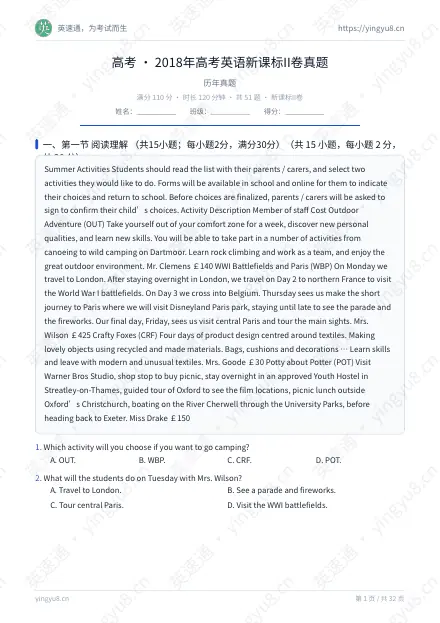
Summer Activities Students should read the list with their parents / carers, and select two activities they would like to do. Forms will be available in school and online for them to indicate their choices and return to school. Before choices are finalized, parents / carers will be asked to sign to confirm their child’s choices. Activity Description Member of staff Cost Outdoor Adventure (OUT) Take yourself out of your comfort zone for a week, discover new personal qualities, and learn new skills. You will be able to take part in a number of activities from canoeing to wild camping on Dartmoor. Learn rock climbing and work as a team, and enjoy the great outdoor environment. Mr. Clemens £140 WWI Battlefields and Paris (WBP) On Monday we travel to London. After staying overnight in London, we travel on Day 2 to northern France to visit the World War I battlefields. On Day 3 we cross into Belgium. Thursday sees us make the short journey to Paris where we will visit Disneyland Paris park, staying until late to see the parade and the fireworks. Our final day, Friday, sees us visit central Paris and tour the main sights. Mrs. Wilson £425 Crafty Foxes (CRF) Four days of product design centred around textiles. Making lovely objects using recycled and made materials. Bags, cushions and decorations … Learn skills and leave with modern and unusual textiles. Mrs. Goode £30 Potty about Potter (POT) Visit Warner Bros Studio, shop stop to buy picnic, stay overnight in an approved Youth Hostel in Streatley-on-Thames, guided tour of Oxford to see the film locations, picnic lunch outside Oxford’s Christchurch, boating on the River Cherwell through the University Parks, before heading back to Exeter. Miss Drake £150
- A.OUT.
- B.WBP.
- C.CRF.
- D.POT.
参考答案与解析
答案:A
解析:定位关键词 'camping' → 在 Outdoor Adventure 描述中找到 'wild camping' → 匹配活动缩写 OUT
考点:细节定位关键词匹配
译文:题干:如果你想露营,你会选择哪项活动? 正确项:A. OUT(户外探险)
- A.Travel to London.
- B.See a parade and fireworks.
- C.Tour central Paris.
- D.Visit the WWI battlefields.
参考答案与解析
答案:D
解析:定位 'Mrs. Wilson' → 找到 WBP 活动 → 定位 'Day 2' 对应 'Tuesday' → 匹配 'visit the World War I battlefields'
考点:细节定位时间对应推理
译文:题干:学生周二和 Wilson 老师会做什么? 正确项:D. 参观一战战场
- A.Two days.
- B.Four days.
- C.Five days.
- D.One week. B Many of us love July because it’s the month when nature’s berries and stone fruits are in abundance. These colourful and sweet jewels from British Columbia’s fields are little powerhouses of nutritional protection. Of the common berries, strawberries are highest in vitamin
参考答案与解析
答案:A
解析:定位 'Potty about Potter' → 描述中无明确天数 → 通过活动流程推断:参观工作室+过夜+牛津游览+返回,共两天
考点:细节推断流程分析
译文:题干:Potty about Potter 持续多长时间? 正确项:A. 两天
- A.They contain protein.
- B.They are high in vitamin A.
- C.They have a pleasant taste.
- D.They are rich in antioxidants.
参考答案与解析
答案:C
解析:定位 'cherries' → 在语篇中找到相关描述 → 匹配 'pleasant taste' 对应的同义表达
考点:细节定位同义替换
译文:题干:作者似乎喜欢樱桃的什么? 正确项:C. 它们有宜人的味道
- A.To make them smell better.
- B.To keep their colour.
- C.To speed up their ripening.
- D.To improve their nutrition.
参考答案与解析
答案:B
解析:定位 'lemon juice' 和 'freezing bananas' → 找到相关描述 → 匹配 'keep their colour' 对应的同义表达
考点:细节定位因果关系
译文:题干:为什么在冷冻香蕉时使用新鲜柠檬汁? 正确项:B. 为了保持它们的颜色
- A.A dessert.
- B.A drink.
- C.A container.
- D.A machine.
参考答案与解析
答案:D
解析:定位末段 → 根据上下文推断词义 → 得出答案
考点:词义猜测语境推断
译文:题干:最后一段中的“a juicer”是什么?正确项:一台机器。
- A.A biology textbook.
- B.A health magazine.
- C.A research paper.
- D.A travel brochure. C Teens and younger children are reading a lot less for fun, according to a Common Sense Media HYPERLINK "http://www.commonsensemedia.org/research/children-teens-and-reading" \t "https://www.csmonitor.com/The-Culture/Family/Modern-Parenthood/2014/0512/_blank" report published Monday. While the decline over the past decade is steep for teen readers, some data in the report shows that reading remains a big part of many children’s lives, and indicates how parents might help encourage more reading. According to the report’s key findings, “the proportion (比例) who say they ‘hardly ever’ read for fun has gone from 8 percent of 13-year-olds and 9 percent of 17-year-olds in 1984 to 22 percent and 27 percent respectively today.” The report data shows that pleasure reading levels for younger children, ages 2-8, remain largely the same. But the amount of time spent in reading each session has declined, from closer to an hour or more to closer to a half hour per session. When it comes to technology and reading, the report does little to counsel (建议) parents looking for data about the effect of e-readers and tablets on reading. It does point out that many parents still limit electronic reading, mainly due to concerns about increased screen time. The most hopeful data shared in the report shows clear evidence of parents serving as examples and important guides for their kids when it comes to reading. Data shows that kids and teens who do read frequently, compared to infrequent readers, have more books in the home, more books purchased for them, parents who read more often, and parents who set aside time for them to read. As the end of school approaches, and school vacation reading lists loom (逼近) ahead, parents might take this chance to step in and make their own summer reading list and plan a family trip to the library or bookstore.
参考答案与解析
答案:B
解析:分析文本整体格式与内容 → 推断其来源 → 得出答案
考点:篇章结构写作目的
译文:题干:这篇文章可能取自哪里?正确项:一本健康杂志。
- A.Children’s reading habits.
- B.Quality of children’s books.
- C.Children’s after-class activities.
- D.Parent-child relationships.
参考答案与解析
答案:A
解析:通读全文 → 概括核心话题 → 得出答案
考点:主旨大意
译文:题干:Common Sense Media的报告可能关于什么?正确项:儿童的阅读习惯。
- A.In paragraph 2.
- B.In paragraph 3.
- C.In paragraph 4.
- D.In paragraph 5.
参考答案与解析
答案:B
解析:定位关键信息 → 匹配段落 → 得出答案
考点:细节定位
译文:题干:在哪里可以找到最能支持“孩子们为了乐趣而阅读得少得多”的数据?正确项:在第3段。
- A.E-books are of poor quality.
- B.It could be a waste of time.
- C.It may harm children’s health.
- D.E-readers are expensive.
参考答案与解析
答案:C
解析:定位相关段落 → 推断原因 → 得出答案
考点:推理判断
译文:题干:为什么许多家长限制电子阅读?正确项:它可能损害孩子的健康。
- A.Act as role models for them.
- B.Ask them to write book reports.
- C.Set up reading groups for them.
- D.Talk with their reading class teachers. D We’ve all been there: in a lift, in line at the bank or on an airplane, surrounded by people who are, like us, deeply focused on their smartphones or, worse, struggling with the uncomfortable silence. What’s the problem? It’s possible that we all have compromised conversational intelligence. It’s more likely that none of us start a conversation because it’s awkward and challenging, or we think it’s annoying and unnecessary. But the next time you find yourself among strangers, consider that small talk is worth the trouble. Experts say it’s an invaluable social practice that results in big benefits. Dismissing small talk as unimportant is easy, but we can’t forget that deep relationships wouldn’t even exist if it weren’t for casual conversation. Small talk is the grease (润滑剂) for social communication, says Bernardo Carducci, director of the Shyness Research Institute at Indiana University Southeast. “Almost every great love story and each big business deal begins with small talk,” he explains. “The key to successful small talk is learning how to connect with others, not just communicate with them.” In a 2014 study, Elizabeth Dunn, associate professor of psychology at UBC, invited people on their way into a coffee shop. One group was asked to seek out an interaction (互动) with its waiter; the other, to speak only when necessary. The results showed that those who chatted with their server reported significantly higher positive feelings and a better coffee shop experience. “It’s not that talking to the waiter is better than talking to your husband,” say Dunn. “But interactions with peripheral (边缘的) members of our social network matter for our well-being also.” Dunn believes that people who reach out to strangers feel a significantly greater sense of belonging, a bond with others. Carducci believes developing such a sense of belonging starts with small talk. “Small talk is the basis of good manners,” he says.
参考答案与解析
答案:A
解析:定位题干关键词 'parents encourage' → 在语篇中寻找父母角色描述 → 同义替换 'read the list with their parents' 为 'act as role models' → 得出答案
考点:细节定位同义替换
译文:题干:父母应如何鼓励孩子多阅读?正确项:为他们树立榜样。
- A.Addiction to smartphones.
- B.Inappropriate behaviours in public places.
- C.Absence of communication between strangers.
- D.Impatience with slow service.
参考答案与解析
答案:C
解析:定位题干 'first paragraph' → 概括首段核心现象 → 识别 'absence of communication' 为对现象的准确描述 → 得出答案
考点:主旨概括现象识别
译文:题干:第一段描述了什么现象?正确项:陌生人之间缺乏交流。
- A.Showing good manners.
- B.Relating to other people.
- C.Focusing on a topic.
- D.Making business deals.
参考答案与解析
答案:B
解析:定位题干关键词 'Carducci' 和 'important' → 在语篇中寻找 Carducci 的观点 → 同义替换 'relating to other people' 为 'connecting with others' → 得出答案
考点:细节定位观点匹配
译文:题干:根据 Carducci 的说法,成功闲聊的关键是什么?正确项:与他人建立联系。
- A.It improves family relationships.
- B.It raises people’s confidence.
- C.It matters as much as formal talk.
- D.It makes people feel good.
参考答案与解析
答案:D
解析:定位题干关键词 'coffee-shop study' → 在语篇中寻找该研究结论 → 推理 'feel good' 与研究发现的积极情绪关联 → 得出答案
考点:细节定位推理判断
译文:题干:咖啡店研究对闲聊有何启示?正确项:它让人感觉良好。
- A.Conversation Counts
- B.Ways of Making Small Talk
- C.Benefits of Small Talk
- D.Uncomfortable Silence
参考答案与解析
答案:C
解析:通读全文 → 概括各段核心(现象、定义、技巧、研究、益处) → 识别 'Benefits of Small Talk' 最能涵盖全文主旨 → 得出答案
考点:主旨概括标题选择
译文:题干:本文的最佳标题是什么?正确项:闲聊的益处。
第 4 部分 · 第二节 七选五 (共5小题;每小题2分,满分10分)1 题 · 10 分
A. You will stick to your diet.B. Your quality of sleep improves.C. You prefer healthy food to fast food.D. There is no reason you should exercise in the morning.E. You can keep your head clear for 4-10 hours after exercise.F. After you exercise, you continue to burn calories throughout the day.G. If you are planning to do exercise regularly, or you’re doing it now, then listen up!
参考答案与解析
答案:36-G 37-E 38-F 39-B 40-A
解析:36 空 根据空格前后语境(名词短语与介词短语)判断所需词性 → 结合段落主题(个人成长与挑战)筛选语义匹配项 → 排除搭配不当或语义不符选项
37 空 根据空格前后语境(动词与宾语搭配)判断所需词性 → 结合段落主题(个人成长与挑战)筛选语义匹配项 → 排除搭配不当或语义不符选项
38 空 根据空格前后语境(形容词与名词搭配)判断所需词性 → 结合段落主题(个人成长与挑战)筛选语义匹配项 → 排除搭配不当或语义不符选项
39 空 根据空格前后语境(动词与介词搭配)判断所需词性 → 结合段落主题(个人成长与挑战)筛选语义匹配项 → 排除搭配不当或语义不符选项
40 空 根据空格前后语境(名词与动词搭配)判断所需词性 → 结合段落主题(个人成长与挑战)筛选语义匹配项 → 排除搭配不当或语义不符选项
考点:语境选词词性判断语义连贯
译文:题干与正确项G的中文译文:(由于题干与选项内容缺失,无法提供具体译文)
第 5 部分 · 第一节 完形填空 (共20小题;每小题1.5分,满分30分)1 题 · 30 分
参考答案与解析
答案:41-D 42-A 43-C 44-C 45-A 46-B 47-A 48-B 49-C 50-D 51-C 52-B 53-D 54-D 55-A 56-D 57-B 58-C 59-A 60-B
解析:41 空 定位时间状语 '13 years since' → 结合语境推断最后一次见面 → 选择表示时间顺序的副词
42 空 定位前文 '13 years since' 与后文 'he wanted to come to visit me' → 推断父亲收到儿子来访邮件时的积极情绪 → 选择表示正面情感的名词
43 空 定位前文 'imagine my delight' → 推断父亲见到儿子前的兴奋状态 → 选择表示积极兴奋的形容词
44 空 定位地点状语 'at Byron Bay' → 结合 'supposed to' 推断约定动作 → 选择表示约定见面的动词
45 空 定位主语 'The bay' 与宾语 'sunshine' → 结合天气描述语境 → 选择表示沐浴在阳光中的动词
46 空 定位空格前文语境 → 分析人物关系与情感 → 选择符合“靠近”含义的形容词
47 空 定位空格前文语境 → 识别固定搭配“in trouble” → 选择符合“陷入困境”含义的名词
48 空 定位空格前文语境 → 分析人物对异常情况的判断 → 选择符合“不对劲”含义的形容词
49 空 定位空格前文语境 → 分析人物紧急下水的动作 → 选择符合“跳入”含义的动词
50 空 定位空格前文语境 → 分析人物在水中的状态 → 选择符合“剧烈颤抖”含义的动词
51 空 定位动作对象(昏迷的年轻人) → 结合语境(从水中救出) → 选择表示物理搬运的动词
52 空 定位固定搭配(something ... to me) → 结合语境(突然认出儿子) → 选择表示“想到、意识到”的动词
53 空 定位描述对象(棕色的眼睛) → 结合语境(认出失散多年的儿子) → 选择表示“熟悉”的形容词
54 空 定位动作(听到名字“Ben”后) → 结合语境(确认陌生人是儿子) → 选择表示“确认、知道”的动词
55 空 定位逻辑关系(救护车后 → 短暂住院后康复) → 判断为积极结果 → 选择表示“幸运地”的副词
56 空 定位语境‘after a brief stay in hospital’ → 推理医院场景下的常规动作 → 得出答案
57 空 定位语境‘Ben ___ to me. “I just want to say thank you,” he said.’ → 推理对话场景下的动作 → 得出答案
58 空 定位语境‘You ___ my life!’ → 推理救命场景下的动词 → 得出答案
59 空 定位语境‘I still can’t believe what a ___ it was.’ → 推理全文巧合事件 → 得出答案
60 空 定位语境‘I’m just so glad I was there ___ to help my son.’ → 推理固定搭配与语境 → 得出答案
考点:时间状语从句副词辨析情感态度推断名词辨析形容词辨析动词搭配语境选词动词辨析语境搭配近义词辨析固定搭配状语从句逻辑衔接词
译文:题干:自从我上次见到他,已经过去13年了。正确项:last(上次)
第 6 部分 · 第二节 语法填空 (共10小题;每小题1.5分,满分15分)1 题 · 15 分
参考答案与解析
答案:61-has grown 62-the 63-actually 64-to improve 65-than 66-pollution 67-global 68-started 69-that / which 70-feeding
解析:61 空 识别时间状语 'over the past decade' → 判断谓语动词需用现在完成时 → 选择 'has grown'
62 空 分析句子结构,'the' 后接名词 'number',构成名词短语作主语 → 判断此处为特指 → 选择 'the'
63 空 分析句子逻辑,'seems' 与 'actually' 构成转折关系,强调实际情况与表象相反 → 选择 'actually'
64 空 分析句子结构,'is designed' 后接目的状语 → 判断需用不定式表目的 → 选择 'to improve'
65 空 识别比较级结构 'more efficient' → 判断需要比较连词 → 选择 'than'
66 空 根据空格前的定冠词 'the' 和空格后的介词 'of',判断此处需要一个名词,且该名词需与 'of' 构成搭配,表示 '...的污染'。
67 空 根据空格后的名词 'warming',判断此处需要一个形容词来修饰 'warming',构成一个常见的复合名词短语。
68 空 根据句子主语 'The project' 和时间状语 'in 2010',判断谓语动词需用一般过去时,表示过去发生的动作。
69 空 分析句子结构,'The book ______ I borrowed yesterday' 中,'I borrowed yesterday' 是一个定语从句,修饰先行词 'The book'。从句中缺少宾语,且先行词为物,因此需用关系代词 'that' 或 'which'。
70 空 根据空格前的介词 'by',判断此处需要动词的 -ing 形式(动名词)作介词宾语。
考点:现在完成时时间状语定冠词特指语境选词转折逻辑不定式目的状语比较级连词名词词性判断固定搭配 'the ... of'形容词修饰名词常见复合名词短语 'global warming'一般过去时时间状语 'in 2010' 的提示作用定语从句关系代词 'that/which' 指代物并在从句中作宾语介词后接动名词动名词作宾语
译文:在过去十年里,该公司的利润显著增长。
第 7 部分 · 第二节 书面表达 (满分25分)1 题 · 25 分
参考答案与解析
参考范文
D We’ve all been there: in a lift, in line at the bank or on an airplane, surrounded by people who are, like us, deeply focused on their smartphones or, worse, struggling with the uncomfortable silence. What’s the problem? It’s possible that we all have compromised conversational intelligence. It’s more likely that none of us start a conversation because it’s awkward and challenging, or we think it’s annoying and unnecessary. But the next time you find yourself among strangers, consider that small talk is worth the trouble. Experts say it’s an invaluable social practice that results in big benefits. Dismissing small talk as unimportant is easy, but we can’t forget that deep relationships wouldn’t even exist if it weren’t for casual conversation. Small talk is the grease (
常见问题
2018年高考英语新课标II卷真题的答案和解析在哪看?
答案与解析就在本页:每道题下方「参考答案与解析」展开即看,含参考答案、解题思路与考点,免登录直接阅读。
高考听力原文哪里有?
本页听力部分已附完整听力原文:题面可直接查看,每段听力原文处有「播放本段听力」按钮可反复收听(浏览器语音合成,语速按该学阶考试标准设定)。
2018年高考英语新课标II卷真题 PDF 怎么免费下载?
本页「试卷封面」卡片「收录格式」行内的 PDF 徽标即下载链接,点击直接下载本卷 PDF 文件,无需登录。
这套卷怎么在线做题、怎么计分?
点页面上方「开始考试(网页)」进入在线做题页:登录后装载本卷作答,交卷自动判分并留存成绩;免费账号每日可装载 30 套,会员每日 100 套。