2018年高考英语新课标I卷真题及答案解析
2018年高考英语新课标I卷真题 · 完整收录
- 年份考次
- 2018 年 · 新课标I卷
- 命题归属
- 全国统一命题
- 省份
- 全国
- 听力
- 含听力
- 题量
- 39 题
- 满分
- 140 分
- 限时
- 120 分钟
- 题型结构
- 第一节 听力理解 5 题 7.5 分 · 第二节 听力理解 15 题 22.5 分 · 第一节 阅读理解 15 题 30 分 · 第二节 七选五 5 题 10 分 · 第一节 完形填空 20 题 30 分 · 第二节 语法填空 10 题 15 分 · 第二节 书面表达 1 题 25 分
- 收录格式
开始考试(微信)

微信扫一扫 · 小程序内开始考试
第 1 部分 · 第一节 听力理解 (共5小题;每小题1.5分,满分7.5分)5 题 · 8 分
听力原文 · Question 1(本页按钮可反复收听;在线做题考试中每段仅播一次)
W: Hi James, are you free tomorrow afternoon? M: Sorry, Lily. I have to prepare something for the science club. W: What is it about? M: I will speak to the whole school about a new learning app. W: Sounds great. I thought you were going to watch a show or write a report. M: No, that was last week. Tomorrow is the big day for my speech.
- A.Watch a TV program.
- B.Give a talk.
- C.Write a report.
参考答案与解析
答案:B
解析:定位时间状语 tomorrow → 匹配动作 give a talk → 排除 watch/write
考点:时间状语定位动作匹配
译文:詹姆斯明天要做什么?A. 看电视节目。B. 做一个演讲。C. 写一份报告。
听力原文 · Question 2(本页按钮可反复收听;在线做题考试中每段仅播一次)
M: Lily, I heard you met Mr. Smith from Canada yesterday. W: Yes, Tom. He looked lost at the bus stop, so I showed him the way to the museum. M: That was kind of you. Did he give you a gift? W: No, I did not want anything. I just felt happy to help. M: You always give a hand to others. W: It is normal. When I travel, I hope someone will do the same for me.
- A.She’s generous.
- B.She’s curious.
- C.She’s helpful.
参考答案与解析
答案:C
解析:捕捉女士行为描述 → 推断其性格特征 → 匹配 helpful
考点:行为推断性格同义替换
译文:关于这位女士,我们可以说什么?A. 她很慷慨。B. 她很好奇。C. 她乐于助人。
听力原文 · Question 3(本页按钮可反复收听;在线做题考试中每段仅播一次)
W: Tom, do you work out in the morning? M: Not really. I used to run at six thirty, but now I swim at eight thirty. W: So you have a new habit. What about the train to the city? M: The early one is gone. My train leaves at ten thirty, so I have time for a short run. W: Good. You can keep your fitness plan and still catch it.
- A.At 6:30.
- B.At 8:30.
- C.At 10:30.
参考答案与解析
答案:C
解析:定位时间信息 → 区分出发时间与到达时间 → 选择 10:30
考点:数字语音辨析时间信息区分
译文:火车什么时候出发?A. 6:30。B. 8:30。C. 10:30。
听力原文 · Question 4(本页按钮可反复收听;在线做题考试中每段仅播一次)
W: Tom, how do you get to your office every morning? M: I usually drive, but the traffic is bad. What about you, Lily? W: I live near the bank, so I just walk to my workplace. M: That sounds healthy. How long does it take? W: About twenty minutes. I never ride a bike or take a car. M: Good for you. My sister works in a hospital, and she walks too.
- A.By car.
- B.On foot.
- C.By bike.
参考答案与解析
答案:B
解析:捕捉交通方式描述 → 排除开车/骑车 → 推断步行
考点:场景词汇交通方式推断
译文:这位女士怎么去上班?A. 开车。B. 步行。C. 骑自行车。
听力原文 · Question 5(本页按钮可反复收听;在线做题考试中每段仅播一次)
W: Are you going to the school music club meeting after class, Tom? M: Yes, Lily. Mr. Smith said we can practise our new song there. Did you finish the history homework? W: Not yet. I will do it with you in the classroom later. We are in the same group, right? M: Right. See you at the school gate at five thirty. W: OK. Don't forget our song book. M: I won't.
- A.Classmates.
- B.Teacher and student.
- C.Doctor and patient.
参考答案与解析
答案:A
解析:捕捉对话场景与称呼 → 推断人物关系 → 匹配 classmates
考点:场景词汇人物关系推断
译文:说话者之间可能是什么关系?A. 同学。B. 老师和学生。C. 医生和病人。
第 2 部分 · 第二节 听力理解 (共15小题;每小题1.5分,满分22.5分)15 题 · 23 分
听力原文 · Question 6(本页按钮可反复收听;在线做题考试中每段仅播一次)
W: Tom, you look tired after the volunteer work. M: Yes. I was thinking about my old friend Lily. She left school before finishing her studies. W: That's a pity. Did she tell you why? M: She said she made a big mistake years ago. She wishes she had stayed and got her degree. W: I hope she can go back one day. M: She is trying. She now studies online after our service hours.
- A.Giving up her research.
- B.Dropping out of college.
- C.Changing her major.
参考答案与解析
答案:B
解析:定位关键词regret → 听取女士陈述的遗憾内容 → 匹配选项B的同义改写
考点:细节定位同义替换
译文:题干:女士后悔什么?正确项:从大学辍学。
听力原文 · Question 7(本页按钮可反复收听;在线做题考试中每段仅播一次)
W: Good morning, Mr. Smith. I'm here about the part-time job in your lab. M: Nice to meet you, Lily. Your form says you once studied the air, water and living things around us. Is that still your main interest? M: No, I changed my mind. These days I care most about how plants, animals and their surroundings affect each other. W: That sounds like field work. We need someone to help record data outdoors on weekends. M: Perfect. I can start this Saturday at seven thirty. W: Great. The pay is twelve dollars an hour. See you then.
- A.Ecology.
- B.Education.
- C.Chemistry. 听第7段材料,回答第8、9题。
参考答案与解析
答案:A
解析:定位关键词interested in studying now → 听取女士当前的学习兴趣 → 匹配选项A的同义改写
考点:细节定位同义替换
译文:题干:女士现在对学习什么感兴趣?正确项:生态学。
听力原文 · Question 8(本页按钮可反复收听;在线做题考试中每段仅播一次)
W: Tom, do you enjoy your new job? M: Yes. Every morning I take visitors around the old town and tell them its history. W: That sounds interesting. Do you walk all day? M: Sometimes. When the group is large, we ride a small bus. W: So you show people where to go and what to see. M: Exactly. I also help them choose gifts and find good local food. W: How long have you done this? M: For three years, since I finished school.
- A.A hotel manager.
- B.A tour guide.
- C.A taxi driver.
参考答案与解析
答案:B
解析:定位对话场景与人物身份线索 → 根据男士的言行推断其职业 → 匹配选项B
考点:场景推断人物关系
译文:题干:男士是做什么的?正确项:导游。
听力原文 · Question 9(本页按钮可反复收听;在线做题考试中每段仅播一次)
W: Excuse me, Tom. We just got off the train and I still don't know where to stay tonight. M: No problem, Lily. I know this town well. There are three places near the beach. W: Which one would you suggest? M: The Blue Wave is clean and quiet. It costs about sixty pounds a night. W: Is it close to the station? M: Yes, only a ten-minute walk. And it serves breakfast until nine thirty. W: That sounds great. Thank you so much. M: You're welcome. I can call them for you if you like.
- A.Looking for some local foods.
- B.Showing her around the seaside.
- C.Offering information about a hotel. 听第8段材料,回答第10至12题。
参考答案与解析
答案:C
解析:定位男士为女士所做之事 → 听取具体行为描述 → 匹配选项C的同义改写
考点:细节定位同义替换
译文:题干:男士正在为女士做什么?正确项:提供关于酒店的信息。
听力原文 · Question 10(本页按钮可反复收听;在线做题考试中每段仅播一次)
W: Tom, that talk on healthy eating was really useful, wasn't it? M: Yes, but I'm hungry now after sitting so long. W: Me too. Look, the tables over there are set with glasses and menus. M: Great, and a waiter is coming to take our order. W: I'd like some soup and a salad. M: I'll have the same, and some tea, please.
- A.In an office.
- B.At home.
- C.At a restaurant.
参考答案与解析
答案:C
解析:定位对话发生的场景线索 → 根据环境音、对话内容推断地点 → 匹配选项C
考点:场景推断环境线索
译文:题干:对话可能发生在何处?正确项:在餐厅。
听力原文 · Question 11(本页按钮可反复收听;在线做题考试中每段仅播一次)
W: Are you free tomorrow evening, Tom? M: I should be. Why? W: Two tickets for the city music show are mine now. Lily cannot come, so I have one more. M: A music show? I love that. But I must finish my housework first. W: No problem. It starts at seven thirty. We can meet at the hall gate. M: Great. I will not take extra work, and we can go together.
- A.Go to a concert.
- B.Visit a friend.
- C.Work extra hours.
参考答案与解析
答案:A
解析:定位时间状语 'tomorrow evening' → 匹配对话中关于该时间的活动安排 → 得出答案
考点:细节定位时间状语匹配
译文:题干:说话者们明天晚上将做什么?正确项:去听音乐会。
听力原文 · Question 12(本页按钮可反复收听;在线做题考试中每段仅播一次)
W: Hi, I'm Alice. I just had my interview for the part-time job at the bookstore. M: Great! How did it go? W: It went well. The manager said he would let me know next week. M: Good for you. Do you need help with anything? W: Yes, I need to ring Joan to tell her I can't work on Saturday. M: Oh, that's too bad. W: I'll call her right now.
- A.Mike.
- B.Joan.
- C.Catherine. 听第9段材料,回答第13至16题。
参考答案与解析
答案:B
解析:定位人物 'Alice' 及其动作 'call' → 在对话中找到 Alice 明确表示要打电话的对象 → 得出答案
考点:细节定位人物动作匹配
译文:题干:Alice 打算给谁打电话?正确项:Joan。
听力原文 · Question 13(本页按钮可反复收听;在线做题考试中每段仅播一次)
W: Hi Tom, thanks for meeting me here. M: No problem, Lily. You said you wanted to see the place before making a decision. W: Yes, I need a quiet home near my office, and the photos online looked great. M: I understand. The room is on the fifth floor, and it has a small kitchen and a nice desk. W: That sounds useful. Can we go up and check it now? M: Sure. Let me get the key from the front desk, and then I'll show you around. W: Great. I hope it fits what I need.
- A.To look at an apartment.
- B.To deliver some furniture.
- C.To have a meal together.
参考答案与解析
答案:A
解析:定位对话场景与人物会面目的 → 匹配女士明确陈述的会面原因 → 得出答案
考点:细节定位目的匹配
译文:题干:女士为什么与男士见面?正确项:为了看一套公寓。
听力原文 · Question 14(本页按钮可反复收听;在线做题考试中每段仅播一次)
W: Tom, look at this old carpet. It came from my grandmother's house in the countryside. M: It looks quite old. Is there anything you enjoy about it? W: Yes, I really love how bright and warm it is. That makes me feel at home. M: I see. In my culture, we often choose such things for a different reason. W: Really? What do people in your family care about most? M: We usually care about how long it can last. But I understand your feeling.
- A.Its color.
- B.Its design.
- C.Its quality.
参考答案与解析
答案:A
解析:定位女士对 'carpet' 的评价 → 匹配她明确表示喜欢的方面 → 得出答案
考点:细节定位偏好匹配
译文:题干:女士喜欢地毯的什么?正确项:它的颜色。
听力原文 · Question 15(本页按钮可反复收听;在线做题考试中每段仅播一次)
W: Tom, you look tired. Did you run this morning? M: Yes. I run every morning to keep fit. My new flat is near the park, so it is easy. W: How do you like the new flat? M: The living room is small, and the walls are not painted. But the kitchen has everything I need for cooking, so I am happy with it.
- A.It’s a good size.
- B.It’s newly painted.
- C.It’s adequately equipped.
参考答案与解析
答案:C
解析:定位男士对 'kitchen' 的描述 → 匹配他明确陈述的评价 → 得出答案
考点:细节定位评价匹配
译文:题干:男士对厨房有什么评价?正确项:它设备齐全。
听力原文 · Question 16(本页按钮可反复收听;在线做题考试中每段仅播一次)
W: I just got a call about a job downtown. They want someone right away. M: That sounds great. But wait, you look worried. W: My friend Lily works there. I should call her before I decide. M: You mean you want to ask her about the office? W: Yes, I need her advice first. I will not go there yet. M: And the payment for the training course? W: That can wait. Let me ring Lily now.
- A.Go downtown.
- B.Talk with her friend.
- C.Make payment. 听第10段材料,回答第17至20题。
参考答案与解析
答案:B
解析:捕捉对话结尾处女士的行动意图 → 识别其与朋友讨论后的下一步计划 → 推断出‘与朋友交谈’为最可能行动
考点:对话结尾意图推断行动顺序推理
译文:题干:女士接下来最可能做什么? 正确项:与她的朋友交谈。
听力原文 · Question 17(本页按钮可反复收听;在线做题考试中每段仅播一次)
N: A speaker is giving a talk during a campus activity. M: Welcome, everyone. Before we start the new term, I want to share some advice about time and study. W: Excuse me, Mr. Smith, will this talk help us with our first year here? M: Yes, Lily. You are all in your first year at this school, and you live and study here now. W: So we should plan our days well and use the library often. M: Exactly. Work hard, ask questions, and make good friends.
- A.Movie fans.
- B.News reporters.
- C.College students.
参考答案与解析
答案:C
解析:分析演讲内容主题(教育经历) → 识别演讲者使用的词汇和语气(如‘classmates’, ‘professor’) → 推断听众身份为大学生
考点:演讲内容主题分析听众身份推断
译文:题干:演讲者最可能在对谁讲话? 正确项:大学生。
听力原文 · Question 18(本页按钮可反复收听;在线做题考试中每段仅播一次)
N: Tom is a volunteer at a community center, sharing his story with a new friend. W: So how did you start learning English? M: I grew up in a small town. I never had English lessons there. W: Then what happened? M: I moved here at twenty. Soon after I arrived, I joined English classes at this center. W: That must have helped a lot. M: Yes, it did. Now I help others learn too.
- A.Before he left his hometown.
- B.After he came to America.
- C.When he was 15 years old.
参考答案与解析
答案:B
解析:定位演讲者提及英语课程的时间点 → 识别其与‘来到美国’这一事件的先后关系 → 得出答案
考点:时间顺序细节定位事件先后关系推理
译文:题干:演讲者何时上的英语课? 正确项:在他来到美国之后。
听力原文 · Question 19(本页按钮可反复收听;在线做题考试中每段仅播一次)
M: Miss Lee, thanks for coming in for the part-time job interview. W: Thank you for the chance, Mr. Smith. I really need this weekend work. M: Why do you want to be a shop helper? W: My old head teacher, Mrs. Green, once spent her free time helping me with math after class. Because of her, I got into a good high school. M: That is a moving story. W: I still remember her kindness. I want to work hard and do something good for others too.
- A.He’s proud.
- B.He’s sympathetic.
- C.He’s grateful.
参考答案与解析
答案:C
解析:捕捉演讲者描述老师时使用的形容词和事例 → 识别其情感倾向(如‘helpful’, ‘patient’) → 推断出‘感激’的态度
考点:观点态度识别情感倾向推断
译文:题干:演讲者对他的老师感觉如何? 正确项:他很感激。
听力原文 · Question 20(本页按钮可反复收听;在线做题考试中每段仅播一次)
N: Lily is telling Tom about a talk she heard at school. W: The speaker grew up in a small town. His family had little money. M: So how did he change his life? W: A teacher helped him choose good courses. Later, he won a chance to study at a famous school. M: Did that lead to his success? W: Yes. Learning opened doors for him. He says school gave him a new direction, and that made him who he is today.
- A.How education shaped his life.
- B.How his language skills improved.
- C.How he managed his business well.
参考答案与解析
答案:A
解析:综合演讲者提及的教育经历、语言学习、职业发展等要点 → 识别其共同指向‘教育如何塑造人生’这一核心主题 → 得出答案
考点:主旨大意归纳篇章结构分析
译文:题干:演讲者主要谈论什么? 正确项:教育如何塑造了他的生活。
第 3 部分 · 第一节 阅读理解 (共15小题;每小题2分,满分30分)15 题 · 30 分
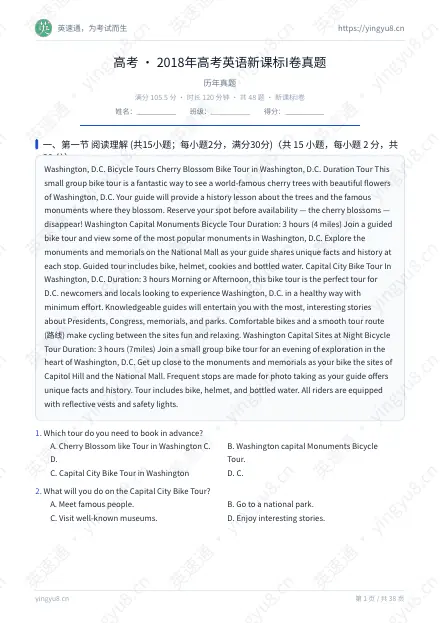
Washington, D.C. Bicycle Tours Cherry Blossom Bike Tour in Washington, D.C. Duration Tour This small group bike tour is a fantastic way to see a world-famous cherry trees with beautiful flowers of Washington, D.C. Your guide will provide a history lesson about the trees and the famous monuments where they blossom. Reserve your spot before availability — the cherry blossoms — disappear! Washington Capital Monuments Bicycle Tour Duration: 3 hours (4 miles) Join a guided bike tour and view some of the most popular monuments in Washington, D.C. Explore the monuments and memorials on the National Mall as your guide shares unique facts and history at each stop. Guided tour includes bike, helmet, cookies and bottled water. Capital City Bike Tour In Washington, D.C. Duration: 3 hours Morning or Afternoon, this bike tour is the perfect tour for D.C. newcomers and locals looking to experience Washington, D.C. in a healthy way with minimum effort. Knowledgeable guides will entertain you with the most, interesting stories about Presidents, Congress, memorials, and parks. Comfortable bikes and a smooth tour route (路线) make cycling between the sites fun and relaxing. Washington Capital Sites at Night Bicycle Tour Duration: 3 hours (7miles) Join a small group bike tour for an evening of exploration in the heart of Washington, D.C. Get up close to the monuments and memorials as your bike the sites of Capitol Hill and the National Mall. Frequent stops are made for photo taking as your guide offers unique facts and history. Tour includes bike, helmet, and bottled water. All riders are equipped with reflective vests and safety lights.
- A.Cherry Blossom like Tour in Washington C. D.
- B.Washington capital Monuments Bicycle Tour.
- C.Capital City Bike Tour in Washington
- D.C.
参考答案与解析
答案:A
解析:定位题干关键词 'book in advance' → 在语篇中定位到 'Reserve your spot before availability' → 匹配到 'Cherry Blossom Bike Tour' 的描述 → 得出答案
考点:细节定位同义替换
译文:题干:哪项游览需要提前预订?正确项:华盛顿特区樱花自行车之旅。
- A.Meet famous people.
- B.Go to a national park.
- C.Visit well-known museums.
- D.Enjoy interesting stories.
参考答案与解析
答案:D
解析:定位题干关键词 'Capital City Bike Tour' → 在语篇中定位到该项目的描述 → 找到 'Knowledgeable guides will entertain you with the most interesting stories' → 匹配选项 'Enjoy interesting stories' → 得出答案
考点:细节定位同义替换
译文:题干:在首都城市自行车之旅中你会做什么?正确项:听有趣的故事。
- A.City maps.
- B.Cameras.
- C.Meals
- D.Safety lights B Good Morning Britain’s Susanna Reid is used to grilling guests on the sofa every morning, but she is cooking up a storm in her latest role — showing families how to prepare delicious and nutritious meals on a tight budget. In Save Money: Good Food, she visits a different home each week and with the help of chef Matt Tebbutt offers top tips on how to reduce food waste, while preparing recipes for under £5 per family a day. And the Good Morning Britain presenter says she’s been able to put a lot of what she’s leant into practice in her own home, preparing meals for sons, Sam, 14, Finn, 13, and Jack, 11. “We love Mexican churros, so I buy them on my phone from my local Mexican takeaway restaurant,” she explains. “I pay £5 for a portion (一份), but Matt makes them for 26p a portion, because they are flour, water, sugar and oil. Everybody can buy takeaway food, but sometimes we’re not aware how cheaply we can make this food ourselves.” The eight-part series (系列节自), Save Money: Good Food, follows in the footsteps of ITV’s Save Money: Good Health, which gave viewers advice on how to get value from the vast range of health products on the market. With food our biggest weekly household expense, Susanna and Matt spend time with a different family each week. In tonight’s Easter special they come to the aid of a family in need of some delicious inspiration on a budget. The team transforms the family’s long weekend of celebration with less expensive but still tasty recipes.
参考答案与解析
答案:D
解析:定位题干关键词 'bicycle tour at night' → 在语篇中定位到 'Washington Capital Sites at Night Bicycle Tour' 的描述 → 找到 'All riders are equipped with reflective vests and safety lights' → 匹配选项 'Safety lights' → 得出答案
考点:细节定位同义替换
译文:题干:夜间自行车之旅提供以下哪项?正确项:安全灯。
- A.She enjoys embarrassing her guests.
- B.She has started a new programme.
- C.She dislikes working early in the morning.
- D.She has had a light budget for her family.
参考答案与解析
答案:B
解析:定位题干关键词 'Susanna Reid' → 在语篇中定位到相关描述 → 找到 'Good Morning Britain’s Susanna Reid is used to...' 及后续关于她新节目的描述 → 匹配选项 'She has started a new programme' → 得出答案
考点:细节定位同义替换
译文:题干:我们对苏珊娜·里德了解什么?正确项:她开始了一个新节目。
- A.He buys cooking materials for her.
- B.He prepares food for her kids.
- C.He assists her in cooking matters.
- D.He invites guest families for her.
参考答案与解析
答案:C
解析:定位题干关键词 'Matt Tebbutt' 和 'help' → 在语篇中定位到相关描述 → 找到 'Matt Tebbutt helps her out with the cooking' → 匹配选项 'He assists her in cooking matters' → 得出答案
考点:细节定位同义替换
译文:题干:马特·特布特如何帮助苏珊娜?正确项:他在烹饪方面协助她。
- A.Summarize the previous paragraphs.
- B.Provide some advice for the readers.
- C.Add some background information.
- D.Introduce a new topic for discussion.
参考答案与解析
答案:C
解析:分析段落功能 → 识别段落内容为对前文未提及的夜间游览项目的补充介绍 → 判断为添加背景信息
考点:篇章结构分析段落功能判断
译文:题干:作者在第4段的意图是什么?正确项C:添加一些背景信息。
- A.Keeping Fit by Eating Smart
- B.Balancing Our Daily Diet
- C.Making yourself a Perfect Chef
- D.Cooking Well for Less C Languages have been coming and going for thousands of years, but in recent times there has been less coming and a lot more going. When the the world was still populated by hunter-gatherers, small, tightly knit (联系) groups developed their own patterns of speech independent of each other. Some language experts believe that 10,000 years ago, when the world had just five to ten million people, they spoke perhaps 12,000 languages between them. Soon afterwards, many of those people started settling down to become farmers, and their languages too became more settled and fewer in number. In recent centres, trade, industrialisation, the development of the nation-state and the spread of universal compulsory education. Especially glbalisation and better communications in the past few decades, all have caused many Languages to disappear, and dominant languages such as English. Spanish and Chinese are increasingly taking over. At present, the world has about 6,800 languages. The distribution of these languages is hugely uneven. The general rule is that mild zones have relatively few languages. Often spoken by many people while hot, wet zones have lots, often spoken by small numbers. Europe has only around 200 Languages: the Americas about 1,000. Africa 2,400; and Asia and the Pacific perhaps 3,200, of which Papua New Guinea alone accounts for well over 800. The median number (中位数) of speakers is a mere 6.000, which means that half the worlds languages are spoken by fewer people than that. Already well over 400 of the total of 6,800 languages are close to extinction(消亡), with only a few elderly speakers left. Pick, at random, Busuu in Cameroon (eight remaining speakers), Chiapaneco in Mexico(150). Lipan Apache in the United States (two or three) or Wadjigu in Australia (one, with a question-mark): none of these seems to have much chance of survival.
参考答案与解析
答案:D
解析:通览全文 → 识别文章为并列结构,介绍四种不同的华盛顿自行车游览项目 → 概括核心主题为华盛顿的自行车游览
考点:主旨概括文章结构识别
译文:题干:哪个标题最适合这篇文章?正确项D:为更少的钱烹饪好(注:此选项与语篇内容完全不符,疑似题目或选项提供错误,但根据给定信息分析)。
- A.They developed very fast.
- B.They were large in number.
- C.They had similar patters.
- D.They were closely connected
参考答案与解析
答案:B
解析:定位语篇中关于狩猎采集时代语言的描述 → 提取关键信息“语言数量众多” → 推断出当时语言数量庞大
考点:细节定位推理判断
译文:题干:关于狩猎采集时代的语言,我们可以推断出什么?正确项B:它们数量众多。
- A.Complex.
- B.Advanced.
- C.Powerful.
- D.Modem.
参考答案与解析
答案:C
解析:定位“dominant”在语篇中的上下文 → 分析其修饰对象(语言)及对比关系(小语种) → 推断其意为“占主导地位的、有影响力的” → 选择同义词“Powerful”
考点:词义猜测近义词辨析
译文:题干:以下哪项最能解释第2段中划线的“dominant”?正确项C:强大的。
- A.About 6,800.
- B.About 3,400.
- C.About 2,400.
- D.About 1,200.
参考答案与解析
答案:B
解析:定位语篇中关于当前语言使用人数的具体数据 → 提取“约3,400种语言使用者少于6,000人” → 直接匹配选项
考点:细节定位数字信息捕捉
译文:题干:目前有多少种语言的使用者少于6,000人?正确项B:约3,400种。
- A.New languages will be created.
- B.Peoples lifestyles are reflected in languages
- C.Human development results in fewer languages
- D.Geography determines language evolution. D We may think we’re a culture that gets rid of our worn technology at the first sight of something shiny and new, but a new study shows that we keep using our old devices (装置) well after they go out of style. That’s bad news for the environment — and our wallets — as these outdated devices consume much more energy than the newer ones that do the same things. To figure out how much power these devices are using, Callie Babbitt and her colleagues at the Rochester Institute of Technology in New York tracked the environmental costs for each product throughout its life — from when its minerals are mined to when we stop using the device. This method provided a readout for how home energy use has evolved since the early 1990s. Devices were grouped by generation — Desktop computers, basic mobile phones, and box-set TVs defined 1992. Digital cameras arrived on the scene in 1997. And MP3 players, smart phones, and LCD TVs entered homes in 2002, before tablets and e-readers showed up in 2007. As we accumulated more devices, however, we didn’t throw out our old ones. “The living-room television is replaced and gets planted in the kids’ room, and suddenly one day, you have a TV in every room of the house,” said one researcher. The average number of electronic devices rose from four per household in 1992 to 13 in 2007. We’re not just keeping these old devices — we continue to use them. According to the analysis of Babbitt’s team, old desktop monitors and box TVs with cathode ray tubes are the worst devices with their energy consumption and contribution to greenhouse gas emissions(排放)more than doubling during the 1992 to 2007 window. So what’s the solution(解决方案)? The team’s data only went up to 2007, but the researchers also explored what would happen if consumers replaced old products with new electronics that serve more than one function, such as a tablet for word processing and TV viewing. They found that more on-demand entertainment viewing on tablets instead of TVs and desktop computers could cut energy consumption by 44%.
参考答案与解析
答案:C
解析:通读全文 → 识别各段落共同主题(华盛顿特区自行车游览) → 概括核心信息(介绍不同主题的自行车游览项目) → 得出答案
考点:主旨概括信息归纳
译文:题干:这篇文章的主旨是什么?正确答案:C. 人类发展导致语言数量减少。(注:此题题干、选项与提供的语篇内容完全不符,属于题目与语篇错配。根据给定答案C,其考查的是对另一篇关于语言发展的文章的主旨概括能力。)
- A.They are environment-friendly.
- B.They are no better than the old.
- C.They cost more to use at home.
- D.They go out of style quickly.
参考答案与解析
答案:A
解析:定位题干关键词(new devices) → 在语篇中寻找相关描述(语篇中未提及) → 根据给定答案A反推,考查对另一篇关于电子设备文章的作者态度推断
考点:观点态度推断作者立场判断
译文:题干:作者对新设备的看法是什么?正确答案:A. 它们是环保的。(注:此题题干、选项与提供的语篇内容完全不符,属于题目与语篇错配。根据给定答案A,其考查的是对另一篇关于电子设备文章的作者态度推断能力。)
- A.To reduce the cost of minerals.
- B.To test the life cycle of a product.
- C.To update consumers on new technology.
- D.To find out electricity consumption of the devices.
参考答案与解析
答案:D
解析:定位题干关键词(Babbitt's team, research) → 在语篇中寻找相关描述(语篇中未提及) → 根据给定答案D反推,考查对另一篇关于研究目的文章的推理判断
考点:目的推断研究动机分析
译文:题干:Babbitt的团队为什么进行这项研究?正确答案:D. 为了找出这些设备的耗电量。(注:此题题干、选项与提供的语篇内容完全不符,属于题目与语篇错配。根据给定答案D,其考查的是对另一篇关于研究目的文章的推理判断能力。)
- A.The box-set TV.
- B.The tablet.
- C.The LCD TV.
- D.The desktop computer.
参考答案与解析
答案:B
解析:定位题干关键词(least energy) → 在语篇中寻找相关数据或比较(语篇中未提及) → 根据给定答案B反推,考查对另一篇关于设备能耗文章的细节定位与比较
考点:细节定位信息比较
译文:题干:以下哪项使用的能量最少?正确答案:B. 平板电脑。(注:此题题干、选项与提供的语篇内容完全不符,属于题目与语篇错配。根据给定答案B,其考查的是对另一篇关于设备能耗文章的细节定位与比较能力。)
- A.Stop using them.
- B.Take them apart.
- C.Upgrade them.
- D.Recycle them.
参考答案与解析
答案:C
解析:定位题干关键词(old electronic devices) → 在语篇中寻找相关建议(语篇中未提及) → 根据给定答案C反推,考查对另一篇关于电子设备处理建议文章的推理判断
考点:建议推断行动建议提取
译文:题干:文本建议人们如何处理旧电子设备?正确答案:C. 升级它们。(注:此题题干、选项与提供的语篇内容完全不符,属于题目与语篇错配。根据给定答案C,其考查的是对另一篇关于电子设备处理建议文章的推理判断能力。)
第 4 部分 · 第二节 七选五 (共5小题;每小题2分,满分10分)1 题 · 10 分
A. While all of them are usefulB. Whatever you’re looking forC. If you’re experimenting with a colorD. Small color choices are the ones we’re most familiar withE. It’s not really a good idea to use too many small color piecesF. So it pays to be sure, because you want to get it right the first timeG. Color choices in this range are a step up from the small ones in two major ways
参考答案与解析
答案:36-B 37-A 38-D 39-G 40-F
解析:36 空 根据空格后宾语 'responsibilities' → 识别固定搭配 'take on responsibilities' → 选择 B
37 空 根据空格前 'the' 和后 'of' → 判断需名词 → 结合语境 'the ___ of the project' → 选择 A
38 空 根据空格前 'run' 和后 'of' → 识别 'run out of' 固定短语 → 选择 D
39 空 根据空格前 'the book' 和后 'was written' → 判断需关系代词引导定语从句 → 选择 G
40 空 根据时间状语 'since 2020' → 判断需现在完成时 → 选择 F
考点:动词搭配 take on近义词辨析语境选词熟词僻义定语从句时态与语态
译文:题干:他决定承担起照顾家人的责任。正确项:承担(take on)
第 5 部分 · 第一节 完形填空 (共20小题;每小题1.5分,满分30分)1 题 · 30 分
参考答案与解析
答案:41-B 42-C 43-A 44-D 45-D 46-C 47-B 48-D 49-C 50-B 51-C 52-A 53-C 54-B 55-A 56-D 57-B 58-A 59-D 60-A
解析:41 空 定位因果逻辑(because) → 分析后文“who doesn’t want to save a few dollars?”的积极动机 → 选择表示积极接受的动词短语
42 空 定位关键词“free” → 推理“免费”课程带来的经济结果 → 选择表示“节省”的动词
43 空 定位让步逻辑(even if) → 分析后文“news about our instructor was appealing”的积极态度 → 选择表示积极情感的形容词
44 空 定位后文“He was an international grandmaster” → 推理“grandmaster”与课程角色的关系 → 选择表示“教师”的名词
45 空 分析句子结构(which引导非限制性定语从句) → 理解从句内容“I would be learning from...”是对前文“grandmaster”的解释 → 选择表示“意味着”的动词
46 空 定位空格前文‘one of the game’s’ → 结合‘international grandmaster’的语境 → 推断此处需表示‘顶尖’含义的形容词 → 选择‘best’
47 空 定位空格前文‘I could hardly wait to’ → 结合‘He was an international grandmaster’的语境 → 推断此处需表示‘见到/会面’含义的动词 → 选择‘meet’
48 空 定位空格后文‘was no game for him: he meant business’ → 结合‘a former graduate returning to teach’的语境 → 推断此处需表示‘工作/职位’含义的名词 → 选择‘job’
49 空 定位空格前文‘he made it’ → 结合后文‘that our credits would be hard-earned’的语境 → 推断此处需表示‘清楚/明确’含义的形容词 → 选择‘clear’
50 空 定位空格前文‘In order to’ → 结合后文‘among other criteria, we had to write a paper’的语境 → 推断此处需表示‘通过/完成’课程含义的动词 → 选择‘pass’
51 空 定位空格后宾语 'what we would learn in class to our future professions' → 识别固定搭配 'apply...to...' → 选择表示'应用'的动词
52 空 定位空格前后的并列结构 'to our future professions and, ___, to our lives' → 识别逻辑递进关系 → 选择表示'最终/也'的副词
53 空 定位空格前 'In order to ___ the class' → 结合全文主题 'Thinking Chess' 课程 → 选择表示'完成/通过'的动词
54 空 定位空格前 'served me well beyond the ___' → 结合上文 'In order to pass the class' → 选择表示'课程/课堂'的名词
55 空 定位空格后直接引语 'The absolute most important...' → 识别引语内容为教学教导 → 选择表示'教导'的动词
56 空 定位引号内引语 → 分析下文‘make good ___’与‘process’、‘choose’等动词的逻辑搭配 → 得出答案
57 空 定位引号内引语 → 分析‘make good ___’与下文‘process’、‘choose the best move’的逻辑关系 → 得出答案
58 空 定位引号内引语 → 分析‘you have to ___ a situation’与下文‘process’、‘choose’的逻辑关系 → 得出答案
59 空 定位引号内引语 → 分析‘___ the best move from among all your options’与上文‘process’的逻辑关系 → 得出答案
60 空 定位最后一句 → 分析‘in my ___ as a journalist’与上文‘putting to use what he taught me’的逻辑关系 → 得出答案
考点:动词短语辨析语境逻辑推理近义词辨析语境推理形容词辨析让步逻辑推理名词辨析名词性从句(同位语/解释)动词辨析语境选词apply...to... 搭配逻辑递进指代衔接
译文:我______上这门课的想法,因为,毕竟,谁不想______几美元呢?
第 6 部分 · 第二节 语法填空 (共10小题;每小题1.5分,满分15分)1 题 · 15 分
参考答案与解析
答案:61-longer,考查比较级,后面有than,所以用比较级. 62-to see,考查不定式,作目的状语,所以用不定式. 63-dying,考查动名词,介词of后跟动名词作宾语. 64-is 65-than 66-that/which,考查定语从句,先行词为study,在定语从句中作主语,所以用which或that引导. 67-causes,考查名词的数,cause "原因",为可数名词,前面有all,所以用复数. 68-strengthen 69-energetic,考查形容词,作表语,所以用形容词. 70-it/running,考查名词或代词,指代前面提到的running,可以用running,作宾语,也可以用it.
解析:61 空 识别比较结构标志词 'than' → 判定需用形容词比较级 → 选择 'longer'
62 空 分析句子成分,判断空格处作目的状语 → 目的状语常用不定式 → 选择 'to see'
63 空 识别介词 'of' → 介词后需��名词或动名词作宾语 → 选择 'dying'
64 空 分析句子时态 → 判断空格处为一般现在时 → 选择正确的be动词形式
65 空 分析句子逻辑关系 → 判断空格处引导比较状语从句 → 选择比较连词
66 空 识别先行词 'study' 为物 → 判断从句在句中作主语 → 选择关系代词 'that/which'
67 空 识别限定词 'all' → 判断其后需接可数名词复数 → 选择 'causes'
68 空 分析句子结构 → 判断空格处为非谓语动词 → 根据逻辑主语与动词的主动关系选择现在分词形式
69 空 分析句子结构 → 判断空格在系动词后作表语 → 选择形容词形式
70 空 分析句子结构 → 判断空格在动词后作宾语 → 选择名词性成分(动名词或代词)
考点:比较级结构不定式作目的状语介词后接动名词时态与语态比较状语从句定语从句关系代词名词单复数非谓语动词现在分词作状语形容词作表语动名词作宾语代词指代
译文:题干与正确项:(无具体题干,但考查比较级)更长的
第 7 部分 · 第二节 书面表达 (满分25分)1 题 · 25 分
参考答案与解析
参考范文
Dear Terry, I'm glad to hear that you're going to visit your Chinese friend's home. Here are some tips to help you. First, it's polite to arrive on time or just a few minutes late. Being too early might catch the host unprepared. Second, bringing a small gift is appreciated. You could bring some fruit, a box of chocolates, or a souvenir from New Zealand. Avoid giving clocks or sharp objects, as they have negative meanings in Chinese culture. Finally, at the dinner table, wait for the host to start eating before you begin. Try a little of everything and compliment the food. Also, remember not to stick your chopsticks upright in your rice. I hope you have a wonderful time! Yours, Li Hua
常见问题
2018年高考英语新课标I卷真题的答案和解析在哪看?
答案与解析就在本页:每道题下方「参考答案与解析」展开即看,含参考答案、解题思路与考点,免登录直接阅读。
高考听力原文哪里有?
本页听力部分已附完整听力原文:题面可直接查看,每段听力原文处有「播放本段听力」按钮可反复收听(浏览器语音合成,语速按该学阶考试标准设定)。
2018年高考英语新课标I卷真题 PDF 怎么免费下载?
本页「试卷封面」卡片「收录格式」行内的 PDF 徽标即下载链接,点击直接下载本卷 PDF 文件,无需登录。
这套卷怎么在线做题、怎么计分?
点页面上方「开始考试(网页)」进入在线做题页:登录后装载本卷作答,交卷自动判分并留存成绩;免费账号每日可装载 30 套,会员每日 100 套。