2021年6月浙江高考英语真题及答案解析
2021年6月浙江高考英语真题 · 完整收录
- 年份考次
- 2021 年
- 命题归属
- 省级自主命题
- 省份
- 浙江
- 听力
- 含听力
- 题量
- 35 题
- 满分
- 150 分
- 限时
- 120 分钟
- 题型结构
- 第一节 听力理解 5 题 7.5 分 · 第二节 听力理解 15 题 22.5 分 · 第一节 阅读理解 10 题 25 分 · 第二节 七选五 5 题 10 分 · 第一节 完形填空 20 题 30 分 · 第二节 语法填空 10 题 15 分 · 第一节 应用文写作 1 题 15 分 · 第二节 读后续写 1 题 25 分
- 收录格式
开始考试(微信)

微信扫一扫 · 小程序内开始考试
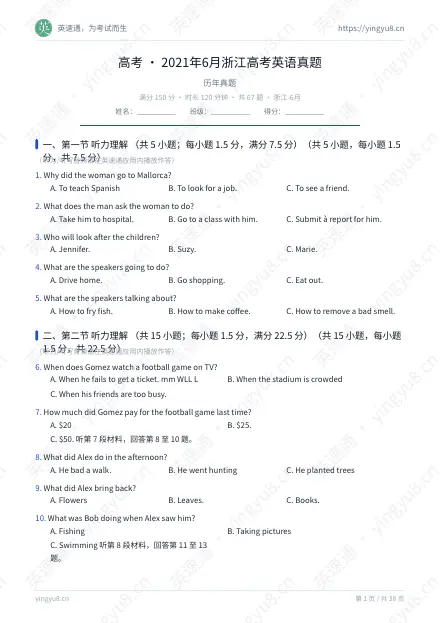
第 1 部分 · 第一节 听力理解 (共 5 小题;每小题 1.5 分,满分 7.5 分)5 题 · 8 分
听力原文 · Question 1(本页按钮可反复收听;在线做题考试中每段仅播一次)
W: I just got back from Mallorca. M: Really? Were you there for work? I heard you were teaching Spanish. W: No, that was last year in Madrid. This time I had no classes and no job interviews. M: So what took you there? W: My old classmate Lily moved there. I flew over to visit her. M: That sounds nice. W: Yes, we spent a week walking by the sea.
- A.To teach Spanish
- B.To look for a job.
- C.To see a friend.
参考答案与解析
答案:C
解析:定位对话中关于Mallorca行程目的的陈述 → 识别关键信息 'see a friend' → 排除其他选项
考点:细节定位目的识别
译文:题干:这位女士为什么去马略卡岛?正确项:去看望一位朋友。
听力原文 · Question 2(本页按钮可反复收听;在线做题考试中每段仅播一次)
W: Hi Tom, you look worried. What's going on? M: I have to hand in my science report before five this afternoon, but I have a music class at four thirty. W: Oh no. Can you finish it in time? M: The report is ready on my desk. Could you please give it to Mr. Smith for me? W: Sure, no problem. I'll take it to his office after lunch. M: Thanks a lot, Lily. You really save my day.
- A.Take him to hospital.
- B.Go to a class with him.
- C.Submit à report for him.
参考答案与解析
答案:C
解析:定位对话中男士对女士的请求 → 识别关键信息 'submit a report for him' → 排除其他选项
考点:细节定位请求识别
译文:题干:男士请女士做什么?正确项:为他提交一份报告。
听力原文 · Question 3(本页按钮可反复收听;在线做题考试中每段仅播一次)
W: Tom, the community centre needs help this weekend. M: I know. Lily and I are busy, so who will take care of the kids? W: Don't worry. Suzy said she is free and would love to stay with them. M: Great. That solves our problem. W: Yes, she is good with children. M: Let's thank her later.
- A.Jennifer.
- B.Suzy.
- C.Marie.
参考答案与解析
答案:B
解析:定位对话中关于照看孩子的人选讨论 → 识别关键信息 'Suzy' → 排除其他选项
考点:细节定位人物识别
译文:题干:谁将照看孩子?正确项:Suzy。
听力原文 · Question 4(本页按钮可反复收听;在线做题考试中每段仅播一次)
W: Tom, the interview at the bookshop starts at seven thirty. Shall we take the bus? M: No need. My father lent me his car, so I can take you there. W: Great. But after the talk, it will be quite late. M: Yes, so I will take you back to your place in that car. W: That sounds good. Let us go now.
- A.Drive home.
- B.Go shopping.
- C.Eat out.
参考答案与解析
答案:A
解析:定位对话中关于接下来行动的讨论 → 识别关键信息 'drive home' → 排除其他选项
考点:细节定位行动识别
译文:题干:说话者打算做什么?正确项:开车回家。
听力原文 · Question 5(本页按钮可反复收听;在线做题考试中每段仅播一次)
W: Tom, this kitchen smells terrible after we cooked fish. M: Yes, that old smell is really strong. What should we do about it? W: My mother told me a simple way. Put some coffee grounds in a small bowl and leave it there. M: Coffee grounds? Do they help with the air? W: Yes, they take the bad smell away. You can also boil some water with lemon skins. M: That sounds easy. Let us try it now.
- A.How to fry fish.
- B.How to make coffee.
- C.How to remove a bad smell.
参考答案与解析
答案:C
解析:综合对话中关于问题(坏气味)和解决方案(咖啡)的讨论 → 归纳核心话题 → 排除具体操作细节
考点:主旨归纳话题识别
译文:题干:说话者在谈论什么?正确项:如何去除难闻的气味。
第 2 部分 · 第二节 听力理解 (共 15 小题;每小题 1.5 分,满分 22.5 分)15 题 · 23 分
听力原文 · Question 6(本页按钮可反复收听;在线做题考试中每段仅播一次)
M: Lily, you travel a lot for work, right? Do you ever watch football on TV? W: Sometimes. My friend Gomez is a big fan. He goes to the stadium whenever he can get a ticket. M: So what does he do when he can't buy one? W: He stays home and watches the match on TV instead. That's his only reason for watching at home. M: Does he ever watch with friends? W: No, his friends are usually busy, but that never makes him watch TV. He just listens to the radio then.
- A.When he fails to get a ticket. mm WLL L
- B.When the stadium is crowded
- C.When his friends are too busy.
参考答案与解析
答案:A
解析:定位关键词 'watch a football game on TV' → 听到 'when I can't get a ticket' → 同义替换为 'fails to get a ticket' → 得出答案
考点:细节定位同义替换
译文:题干:戈麦斯什么时候在电视上看足球比赛?正确项:当他没买到票的时候。
听力原文 · Question 7(本页按钮可反复收听;在线做题考试中每段仅播一次)
W: Tom, did you go to the football game last time? M: Yes, but the ticket was not cheap. I paid twenty-five dollars for it. W: Really? I thought it was fifty. M: No, the twenty-dollar seats were all sold out, so I chose the next price. W: What a pity! I missed the lecture about that game yesterday.
- A.$20
- B.$25.
- C.$50. 听第 7 段材料,回答第 8 至 10 题。
参考答案与解析
答案:B
解析:定位关键词 'pay for the football game last time' → 听到 'I paid 25 dollars' → 直接捕捉数字 → 得出答案
考点:数字语音捕捉
译文:题干:戈麦斯上次看足球比赛花了多少钱?正确项:25美元。
听力原文 · Question 8(本页按钮可反复收听;在线做题考试中每段仅播一次)
W: How was your day, Alex? M: Busy, but fine. In the morning I fixed the kitchen tap. W: And after lunch? M: I just walked slowly around the lake near our flat. W: Did you go hunting with Tom? M: No, I never went out with a gun. W: Did you plant trees in the garden? M: No, I did not touch the garden at all. W: So the afternoon was quiet. M: Yes, just a peaceful walk by myself.
- A.He bad a walk.
- B.He went hunting
- C.He planted trees
参考答案与解析
答案:A
解析:定位关键词 'Alex' 和 'afternoon' → 听到 'I went for a walk' → 同义替换为 'had a walk' → 得出答案
考点:细节定位同义替换
译文:题干:亚历克斯下午做了什么?正确项:他散步了。
听力原文 · Question 9(本页按钮可反复收听;在线做题考试中每段仅播一次)
W: Alex, you look happy. What did you bring back from the park? M: I picked up a lot of fallen things from the ground. W: Oh, so you collected some pretty blooms? M: No, I did not take any blooms. I found some green things that had dropped from the trees. W: Are they for a science project? M: Yes, Mr. Smith asked us to study how trees change in autumn. I put them in my bag. W: That sounds useful. Let me see them later. M: Sure. I will show you after lunch.
- A.Flowers
- B.Leaves.
- C.Books.
参考答案与解析
答案:B
解析:定位关键词 'Alex' 和 'bring back' → 听到 'I picked some leaves' → 同义替换为 'brought back leaves' → 得出答案
考点:细节定位同义替换
译文:题干:亚历克斯带回了什么?正确项:树叶。
听力原文 · Question 10(本页按钮可反复收听;在线做题考试中每段仅播一次)
W: Did you see Bob at the lake yesterday? M: Yes, I went there to try my new camera. When I saw him, he was sitting by the water with a long line in his hands. W: Was he catching anything? M: Not yet, but he looked very quiet and patient. W: I thought he was in the city for a tech meeting. M: He changed his plan. He wanted a day off from all those apps and screens.
- A.Fishing
- B.Taking pictures
- C.Swimming 听第 8 段材料,回答第 11 至 13 题。
参考答案与解析
答案:A
解析:定位关键词 'Bob' 和 'when Alex saw him' → 听到 'I saw Bob fishing' → 直接匹配选项 → 得出答案
考点:细节定位
译文:题干:亚历克斯看到鲍勃时,鲍勃在做什么?正确项:钓鱼。
听力原文 · Question 11(本页按钮可反复收听;在线做题考试中每段仅播一次)
W: Did you go anywhere for your last holiday, David? M: Yes, I went to a small village in the mountains. W: Was it a relaxing trip? M: Not really. I walked up a high hill for six hours. W: That sounds tiring! Did you take a boat or a balloon? M: No, I just used my legs and a walking stick. W: So your latest holiday was all about going up that hill? M: That's right. It was hard but the view was wonderful.
- A.He had a boat trip
- B.He took a balloon flight.
- C.He climbed a mountain.
参考答案与解析
答案:C
解析:定位关键词 'most recent holiday' → 匹配录音中 'climbed a mountain' 的事实 → 排除其他活动
考点:细节定位事实匹配
译文:题干:David最近一次假期做了什么? 正确项:他爬了一座山。
听力原文 · Question 12(本页按钮可反复收听;在线做题考试中每段仅播一次)
W: David, you look busy. What are you doing? M: I'm making a list of things I hope to do this year. W: Like what? M: I want to run a race, learn to swim, and go climbing. W: That sounds exciting. Is exercise on it too? M: Yes, I plan to work out three times a week. W: Good for you. I just watch TV and eat snacks. M: You can join me. Let's start tomorrow at seven thirty. W: Okay, I will.
- A.Gifts he needed to buy.
- B.Things he wished to do.
- C.Dates he had to remember.
参考答案与解析
答案:B
解析:定位关键词 'list' → 结合上下文推断其性质(愿望清单) → 匹配 'Things he wished to do'
考点:细节定位语境推断
译文:题干:David的清单上有什么? 正确项:他希望做的事情。
听力原文 · Question 13(本页按钮可反复收听;在线做题考试中每段仅播一次)
W: David, you look tired. Are you planning a trip for your next holiday? M: I was thinking about Australia, but it is too far and costly. W: Why not go to the Amazon? You have always loved nature and wild rivers. M: That sounds exciting, but I am busy with a new job plan. W: You can still take a short break there after your interview. M: Good idea. I will check the flights to the Amazon tonight.
- A.Australia.
- B.California.
- C.The Amazon. 听第 9 段材料,回答第 14 至 17 题。
参考答案与解析
答案:C
解析:定位关键词 'suggest' 和 'next holiday' → 匹配女士建议的地点 'The Amazon' → 排除其他地点
考点:细节定位建议识别
译文:题干:女士建议David下次假期去哪里? 正确项:亚马逊。
听力原文 · Question 14(本页按钮可反复收听;在线做题考试中每段仅播一次)
W: Hi Tom, this is Sarah. Sorry to call so late. M: That's okay. What's going on? W: I'm in trouble with the school concert. Could you lend me a hand tonight? M: Sure, what do you need? W: My poster is half done. I have to finish it before seven thirty tomorrow. M: No problem. I'll come over after dinner. W: Thanks a lot. You're saving my life.
- A.To ask a favor.
- B.To pass on a message.
- C.To make an appointment.
参考答案与解析
答案:A
解析:分析对话开头Sarah的陈述目的 → 推断其核心意图是请求帮助(ask a favor) → 排除传递信息或预约
考点:意图推断语用分析
译文:题干:Sarah为什么打电话? 正确项:请求帮忙。
听力原文 · Question 15(本页按钮可反复收听;在线做题考试中每段仅播一次)
W: Tom, have you seen Sarah today? We need her help at the food bank. M: She called me this morning. She is staying in today. W: But I thought she was going to Brighton for a trip. M: No, she changed her plan. She is not at the Shelton Hotel either. W: So where can we find her? M: Just call her home phone. She is there all day. W: Good. I will call her right away.
- A.In Brighton.
- B.At her home.
- C.At the Shelton Hotel.
参考答案与解析
答案:B
解析:定位关键词 'Where is Sarah now' → 匹配对话中明确说明的地点 'at home' → 排除其他地点
考点:细节定位事实匹配
译文:题干:Sarah现在在哪里? 正确项:在她家里。
听力原文 · Question 16(本页按钮可反复收听;在线做题考试中每段仅播一次)
W: Hi Michael, do you want to meet for breakfast before your part-time interview tomorrow? M: I'd love to, but I need to leave my place at twenty to eight to catch the early bus. W: That's early. I thought your interview was at nine. M: It is, but the bus ride takes about an hour, and I want to arrive a bit early. W: Then let's meet near the bus stop at seven thirty. M: Sounds good. I'll see you there.
- A.At 7:40.
- B.At 8:00.
- C.At 8:20.
参考答案与解析
答案:A
解析:定位时间信息 → 识别数字与时间表达 → 区分出发时间与相关时间点
考点:数字时间语音时间点区分
译文:题干:迈克尔明天早上几点离开住处?正确项:7:40。
听力原文 · Question 17(本页按钮可反复收听;在线做题考试中每段仅播一次)
W: John, I picked a cooking class for us this term. M: Sounds fun, Sarah. But I have to check with my manager first. W: Oh, right, your office may send you to Chicago again. M: Yes, but I will ask my boss to let me stay. W: The kids need us home in the evening, after all. M: True. I will call you at lunch, dear.
- A.Neighbors.
- B.Fellow workers.
- C.Husband and wife. 听第 10 段材料,回答第 18 至 20 题。
参考答案与解析
答案:C
解析:定位人物关系线索 → 分析对话内容与语气 → 推断人物关系
考点:场景词汇与人物关系对话内容推断
译文:题干:约翰和莎拉可能是什么关系?正确项:夫妻。
听力原文 · Question 18(本页按钮可反复收听;在线做题考试中每段仅播一次)
W: Tom, on our trip I heard many people talk about speaking well. M: Yes, most of them say the most important thing is the words you know. Grammar and clear sounds come later, they say. W: That is interesting. So if you lack the right words, you cannot share your ideas. M: Right. On the train, an old man told me he once lost his way in a small town. He knew little of the local language, but he had a small notebook full of useful words. W: And that helped him find his hotel? M: Yes, it did. He said words were his best map.
- A.Pronunciation.
- B.Vocabulary.
- C.Grammar. mm WLL L
参考答案与解析
答案:B
解析:定位观点陈述 → 识别“大多数人认为”的表述 → 匹配具体要素
考点:细节定位与捕捉观点识别
译文:题干:大多数人认为口语交流中什么最重要?正确项:词汇。
听力原文 · Question 19(本页按钮可反复收听;在线做题考试中每段仅播一次)
W: How was the talk on learning English, Tom? M: Really useful. The speaker gave us one clear piece of advice. W: What was it? M: He said we should record experts speaking and listen closely to them. W: Why is that helpful? M: Because then you can catch the sounds you say wrongly and fix them. W: That sounds simple but smart. M: Yes, and he added that it works better than just reading about rules.
- A.To develop your reading fluency.
- B.To improve your note-taking skills.
- C.To find out your mispronunciations.
参考答案与解析
答案:C
解析:定位建议内容 → 分析“为什么”的因果逻辑 → 推断具体目的
考点:推理判断因果逻辑
译文:题干:根据说话者,为什么应该听专家的?正确项:找出你的发音错误。
听力原文 · Question 20(本页按钮可反复收听;在线做题考试中每段仅播一次)
W: Tom, how can I get better at reading English words in my new flat? M: First, write each new word on a card and keep it by your desk. W: And then? M: Then, listen to a short story and follow the lines with your finger. W: What else? M: Finally, say each word in a clear voice several times. That will help you remember the sounds.
- A.Spell out the difficult words
- B.Check the words in a dictionary.
- C.Practice reading the words aloud.
参考答案与解析
答案:C
解析:定位“最后建议”的表述 → 识别建议的具体动作 → 匹配选项
考点:细节定位与捕捉建议识别
译文:题干:说话者的最后一个建议是什么?正确项:大声朗读单词进行练习。
第 3 部分 · 第一节 阅读理解 (共 10 小题;每小题 2.5 分,满分 25 分)10 题 · 25 分
阅读下列短文,从每题所给的 A、B、C 和 D 四个选项中,选出最佳选项,并在答题纸上将该项涂黑。 A Leslie Nielsen’s childhood was a difficult one, but he had one particular shining star in his life — his uncle, who was a well-known actor. The admiration and respect his uncle earned inspired Nielsen to make a career(职业) in acting. Even though he often felt he would be discovered to be a no-talent, he moved forward, gaining a scholarship to the Neighborhood Playhouse and making his first television appearance a few years later in 1948. However, becoming a full-time, successful actor would still be an uphill battle for another eight years until he landed a number of film roles that finally got him noticed. But even then, what he had wasn’t quite what he wanted. Nielsen always felt he should be doing comedy but his good looks and distinguished voice kept him busy in dramatic roles. It wasn’t until1980 - 32 years into his career — that he landed the role it would seem he was made for in Airplane! That movie led him into the second half of his career where his comedic presence alone could make a movie a financial success even when movie reviewers would not rate it highly. Did Nielsen then feel content in his career? Yes and no. He was thrilled to be doing the comedy that he always felt he should do, but even during his last few years, he always had a sense of curiosity, wondering what new role or challenge might be just around the corner. He never stopped working, never retired. Leslie Nielsen’s devotion to acting is wonderfully inspiring. He built a hugely successful career with little more than plain old hard work and determination. He showed us that even a single desire, never given up on, can make for a remarkable life.
- A.He enjoyed watching movies.
- B.He was eager to earn money.
- C.He wanted to be like his uncle.
- D.He felt he was good at acting.
参考答案与解析
答案:C
解析:定位首段关键句 → 提取因果关系(叔叔的榜样作用) → 同义替换得出答案
考点:细节定位因果关系
译文:题干:尼尔森为什么想成为一名演员?正确项:他想像他的叔叔一样。
- A.He directed some high quality movies.
- B.He avoided taking on new challenges.
- C.He focused on playing dramatic roles.
- D.He became a successful comedy actor.
参考答案与解析
答案:D
解析:定位第二段关键句 → 提取职业生涯后半段的核心特征(喜剧成功) → 同义替换得出答案
考点:细节定位信息匹配
译文:题干:关于尼尔森职业生涯的后半段,我们知道什么?正确项:他成为了一名成功的喜剧演员。
- A.Art is long, life is short.
- B.He who laughs last laughs longest.
- C.It’s never too late to learn.
- D.Where there’s a will there’s a way. B
参考答案与解析
答案:D
解析:通读全文提炼主旨 → 匹配选项寓意 → 选择最贴合的谚语
考点:主旨概括寓意匹配
译文:题干:尼尔森的职业生涯故事告诉我们什么?正确项:有志者事竟成。
We live in a town with three beaches. There are two parks less than 10 minutes’ walk from home where neighbourhood children gather to play. However, what my children want to do after school is pick up a screen — any screen — and stare at it for hours. They are not alone. Today’s children spend an average of four and a half hours a day looking at screens, split between watching television and using the Internet. In the past few years, an increasing number of people and organisations have begun coming up with plans to counter this trend. A couple of years ago, film-maker David Bond realised that his children, then aged five and three, were attached to screens to the point where he was able to say "chocolate" into his three-year-old son’s ear without getting a response. He realised that something needed to change, and, being a London media type, appointed himself "marketing director for Nature". He documented his journey as he set about treating nature as a brand to be marketed to young people. The result was Project Wild Thing, a film which charts the birth of the Wild Network a group of organisations with the common goal of getting children out into nature. "Just five more minutes outdoors can make a difference," David Bond says. "There is a lot of really interesting evidence which seems to be suggesting that if children are inspired up to the age of seven, then being outdoors will be a habit for life." His own children have got into the habit of playing outside now: "We just send them out into the garden and tell them not to come back in for a while." Summer is upon us. There is an amazing world out there, and it needs our children as much as they need it. Let us get them out and let them play.
- A.They often annoy the neighbours.
- B.They are tired of doing their homework.
- C.They have no friends to play with.
- D.They stay in front of screens for too long.
参考答案与解析
答案:D
解析:定位首段关键句 → 提取作者孩子的问题(沉迷屏幕) → 同义替换得出答案
考点:细节定位信息匹配
译文:题干:作者的孩子有什么问题?正确项:他们在屏幕前待的时间太长了。
- A.By making a documentary film.
- B.By organizing outdoor activities.
- C.By advertising in London media.
- D.By creating a network of friends.
参考答案与解析
答案:A
解析:定位第二段关键句 → 提取David Bond的行动方式(制作电影) → 同义替换得出答案
考点:细节定位信息匹配
译文:题干:大卫·邦德是如何倡导他的想法的?正确项:通过制作一部纪录片。
- A.records
- B.predicts
- C.delays
- D.confirms
参考答案与解析
答案:A
解析:定位第二段末句 → 分析'charts'在'charts the birth of the Wild Network'中的语境义 → 识别其为'记录、追踪'之意 → 匹配同义词'records'
考点:语境选词近义词辨析
译文:题干:下列哪个词可以替换第二段中划线的单词“charts”? 正确项:A. records(记录)
- A.Let Children Have Fun
- B.Young Children Need More Free Time
- C.Market Nature to Children
- D.David Bond: A Role Model for Children C
参考答案与解析
答案:C
解析:通读全文 → 概括各段核心:第一段提出问题(儿童沉迷屏幕),第二段介绍解决方案(David Bond将自然品牌化),第三、四段阐述效果与呼吁 → 识别文章核心是介绍“将自然品牌化以吸引儿童”这一具体行动 → 匹配标题C
考点:主旨大意篇章结构
译文:题干:下列哪项是本文合适的标题? 正确项:C. Market Nature to Children(将自然品牌化以吸引儿童)
If you ever get the impression that your dog can "tell" whether you look content or annoyed, you may be onto something. Dogs may indeed be able to distinguish between happy and angry human faces, according to a new study. Researchers trained a group of 11 dogs to distinguish between images(图像)of the same person making either a happy or an angry face. During the training stage, each dog was shown only the upper half or the lower half of the person’s face. The researchers then tested the dogs’ ability to distinguish between human facial expressions by showing them the other half of the person’s face or images totally different from the ones used in training. The researchers found that the dogs were able to pick the angry or happy face by touching a picture of it with their noses more often than one would expect by random chance. The study showed the animals had figured out how to apply what they learned about human faces during training to new faces in the testing stage. "We can rule out that the dogs simply distinguish between the pictures based on a simple cue, such as the sight of teeth," said study author Corsin Muller. "Instead, our results suggest that the successful dogs realized that a smiling mouth means the same thing as smiling eyes, and the same rule applies to an angry mouth having the same meaning as angry eyes.” "With our study, we think we can now confidently conclude that at least some dogs can distinguish human facial expressions," Muller told Live Science. At this point, it is not clear why dogs seem to be equipped with the ability to recognize different facial expressions in humans. "To us, the most likely explanation appears to be that the basis lies in their living with humans, which gives them a lot of exposure to human facial expressions," and this exposure has provided them with many chances to learn to distinguish between them, Muller said.
- A.distinguish shapes
- B.make sense of human faces
- C.feel happy or angry
- D.communicate with each other
参考答案与解析
答案:B
解析:定位题干关键词“new study”和“focused on” → 在第一段找到研究目的“distinguish between happy and angry human faces” → 在第二段找到具体方法“distinguish between images of the same person making either a happy or an angry face” → 综合推断研究核心是“理解人类面孔” → 匹配选项B
考点:细节定位与捕捉推理判断
译文:题干:这项新研究主要关注狗是否能够_________。 正确项:B. make sense of human faces(理解人类面孔)
- A.Researchers tested the dogs in random order.
- B.Diverse methods were adopted during training.
- C.Pictures used in the two stages were different
- D.The dogs were photographed before the test.
参考答案与解析
答案:C
解析:定位题干“paragraph 2” → 仔细阅读第二段关于实验设计的描述 → 对比训练阶段(只展示上半脸或下半脸)和测试阶段(展示另一半脸或完全不同的图片) → 得出结论:两个阶段使用的图片不同 → 匹配选项C
考点:细节定位与捕捉
译文:题干:从第二段中我们可以了解到关于这项研究的什么信息? 正确项:C. Pictures used in the two stages were different(两个阶段使用的图片不同)
- A.A suggestion for future studies.
- B.A possible reason for the study findings.
- C.A major limitation of the study
- D.An explanation of the research method.
参考答案与解析
答案:B
解析:定位最后一段 → 分析段落结构:首句提出未知问题(为何狗有此能力),随后引用研究者的话给出“最可能的解释”(与人类共同生活提供了大量接触和学习机会) → 概括段落主旨为“对研究发现的一种可能解释” → 匹配选项B
考点:主旨大意推理判断
译文:题干:最后一段主要讲了什么? 正确项:B. A possible reason for the study findings(对研究发现的一种可能解释)
第 4 部分 · 第二节 七选五 (共 5 小题;每小题 2 分,满分 10 分)1 题 · 10 分
A. And that’s totally fine.B. That makes it extra hard to learn and practice it.C. He likes to think of sending postcards as a family-friendly hobby.D. Many love to make a connection with someone from across the world.E. On August 5, the number of postcards exchanged by members topped 31 million.F. Similarly, if you speak only Chinese, receiving a card in Swedish takes part of the fun away.G. In short, he loves postcards, and the excitement of getting a hand-written note from someone far away.
参考答案与解析
答案:31-G 32-A 33-E 34-F 35-B
解析:31 空 根据空格前后语境(名词短语与介词短语)判断所需词性 → 结合段落主题(科技发展)与逻辑关系(转折/递进)筛选选项 → 通过词义与搭配验证确定答案
32 空 分析句子结构,识别空格处为定语从句或非谓语动词结构 → 根据先行词与从句逻辑关系(主动/被动、完成/进行)筛选选项 → 验证语法正确性与语义通顺性
33 空 定位题干关键词在语篇中的对应信息 → 分析该信息与选项的逻辑关系(同义、推断、矛盾) → 排除直接矛盾或无依据选项,选择最合理的推断
34 空 识别语篇中表达观点态度的关键词(如形容词、副词、情态动词、特定句式) → 分析作者或说话人对所述话题的整体倾向 → 区分事实陈述与态度表达,选择最匹配的选项
35 空 分析语篇段落或句子间的逻辑关系(如因果、转折、举例、总分) → 识别空格处所需的逻辑衔接功能(如总结、转折、递进) → 选择最能体现该逻辑关系的选项
考点:语境选词词性判断逻辑衔接定语从句非谓语动词句子成分分析推理判断细节定位逻辑推断观点态度主旨大意情感色彩判断篇章结构谋篇布局
译文:题干与正确项G的中文译文需根据具体语篇内容确定,此处无法提供。
第 5 部分 · 第一节 完形填空 (共 20 小题;每小题 1.5 分,满分 30 分)1 题 · 30 分
参考答案与解析
答案:37-D 38-C 39-D 40-A 41-B 42-B 43-C 44-C 45-D 46-A 47-D 48-B 49-A 50-A 51-C 52-C 53-A 54-B 55-C 20-A
解析:36 空 根据下文‘go to a nearby store’和‘pay for her groceries’的语境,推断母亲去商店是为了购物。
37 空 根据下文‘providing...and transportation’的并列结构,以及‘doctor’的职业背景,推断提供的是‘陪伴’。
38 空 根据‘go to a nearby store’和‘some small things she needs’的语境,推断动作为‘购买’。
39 空 根据下文‘take off...she could do without’和‘the new total to the amount of cash she had’的语境,推断她钱不够,即‘短缺’。
40 空 根据下文‘to pay for the groceries’和‘take off...she could do without’的语境,推断这是‘支付’的‘方式’。
41 空 定位空格前文‘take off the... she could do without’及后文‘a bottle of rubbing alcohol and a bar of soup’ → 推断空格需概括这两样具体物品 → 得出答案
42 空 定位空格前文‘By taking off these’及后文‘the new total to the amount of cash she had’ → 推断空格需表达‘使总额达到’的含义 → 得出答案
43 空 定位空格后文‘and then go off to the side to... their own groceries’ → 推断空格需表达‘结账’的含义 → 得出答案
44 空 定位空格前文‘go off to the side’及后文‘their own groceries’ → 推断空格需表达‘整理/打包’的含义 → 得出答案
45 空 定位空格后文‘came up to her and said... handing her the rubbing alcohol and the...’ → 推断空格需表达‘陌生人’的含义 → 得出答案
46 空 定位空格前文‘take off the... she could do without’ → 推断空格处动词需与‘take off’(拿掉)构成同义或近义动作 → 得出答案
47 空 定位前文‘a bottle of rubbing alcohol and a bar off soup’ → 推断空格处名词需与‘rubbing alcohol’并列,且为‘bar of’修饰的物品 → 得出答案
48 空 定位空格后文‘for the woman’s name and address so that she could... her’ → 推断空格处动词需与‘索要信息以回报’的意图匹配 → 得出答案
49 空 定位前文‘She asked for the woman’s name and address’ → 推断空格处动词需表达‘回报’或‘感谢’的意图 → 得出答案
50 空 定位空格前文‘The woman told her it was her...’ → 推断空格处名词需表达‘这是我的荣幸/应该做的’的谦逊回应 → 得出答案
51 空 定位母亲被陌生人帮助后的反应 → 结合‘speechless’与后续回报行为 → 推断情感为感动
52 空 分析空格前后句逻辑关系 → 前句为‘以防’,后句为‘同样的事发生在别人身上’ → 判断为条件/目的状语从句
53 空 定位前文‘was about three dollars’ → 结合‘pay for her groceries’ → 推断此处指‘钱’
54 空 定位全文核心事件(陌生人帮忙付钱) → 结合‘random act of’固定搭配 → 推断为‘善举’
55 空 定位‘not only helped my mother out, but... too’结构 → 结合全文积极基调 → 推断为‘让她开心/受益’
考点:语境选词并列结构固定搭配近义词辨析动词搭配动词搭配 take off指代与衔接推理判断状语从句逻辑衔接词搭配类熟词僻义
译文:我母亲是医生,提供______和交通。然而,在工作日,她喜欢去附近的商店______一些她需要的小东西。
第 6 部分 · 第二节 语法填空 (共 10 小题;每小题 1.5 分,满分 15 分)1 题 · 15 分
参考答案与解析
答案:56-has proved/has proven 57-for 58-marriage 59-smaller 60-was painted 61-herself 62-neither 63-to plant 64-The 65-sold
解析:56 空 根据语境判断动作(证明)对现在的影响 → 选择现在完成时
57 空 根据固定搭配(be responsible for)判断介词 → 选择 for
58 空 根据冠词 a 判断空格处需要名词 → 选择 marriage
59 空 根据比较级标志词 than 判断空格处需要形容词比较级 → 选择 smaller
60 空 根据主语 the painting 与动词 paint 的被动关系及过去时间背景 → 选择一般过去时的被动语态
61 空 分析句子结构 → 判断空格处为动词不定式作目的状语 → 得出答案
62 空 分析句子结构 → 判断空格处为连接代词引导主语从句 → 得出答案
63 空 分析句子结构 → 判断空格处为动词不定式作目的状语 → 得出答案
64 空 分析句子结构 → 判断空格处为定冠词修饰特指名词 → 得出答案
65 空 分析句子结构 → 判断空格处为过去分词作后置定语 → 得出答案
考点:现在完成时固定搭配 be responsible for名词形式形容词比较级一般过去时的被动语态非谓语动词作目的状语名词性从句(主语从句)定冠词特指过去分词作定语
译文:题干与正确项的中文译文:这(项研究)已经证明了……
第 7 部分 · 第一节 应用文写作(满分 15 分)1 题 · 15 分
参考答案与解析
参考范文
Yesterday, I had the pleasure of visiting the Student Chinese Painting Exhibition held in our school's Art Gallery. The exhibition, which runs from Monday to Friday this week, showcases a stunning collection of works created by our talented classmates. Walking through the gallery, I was deeply impressed by the delicate brushstrokes and the rich cultural heritage reflected in each painting. From majestic landscapes to elegant plum blossoms, every piece tells a story of tradition and creativity. It was a wonderful opportunity to appreciate the beauty of Chinese art and feel proud of our peers' artistic achievements. I highly recommend this exhibition to everyone. It is not only a visual feast but also a chance to immerse yourself in the charm of Chinese culture. Don't miss it!
第 8 部分 · 第二节 读后续写(满分 25 分)1 题 · 25 分
参考答案与解析
参考范文
At home, my dad said, "A job's a big step to growing up." He didn't say much more, but I could see a hint of pride in his eyes. That summer, I learned more than just identifying weeds; I learned the value of hard work and the satisfaction of earning my own money. When I finally received my pay, it wasn't as much as I had imagined, but it felt like a fortune. I decided to save it for something special. The following year, as I entered high school, my focus shifted to football. I practiced tirelessly, determined to become the star quarterback I dreamed of being. However, the reality of high school sports was tougher than I expected. The competition was fierce, and I often found myself on the bench, watching others play. Frustration set in, and I began to doubt myself. One evening, after a particularly disappointing practice, I came home feeling defeated. My dad was in the garage, fixing an old tractor. He looked up and saw the dejection on my face. Without a word, he handed me a wrench and pointed to a loose bolt. "Help me with this," he said. As we worked together in silence, I noticed how methodical and patient he was. He didn't rush; he just focused on the task at hand. Finally, he spoke. "You know, this tractor has been with me for years. It breaks down sometimes, but with a little care and effort, it always gets back to work." He paused, then added, "Life's like that too. You'll face setbacks, but it's how you respond that matters. Don't give up on your dreams, but also learn to appreciate the journey." His words struck a chord. I realized that my dad, with his limited education, had built a life of quiet dignity through perseverance. He didn't need grand achievements to feel proud; he found meaning in his work and his family. Inspired, I returned to football with a new perspective. I worked harder, not just to be the best, but to enjoy the process and support my teammates. By my senior year, I had earned the starting quarterback position. On graduation day, as I walked across the stage, I saw my dad in the audience. His eyes were shining with tears of pride. In that moment, I understood that surpassing his accomplishments wasn't about fame or glory. It was about carrying forward the values he had taught me: hard work, humility, and resilience. I had grown up, not just in age, but in character, thanks to the quiet lessons from my dad.
常见问题
2021年6月浙江高考英语真题的答案和解析在哪看?
答案与解析就在本页:每道题下方「参考答案与解析」展开即看,含参考答案、解题思路与考点,免登录直接阅读。
高考听力原文哪里有?
本页听力部分已附完整听力原文:题面可直接查看,每段听力原文处有「播放本段听力」按钮可反复收听(浏览器语音合成,语速按该学阶考试标准设定)。
2021年6月浙江高考英语真题 PDF 怎么免费下载?
本页「试卷封面」卡片「收录格式」行内的 PDF 徽标即下载链接,点击直接下载本卷 PDF 文件,无需登录。
这套卷怎么在线做题、怎么计分?
点页面上方「开始考试(网页)」进入在线做题页:登录后装载本卷作答,交卷自动判分并留存成绩;免费账号每日可装载 30 套,会员每日 100 套。