2021年甘肃省武威市中考英语真题及答案解析
2021年甘肃省武威市中考英语真题
- 年份考次
- 2021 年
- 命题归属
- 市级统一命题
- 省份
- 甘肃
- 市
- 武威市
- 听力
- 含听力
- 题量
- 34 题
- 满分
- 126 分
- 限时
- 120 分钟
- 题型结构
- I.听力理解 17 题 17 分 · 语法与情景对话 20 题 20 分 · 完形填空 10 题 15 分 · 阅读理解 10 题 20 分 · V.任务型完形填空 10 题 10 分 · 根据所给汉语提示完成句子 1 题 1 分 · 别忘了在完成写作后仔细检查。 1 题 18 分 · 书面表达 1 题 10 分 · 标题、首末段已给出,不计入总词数,无需抄写在答题卡书面表达作答区域; 1 题 15 分
- 修复记录
- 归因补全
- 收录格式
开始考试(微信)

微信扫一扫 · 小程序内开始考试
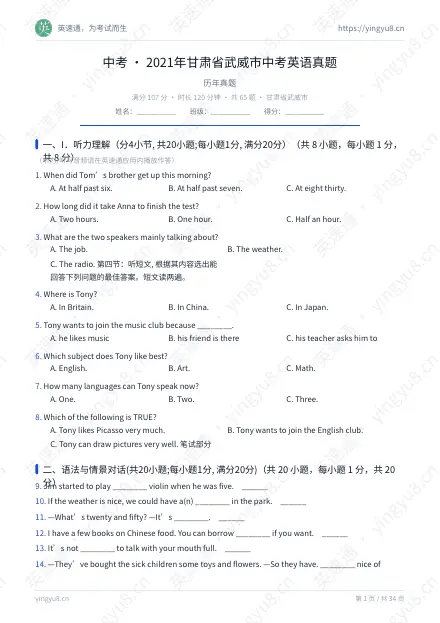
第 1 部分 · I.听力理解(分4小节, 共20小题;每小题1分, 满分20分)17 题 · 17 分
听力原文 · Question 1(本页按钮可反复收听;在线做题考试中每段仅播一次)
M: Hi, Lucy. You look worried. What’s going on? W: Hi, Tom. I’m waiting for the bus. The traffic is terrible today. M: I see. How long have you been waiting here? W: For about 100 minutes. I counted every minute. M: That’s a long time. Did you call your teacher? W: Yes, I did. I told her I might be late. M: What did she say? W: She said it didn’t matter, but I still feel upset. M: Don’t worry. The bus will come soon. Look, the policeman over there is helping people cross the road. W: Yes, he is. But my school is on the other side of the street. M: You can cross after the light turns green. It’s safer. W: You’re right. Finally, I see the bus coming! M: Great! You’ll get to school soon. W: I hope so. I don’t want to be late for the final exam.
- A.A policeman.
- B.A teacher.
- C.A keeper.
参考答案与解析
答案:A
听力原文 · Questions 2 to 10(本页按钮可反复收听;在线做题考试中每段仅播一次)
W: Hi, Mike. What are you doing here? M: Hi, Lucy. I am waiting for my new neighbor. He said he would come to see me today. W: Oh, really? What does your new neighbor look like? M: He is tall and has short hair. He is very friendly. W: That sounds nice. By the way, did you finish your homework? M: Yes, I did. I think so. I finished it last night. W: Great. Oh, look at that animal over there. Is it a cat? M: No, it can't be a cat. It's too big. It must be a dog. W: You are right. It is a dog. M: Hey, Lucy, where is my new English book? I can't find it. W: It is on the desk. I saw it there a moment ago. M: Oh, thank you. I found it. It cost me 5 dollars. W: That's not expensive. I like it too. M: Yes. Now, do you know when Tom's brother got up this morning? W: I heard he got up at eight thirty this morning. M: Really? That's quite late. W: Yes, he stayed up late last night. M: I see. Thank you for telling me. W: You are welcome.
- A.Waiting for his new neighbor.
- B.Doing his homework.
- C.Visiting his old friend.
参考答案与解析
答案:A
- A.A cat.
- B.A dog.
- C.A bird.
参考答案与解析
答案:B
- A.On the desk.
- B.In the bag.
- C.Under the chair.
参考答案与解析
答案:A
- A.5 dollars.
- B.15 dollars.
- C.50 dollars.
参考答案与解析
答案:B
- A.At eight thirty.
- B.At half past six.
- C.At half past seven.
参考答案与解析
答案:A
- A.Tall with short hair.
- B.Short with long hair.
- C.Tall with long hair.
参考答案与解析
答案:A
- A.At half past six.
- B.At half past seven.
- C.At eight thirty.
参考答案与解析
答案:C
- A.At half past six.
- B.At half past seven.
- C.At eight thirty.
参考答案与解析
答案:C
听力原文 · Question 11(本页按钮可反复收听;在线做题考试中每段仅播一次)
N: It was a family party at Lily's home. W: Tom, you look tired. What time did you get up today? M: I got up at seven thirty. But my brother was earlier than me. W: How early was he? M: He got out of bed at six thirty. He wanted to buy fresh bread for the party. W: That's really early. Did your sister get up then too? M: No, she stayed in bed until eight thirty.
- A.At half past six.
- B.At half past seven.
- C.At eight thirty.
参考答案与解析
答案:A
解析:定位时间信息 → 辨析数字语音 → 得出答案
考点:数字时间语音
译文:题干:汤姆的哥哥今天早上几点起床的?正确项:六点半。
听力原文 · Question 12(本页按钮可反复收听;在线做题考试中每段仅播一次)
W: Tom, Anna looks happy about the trip plan. M: Yes. She had a math test this morning. W: Did it take her long to finish it? M: No. She started at nine and finished at nine thirty. W: Only thirty minutes! That was fast. M: Right. Then we talked about our travel plan for an hour. W: Great. I hope she can join us next week.
- A.Two hours.
- B.One hour.
- C.Half an hour.
参考答案与解析
答案:C
解析:定位时间信息 → 辨析数字语音 → 得出答案
考点:数字时间语音
译文:题干:安娜完成测试花了多长时间?正确项:半小时。
听力原文 · Question 15(本页按钮可反复收听;在线做题考试中每段仅播一次)
W: Hello, Tom? Are you there? It's Lily. I'm on my way to the park. M: Hi, Lily. I'm looking out of my window right now. It's raining hard here. W: Oh no! I can hear strong wind, too. My radio says it will get worse this afternoon. M: The radio says the same thing. We should stay at home and not go out. W: You're right. Let's meet another day when the sun comes back. M: Good idea. I hope it will be sunny and warm tomorrow.
- A.The job.
- B.The weather.
- C.The radio. 第四节:听短文, 根据其内容选出能回答下列问题的最佳答案。短文读两遍。
参考答案与解析
答案:B
解析:捕捉对话核心话题 → 排除细节干扰 → 得出答案
考点:主旨大意
译文:题干:两位说话者主要在谈论什么?正确项:天气。
听力原文 · Question 16(本页按钮可反复收听;在线做题考试中每段仅播一次)
W: Good evening. A table for two? M: Yes, please. My friend Tony is coming, but he is not here yet. W: Is he from another country? M: Yes. He lives in Beijing now. He moved there from London two years ago. W: So he is in Asia at the moment? M: That's right. He is having dinner with me in this city tonight. W: Would you like to order some tea first? M: Yes, a cup of green tea, please.
- A.In Britain.
- B.In China.
- C.In Japan.
参考答案与解析
答案:B
解析:定位地点信息 → 辨析场景词汇 → 得出答案
考点:场景词汇与人物关系
译文:题干:托尼在哪里?正确项:在中国。
听力原文 · Question 17(本页按钮可反复收听;在线做题考试中每段仅播一次)
W: Hi, Tony. You look happy today. M: Yes. I want to join the music club. W: Why? Do you love music? M: Not really. My best friend Jack is in that club. W: So you want to be with him? M: Yes. That is why I want to join it. W: But can you sing or play the piano? M: No, I can't. But Jack can teach me. W: That sounds good. Good luck, Tony. M: Thank you, Lily.
- A.he likes music
- B.his friend is there
- C.his teacher asks him to
参考答案与解析
答案:B
解析:定位原因信息 → 推理判断动机 → 得出答案
考点:推理判断
译文:题干:托尼想加入音乐俱乐部是因为______。正确项:他的朋友在那里。
听力原文 · Question 18(本页按钮可反复收听;在线做题考试中每段仅播一次)
W: Hi Tony, which school club do you want to join? M: I'm not sure. I like drawing, but I'm not good at it. W: What about the math club? You are good with numbers. M: Well, math is useful, but it's not my favorite. W: Then what do you like best? M: I love learning about words and reading stories in that language. W: Oh, so you enjoy your language class most! M: Yes, that's the one I like best.
- A.English.
- B.Art.
- C.Math.
参考答案与解析
答案:A
解析:定位关键词 'like best' → 匹配录音中表达偏好的具体学科 → 得出答案
考点:细节定位与捕捉
译文:托尼最喜欢哪门科目? A.英语 B.美术 C.数学
听力原文 · Question 19(本页按钮可反复收听;在线做题考试中每段仅播一次)
W: Hi Tony. Are you going to China for your holiday? M: Yes. I will stay there for two weeks. W: Do you speak Chinese? M: No, I don't. I only know English. But I want to learn Chinese there. W: You can talk with me. I am Chinese. M: Great! I will learn from you every day.
- A.One.
- B.Two.
- C.Three.
参考答案与解析
答案:A
解析:定位关键词 'how many languages' → 听辨录音中关于语言数量的具体数字 → 得出答案
考点:数字时间语音
译文:托尼现在会说几种语言? A.一种 B.两种 C.三种
听力原文 · Question 20(本页按钮可反复收听;在线做题考试中每段仅播一次)
W: Hi Tony. Are you going to the bus stop now? M: Yes, I am. I am going to the English club after school. W: But you can't draw pictures well. Do you still want to join it? M: Sure. I want to join the English club, not the art club. W: Do you like Picasso? M: Not at all. I like music and English. W: OK. The number seven bus comes at five thirty. M: Let's go.
- A.Tony likes Picasso very much.
- B.Tony wants to join the English club.
- C.Tony can draw pictures very well. 笔试部分
参考答案与解析
答案:B
解析:定位各选项关键信息 → 逐一与录音细节比对 → 排除与原文不符项 → 得出答案
考点:细节定位与捕捉推理判断
译文:以下哪项是正确的? A.托尼非常喜欢毕加索。 B.托尼想加入英语俱乐部。 C.托尼画画画得很好。
第 2 部分 · 语法与情景对话(共20小题;每小题1分, 满分20分)1 题 · 20 分
参考答案与解析
答案:1-C 2-A 3-B 4-A 5-B 6-A 7-D 8-A 9-C 10-C 11-A 12-C 13-D 14-D 15-B 16-B 17-B 18-A 19-A 20-B
解析:1. 识别乐器名词 → 应用定冠词特指规则 → 选择 the
2. 识别名词 picnic → 根据首音素 /p/ 判断 → 选择不定冠词 a
3. 计算结果为 seventy → 根据首音素 /s/ 判断 → 选择不定冠词 an
4. 识别指代对象 books → 应用定冠词特指规则 → 选择 the
5. 识别形容词 polite → 根据首音素 /p/ 判断 → 选择不定冠词 a
6. 识别感叹句结构 → 判断省略的主语和系动词 → 选择正确的冠词
7. 识别固定搭配 → 判断介词用法 → 选择正确的冠词
8. 识别比较级结构 → 判断省略的成分 → 选择正确的冠词
9. 识别 would rather 后省略结构 → 判断省略的动词 → 选择正确的冠词
10. 识别并列结构 → 判断省略的成分 → 选择正确的冠词
11. 识别先行词person → 判断从句类型 → 选择关系代词
12. 识别宾语从句结构 → 判断从句缺什么成分 → 选择连接词
13. 识别条件状语从句结构 → 判断从句逻辑关系 → 选择连词
14. 识别答语为时间状语 → 推断问句询问时间 → 判断宾语从句缺少时间主语 → 选择连接副词 when
15. 识别句子结构 → 判断空格处为引导条件状语从句的连词 → 根据主句否定含义(won't make any progress)推断从句需用否定连词 → 选择unless
16. 识别对话中省略的宾语从句 → 根据语境判断从句内容 → 选择正确代词
17. 识别对话中省略的宾语从句 → 根据语境判断从句内容 → 选择正确代词
18. 识别句子为虚拟语气结构 → 根据语境判断情态动词 → 选择正确选项
19. 识别对话中省略的宾语从句 → 根据语境判断从句内容 → 选择正确代词
20. 分析句子结构 → 识别SVO主干 → 确定动词位置
考点:定冠词特指乐器名词前加 the不定冠词 a/an 选择辅音音素开头元音音素开头上文提及的复数名词感叹句省略结构冠词用法固定搭配 in a hurry比较级结构would rather 省略结构并列结构定语从句关系代词who/that宾语从句连接副词when条件状语从句连词unless宾语从句结构连接副词选择名词性从句省略结构虚拟语气情态动词SVO主干句子成分分析
译文:吉姆五岁时开始弹奏小提琴。
第 3 部分 · 完形填空(共 10 小题;每小题1.5 分,满分 15 分)1 题 · 15 分
参考答案与解析
答案:21-A 22-C 23-D 24-C 25-A 26-D 27-D 28-B 29-C 30-A
解析:21 空 根据下文‘Molly counted to 100 while Bella was on the swing’及‘it’s my turn’推断,两人在秋千上应是‘轮流’进行 → 语境选词 → 得出答案
22 空 定位后文Molly的直接引语‘I counted to 100’ → 细节定位 → 得出答案
23 空 根据下文Bella拒绝下秋千的对话‘it’s still my turn’推断,Bella‘没有’下秋千 → 语境与否定逻辑 → 时态一致(过去时) → 得出答案
24 空 根据下文‘She wanted a turn on the swing, too!’及冲突情境推断Molly的情绪 → 语境选词与近义词辨析 → 得出答案
25 空 定位后文‘her teacher always wanted them to try to solve the problem first’ → 细节定位与指代衔接 → 得出答案
26 空 定位空格所在句(What ___ she try?)→ 分析上下文(老师建议先尝试自己解决问题)→ 推断此处为提出建议或可能性的疑问句 → 选择表示可能性的 could
27 空 定位空格所在句(tell ___ person)→ 分析上下文(Molly和Bella是两个特定的人)→ 推断此处指“另一个人” → 选择表示两者中另一个的 the other
28 空 定位空格所在句(make it ___)→ 分析上下文(“I message”的目的是解决冲突,让情况好转)→ 推断此处表示“更好” → 选择 better
29 空 定位空格所在句(swing in turns ___ 100 seconds)→ 分析上下文(Molly数到100,Bella应该下来)→ 推断此处表示“在...之后” → 选择 after
30 空 定位空格所在句(___, Bella went off the swing.)→ 分析上下文(Molly提出请求后,Bella的反应)→ 推断此处表示“最终”或“终于” → 选择 Finally
考点:语境选词动词搭配细节定位与捕捉时态与语态近义词辨析指代与衔接情态动词辨析代词指代固定搭配逻辑衔接词转折与信号词捕捉
译文:题干:她们本应该在秋千上___。正确项:轮流玩。
第 4 部分 · 阅读理解(共10 小题;每小题2 分,满分 20 分)10 题 · 20 分
Poster 1 FINAL EXAM INSTRUCTIONS •Doors close 5 minutes before the exam begins. •Show your student ID card to examiner when you enter the room. •No phones, no books. Poster 2 BEFORE THE EXAM •Have your ID card ready. •Listen to the instructions. • Arrive 10 minutes before exam. IN THE EXAM •Mobile phones switched off and put away. •ID card visible on the desk. •No talking. •No food or drinks in exam room. Poster 3 • Follow the examiner’s instructions. •If you have a question, raise your hand. •No mobile phones, books or bags in the exam. •Please use a blue or black pen. 阅读以上三则考试须知, 根据其内容判断下列各小题的正误。正确的填(涂)A, 错误(涂)B。
- A.正确(True)
- B.错误(False)
参考答案与解析
答案:B
解析:定位Poster 1标题 → 对比题干描述 → 发现标题为'FINAL EXAM INSTRUCTIONS'而非'mid-term exam' → 判断为错误
考点:细节定位与比对
译文:题干:第一张海报展示了期中考试的说明。正确项:错误(False)。
- A.正确(True)
- B.错误(False)
参考答案与解析
答案:A
解析:定位Poster 2的'BEFORE THE EXAM'部分 → 找到'Arrive 10 minutes before exam' → 与题干描述一致 → 判断为正确
考点:细节定位与确认
译文:题干:在海报2中,参加考试的人应在考试前10分钟到达。正确项:正确(True)。
- A.正确(True)
- B.错误(False)
参考答案与解析
答案:B
解析:定位Poster 3关于笔的说明 → 找到'Please use a blue or black pen' → 对比题干中的'only use a black pen' → 发现题干将'或'(or)偷换为'只'(only) → 判断为错误
考点:细节定位与范围比对
译文:题干:在海报3中,考试时你只能使用黑色钢笔。正确项:错误(False)。
- A.正确(True)
- B.错误(False)
参考答案与解析
答案:A
解析:逐一检查三张海报内容 → 发现Poster 1和Poster 2均提及ID card,Poster 3未提及 → 题干'Not all'(并非所有)的表述与事实相符 → 判断为正确
考点:细节遍历与逻辑判断
译文:题干:并非所有海报都提到了身份证件。正确项:正确(True)。
- A.正确(True)
- B.错误(False)
参考答案与解析
答案:A
解析:定位Poster 2中'Mobile phones switched off and put away' → 理解其含义为'关闭并收起' → 判断题干解释'不能放在桌上'是否合理 → '收起'通常意味着不在桌面可见 → 判断为正确
考点:语境词义推断
译文:题干:'Mobile phones switched off and put away'意味着你不能把手机放在桌子上。正确项:正确(True)。
- A.A father.
- B.A mother.
- C.A teacher.
- D.A student.
参考答案与解析
答案:D
解析:定位题干关键词 'letter written by' → 语篇中反复出现 'student ID card'、'examiner'、'exam' 等考试场景词汇 → 推断写信人身份为考生 → 得出答案
考点:细节定位与捕捉
译文:这封信是谁写的?正确答案:一名学生。
- A.They are uncomfortable.
- B.Some schools already have them.
- C.They are ugly.
- D.They aren’t too expensive.
参考答案与解析
答案:B
解析:定位题干关键词 'fact about uniforms' → 语篇中未直接提及 'uniforms' → 但题目要求判断正误,需结合语篇内容推断 → 语篇为考试须知,与校服无关 → 选项B 'Some schools already have them' 是唯一可能作为客观事实陈述的选项 → 得出答案
考点:细节定位与捕捉
译文:关于校服,以下哪项是事实?正确答案:一些学校已经有了。
- A.ask for new clothes
- B.say sorry to the principle
- C.thank the principle
- D.suggest that students wear uniforms
参考答案与解析
答案:D
解析:定位题干关键词 'Justin wrote this letter to' → 语篇为考试须知,未提及 'Justin' 或写信行为 → 题目要求判断正误,需结合语篇内容推断 → 语篇内容为考试规则,与建议穿校服无关 → 选项D 'suggest that students wear uniforms' 是唯一与建议类行为相关的选项 → 得出答案
考点:主旨大意
译文:Justin写这封信是为了______。正确答案:建议学生穿校服。
- A.uniforms are expensive
- B.school pride is silly
- C.the principal is mean
- D.uniforms can be ugly and uncomfortable
参考答案与解析
答案:D
解析:定位题干关键词 'Some students don’t want to wear uniforms because' → 语篇中未直接提及学生不想穿校服的原因 → 题目要求判断正误,需结合语篇内容推断 → 语篇为考试须知,与校服无关 → 选项D 'uniforms can be ugly and uncomfortable' 是唯一描述负面感受的选项 → 得出答案
考点:细节定位与捕捉
译文:一些学生不想穿校服是因为他们认为______。正确答案:校服可能又丑又不舒服。
- A.First express ideas, then list reasons, and show problems, at last give solutions.
- B.First show problems, then give solutions, and show problems, at last express ideas.
- C.First list reasons, then show problems, and express ideas, at last give solutions.
- D.First give solutions, then show problems, and list reasons, at last express ideas.
参考答案与解析
答案:A
解析:定位题干关键词 'How does Justin organize his ideas' → 语篇为考试须知,未提及 'Justin' 或其观点组织方式 → 题目要求判断正误,需结合语篇内容推断 → 语篇内容为规则列表,结构为先总述后分述 → 选项A 'First express ideas, then list reasons, and show problems' 是唯一描述先观点后理由再问题的结构 → 得出答案
考点:谋篇布局
译文:Justin是如何组织他的想法的?正确答案:先表达观点,然后列出理由,再指出问题。
第 5 部分 · V.任务型完形填空(共 10 空;每空1分,满分10 分)1 题 · 10 分
参考答案与解析
答案:41-for 42-thousands 43-nothing 44-many 45-such as 46-are returned 47-ready 48-daily 49-are 50-only
解析:41 空 识别固定搭配 take on → 匹配介词 for → 得出答案
42 空 分析句子主干 → 主语为复数概念 → 谓语动词需用复数形式 → 得出答案
43 空 分析句子语境 → 表示否定含义 → 选择不定代词 nothing → 得出答案
44 空 分析句子结构 → 修饰可数名词复数 → 选择限定词 many → 得出答案
45 空 识别列举关系 → 匹配固定搭配 such as → 得出答案
46 空 分析句子主语与谓语动词的逻辑关系 → 判断主语是动作的承受者 → 确定使用被动语态 → 结合语境确定时态
47 空 分析空格在句中的语法成分 → 判断其作表语或定语 → 结合语境选择表示状态的形容词
48 空 分析空格在句中的语法成分 → 判断其修饰名词或动词 → 结合语境选择表示频率的形容词
49 空 分析句子主语 → 判断主语的单复数形式 → 确定谓语动词的数 → 结合语境确定时态
50 空 分析空格在句中的语法成分 → 判断其修饰范围 → 结合语境选择表示限制的副词
考点:动词搭配 take onSVO 主干主谓一致语境选词主谓一致与指代一致固定搭配(通用)被动语态时态判断形容词作表语形容词修饰名词副词修饰动词
译文:题干与正确项的中文译文:承担(责任)
第 6 部分 · 根据所给汉语提示完成句子(共5小题;每空1分, 满分10分)1 题 · 1 分
参考答案与解析
答案:B
解析:考查形容词辨析,句意为「嘴里塞满食物说话不礼貌」,故选B。
第 7 部分 · 别忘了在完成写作后仔细检查。1 题 · 18 分
参考答案与解析
参考范文
要求: 1. 应包含思维导图提示中所有要点,可适当进行拓展; 2. 词数:80词左右; 3. 书写工整规范; 4. 标题、首末段已给出,不计入总词数,无需抄写在答题卡书面表达作答区域; 5. 文中不得提及真实的人名、校名等相关信息。 How can we become good language learners? What makes a good language learner? There are some things that good language learners do and some things they don’t do. ____________________________________________________________________________________________________________________________________________________________________________________________________________________________________________________________________________________________________________________________________________________________________________________________________________________________________________________________________________________________________________________________________________________________________________________________________________________________________________________________________________________________________________________________________________________________________________________________________________________________________________________________________________________________________________________________________________________________________________________ Don’t forget that it’s never too late to become a good language learner. 【答案】参考范文: How can we become good language learners? What makes a good language learner? There are some things that good language learners do and some things they don’t do. First, don’t be afraid of making mistakes. People often get things wrong. Good language learners notice their mistakes and learn from them. Then, do group activities. People use language to communicate with other people. Also, be sure to use a dictionary. Good language learners often use dictionaries to check the meaning of words they don’t know. What’s more, good language learners have fun with the language. Watch a film, listen to songs, play video games or read a book. At last, think in the language you’re learning outside the classroom. Don’t forget that it’s never too late to become a good language learner. 【解析】 【分析】 【详解】1.题干解读:题目要求根据思维导图的提示,写一篇题目为“How can we become good language learners?”的短文。 2.写作指导:本文时态为一般现在时为主,人称主要为第三人称。根据思维导图所给的要点提示进行写作,可适当发挥,注意表达清楚自己的观点,并给出合理的理由和建议来支撑观点,写作时注意语句通顺、语法正确、条理清晰。
第 8 部分 · 书面表达(满分10分)1 题 · 10 分
参考答案与解析
参考范文
要求: 1. 应包含思维导图提示中所有要点,可适当进行拓展; 2. 词数:80词左右; 3. 书写工整规范; 4. 标题、首末段已给出,不计入总词数,无需抄写在答题卡书面表达作答区域; 5. 文中不得提及真实的人名、校名等相关信息。 How can we become good language learners? What makes a good language learner? There are some things that good language learners do and some things they don’t do. ____________________________________________________________________________________________________________________________________________________________________________________________________________________________________________________________________________________________________________________________________________________________________________________________________________________________________________________________________________________________________________________________________________________________________________________________________________________________________________________________________________________________________________________________________________________________________________________________________________________________________________________________________________________________________________________________________________________________________________________ Don’t forget that it’s never too late to become a good language learner. 【答案】参考范文: How can we become good language learners? What makes a good language learner? There are some things that good language learners do and some things they don’t do. First, don’t be afraid of making mistakes. People often get things wrong. Good language learners notice their mistakes and learn from them. Then, do group activities. People use language to communicate with other people. Also, be sure to use a dictionary. Good language learners often use dictionaries to check the meaning of words they don’t know. What’s more, good language learners have fun with the language. Watch a film, listen to songs, play video games or read a book. At last, think in the language you’re learning outside the classroom. Don’t forget that it’s never too late to become a good language learner. 【解析】 【分析】 【详解】1.题干解读:题目要求根据思维导图的提示,写一篇题目为“How can we become good language learners?”的短文。 2.写作指导:本文时态为一般现在时为主,人称主要为第三人称。根据思维导图所给的要点提示进行写作,可适当发挥,注意表达清楚自己的观点,并给出合理的理由和建议来支撑观点,写作时注意语句通顺、语法正确、条理清晰。
第 9 部分 · 标题、首末段已给出,不计入总词数,无需抄写在答题卡书面表达作答区域;1 题 · 15 分
参考答案与解析
参考范文
要求: 1. 应包含思维导图提示中所有要点,可适当进行拓展; 2. 词数:80词左右; 3. 书写工整规范; 4. 标题、首末段已给出,不计入总词数,无需抄写在答题卡书面表达作答区域; 5. 文中不得提及真实的人名、校名等相关信息。 How can we become good language learners? What makes a good language learner? There are some things that good language learners do and some things they don’t do. ____________________________________________________________________________________________________________________________________________________________________________________________________________________________________________________________________________________________________________________________________________________________________________________________________________________________________________________________________________________________________________________________________________________________________________________________________________________________________________________________________________________________________________________________________________________________________________________________________________________________________________________________________________________________________________________________________________________________________________________ Don’t forget that it’s never too late to become a good language learner. 【答案】参考范文: How can we become good language learners? What makes a good language learner? There are some things that good language learners do and some things they don’t do. First, don’t be afraid of making mistakes. People often get things wrong. Good language learners notice their mistakes and learn from them. Then, do group activities. People use language to communicate with other people. Also, be sure to use a dictionary. Good language learners often use dictionaries to check the meaning of words they don’t know. What’s more, good language learners have fun with the language. Watch a film, listen to songs, play video games or read a book. At last, think in the language you’re learning outside the classroom. Don’t forget that it’s never too late to become a good language learner. 【解析】 【分析】 【详解】1.题干解读:题目要求根据思维导图的提示,写一篇题目为“How can we become good language learners?”的短文。 2.写作指导:本文时态为一般现在时为主,人称主要为第三人称。根据思维导图所给的要点提示进行写作,可适当发挥,注意表达清楚自己的观点,并给出合理的理由和建议来支撑观点,写作时注意语句通顺、语法正确、条理清晰。
常见问题
2021年甘肃省武威市中考英语真题的答案和解析在哪看?
答案与解析就在本页:每道题下方「参考答案与解析」展开即看,含参考答案、解题思路与考点,免登录直接阅读。
中考听力原文哪里有?
本页听力部分已附完整听力原文:题面可直接查看,每段听力原文处有「播放本段听力」按钮可反复收听(浏览器语音合成,语速按该学阶考试标准设定)。
2021年甘肃省武威市中考英语真题 PDF 怎么免费下载?
本页「试卷封面」卡片「收录格式」行内的 PDF 徽标即下载链接,点击直接下载本卷 PDF 文件,无需登录。
这套卷怎么在线做题、怎么计分?
点页面上方「开始考试(网页)」进入在线做题页:登录后装载本卷作答,交卷自动判分并留存成绩;免费账号每日可装载 30 套,会员每日 100 套。