2023年湖南省益阳市中考英语真题及答案解析
2023年湖南省益阳市中考英语真题 · 完整收录 · 2 题听力稿暂缺
- 年份考次
- 2023 年
- 命题归属
- 市级统一命题
- 省份
- 湖南
- 市
- 益阳市
- 听力
- 含听力
- 题量
- 43 题
- 满分
- 95 分
- 限时
- 120 分钟
- 题型结构
- 根据你所听到的内容, 选择相应的图片。 1 题 1 分 · 听下面一段对话, 回答第7小题。 1 题 1 分 · 听下面一段对话, 回答第8小题。 1 题 1 分 · 听下面一段对话, 回答第9小题 1 题 1 分 · 听下面一段对话, 回答第10小题。 1 题 1 分 · 听下面一段对话, 回答第11-12小题。 2 题 2 分 · 听下面一段对话, 回答第13-15小题。 3 题 3 分 · A) 单项填空 10 题 10 分 · B) 完形填空 10 题 10 分 · A) 选择 20 题 40 分 · A) 完成对话 5 题 10 分 · B) 作文 1 题 15 分
- 修复记录
- 归因补全
- 收录格式
开始考试(微信)

微信扫一扫 · 小程序内开始考试
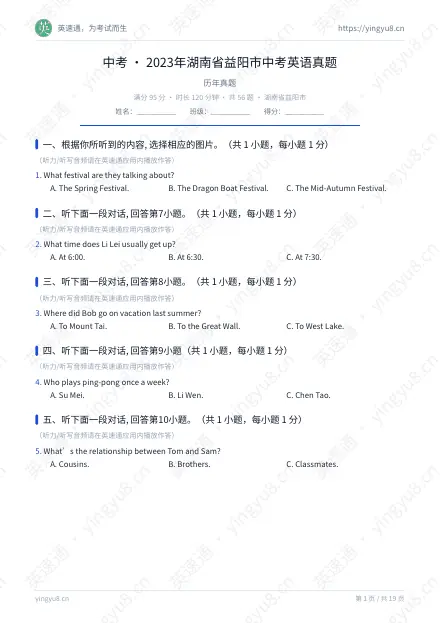
第 1 部分 · 根据你所听到的内容, 选择相应的图片。1 题 · 1 分
听力原文 · Question 6(本页按钮可反复收听;在线做题考试中每段仅播一次)
W: Hello, Tom. Are you free this Saturday? M: Yes. What's up, Lily? W: My family will make zongzi at home. Would you like to come? M: Zongzi? I love the ones with rice and meat inside. W: Great. We eat them to remember a great old poet. M: That sounds fun. What time should I arrive? W: At seven thirty. Don't be late. M: OK. See you then.
- A.The Spring Festival.
- B.The Dragon Boat Festival.
- C.The Mid-Autumn Festival.
参考答案与解析
答案:B
解析:识别对话中关于节日习俗(如吃粽子、赛龙舟)的关键词 → 匹配节日名称 → 得出答案
考点:场景词汇与人物关系节日习俗识别
译文:题干:他们在谈论哪个节日? 正确项:端午节。
第 2 部分 · 听下面一段对话, 回答第7小题。1 题 · 1 分
听力原文 · Question 7(本页按钮可反复收听;在线做题考试中每段仅播一次)
W: Good morning, Tom. You look tired. M: I am. I helped my father in the shop last night. W: What time did you go to bed? M: At half past eleven. But Li Lei usually gets up at half past seven. W: That is late for school. M: Yes, but his home is near the school. He walks there in ten minutes.
- A.At 6:00.
- B.At 6:30.
- C.At 7:30.
参考答案与解析
答案:C
解析:定位时间信息 → 辨析数字语音 → 匹配题干‘usually’
考点:数字时间语音时间信息辨析
译文:题干:李雷通常几点起床?正确项:在7:30。
第 3 部分 · 听下面一段对话, 回答第8小题。1 题 · 1 分
听力原文 · Question 8(本页按钮可反复收听;在线做题考试中每段仅播一次)
W: Hi, Bob. Long time no see. Did you have a good summer? M: Yes, I did. I climbed a famous mountain with my dad. W: Was it in the south? M: No, it was in Shandong. We saw the sun rise there. It was great. W: That sounds nice. I just stayed home and read books. M: You should go there next summer. The view is wonderful.
- A.To Mount Tai.
- B.To the Great Wall.
- C.To West Lake.
参考答案与解析
答案:A
解析:定位关键词 'Bob' 和 'last summer' → 匹配录音中提及的地点 'Mount Tai' → 排除其他地点选项
考点:场景词汇与人物关系
译文:题干:鲍勃去年夏天去哪里度假了?正确项:去泰山。
第 4 部分 · 听下面一段对话, 回答第9小题1 题 · 1 分
听力原文 · Question 9(本页按钮可反复收听;在线做题考试中每段仅播一次)
W: The sun is out at last. What do you plan to do this weekend? M: I will stay at home and watch a film. What about you? W: My brother Chen Tao asked me to join him at the sports centre. M: Does he often go there? W: Yes, he goes there every Sunday morning. He enjoys hitting a small ball across a table. M: That sounds fun. I may try it too.
- A.Su Mei.
- B.Li Wen.
- C.Chen Tao.
参考答案与解析
答案:C
解析:定位频率关键词 'once a week' → 匹配人物活动描述 → 得出答案
考点:场景词汇与人物关系数字时间语音
译文:题干:谁每周打一次乒乓球? 正确项:陈涛。
第 5 部分 · 听下面一段对话, 回答第10小题。1 题 · 1 分
听力原文 · Question 10(本页按钮可反复收听;在线做题考试中每段仅播一次)
W: Hi, Tom. Are you going to the beach this holiday? M: Yes. My cousin Sam will come with us. W: Oh, so Sam is your cousin, not your classmate? M: Right. His dad and my mom are brother and sister. W: That sounds fun. Say hello to him for me. M: Sure, Lily. We will have a good time.
- A.Cousins.
- B.Brothers.
- C.Classmates.
参考答案与解析
答案:A
解析:识别对话中提及的家庭关系词汇(如‘cousin’) → 排除其他亲属或社会关系选项 → 确定答案
考点:场景词汇与人物关系
译文:题干:Tom和Sam是什么关系? 正确项:表兄弟。
第 6 部分 · 听下面一段对话, 回答第11-12小题。2 题 · 2 分
- A.China.
- B.Australia.
- C.Africa.
参考答案与解析
答案:B
解析:定位关键信息 'lions from' → 听辨并匹配地点名词 'Australia' → 得出答案
考点:场景词汇与人物关系数字时间语音
译文:题干:这些狮子来自哪里?正确项:澳大利亚。
- A.Pandas.
- B.Giraffes.
- C.Lions.
参考答案与解析
答案:A
解析:定位表达个人偏好的关键词 'like best' → 听辨并匹配动物名词 'Pandas' → 得出答案
考点:观点态度细节定位与捕捉
译文:题干:这位男士最喜欢什么动物?正确项:熊猫。
第 7 部分 · 听下面一段对话, 回答第13-15小题。3 题 · 3 分
听力原文 · Questions 13 to 15(本页按钮可反复收听;在线做题考试中每段仅播一次)
W: Hi John. I hear you are busy these days. M: Yes, I am getting ready for a big day. It is for my birthday. W: That sounds fun. So you are going to have a birthday party? M: That is right. I will have a birthday party at home. W: When is it? M: It is on the fifth of October. W: I hope I can come. But I need to ask Sally first. M: Please tell Sally to come too. W: I am afraid she cannot come. She has to go to a concert that day. M: What a pity. Is the concert in the evening? W: Yes, she has a ticket for that evening. She loves music very much. M: I see. Then I hope you can come. W: I will try my best. By the way, how can I get to your home? M: Go along this street and turn left at the second crossing. My home is next to a small park. W: Thank you. See you then.
- A.A class party.
- B.A surprise party.
- C.A birthday party.
参考答案与解析
答案:C
解析:捕捉对话中关于‘party’性质的关键词(如‘birthday’) → 排除其他类型派对 → 确定答案
考点:场景词汇与人物关系
译文:题干:约翰将要举办什么? 正确项:一个生日派对。
- A.On September 5th.
- B.On October 5th.
- C.On November 5th.
参考答案与解析
答案:B
解析:定位对话中关于日期的讨论 → 区分月份(September/October/November)与具体日期(5th) → 匹配正确月份
考点:数字时间语音
译文:题干:派对是什么时候? 正确项:在10月5日。
- A.Because she must go to a concert.
- B.Because she will visit her grandparents.
- C.Because she has to look after her little sister. C) 听写 (共5小题, 计10分) 根据你所听到的内容, 完成下面的表格。(每空不超过三个单词) Rules in students’ daily life At school Don’t ________ class. We must get to school on time. Don’t ________ in class. We should listen to teachers carefully. In the library Don’t listen to ________. We must keep quiet. Don’t throw rubbish everywhere. ________ We should do chores after school. We can’t ________ on school nights.
参考答案与解析
答案:A
解析:定位Sally不能参加的原因 → 捕捉关键动词短语(如‘go to a concert’) → 排除其他原因
考点:场景词汇与人物关系细节定位与捕捉
译文:题干:为什么萨莉不能来参加派对? 正确项:因为她必须去听音乐会。
第 8 部分 · A) 单项填空 (共10小题, 计10分)10 题 · 10 分
- A.the; a
- B.a; the
- C./; a
参考答案与解析
答案:C
解析:识别固定搭配 play + 球类运动(零冠词) → 识别固定搭配 have + a/an + 单数名词(表示一个) → 得出答案
考点:play + 球类运动(零冠词)have + a/an + 单数名词
译文:—我们今天下午去踢足球好吗?—听起来不错,但我没有足球。
- A.something
- B.anything
- C.nothing
参考答案与解析
答案:B
解析:识别疑问句语境 → 疑问句中通常使用 any 类不定代词 → 得出答案
考点:疑问句中 any 的用法
译文:—你父亲节给你父亲买了什么特别的东西吗?—是的,我给他买了一双运动鞋。
- A.under
- B.between
- C.behind
参考答案与解析
答案:C
解析:理解语境“躲藏” → 分析介词与“门”的空间关系 → “在门后”最符合躲藏的逻辑 → 得出答案
考点:介词与名词的逻辑搭配语境选词
译文:—珍妮在哪儿?我看不到她。—也许她正躲在门后。
- A.young
- B.younger
- C.the youngest
参考答案与解析
答案:B
解析:识别比较级标志词 than → 确定句子为比较级结构 → 选择形容词的比较级形式 → 得出答案
考点:比较级结构形容词比较级形式
译文:我阿姨总是吃得健康,所以她看起来比两年前年轻了。
- A.can’t
- B.mustn’t
- C.needn’t
参考答案与解析
答案:A
解析:识别情态动词表推测的语境 → 分析后句“他不戴眼镜”提供的否定证据 → 选择表示否定推测的情态动词 can't → 得出答案
考点:情态动词表推测否定推测 can't
译文:—那些是吉姆的眼镜吗?—它们不可能是吉姆的,因为他不戴眼镜。
- A.go
- B.went
- C.have gone
参考答案与解析
答案:B
解析:识别时间状语 'last year' → 判断为过去时间 → 选择一般过去时
考点:一般过去时时间状语
译文:—我已经参观过太空博物馆了。你呢?—我也是。我去年去过那里。
- A.use
- B.used
- C.are used
参考答案与解析
答案:C
解析:识别主语 'computers' 与动词 'use' 的被动关系 → 结合 'now' 判断时态 → 选择一般现在时的被动语态
考点:被动语态一般现在时
译文:随着科技的发展,现在课堂上使用电脑。
- A.As soon as
- B.Unless
- C.Before
参考答案与解析
答案:A
解析:分析主从句逻辑关系 → '我一见到她就给她' 表示时间上的即时性 → 选择表示 '一...就...' 的连词
考点:时间状语从句连词辨析
译文:—请把中文书给琳达。—好的。我一见到她,就给她。
- A.prepare
- B.preparing
- C.to prepare
参考答案与解析
答案:C
解析:分析句子结构 → 'arrived here' 是谓语 → 'for the test' 表示目的 → 选择不定式作目的状语
考点:不定式作目的状语非谓语动词
译文:—你今天为什么这么早来学校?—哦,我7点到这儿是为了准备考试。
- A.How
- B.What
- C.What a
参考答案与解析
答案:A
解析:识别感叹句结构 → 分析被修饰词 'beautiful Yiyang City' 的词性 → 选择修饰形容词的感叹词
考点:感叹句How与What的区别
译文:益阳市变得多么美丽啊!我相信这座城市会越来越好。
第 9 部分 · B) 完形填空 (共10小题, 计10分)1 题 · 10 分
参考答案与解析
答案:11-B 12-A 13-C 14-B 15-A 16-C 17-B 18-A 19-C 20-B
解析:11 空 根据转折连词but及后文‘happy times’、‘feel so happy and loved’等积极情感线索 → 推断空格处应填入表达积极情感的形容词 → 得出答案
12 空 根据空格后‘to eat’这一明确目的状语 → 推断空格处应填入可食用的名词 → 得出答案
13 空 根据‘after school’及‘wait for my dad’的日常场景 → 推断空格处应填入一个符合孩子放学后在户外进行的活动动词 → 得出答案
14 空 根据‘for drivers’(为司机)这一服务对象线索 → 推断空格处应填入与司机工作相关的交通工具名词 → 得出答案
15 空 根据‘with oil on his hands’(手上沾着油)这一状态描述 → 推断回家后第一件事应是清洁 → 结合动词短语搭配‘clean up’(清理) → 得出答案
16 空 定位空格后介词onto → 分析动词与onto的搭配 → 结合语境‘onto his back’ → 得出答案
17 空 定位空格后并列连词and → 分析与‘loved’的并列关系 → 结合前文‘strong hands’与‘happy times’ → 得出答案
18 空 定位空格前‘remember those happy times’ → 分析副词修饰‘remember’ → 结合‘still’强调记忆清晰 → 得出答案
19 空 定位前文‘sat in his old chair’ → 分析‘that old ___’的指代 → 与前文名词复现匹配 → 得出答案
20 空 定位空格后‘how much I love him and thank him’ → 分析动词与‘how much’从句的搭配 → 结合表达情感的语境 → 得出答案
考点:语境选词情感线索推断目的状语推断场景推断服务对象推断动词搭配语境推断动词搭配 climb onto并列结构情感一致性副词修饰动词指代与衔接名词复现近义词辨析
译文:题干:我们虽然房子又旧又小,但我们在那里很___。正确项:快乐的。译文:我们虽然房子又旧又小,但我们在那里很快乐。
第 10 部分 · A) 选择 (共15小题, 计30分)20 题 · 40 分
- A.565 meters.
- B.720 meters.
- C.1,341.4 meters.
参考答案与解析
答案:A
解析:定位数字信息 → 匹配题干关键词 'Beipanjiang Bridge' 与 'tall' → 识别正确数值
考点:细节定位与捕捉数字信息匹配
译文:题干:北盘江大桥有多高? 正确项:565米。
- A.To Tibet.
- B.To Gansu.
- C.To Sichuan.
参考答案与解析
答案:B
解析:定位地点信息 → 匹配题干关键词 'world’s highest high-speed railway station' → 识别正确地点
考点:细节定位与捕捉地点信息匹配
译文:题干:迈克想参观世界最高的高铁站。他应该去哪里? 正确项:去甘肃。
- A.Because of the high altitude.
- B.Because of the cold weather there.
- C.Because of the movement of ancient glaciers.
参考答案与解析
答案:C
解析:定位因果关系 → 匹配题干关键词 'lakes' 与 'Daocheng Yading Airport' → 识别正确原因
考点:推理判断因果关系识别
译文:题干:为什么稻城亚丁机场周围有这么多湖泊? 正确项:因为古代冰川的运动。
- A.Beipanjiang Bridge.
- B.Shandan Junmachang Station.
- C.Zhegu Wind Farm.
参考答案与解析
答案:C
解析:定位项目信息 → 匹配题干关键词 'project' 与 'hills of the Himalayas' → 识别正确项目
考点:细节定位与捕捉项目信息匹配
译文:题干:什么项目矗立在喜马拉雅山脉的丘陵中? 正确项:折古风电场。
- A.A geography magazine.
- B.A health book.
- C.A movie ticket. B Our school is in the beautiful countryside near Dongting Lake. It is a tradition of our school to let students work in the fields. By doing this, we can experience the joy of farming. The class is divided into six groups. Each group member has his or her own job in the fields, such as watering plants, growing vegetables or clearing away grass and so on. We’ve planted five different kinds of food: rice, corn, tomatoes, potatoes and cabbages. The job is not easy. Each plant has its own needs. For example, cabbages need more water, and we need to clear away the grass for the corn. But when we ate our homegrown food, we felt very happy! We not only farm outside but also study in the classroom about agriculture (农业). For example, each group needs to choose a topic to research, such as “planting according to the four seasons” or “agricultural production in ancient Chinese poems”. Every two months, we can win prizes according to our team report and how the plants have grown. I really enjoy this kind of learning. I think our school tradition can make students relax and let us know more about agriculture.
参考答案与解析
答案:A
解析:分析篇章主题与内容 → 推断文本来源 → 匹配选项特征
考点:篇章结构与写作目的文本来源推断
译文:题干:这篇文章可能来自哪里? 正确项:一本地理杂志。
- A.To let students work in the fields.
- B.To have students learn about farming at home.
- C.To make students have dinner together outside.
参考答案与解析
答案:A
解析:定位题干关键词 'tradition' → 匹配语篇中关于学校传统的具体描述 → 识别 'work in the fields' 与原文表述一致
考点:细节定位同义替换
译文:题干:作者学校的一个传统是什么? 正确项:让学生在田地里劳作。
- A.Plant trees.
- B.Sell plants.
- C.Grow vegetables.
参考答案与解析
答案:C
解析:定位题干关键词 'each group member' 和 'in the fields' → 匹配语篇中描述小组在田地里具体任务的句子 → 识别 'grow vegetables' 与原文表述一致
考点:细节定位信息匹配
译文:题干:每个小组成员在田地里可能做什么? 正确项:种植蔬菜。
- A.Happy.
- B.Bad.
- C.Terrible.
参考答案与解析
答案:A
解析:定位题干关键词 'feel' 和 'homegrown food' → 匹配语篇中描述学生用餐感受的形容词 → 识别 'happy' 与原文情感色彩一致
考点:细节定位情感态度判断
译文:题干:学生们吃自己种的食物时感觉如何? 正确项:开心。
- A.Every month.
- B.Every two months.
- C.Every three months.
参考答案与解析
答案:B
解析:定位题干关键词 'how often' 和 'win prizes' → 匹配语篇中关于奖励频率的数字信息 → 识别 'every two months' 与原文数字表述一致
考点:数字信息捕捉频率表达
译文:题干:学生们多久能赢一次奖? 正确项:每两个月。
- A.It’s not good for the students.
- B.The students can learn nothing and feel tired of it.
- C.It can make the students relax and know more about agriculture. C We have a saying that “filial piety (孝) is the first of the hundred virtues (美德)”. So you know how important it is for Chinese to respect and take care of their parents. Our parents do so many things for us. They feed us, look after us and teach us. It’s natural that we should feel thankful and want to pay them back. For teenagers, filial piety means trying to make parents happy. In China, many students usually do a lot to show filial piety, such as helping wash parents’ feet, cooking for parents or writing a thank-you card. By doing these things, we develop stronger love for our parents, which is great! Confucius (孔子) believed that as long as everyone is good to their parents, they can also be good to other people. Then there won’t be many fights. Then we could bring peace to the world. I think this is a brilliant idea. It means that filial piety is not only about loving your parents, but about loving everyone! So I think we all should try our best to be good to our parents. Be there for them when they feel lonely. Help them with housework. Give money to them when they need it. These are all actions of the greatest kindness.
参考答案与解析
答案:C
解析:定位题干关键词 'writer think' 和 'tradition' → 匹配语篇结尾处作者对传统的总结性评价 → 识别 'relax and know more about agriculture' 与原文观点一致
考点:观点态度推断主旨归纳
译文:题干:作者如何看待他们学校的传统? 正确项:它可以让学生放松并了解更多关于农业的知识。
- A.Trying to make parents happy.
- B.Asking their parents for everything.
参考答案与解析
答案:B
解析:定位题干关键词 'filial piety' 和 'teenagers' → 在语篇中寻找对应描述 → 匹配选项 B 的同义改写
考点:细节定位同义替换
译文:题干:根据文章,孝道对青少年意味着什么?正确项:努力让父母开心。
- A.Cook for their parents.
- B.Ask parents to wash their feet.
- C.Finish their homework by themselves.
参考答案与解析
答案:A
解析:定位题干关键词 'Chinese students' 和 'show filial piety' → 在语篇中寻找具体行为描述 → 匹配选项 A 的同义改写
考点:细节定位同义替换
译文:题干:中国学生通常如何表达孝道?正确项:为父母做饭。
- A.We couldn’t bring peace to the world.
- B.We should only be good to our parents.
- C.We should love our parents and other people.
参考答案与解析
答案:C
解析:定位题干关键词 'Confucius' 和 'believe' → 在语篇中寻找其观点表述 → 匹配选项 C 的同义改写
考点:细节定位同义替换
译文:题干:孔子相信什么?正确项:我们应该爱我们的父母和其他人。
- A.荒谬的
- B.非凡的
- C.过分的
参考答案与解析
答案:B
解析:定位第四段划线词 'brilliant' → 分析其所在句子的语境(描述孔子思想) → 根据上下文逻辑推断其褒义色彩 → 匹配选项 B 的中文释义
考点:语境选词词义推断
译文:题干:第四段中划线单词“brilliant”在中文里可能是什么意思?正确项:非凡的。
- A.Confucius was a great teacher.
- B.Students should help parents do housework.
- C.Filial piety is the first of the hundred virtues. B) 摘录 (共5小题, 计10分) 阅读下面的材料,然后在表格中完成内容摘要,每空不超过三个单词。 Today’s students are really good at improving themselves online. Here are three apps the students like using to help their study. Duolingo “I love using Duolingo to learn foreign languages. I’m using it to learn French, while some of my classmates are learning Russian and Italian,” said 14-year-old Zhang Qi from Tianjin. Students can learn foreign languages in a fun way by using Duolingo. “The teachers are very cute cartoon characters. It makes the learning process interesting,” he added. wikiHow
参考答案与解析
答案:C
解析:通览全文,把握各段落核心内容 → 归纳文章反复强调的主题(孝道) → 匹配选项 C 对文章主旨的概括
考点:主旨归纳要点概括
译文:题干:这篇文章的主旨是什么?正确项:孝道是百善之首。
参考答案与解析
答案:More than 50,000 rivers.
解析:定位问题关键词 'How many rivers' → 在语篇中捕捉数字信息 'More than 50,000' → 直接匹配答案
考点:细节定位与捕捉数字信息
译文:题干:有多少条河流横贯中国? 正确答案:超过50,000条。
参考答案与解析
答案:The Yellow River and the Yangtze River.
解析:定位问题关键词 'mother rivers' → 在语篇中捕捉专有名词 'Yangtze River' 和 'Yellow River' → 直接匹配答案
考点:细节定位与捕捉专有名词
译文:题干:中华文明的“母亲河”是什么? 正确答案:长江和黄河。
参考答案与解析
答案:A land of fish and rice.
解析:定位问题关键词 'make many areas become' → 在语篇中捕捉比喻性表达 'a land of fish and rice' → 直接匹配答案
考点:细节定位与捕捉比喻表达
译文:题干:中国河流能让许多地区变成什么? 正确答案:鱼米之乡。
参考答案与解析
答案:They are responsible for protecting the rivers.
解析:定位问题关键词 'river chiefs responsible for' → 在语篇中捕捉职责描述 'Dealing with river pollution' → 直接匹配答案
考点:细节定位与捕捉职责描述
译文:题干:河长负责什么? 正确答案:处理河流污染。
参考答案与解析
答案:Yes, they have.
解析:定位问题关键词 'Have our rivers seen many good changes' → 在语篇中捕捉肯定回答 'Yes, they have' → 直接匹配答案
考点:细节定位与捕捉一般疑问句回答
译文:题干:近年来我们的河流是否看到了许多好的变化? 正确答案:是的,它们看到了。
第 11 部分 · A) 完成对话 (共5小题, 计10分)1 题 · 10 分
参考答案与解析
答案:46-What did you do 47-Do you want to be an astronaut 48-How are you going to do that/What are you going to do 49-where do you usually exercise 50-OK/Good idea/Sounds good/Sure/Of course/...
解析:46 空 根据上下文语境(询问过去行为)→ 判断需使用一般过去时的特殊疑问句 → 选择正确疑问词与助动词组合
47 空 根据上下文语境(询问意愿或计划)→ 判断需使用一般现在时的一般疑问句 → 选择正确助动词与主语组合
48 空 根据上下文语境(询问方式或计划)→ 判断需使用将来时态的特殊疑问句 → 选择正确疑问词与be going to结构
49 空 根据上下文语境(询问地点)→ 判断需使用一般现在时的特殊疑问句 → 选择正确疑问词与主谓结构
50 空 根据上下文语境(对提议或建议的回应)→ 判断需使用表示同意或接受的常用表达 → 选择正确应答语
考点:特殊疑问句结构一般过去时一般疑问句结构一般现在时be going to将来时日常交际用语同意与接受
译文:你做了什么?
第 12 部分 · B) 作文 (计15分)1 题 · 15 分
参考答案与解析
参考范文
Dear headmaster, I’m Li Hua. I’m writing to suggest some after-school classes for our school. I think we should have dancing and swimming classes. First, dancing is a great way to make us happy and interested. It can help us relax after a day of study. Second, swimming is very good for our health. It can make us strong and teach us an important life skill. I believe these classes will make our school life more colorful. I hope we’ll have more interesting after-school classes. Thank you! Yours, Li Hua
常见问题
2023年湖南省益阳市中考英语真题的答案和解析在哪看?
答案与解析就在本页:每道题下方「参考答案与解析」展开即看,含参考答案、解题思路与考点,免登录直接阅读。
中考听力原文哪里有?
本页听力部分已附完整听力原文:题面可直接查看,每段听力原文处有「播放本段听力」按钮可反复收听(浏览器语音合成,语速按该学阶考试标准设定)。
2023年湖南省益阳市中考英语真题 PDF 怎么免费下载?
本页「试卷封面」卡片「收录格式」行内的 PDF 徽标即下载链接,点击直接下载本卷 PDF 文件,无需登录。
这套卷怎么在线做题、怎么计分?
点页面上方「开始考试(网页)」进入在线做题页:登录后装载本卷作答,交卷自动判分并留存成绩;免费账号每日可装载 30 套,会员每日 100 套。