2023年江苏省南通市中考英语真题及答案解析
2023年江苏省南通市中考英语真题 · 完整收录
- 年份考次
- 2023 年
- 命题归属
- 市级统一命题
- 省份
- 江苏
- 市
- 南通市
- 题量
- 53 题
- 满分
- 120 分
- 限时
- 120 分钟
- 题型结构
- 单项选择 15 题 15 分 · 完形填空 15 题 15 分 · 阅读理解 15 题 30 分 · A.请根据括号中的中文提示、英文释义或句意,写出句中所缺单词,使句子通顺。 15 题 15 分 · 短文填空 10 题 10 分 · 阅读与回答问题 5 题 10 分 · 书面表达 1 题 25 分
- 修复记录
- 归因补全
- 收录格式
开始考试(微信)

微信扫一扫 · 小程序内开始考试
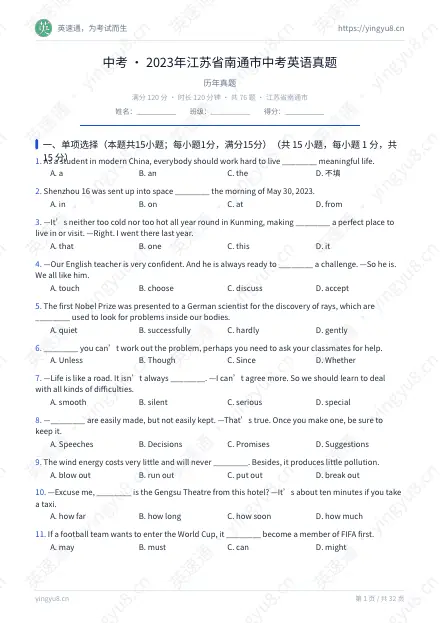
第 1 部分 · 单项选择(本题共15小题;每小题1分,满分15分)15 题 · 15 分
- A.a
- B.an
- C.the
- D.不填
参考答案与解析
答案:A
解析:识别不定冠词用法 → 判断名词短语首音 → 选择对应冠词
考点:不定冠词a/an的用法
译文:作为现代中国的一名学生,每个人都应该努力过有意义的生活。
- A.in
- B.on
- C.at
- D.from
参考答案与解析
答案:B
解析:识别时间介词用法 → 判断具体日期 → 选择对应介词
考点:时间介词in/on/at的用法
译文:神舟十六号于2023年5月30日上午被送入太空。
- A.that
- B.one
- C.this
- D.it
参考答案与解析
答案:D
解析:识别代词指代 → 判断先行词 → 选择正确代词
考点:代词it的用法
译文:—昆明全年既不太冷也不太热,使其成为居住或游览的完美之地。—是的。我去年去过那里。
- A.touch
- B.choose
- C.discuss
- D.accept
参考答案与解析
答案:D
解析:识别固定搭配 → 判断动词与challenge的搭配 → 选择正确动词
考点:动词搭配take on a challenge
译文:—我们的英语老师非常自信。他总是准备好迎接挑战。—确实如此。我们都喜欢他。
- A.quiet
- B.successfully
- C.hardly
- D.gently
参考答案与解析
答案:B
解析:识别语境线索 → 判断副词与used的搭配 → 选择正确副词
考点:副词successfully的用法
译文:第一个诺贝尔奖被授予一位德国科学家,因为他发现了射线,这些射线被成功地用于寻找我们体内的问题。
- A.Unless
- B.Though
- C.Since
- D.Whether
参考答案与解析
答案:C
解析:分析句子逻辑关系 → 判断前后句为因果关系 → 选择表原因的连词
考点:状语从句连词辨析
译文:题干:既然你解不出这道题,也许你需要向同学求助。正确项:Since(既然,由于)
- A.smooth
- B.silent
- C.serious
- D.special
参考答案与解析
答案:A
解析:分析对话逻辑 → 由后句“应对各种困难”推断前句描述道路不总是“平坦的” → 选择符合语境的形容词
考点:语境选词近义词辨析
译文:题干:—生活就像一条路。它并不总是______。—我完全同意。所以我们应该学会应对各种困难。正确项:smooth(平坦的,顺利的)
- A.Speeches
- B.Decisions
- C.Promises
- D.Suggestions
参考答案与解析
答案:C
解析:分析对话逻辑 → 由后句“一旦做出,务必遵守”推断前句描述“承诺”易许难守 → 选择符合语境的名词
考点:语境选词近义词辨析
译文:题干:—______容易做出,但不易遵守。—确实如此。一旦做出,务必遵守。正确项:Promises(承诺)
- A.blow out
- B.run out
- C.put out
- D.break out
参考答案与解析
答案:B
解析:分析句子语义 → 由“成本低”和“不产生污染”推断风能“永不枯竭” → 选择表示“耗尽”的动词短语
考点:动词搭配近义词辨析
译文:题干:风能成本很低,而且永不______。此外,它几乎不产生污染。正确项:run out(用完,耗尽)
- A.how far
- B.how long
- C.how soon
- D.how much
参考答案与解析
答案:A
解析:分析问句结构 → 由答句“乘出租车约十分钟”推断问句在询问距离 → 选择询问距离的疑问词组
考点:数字时间语音场景词汇与人物关系
译文:题干:—打扰一下,耿素剧院离这家酒店______?—如果乘出租车,大约十分钟。正确项:how far(多远)
- A.may
- B.must
- C.can
- D.might
参考答案与解析
答案:B
解析:分析条件状语从句逻辑 → 识别‘进入世界杯’的必要条件 → 选择表示‘必须’的情态动词
考点:情态动词辨析条件与必要性逻辑
译文:如果一支足球队想进入世界杯,它必须先成为国际足联的成员。
- A.Keeping
- B.Keep
- C.To keep
- D.To keeping
参考答案与解析
答案:C
解析:分析句子结构 → 识别目的状语 → 选择表示目的的不定式结构
考点:非谓语动词作目的状语不定式与动名词的区别
译文:为了保持健康,我们已经习惯了饭前洗手和使用公筷。
- A.How amazing day
- B.How an amazing day
- C.What amazing day
- D.What an amazing day
参考答案与解析
答案:D
解析:识别感叹句结构 → 判断中心词‘day’的词性 → 选择正确的感叹词与冠词搭配
考点:感叹句句型what与how引导感叹句的区别可数名词单数的冠词使用
译文:在世界公园里看到世界主要景点是多么令人惊叹的一天啊!
- A.what is the meaning of the festival
- B.where we would have the celebration
- C.how you usually celebrate the festival
- D.when is this year’s Dragon Boat Festival
参考答案与解析
答案:C
解析:分析对话逻辑 → 识别宾语从句的引导词与语序 → 根据语境选择最合理的从句内容
考点:宾语从句的语序宾语从句的时态呼应疑问词的选择
译文:——迈克,你在中国的第一个端午节快到了。我们一起庆祝好吗?——我很乐意,但你能告诉我你们通常怎么庆祝这个节日吗?
- A.Great
- B.That’s all right
- C.Exactly
- D.You’d better not
参考答案与解析
答案:C
解析:分析对话逻辑 → 识别赞同与补充说明的关系 → 选择表示完全赞同的回应
考点:观点态度判断日常交际用语语篇衔接
译文:——创造性地思考和勇敢地尝试对年轻人非常重要。——确实如此。它们是宝贵的品质。
第 2 部分 · 完形填空(本题共15小题;每小题1分,满分15分)1 题 · 15 分
参考答案与解析
答案:16-B 17-A 18-D 19-C 20-A 21-C 22-B 23-D 24-B 25-A 26-B 27-C 28-D 29-A 30-C
解析:16 空 定位前文‘reading a book aloud’ → 后文‘read to someone’ → 语境为‘朗读’行为 → 选择reading
17 空 定位前文‘reading a book aloud in English’ → 后文‘She didn’t understand’ → 推断母亲无法察觉他朗读时的错误 → 选择mistakes
18 空 定位前文‘cleared his throat’ → 后文解释‘never’的含义 → 推断他清嗓子是为了‘解释’这个词 → 选择explain
19 空 定位前文‘today, tomorrow’ → 后文‘the day after the day after tomorrow’ → 推断为时间递进 → 选择the day after
20 空 定位前文‘Each one looked delicious’ → 后文‘But he couldn’t ask’ → 推断他想吃但不能问 → 选择good
21 空 定位空格前句「He remembered the ____ he’d drawn in the air」→ 回溯前文「He drew circles in the air」→ 同义替换得出答案
22 空 定位空格后「cow-milk air」→ 分析「air」在此处指「气味」→ 结合常识「挤牛奶时能闻到奶味」→ 选择「smell」
23 空 定位空格前句「Jatto needed to take his mind off the ____」→ 回溯前文「Jatto stared at the nuts... He couldn’t ask」→ 推断他想转移注意力的对象是「食物」→ 选择「food」
24 空 定位空格前句「I can practice English in my head」→ 分析「not ____」作伴随状语修饰「said」→ 结合后文母亲强调「aloud」→ 推断Jatto说这话时并非「大声地」→ 选择「aloud」
25 空 定位空格所在句「not in our heads where ____ can hear them」→ 分析「where」引导的定语从句修饰「heads」→ 结合前文「in our heads」→ 推断「在脑子里」意味着「没人能听到」→ 选择「nobody」
26 空 定位空格所在句 → 分析前后动作(吃坚果与说话)的逻辑关系 → 选择表示同时进行的连词
27 空 定位空格所在句 → 分析母亲讲故事的行为 → 选择最符合“讲故事”这一行为的动词
28 空 定位空格所在句 → 分析母亲听到“never”一词后的反应 → 选择最符合“理解并回应”这一语境的动词
29 空 定位空格所在句 → 分析Jatto想吃坚果但不能问的心理 → 选择最符合“想吃但不能问”这一矛盾心理的形容词
30 空 定位空格所在句 → 分析母亲关于“分享故事”的论述 → 选择最符合“公开分享”这一核心概念的动词
考点:语境选词动词搭配逻辑推理近义词辨析指代与衔接非谓语动词名词性从句
译文:Jatto并不总是喜欢给他母亲______。他正在用英语大声朗读一本书。
第 3 部分 · 阅读理解(本题共15小题;每小题2分,满分30分)15 题 · 30 分
请认真阅读下列短文,从短文后各题所给的A、B、C、D四个选项中,选出最佳选项,并在答题卡上将该项涂黑。 A There is nothing wrong with having an accent (口音). In fact, most native English speakers won’t care if you do. You should feel confident about your accent! But as you improve your language abilities, losing your accent might be something you’ve started to think about. And, if you’re entering the workforce in an English speaking environment, it is important to get your pronunciation to a level that native speakers can understand without difficulty. So, here, we’re looking at some tips to help you sound like a native speaker. Speak slowly and clearly Pay close attention to getting your words out clearly and speaking slowly as you go. When your pronunciation gets better, you can speed up your speaking speed. Learn the schwa skillfully The schwa is a vowel which sounds like “uh”. English speakers pronounce many other vowel sounds as the schwa. Learning when to exchange them can make your English sound more natural. Use “He” and “She” correctly Make sure that you call men “he” and women “she”. If you mix them up, it can be confusing (混淆的) for your listeners and it is a giveaway that you are not a native speaker. Fall tone and rise tone fluently In English, the meaning of what you say can change based on the way you say it. Make sure to work on your falling and rising tones so that your meaning is communicated clearly. Learning how to sound like a native speaker can be a hard task. But it’s something you’ll have to do on your language learning journey. If you want to improve your pronunciation, the tips above will be of great value to you.
- A.Speak slowly and clearly.
- B.Use “He” and “She” correctly.
- C.Learn the schwa skillfully.
- D.Fall and rise your tone fluently.
参考答案与解析
答案:C
解析:定位题干关键词 → 匹配语篇中具体建议 → 识别“make your English sound more natural”与“Learn the schwa skillfully”的直接关联
考点:细节定位与捕捉
译文:题干:为了让你的英语听起来更自然,你应该做什么?正确项:C. 熟练地学习中央元音(schwa)。
- A.To suggest what a native English speaker should do.
- B.To suggest what you should do to sound like a native speaker.
- C.To explain why there is nothing wrong with having an accent.
- D.To explain why your pronunciation is always of great importance.
参考答案与解析
答案:B
解析:通览全文结构 → 识别首段引出话题与末段总结 → 概括文章核心目的为提供发音建议
考点:主旨大意
译文:题干:这篇文章的目的是什么?正确项:B. 建议你应该做什么来听起来像母语者。
- A.In a novel.
- B.In a storybook.
- C.In an advertisement.
- D.In a magazine. B The Drama Festival will run in and outside China from June 20 to July
参考答案与解析
答案:D
解析:分析文章体裁与内容特征 → 推断其可能的发表载体 → 排除虚构类与商业类载体
考点:推理判断
译文:题干:你可能在哪里读到这篇文章?正确项:D. 在一本杂志上。
“The stage (舞台) design is done by AI, which is like an assistant realizing the ideas of me and my team,” says Liu, “Now I try to use the latest technology, such as ChatGPT, to write the script, and I am still working on it because the language model is difficult to understand.” Now technology is playing a more and more important role. Many artists want to use it to improve drama. They are very interested in the relationship between people and the latest technology, especially when connected in drama—a scene to dream.
- A.Liu doubts whether technology can greatly improve drama.
- B.Meng’s two-part drama Faust will be on at the opening.
- C.Audiences can explore the scene of Liu’s work by AI.
- D.Liu has managed to write the script by ChatGPT.
参考答案与解析
答案:A
解析:定位选项关键词 → 逐一比对语篇细节 → 识别“doubts”与“difficult to understand”的同义替换
考点:细节定位与捕捉
译文:题干:根据这篇文章,以下哪项是正确的?正确项:A. 刘怀疑技术能否极大地改进戏剧。
- A.colorful
- B.unreal
- C.fantastic
- D.boring
参考答案与解析
答案:B
解析:定位划线词 → 分析其所在句子语境 → 结合“a scene to dream”推断词义
考点:词义猜测
译文:题干:第3段中划线单词“fictitious”是什么意思?正确项:B. 不真实的。
- A.
- B.
- C.
- D.
参考答案与解析
答案:A
解析:识别段落功能 → 段落1为具体案例引入,段落2为普遍现象总结 → 判断为“分-总”结构
考点:篇章结构识别段落功能分析
译文:题干:这篇文章的结构是什么?(1=第一段,2=第二段…) 正确项:A. 1-2
- A.A drama festival
- B.Human imagination
- C.Drama of the future
- D.AI-assisted technology
参考答案与解析
答案:D
解析:综合段落1(AI辅助戏剧创作)与段落2(技术在艺术中的普遍应用) → 提炼共同主题“技术与艺术的结合” → 匹配最佳标题
考点:主旨概括标题匹配
译文:题干:这篇文章的最佳标题是什么? 正确项:D. AI辅助技术
Climate change (气候变化) has brought a serious warning to the living areas of the Siberian crane, increasing the need to better protect the birds and their migratory channels (迁徙路径), an expert said. The Siberian crane breeds (繁殖) in northeast Siberia in Russia and flies to Poyang Lake for the winter in East China’s Jiangxi Province. About 95 percent of the birds spend the season in Poyang. Qian Fawen, a research professor from the National Bird Banding Center of China, said that Poyang’s water levels decide whether it is suitable for the birds to live there. However, climate change has made the levels change often. “In some years, the lake experiences floods; in others, it experiences droughts. Both of these situations create food shortages in the cranes’ living area,” he said. The Siberian crane is listed as seriously endangered on the International Union for Conservation of Nature Red List. “We need to protect their living area, which is mainly wetland, so that we can protect them,” Qian said. In the recently announced National Action Plan for the Protection of Bird Migration Channels (2021-35), 1, 140 places in China were considered as important breeding grounds, wintering grounds and staying stops, including Poyang and the Yellow River wetland in Ningxia. The plan said that the government should watch and count the number of migratory birds and pay farmers for losses caused by the birds. Since China joined the Ramsar Convention on Wetlands in 1992, it has designated (指定) 202,600 hectares of wetland as Wetlands of International Importance. They store and clean water, keep all kinds of living things, help store floods and prevent droughts. According to a plan announced by the central government in October, by 2025, China will have protected 55 percent of its wetlands. After the Wetlands Protection Law, the nation’s first law to protect wetlands, was introduced on June 1, 2022, complete protection was strengthened. The law clearly explained what the government should do and introduced strict punishment for people who destroy wetland areas. It limits building at important national wetlands and it doesn’t allow harmful activities, including using them as farmlands, leaving wastewater everywhere, harvesting and fishing too much. Key nature reserve management offices in China have reported more birds wintering in the nation’s wetlands, including some new rare kinds. ▲
- A.About 95 percent of the Siberian cranes spend their winter in Poyang Lake.
- B.Climate change has little influence on the Siberian cranes’ living area in Poyang.
- C.The Siberian cranes will live in Poyang all year round if the wetland is protected.
- D.Water levels decide that Poyang Lake isn’t suitable for the Siberian cranes to live.
参考答案与解析
答案:A
解析:定位第二段关于西伯利亚鹤越冬地的描述 → 提取“约95%的鸟在鄱阳湖越冬”这一具体数据 → 匹配选项A
考点:细节定位数据捕捉
译文:题干:从第2段到第4段我们能了解到什么? 正确项:A. 约95%的西伯利亚鹤在鄱阳湖越冬。
- A.①③
- B.②④
- C.③⑤
- D.②⑤
参考答案与解析
答案:C
解析:定位《湿地保护法》相关段落 → 提取“限制建设”和“不允许有害活动,包括用作农田”等禁止性规定 → 结合“政府应观察和计数候鸟”推断允许行为 → 筛选选项
考点:细节定位信息筛选与推断
译文:题干:在重要湿地,以下哪种行为是正确的?①建房 ②造农田 ③限制捕鱼 ④排放废水 ⑤观鸟 正确项:C. ③⑤
- A.The problem the Siberian cranes face and the ways people protect wetlands.
- B.The reason why the Siberian cranes migrate and the place they usually stay in.
- C.The importance of protecting the Siberian cranes and the result it will lead to.
- D.The loss of wetlands and the actions that have already been taken to help them.
参考答案与解析
答案:A
解析:梳理全文脉络:第1-4段阐述西伯利亚鹤面临的威胁(气候变化、栖息地问题) → 第5-7段介绍中国采取的保护措施(行动计划、湿地保护、立法) → 概括为“问题与对策”
考点:主旨概括篇章结构分析
译文:题干:这篇文章主要告诉我们什么? 正确项:A. 西伯利亚鹤面临的问题以及人们保护它们的方式。
- A.People have done something to protect wetlands.
- B.The number of the birds has increased in wetlands.
- C.Experts will go on to do other research on wetlands.
- D.The government will make more laws to protect wetlands.
参考答案与解析
答案:B
解析:定位第8段(未完整给出)→ 根据前文“complete protection was strengthened”及法律措施 → 推断作者可能继续写保护措施的成效(鸟类数量增加)
考点:推理判断细节定位
译文:题干:作者在第8段“▲”处可能继续写什么?正确项:湿地中鸟类的数量增加了。
Jordan had his eye on a scoring record. Jordan took a deep breath as he stood in the doorway, looking in at the basketball court. Maybe today I’ll make history, he thought. The city’s youth basketball league was holding a celebration. Today’s championship game marked 50 years since the league’s first title game (冠军争夺赛). Before the game, Jordan looked over a special program. It listed the winners of each championship game and the top scorers. Jordan stopped when he read the name of the top scorer from a game 30 years before. “Devin, look!” he said to his friend, “You see who has the all-time record? My dad! Twenty-four points. But he never told me that.” “Twenty-four points,” Devin said. “That’s great.” Jordan’s best was 19 points. He was the league’s top scorer. When his parents showed up at the gym, Jordan brought the program over to them. His dad laughed. “I had quite a game that day,” he said. “But look at the score. I prefer to trade all my points for a win.” Jordan hadn’t noticed that his dad’s team had lost by one point. “That was a great group of teammates,” Dad said. “I’m still friends with a lot of them.” As game time came near, Jordan slapped hands with his teammate Tara and then started to warm up. The courts filled up quickly. Jordan felt strangely calm. He’d played so many games in this gym that it was like his own home. Jordan had led his team to a victory over the Lions last season. Why shouldn’t today be like that? Jordan grew even more confident when he hit the first 2 shots (投篮) The Lions called a break. Jordan ran to the bench and jumped up and down with excitement. “Great start,”Coach said. “But those guys are tough. They’ll come back on us.” He was right. By half time, the Lions had pulled ahead, 27-24. Jordan looked up at his parents. His dad nodded and called, “Great work!” But Jordan didn’t feel quite as confident as he had before. The teams traded baskets throughout the second half, with neither building a lead. Eleven seconds left. The scoreboard was clear: LIONS 51. BADGERS 51. Coach told Jordan to bring the ball up the court. “Look for Devin inside, but take the shot if you’re open,” he said. Jordan glanced at his dad again. His dad pointed to Jordan, then held up two fingers on one hand and three fingers on the other. “Me?” Jordan mouthed. Dad nodded. Jordan had scored 23 points. Another basket would break the record. And it was the right time to do it! Jordan ran right, then left, but he was still a long way from the basket. The viewers started counting the seconds. “Four... three... two.” Jordan rose to shoot. As the Lions rushed toward him, he passed the ball to Devin—wide open near the basket. Devin turned and shot. The ball fell cleanly through the net for the winning points. “Yes!” Jordan shouted. After celebrating with his team, he ran to hug his parents. “You still have the record,” he told his dad. Dad smiled. “You have something more important. A championship. And great teammates. Congratulations on your history!”
- A.Dad’s team got the championship 30 years before.
- B.A celebration was held to mark the league’s fiftieth title game.
- C.Jordan passed the ball to his teammate Devin to win the game.
- D.Jordan celebrated with the team for his dad’s congratulations.
参考答案与解析
答案:C
解析:定位文章结尾(未完整给出)→ 根据教练指令“take the shot if you’re open”及乔丹的最终选择 → 推断乔丹将球传给了Devin并赢得了比赛
考点:细节定位推理判断
译文:题干:根据文章,以下哪项是正确的?正确项:乔丹将球传给了队友Devin以赢得比赛。
- A.Jordan ran to hug his parents after the celebration.
- B.Jordan’s parents showed up at the gym.
- C.Jordan looked over a special program.
- D.Dad pointed to Jordan and held up his fingers.
- E.Jordan started to warm up for the game.
参考答案与解析
答案:B
解析:梳理事件时间线:赛前看节目单(C) → 父母到场(B) → 赛前热身(E) → 比赛中暂停 → 比赛结束(未给出)→ 庆祝(未给出)→ 父亲指向乔丹(未给出)→ 赛后拥抱父母(未给出)→ 根据选项逻辑判断B为最早发生的事件
考点:细节定位谋篇布局
译文:题干:以下事件的正确顺序是?正确项:乔丹的父母出现在体育馆。
- A.stayed calm for the victory over the Lions last season
- B.grew more confident for his teammate’s first 2 shots
- C.became excited about the Lions’ calling a break
- D.felt proud of his dad’s basketball career
参考答案与解析
答案:A
解析:定位描述乔丹心理状态的句子 → “Jordan felt strangely calm... like his own home” → 推断乔丹在上赛季对阵雄狮队的胜利中保持了冷静
考点:推理判断细节定位
译文:题干:从文章中我们可以看出乔丹________。正确项:在上赛季战胜雄狮队的比赛中保持了冷静。
- A.Team’s celebration
- B.Dad’s record
- C.Friend’s encouragement
- D.Jordan’s history
参考答案与解析
答案:D
解析:通读全文 → 把握核心线索:乔丹想打破纪录 → 发现父亲旧纪录 → 比赛过程 → 最终选择(传球) → 主题围绕乔丹创造自己的“历史”(可能是团队胜利或个人成长)
考点:主旨大意篇章结构
译文:题干:这篇文章的最佳标题是什么?正确项:乔丹的历史。
第 4 部分 · A.请根据括号中的中文提示、英文释义或句意,写出句中所缺单词,使句子通顺。15 题 · 15 分
参考答案与解析
答案:local
解析:根据括号内中文提示'当地的' → 结合语境'help with the ________ development' → 选择形容词'local'修饰名词'development'
考点:语境选词形容词修饰名词
译文:经过四年的大学教育,越来越多的年轻人回到南通帮助当地的(local)发展。
参考答案与解析
答案:control
解析:根据括号内中文提示'控制' → 识别固定搭配'bring...under control' → 选择名词'control'
考点:固定搭配 bring...under control
译文:我最好的朋友May总是多锻炼以使她的体重得到控制(control)。
参考答案与解析
答案:need
解析:分析句子结构'If you ________ more information... you may search...' → 判断为条件状语从句 → 主句用情态动词may,从句用一般现在时表将来 → 填入动词原形'need'
考点:条件状语从句时态主将从现
译文:如果你需要(need)更多关于扎龙自然保护区的信息,你可以在课后上网搜索。
参考答案与解析
答案:finally
解析:根据括号内中文提示'at last' → 结合语境'were ________ in agreement' → 选择副词'finally'表示'最终'达成一致
考点:语境选词副词作状语
译文:我们昨天最终(finally)达成了一致。所以,我们将去西安进行一次研学旅行。
参考答案与解析
答案:except
解析:分析句意'open every day ________ Sundays'与后文'have a day off per week'形成逻辑对应 → 选择介词'except'表示'除了周日' → 其他选项词性或语义不符
考点:语境选词介词逻辑关系
译文:我们学校图书馆每天都开放,除了(except)周日。这样,图书管理员每周可以休息一天。
参考答案与解析
答案:himself
解析:识别固定搭配 'learn sth. by oneself' → 同义替换为 'learn it all by himself' → 得出答案
考点:固定搭配 by oneself
译文:大卫,一位来自英国的交换生,对中国功夫非常着迷。他在业余时间完全靠______学习。
参考答案与解析
答案:third
解析:定位关键词 'failed twice' → 推断逻辑顺序为第一次、第二次、第三次 → 得出答案
考点:语境逻辑推断
译文:尽管这个男孩已经失败了两次,我们最好给他______一次机会来展示他的技能。
参考答案与解析
答案:properly
解析:定位因果关系 'lose marks simply because' → 推断原因应为负面行为 → 选择表示'正确地、恰当地'的副词 → 得出答案
考点:语境选词
译文:一些学生丢分仅仅是因为他们没有______阅读问题。
参考答案与解析
答案:unusual
解析:定位同位语 'a world-famous composer' 和后置定语 'with great musical talent' → 推断人物特质为非凡、杰出 → 选择表示'不寻常的、非凡的'的形容词 → 得出答案
考点:近义词辨析
译文:谭盾,一位世界著名的作曲家,是一位拥有非凡音乐天赋的______人物。
参考答案与解析
答案:visitors
解析:定位主语 'Museum' 和谓语 'attracts' → 推断宾语应为'人' → 从动词列表 'hold, wait, paint, begin, do' 中选择可表示'参观'的动词 'visit' → 根据句意和构词法(visit + -or)转换为名词 'visitors' → 得出答案
考点:语境选词词根词缀
译文:位于濠河边的张謇博物馆每年吸引着来自世界各地的许多______。
参考答案与解析
答案:was waiting
解析:定位时间状语 'then' → 判断动作发生在过去特定时间点 → 选择过去进行时
考点:过去进行时时间状语 'then'
译文:—雨真大!—今天早上大约七点开始下的。那时我正在等校车。
参考答案与解析
答案:began
解析:定位时间状语 'after the teacher divided them' → 判断动作发生在过去 → 选择一般过去时
考点:一般过去时时间状语从句
译文:老师把孩子们分成小组后,他们开始讨论这个项目。
参考答案与解析
答案:am going to do
解析:定位时间状语 'later this afternoon' → 判断为将来计划 → 选择 'be going to' 结构
考点:be going to 表将来计划将来时态
译文:—今天下午晚些时候我打算做一个关于如何走向绿色的调查。我需要你的帮助。—很乐意。
参考答案与解析
答案:paints
解析:定位宾语 'the walls blue' → 判断 'paint' 为及物动词 '给...涂上颜色' → 选择一般现在时
考点:paint 的熟词僻义(涂色)一般现在时表习惯
译文:他喜欢待在房间里,因为他把墙漆成蓝色,一种平静安宁的颜色。
参考答案与解析
答案:is holding
解析:定位语境 'She... a parents’ meeting' → 判断动作正在进行 → 选择现在进行时
考点:现在进行时正在进行的动作
译文:—你好,请问张小姐在吗?—抱歉。她正在学校礼堂开家长会。
第 5 部分 · 短文填空(本题共10小题;每小题1分,满分10分)1 题 · 10 分
参考答案与解析
答案:61-During 62-listen 63-pictures 64-else 65-express 66-traditional 67-popular 68-added 69-met 70-countries
解析:61 空 分析句子时间状语 → 判断时态 → 选择介词During
62 空 分析句子结构 → 判断非谓语动词形式 → 选择listen
63 空 分析主语单复数 → 判断名词形式 → 选择pictures
64 空 分析句子逻辑关系 → 判断语境含义 → 选择else
65 空 分析句子成分 → 判断从句类型 → 选择express
66 空 根据空格后名词 'culture' 的语义,结合上下文语境,选择能修饰 'culture' 的形容词
67 空 根据空格后名词 'music' 的语义,结合上下文语境,选择能修饰 'music' 的形容词
68 空 根据句子时态(一般过去时)和主语 'He',判断谓语动词需用过去式
69 空 根据句子时态(一般过去时)和主语 'She',判断谓语动词需用过去式
70 空 根据空格前数词 'many' 的修饰要求,判断名词需用复数形式
考点:时态与语态介词用法非谓语动词不定式作目的状语主谓一致名词复数语境选词固定搭配名词性从句宾语从句主谓一致与指代一致
译文:在(During)会议期间,他提出了一个新想法。
第 6 部分 · 阅读与回答问题(本题共5小题;每小题2分,满分10分)5 题 · 10 分
参考答案与解析
答案:A Swedish teacher at Beijing Union University.
解析:定位首段人物介绍 → 提取职业与地点信息 → 匹配选项
考点:细节定位信息提取
译文:题干:本文中的卡尔森是谁? 正确答案:北京联合大学的一位瑞典籍教师。
参考答案与解析
答案:He learned Chinese by using textbooks, heavy dictionaries and audio tapes. / He would read the dictionary carefully for hours to understand a one-page Chinese article.
解析:定位学习方法段落 → 提取具体工具与行为 → 概括学习方式
考点:细节定位信息概括
译文:题干:卡尔森在瑞典是如何学习中文的? 正确答案:他通过使用教科书、厚重的词典和录音带学习中文。/ 他会仔细阅读词典数小时,以理解一页中文文章。
参考答案与解析
答案:In 2009.
解析:定位职业变动时间点 → 提取具体年份 → 匹配选项
考点:细节定位数字信息
译文:题干:卡尔森何时开始在北联大教授商务课程? 正确答案:在2009年。
参考答案与解析
答案:Life in Beijing. / His life in Beijing.
解析:定位个人成长相关表述 → 提取原因/来源 → 匹配选项
考点:细节定位因果关系
译文:题干:是什么为卡尔森提供了许多个人成长的机会? 正确答案:在北京的生活。/ 他在北京的生活。
参考答案与解析
答案:We should never give up our dreams and be brave to face challenges. / It is important to follow our dreams and help others.
解析:综合卡尔森克服困难、坚持学习、乐于助人的经历 → 推断其体现的精神品质 → 概括为普遍启示
考点:推理判断观点态度主旨概括
译文:题干:从卡尔森的经历中你能学到什么?(请自拟一句话作答) 正确答案:我们永远不应放弃梦想,要勇敢面对挑战。/ 遵循梦想并帮助他人很重要。
第 7 部分 · 书面表达(满分25分)1 题 · 25 分
参考答案与解析
参考范文
注意:1. 词数90左右,短文开头已给出,不计入总词数。 2. 表达中请勿提及真实校名及姓名。 参考词汇:responsibility n. 责任;义务 The summer holiday is coming. In order to develop my sense of responsibility, I plan to have a social practice activity. __________________________________________________________________________________________________________________________________________________________________________________________________________________________________________________________________________________________________________________________________________________________________________________________________________________________________________________________________________________________________________________________________________________________________________________________________________________________________________________________________________________________________________________________________________________________________________________________________________________________________________________________________________________________________________________________________________________________________________________________________________________________________________________________________________________ 【答案】例文: The summer holiday is coming. In order to develop my sense of responsibility, I plan to have a social practice activity. I’m going to take part in a voluntary activity in Old People’s Home. First, I can talk to the old about something interesting or take a walk with them. Then, I may give them a great performance. Finally, I can do whatever I can such as cleaning the bedrooms or folding clothes for the old. I believe these activities will not only make the old happy but also help me learn a lot. Isn’t it meaningful? 【解析】 【详解】[总体分析] ①题材:本文是一篇材料作文; ②时态:时态为“一般将来时”; ③提示:写作要点已给出,考生应选择一种社会行为,介绍今年暑假准备做的社会实践活动,要包含要点“做什么、为何做、怎样做”。 [写作步骤] 第一步,点明主题,介绍做什么,为何做; 第二步,介绍怎么做; 第三步,再次点明活动的益处,暗含这么做的原因。 [亮点词汇] ①take part in 参加 ②such as 例如 ③fold clothes 叠衣服 ④not only ... but also ... 不仅……而且…… [高分句型] ①Finally, I can do whatever I can such as cleaning the bedrooms or folding clothes for the old.(whatever引导宾语从句) ②Isn’t it meaningful?(否定疑问句)
常见问题
2023年江苏省南通市中考英语真题的答案和解析在哪看?
答案与解析就在本页:每道题下方「参考答案与解析」展开即看,含参考答案、解题思路与考点,免登录直接阅读。
2023年江苏省南通市中考英语真题 PDF 怎么免费下载?
本页「试卷封面」卡片「收录格式」行内的 PDF 徽标即下载链接,点击直接下载本卷 PDF 文件,无需登录。
这套卷怎么在线做题、怎么计分?
点页面上方「开始考试(网页)」进入在线做题页:登录后装载本卷作答,交卷自动判分并留存成绩;免费账号每日可装载 30 套,会员每日 100 套。