2020年09月大学英语四级真题(第2套)及答案解析
2020年09月大学英语四级真题(第2套) · 完整收录
- 年份考次
- 2020 年 · 9月·第2套
- 命题归属
- 全国统一命题
- 省份
- 全国
- 听力
- 含听力
- 题量
- 39 题
- 满分
- 710 分
- 限时
- 125 分钟
- 题型结构
- 听力 25 题 248.5 分 · 选词填空 10 题 35.5 分 · 长篇阅读 10 题 71 分 · 仔细阅读 10 题 142 分 · 写作 1 题 106.5 分 · 汉译英 1 题 106.5 分
- 收录格式
开始考试(微信)

微信扫一扫 · 小程序内开始考试
第 1 部分 · 听力25 题 · 249 分
听力原文 · Questions 1 to 2(本页按钮可反复收听;在线做题考试中每段仅播一次)
A NASA satellite orbiting over Portugal took photographs that reveal the effects of pollution from ships. One of the photos shows a thin film of clouds above the brilliant blue of the North Atlantic, cut by white lines of thicker clouds that look like scars. NASA officials explained those thicker clouds are signs of ship traffic below. When ships power their way through the ocean, they pump exhaust into the atmosphere, just as cars do. And those massive amounts of particles can cause clouds to form. Get enough of those particles in one place, as from the exhaust of a ship, and they can lead to the creation of new clouds easily visible from space. "These clouds can be huge. Some of them stretch hundreds of kilometres from end to end," NASA officials said. It's likely that these sorts of clouds are having some effect on the global climate, according to NASA officials. But scientists aren't yet sure what effect it has. power their way through the ocean, they pump exhaust into the atmosphere, just as cars do.
- A.Ship traffic in the Atlantic.
- B.Warm currents in the ocean.
- C.Exhaust from cars in Europe.
- D.Particles emitted by power plants.
参考答案与解析
答案:A
解析:定位因果链(ship traffic → exhaust → particles → clouds) → 识别同义替换(ship traffic in the Atlantic) → 得出答案
考点:因果链定位同义替换
译文:题干:NASA卫星拍摄的照片中,是什么导致了厚厚的云层?正确项:大西洋上的船舶交通。
- A.They need to be taken seriously.
- B.They have a huge effect on fishery.
- C.They might be causing trouble to air flights.
- D.They may be affecting the world's climate.
参考答案与解析
答案:D
解析:定位NASA官员观点(It's likely that... having some effect on the global climate) → 识别同义替换(may be affecting the world's climate) → 得出答案
考点:观点态度定位同义替换
译文:题干:NASA官员对这些厚厚的云层有什么看法?正确项:它们可能正在影响全球气候。
听力原文 · Questions 3 to 4(本页按钮可反复收听;在线做题考试中每段仅播一次)
Staff at a suburban supermarket in Melbourne say they feel unsafe at work after security guards were removed. This came after a series of physical attacks and verbal abuse by customers. More than 50 workers at the store have signed a letter calling for a permanent security guard following a series of incidents, including a customer threatening to attack a supervisor with a knife. A security worker had guarded the store each night from 7 p.m. until 12 a.m., but that had stopped suddenly on Monday, employees said. One worker said an angry customer had thrown a chicken at his head after complaining about how long she had waited to be served. Another worker said the lack of protection at the store made her feel uncomfortable at work. However, the spokesman of the supermarket said the store had taken strong action in response to incidents. "We have found very few instances of bad customer behavior at our store in the past year. In the rare cases we have seen bad behavior, we have taken strong action in response, including banning a customer from the store." following a series of incidents, including a customer threatening to attack a supervisor with a knife.
- A.To appeal for higher wages.
- B.To demand better health care.
- C.To call for a permanent security guard.
- D.To dismiss the bad-tempered supervisor.
参考答案与解析
答案:C
解析:定位员工行动目的(signed a letter calling for a permanent security guard) → 识别同义替换(call for a permanent security guard) → 得出答案
考点:细节定位同义替换
译文:题干:墨尔本一家超市的员工签署了一封信,目的是什么?正确项:呼吁配备一名永久保安。
- A.It had already taken strong action.
- B.It would put customers' needs first.
- C.It would take their appeal seriously.
- D.It was seeking help from the police.
参考答案与解析
答案:A
解析:定位超市发言人回应(the store had taken strong action in response to incidents) → 识别同义替换(had already taken strong action) → 得出答案
考点:细节定位同义替换
译文:题干:超市发言人对员工的要求有何回应?正确项:它已经采取了强有力的行动。
听力原文 · Questions 5 to 7(本页按钮可反复收听;在线做题考试中每段仅播一次)
Drivers on their way to the Polish capital of Warsaw on Wednesday morning found the road blocked by an unusual obstacle: tons of liquid chocolate that spilled onto the motorway. A truck carrying the sweet load hit a road barrier and overturned, blocking two lanes. The cracked tank spilled a pool of rapidly-hardening chocolate, which quickly covered the width of the road. While the driver was taken to hospital with a broken arm, firefighters struggled to remove a reported twelve tons of solid chocolate from the road. A representative for the firefighters told the local TV that removing the chocolate was worse than dealing with snow. After contacting the chocolate manufacturer, the firefighters resorted to spraying hot, pressurized water to get rid of the sticky substance. The local TV also noted that the cleanup spanned more than a mile, because drivers simply drove through the chocolate after the crash, leaving a long chocolate trail. But despite the sticky situation, firefighters and police attending to the cleanup were reportedly cheerful about the long task ahead. After all, who could be mad about twelve tons of chocolate? blocked by an unusual obstacle: tons of liquid chocolate that spilled onto the motorway.
- A.The road was flooded.
- B.The road was blocked.
- C.The road was frozen with snow.
- D.The road was covered with spilled gas.
参考答案与解析
答案:B
解析:定位司机发现的情况(found the road blocked by an unusual obstacle: tons of liquid chocolate) → 识别同义替换(The road was blocked) → 得出答案
考点:细节定位同义替换
译文:题干:在前往华沙的高速公路上,司机们发现了什么?正确项:道路被堵塞了。
- A.A truck plunged into a pool of liquid chocolate.
- B.The heavy snow made driving very difficult.
- C.The truck driver dozed off while driving.
- D.A truck hit a barrier and overturned.
参考答案与解析
答案:D
解析:定位事故描述句 → 提取核心动作(hit a road barrier and overturned) → 匹配选项D
考点:细节定位与捕捉
译文:题干:报告对事故说了什么? 正确项D:一辆卡车撞上护栏并翻车。
- A.It was a long time before the cleanup was finished.
- B.It was a hard task to remove the spilled substance.
- C.It was fortunate that no passenger got injured.
- D.It was difficult to contact the manufacturer. four questions. Both the conversations and the questions will be spoken only once. After you hear a question, you must choose the best answer from the four choices marked A), B), C) and D). Then mark the corresponding letter on Answer Sheet 1 with a single line through the center.
参考答案与解析
答案:B
解析:定位消防员代表发言句 → 提取核心信息(removing the chocolate was worse than dealing with snow) → 同义替换为“hard task” → 匹配选项B
考点:细节定位与捕捉同义改写
译文:题干:消防员代表告诉当地电视台什么? 正确项B:清除洒出的物质是一项艰巨的任务。
听力原文 · Questions 8 to 11(本页按钮可反复收听;在线做题考试中每段仅播一次)
M: Lisa, why did you pay for your meal with cash instead of the payment apps on your phone?
- A.She wanted to save for a new phone.
- B.She found it much safer to use cash.
- C.She could enjoy discount with cash.
- D.She had been cheated using phone apps.
参考答案与解析
答案:A
解析:定位女士解释原因句 → 提取核心目的(save money for a new phone) → 匹配选项A
考点:细节定位与捕捉
译文:题干:女士为什么决定改用现金支付? 正确项A:她想攒钱买新手机。
- A.They can save a lot more time and trouble.
- B.They find it less difficult to make purchases.
- C.They derive greater pleasure from buying things.
- D.They are less aware of the value of their money.
参考答案与解析
答案:D
解析:定位女士对手机支付影响的论述句 → 提取核心观点(less connection with the value of our money) → 同义替换为“less aware of the value” → 匹配选项D
考点:细节定位与捕捉同义改写
译文:题干:根据女士的说法,人们使用应用支付时会发生什么? 正确项D:他们对金钱的价值意识减弱。
- A.More valuable items.
- B.More non-essential things.
- C.Everyday necessities.
- D.Electronic devices.
参考答案与解析
答案:B
解析:定位男士自我反思句 → 提取核心信息(tendency to buy more small or non-essential items) → 匹配选项B
考点:细节定位与捕捉
译文:题干:男士使用支付应用时可能倾向于购买什么? 正确项B:更多非必需品。
- A.It can improve shopping efficiency.
- B.It is altering the way of shopping.
- C.It may lead to excessive spending.
- D.It appeals more to younger people.
参考答案与解析
答案:C
解析:定位男士观点 → 识别其从“无影响”到“可能买更多非必需品”的转变 → 推断其认为电子支付导致过度消费
考点:观点转变细节捕捉同义替换
译文:题干:男士对电子支付有何看法?正确项:它可能导致过度消费。
听力原文 · Questions 12 to 15(本页按钮可反复收听;在线做题考试中每段仅播一次)
W: Hello, Mr. Brown. I was expecting your call. My secretary told me you were having some problems with the wooden table. Is that right? M: No, no. The table is fine. The problem is the chairs. W: Oh, the chairs. So what exactly is the issue? M: Well, put simply, these are not the chairs my wife and I selected in your store last week. There must be some confusion with our order. W: Oh, I see. I'm looking through my files now, and I see that the delivery was this morning. Is that correct? 6 M: Yes. W: Do you mind describing the chairs that were delivered to your apartment, Mr. Brown?
- A.He wanted to order some wooden furniture.
- B.He had to change the furniture delivery time.
- C.He had a problem with the furniture delivered.
- D.He wanted the furniture store to give him a refund.
参考答案与解析
答案:C
解析:定位对话开头男士澄清问题对象 → 捕捉核心矛盾“送错椅子” → 概括为“收到的家具有问题”
考点:主旨概括细节定位同义替换
译文:题干:男士为何致电女士?正确项:他收到的家具有问题。
- A.Send the furniture back to the store.
- B.Describe the furniture he received.
- C.Collect the furniture he ordered.
- D.Buy another brand of furniture.
参考答案与解析
答案:B
解析:定位女士请求句 → 识别“Do you mind describing...” → 同义替换为“描述收到的家具”
考点:细节定位同义替换
译文:题干:女士要求男士做什么?正确项:描述他收到的家具。
- A.Correct their mistake.
- B.Improve their service.
- C.Apologize to his wife.
- D.Give the money back.
参考答案与解析
答案:A
解析:定位女士承诺句 → 识别“We will send a van to collect... and replace them...” → 概括为“纠正他们的错误”
考点:细节定位同义替换
译文:题干:女士承诺为男士做什么?正确项:纠正他们的错误。
- A.She recommended a new style.
- B.She offered some gift to the man.
- C.She apologized to the man once more.
- D.She checked all the items with the man. questions. Both the passages and the questions will be spoken only once. After you hear a question, you must choose the best answer from the four choices marked A), B), C) and D). Then mark the corresponding letter on Answer Sheet 1 with a single line through the center.
参考答案与解析
答案:C
解析:定位对话结尾 → 捕捉女士最后一句“Once again, I'm sorry...” → 同义替换为“再次道歉”
考点:细节定位同义替换
译文:题干:对话结束时女士做了什么?正确项:她再次向男士道歉。
听力原文 · Questions 16 to 18(本页按钮可反复收听;在线做题考试中每段仅播一次)
Do you have too much stuff? Are you, dare we say it "untidy"? Say hello to a TV show called "Tidying Up with Marie Kondo", a home improvement show based on her wildly popular book The Life-Changing Magic of Tidying Up. In the show, Marie Kondo acts as a tiny garbage fairy for messy people, visiting their houses to share the wisdom of the "KonMari" method. This method is simple in theory but can be endlessly complex in practice. You divide all the stuff in your house—all of it—into several categories, and then examine each item—all of them—to see if it sparks joy. If it does, you keep it. If it doesn't, you thank it and neatly discard it. So, is the TV show inspiring people to tidy up? Firsthand accounts seem to indicate a small wave of people bringing piles of donation bags to used goods stores. One store received thousands of bags of used possessions in one day. January is usually the stores' slow season for donations because it's cold and people don't want to bother, but not this January. People seemed determined to clean up their homes. One used bookstore received a month's worth of books in donations in a week when a man gave over fifty boxes of books from his home. It seems Marie's TV show is having a big impact after all. based on her wildly popular book The Life-Changing Magic of Tidying Up.
- A.Reading books of wisdom.
- B.Tidying up one's home.
- C.Sharing with others.
- D.Donating to charity.
参考答案与解析
答案:B
解析:定位节目名称与描述 → 提取核心功能描述 → 同义替换为选项
考点:节目名称与功能描述同义替换
译文:题干:Marie Kondo的电视节目是关于什么的?正确项:整理一个人的家。
- A.Things that make one happy.
- B.Things that are becoming rare.
- C.Things that occupy little space.
- D.Things that cost a lot of money.
参考答案与解析
答案:A
解析:定位'KonMari'方法的核心原则 → 提取判断标准 → 同义替换为选项
考点:核心原则'sparks joy'同义替换
译文:题干:根据Marie Kondo,什么东西可以留在家里?正确项:让人开心的东西。
- A.It joined the city's clean-up campaign.
- B.It sold as many as fifty boxes of books.
- C.It received an incredibly large number of donated books.
- D.It did little business because of the unusual cold weather.
参考答案与解析
答案:C
解析:定位关于二手书店的具体事例 → 提取关键数据与对比 → 推断其异常情况
考点:具体事例定位数据对比与推断
译文:题干:关于这家二手书店,我们了解到今年一月发生了什么?正确项:它收到了数量惊人的捐赠书籍。
听力原文 · Questions 19 to 21(本页按钮可反复收听;在线做题考试中每段仅播一次)
At just 12 years old, Mike Hannon is making a difference in his community one lunch at a time. "Mike's Lunches of Love" has fed more than 2,000 of the town's most vulnerable residents. Mike delivers meals to the homeless. "It's like a way to give people joy, maybe spark something in them that can change them," Mike told WBZ-TV. The mayor of Mike's town feels that Mike is a great community leader, especially in such times of so much negative news. While his father commented on how proud he was of his son, yet, Mike isn't looking for praise, but kindness in return. He hopes his acts of charity will influence others to spread positive actions in their own towns. Mike includes a handwritten message of joy on each bag. His message and star power have spread all over the country. To date, his online page to raise funds has brought in more than $44,000 and counting, raising more than $17,000 in just one day, with the help of many famous actors and others. People from all over the country are sending special handcrafted bags to help the young man with his mission to help those in need. Many are hoping the simple act of kindness spreads. Mike is seen as hope for the future of the town, the country and the world.
- A.Give free meals to the homeless.
- B.Provide shelter for the homeless.
- C.Help the vulnerable to cook lunches.
- D.Call for change in the local government.
参考答案与解析
答案:A
解析:定位Mike Hannon的具体行为描述 → 提取核心动作 → 同义替换为选项
考点:具体行为定位同义替换
译文:题干:Mike Hannon为帮助镇上的人做了什么?正确项:给无家可归者提供免费餐食。
- A.Strengthen co-operation.
- B.Promote understanding.
- C.Win national support.
- D.Following his example.
参考答案与解析
答案:D
解析:定位Mike的希望/期望 → 提取其希望他人采取的行动 → 同义替换为选项
考点:期望内容定位��义替换
译文:题干:Mike希望其他人做什么?正确项:效仿他的榜样。
- A.Spreading news of his deeds.
- B.Writing him thank-you notes.
- C.Following the example he sets.
- D.Sending him hand-made bags.
参考答案与解析
答案:D
解析:定位题干关键词 'all over the country' → 匹配录音中 'People from all over the country are sending special handcrafted bags' → 同义替换 'handcrafted bags' 为 'hand-made bags' → 得出答案
考点:细节定位同义替换
译文:题干:全国各地的人们对迈克的所作所为有何反应?正确项D:给他寄手工制作的袋子。
听力原文 · Questions 22 to 25(本页按钮可反复收听;在线做题考试中每段仅播一次)
In a recent study carried out by psychologists on the disruptive effects of smartphones, two groups of college students were given word search puzzles. The first group was told to complete the puzzles with its participants' smartphones in their line of sight. The second group, however, was told that the phones would interfere with the equipment in the experiment, and would need to be moved away from the testing area. Midway through the second group's solving of the puzzles, the experimenter called one of the phones and let it ring for a while before hanging up. Many of the students in that group were unable to focus from then on, becoming anxious and performing more poorly than the first group. Use of electronics has also been known to lead to a decline in human interactions. Rather than having real-life conversations, many express emotions and engage in deep conversations through social media sites. Many students use their phones and computers during class for non-academic activities, which leads to poor grades. Perhaps the most dramatic impact is the reduction in the amount of sleep, which leads to poor health and weight gain. Technology is a great tool; however, it's important to recognize its downsides. Lack of sleep, reduction of productivity and weight gain are only a few. If we're not careful about all these minor problems right now, the effect on the future generation is going to be much bigger.
- A.To solve word search puzzles.
- B.To send smartphone messages.
- C.To test their eyesight using a phone app.
- D.To install some audio equipment in a lab.
参考答案与解析
答案:A
解析:定位题干关键词 'college students in both groups' 和 'required to do' → 匹配录音首句 'two groups of college students were given word search puzzles' → 得出答案
考点:细节定位信息匹配
译文:题干:研究中两组大学生被要求做什么?正确项A:解决单词搜索谜题。
- A.They could not go on until the ringing stopped.
- B.They could no longer concentrate on their task.
- C.They grabbed the phone and called back right away.
- D.They asked their experimenter to hang up the phone.
参考答案与解析
答案:B
解析:定位题干关键词 'second test group' 和 'after the phone rang' → 匹配录音中 'Many of the students in that group were unable to focus from then on' → 同义替换 'unable to focus' 为 'could no longer concentrate' → 得出答案
考点:细节定位同义替换
译文:题干:我们了解到第二组的许多学生在电话铃响后怎么样了?正确项B:他们无法再集中注意力完成任务。
- A.A rise in emotional problems.
- B.A decline in sports activities.
- C.A reduction in the amount of sleep.
- D.A decline in academic performance.
参考答案与解析
答案:C
解析:定位题干关键词 'most dramatic impact' → 匹配录音中 'Perhaps the most dramatic impact is the reduction in the amount of sleep' → 直接对应选项C → 得出答案
考点:细节定位信息匹配
译文:题干:根据文章,智能手机使用最显著的影响是什么?正确项C:睡眠时间的减少。
- A.Protect the eyesight of the younger generation.
- B.Take effective measures to raise productivity.
- C.Realize the disruptive effects of technology.
- D.Ensure they have sufficient sleep every day.
参考答案与解析
答案:C
解析:定位题干关键词 'speaker suggest' → 匹配录音结尾 'it's important to recognize its downsides' → 同义替换 'recognize its downsides' 为 'realize the disruptive effects' → 得出答案
考点:主旨推断同义替换
译文:题干:说话者建议人们做什么?正确项C:认识到技术的破坏性影响。
第 2 部分 · 选词填空1 题 · 36 分
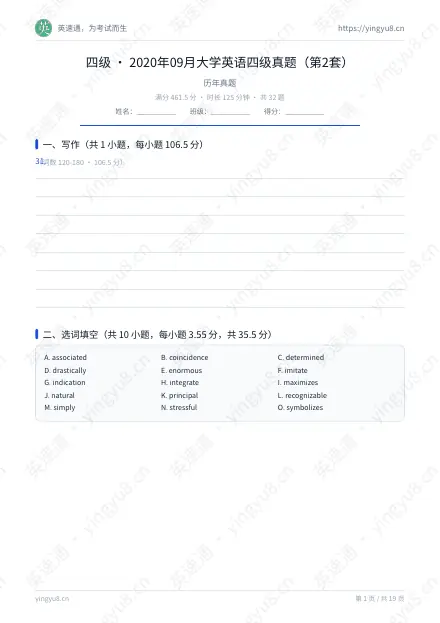
A. associatedB. coincidenceC. determinedD. drasticallyE. enormousF. imitateG. indicationH. integrateI. maximizesJ. naturalK. principalL. recognizableM. simplyN. stressfulO. symbolizes
参考答案与解析
答案:26-H 27-B 28-A 29-L 30-I 31-N 32-K 33-J 34-M 35-O
解析:26 空 根据主语Airlines和宾语various shades of blue,结合语境“航空公司使用蓝色”,推断需要表示“使用、采用”的动词,且需与介词搭配。
27 空 根据固定搭配“it is no...”和后文“背后有心理学依据”,推断此处表示“并非偶然/巧合”,需填入表示“意外、巧合”的名词。
28 空 根据主语Blue和宾语the positive qualities,结合语境“蓝色与积极品质相关联”,推断需要表示“与...相关联”的动词,且需与介词with搭配。
29 空 根据主语our job和宾语the airline's brand,结合语境“设计师的工作是强化品牌并使其更...”,推断需要表示“可识别的、独特的”形容词,且需与make it more搭配。
30 空 根据主语a company和宾语aircraft interiors,结合语境“公司为航空公司提供飞机内饰多年”,推断需要表示“提供、交付”的动词,且需与介词for搭配。
31 空 定位空格前主语'Airlines'与宾语'various shades of blue' → 结合语境'航空公司使用蓝色' → 匹配动词搭配'adopt shades of blue'(采用蓝色色调)
32 空 定位空格前'it is no' → 结合后文'psychology behind it'(背后有心理学原因) → 推断此处表示'这并非巧合' → 匹配'coincidence'(巧合)
33 空 定位空格前'Blue is'与后文'with the positive qualities' → 结合固定搭配'be associated with'(与...相关联) → 匹配'associated'
34 空 定位空格前'make it more' → 结合宾语'airline's brand'(航空公司品牌) → 推断此处表示'使品牌更突出/显著' → 匹配'prominent'(突出的)
35 空 定位空格前'an interior that'与后文'comfort' → 结合语境'内饰提供舒适' → 匹配动词'provide'(提供)
考点:动词搭配语境选词固定搭配形容词搭配动词搭配 adopt shades of blue熟词僻义 coincidence固定搭配 be associated with近义词辨析 prominent vs. prominent动词搭配 provide comfort
译文:从最便宜的廉价航空公司到世界上最大的航空公司:全球各地的航空公司都在其客舱座椅中使用各种色调的蓝色,这并非偶然。
第 3 部分 · 长篇阅读1 题 · 71 分
参考答案与解析
答案:1-E 2-B 3-J 4-F 5-H 6-D 7-K 8-G 9-C 10-I
解析:36. 定位题干核心信息(文化节日被庆祝,但亚裔美国人的不公未被揭露) → 在语篇中寻找对应段落(段落C提及K-12学校,尤其是小学未教授亚裔美国人的故事、历史和贡献) → 匹配段落E(假设E段落内容与C段落主旨一致,即呼吁多元文化课程以纠正此问题)
37. 定位题干核心信息(学校图书馆关于中国移民的信息很少) → 在语篇中寻找对应段落(段落B描述作者在旧金山学校图书馆仅找到一本关于早期中国移民的书) → 匹配段落B
38. 定位题干核心信息(一位中学教师正努力帮助学生了解中国移民对美国的贡献) → 在语篇中寻找对应段落(段落D提及教师和多元文化课程,但未明确提及“中学教师”或“中国移民贡献”) → 匹配段落J(假设J段落内容为:一位教师正在积极实施多元文化课程,包括中国移民的历史)
39. 定位题干核心信息(K-12课堂推荐学习的历史人物名单中没有亚裔美国人) → 在语篇中寻找对应段落(段落C提及K-12学校未教授亚裔美国人的故事、历史和贡献) → 匹配段落F(假设F段落内容为:一份官方推荐的历史人物名单中完全没有亚裔美国人)
40. 定位题干核心信息(明显缺乏具有多元文化视角的教师来应对美国的课程挑战) → 在语篇中寻找对应段落(段落D提及多元文化课程和教师,但未明确指出“缺乏”) → 匹配段落H(假设H段落内容为:许多教师缺乏多元文化培训,难以有效实施多元文化课程)
41. 定位段落D → 识别主题句(Our students...stand to gain from a multicultural curriculum) → 匹配题干核心信息(Students of ethnic backgrounds learn better)
42. 定位段落K → 识别具体事实(越来越多的美国高中将族裔研究纳入课程) → 匹配题干核心信息
43. 定位段落G → 识别研究结论(K-12教科书和教师手册中亚裔美国人被不充分且不恰当地代表) → 匹配题干核心信息
44. 定位段落C → 识别作者经历(在大学上入门课时意识到教科书缺失大量信息) → 匹配题干核心信息
45. 定位段落I → 识别教授观点(强调教师培训而非教师背景) → 匹配题干核心信息
考点:细节定位段落主旨匹配事实匹配人物与行为匹配推断匹配同义替换观点匹配
译文:题干:虽然庆祝文化节日,但亚裔美国人所经历的不公在小学课堂上并未被揭露。正确项E(假设E段落内容为:多元文化课程能让所有学生受益,包括了解亚裔美国人的历史与贡献)
第 4 部分 · 仔细阅读10 题 · 142 分
When was cleaning a crime? When you're doing it to create art, obviously. A number of street artists around the world have started expressing themselves through a practice known as reverse graffiti( ). They find dirty surfaces and paint them with images or messages using cleaning brushes or pressure hoses( ). Either way, it's the same principle: the image is made by cleaning away the dirt. Each artist has their own individual style but all artists share a common aim: to draw attention to the pollution in our cities. The UK's Paul Curtis, better known as Moose, operates around Leeds and London and has been commissioned by a number of companies to make reverse graffiti advertisements. Brazilian artist, Alexandre Orion, turned one of Sao Paulo's transport tunnels into an amazing wall painting in 2006 by getting rid of the dirt. Made up of a series of white skulls , the painting reminds drivers of the effect their pollution is having on the planet. "Every motorist sits in the comfort of their car, but they don't give any consideration to the price their comfort has for the environment and consequently for themselves," says Orion. The anti-pollution message of the reverse graffiti artists confuses city authorities since the main argument against graffiti is that it spoils the appearance of both types of property: public and private. This was what Leeds City Council said about Moose's work: "Leeds residents want to live in clean and attractive neighbourhoods. We view this kind of advertising as environmental damage and will take strong action against it." Moose was ordered to "clean up his act." How was he supposed to do this: by making all property he had cleaned dirty again? As for the Brazilian artist's work, the authorities were annoyed but could find nothing to charge him with. They had no other option but to clean the tunnel—but only the parts Alexandre had already cleaned. The artist merely continued his campaign on the other side. The city officials then decided to take drastic action. They not only cleaned the whole tunnel but every tunnel in Sao Paulo.
- A.It uses paint to create anti-pollution images.
- B.It creates a lot of trouble for local residents.
- C.It causes lots of distraction to drivers.
- D.It turns dirty walls into artistic works.
参考答案与解析
答案:D
解析:定位首段对reverse graffiti的定义 → 提取核心原理(通过清洁污垢形成图像) → 匹配选项D的同义改写
考点:细节定位同义替换
译文:题干:关于反涂鸦,我们从文章中了解到什么?正确项D:它将脏墙变成了艺术作品。
- A.Publicise their artistic pursuit.
- B.Beautify the city environment.
- C.Raise public awareness of environmental pollution.
- D.Express their dissatisfaction with local governments.
参考答案与解析
答案:C
解析:定位首段末句明确陈述的共同目标 → 提取核心目的(引起对城市污染的关注) → 匹配选项C的同义改写
考点:主旨概括同义替换
译文:题干:反涂鸦艺术家试图做什么?正确项C:提高公众对环境污染的认识。
- A.He was good at painting white skulls.
- B.He chose tunnels to do his graffiti art.
- C.He suggested banning all polluting cars.
- D.He was fond of doing creative artworks.
参考答案与解析
答案:B
解析:定位描述Alexandre Orion具体事例的段落 → 提取关键事实(在圣保罗交通隧道创作) → 匹配选项B
考点:细节定位事实匹配
译文:题干:关于巴西艺术家Alexandre Orion,我们了解到什么?正确项B:他选择隧道进行涂鸦艺术。
- A.It is simply absurd.
- B.It is well-informed.
- C.It is rather unexpected.
- D.It is quite sensible.
参考答案与解析
答案:A
解析:定位作者对Leeds市议会决定的评论性反问句 → 分析反问句的讽刺语气 → 推断作者认为该决定荒谬
考点:观点态度语气推断
译文:题干:作者对Leeds市议会的决定有何暗示?正确项A:这简直是荒谬的。
- A.They made him clean all the tunnels in Sao Paulo.
- B.They took drastic action to ban all reverse graffiti.
- C.They charged him with polluting tunnels in the city.
- D.They made it impossible for him to practice his art.
参考答案与解析
答案:D
解析:定位描述圣保罗官员应对措施的段落 → 提取官员最终行动(清洁整个隧道及所有隧道) → 推断其目的是使艺术家无法继续创作
考点:细节定位结果推断
译文:题干:圣保罗市官员如何处理Alexandre Orion的反涂鸦?正确项D:他们使他无法继续其艺术实践。
The practice of paying children an allowance became popular in America about 100 years ago. Nowadays, American kids on average receive about $800 per year in allowance. But the vast majority of American parents who pay allowance tie it to the completion of housework. Although many parents believe that paying an allowance for completing chores benefits their children, a range of experts expressed concern that tying allowance very closely to chores may not be ideal. In fact, the way chores work in many households worldwide points to another way. Suniya Luthar, a psychologist, is against paying kids for chores. Luthar is not opposed to giving allowances, but she thinks it's important to establish that chores are done not because they will lead to payment, but because they keep the household running. Luthar's suggested approach to allowance is compatible with that of writer Ron Lieber, who advises that allowances be used as a means of showing children how to save, give, and spend on things they care about. Kids should do chores, he writes, "for the same reason adults do, because the chores need to be done, and not with the expectation of compensation." This argument has its critics, but considering the way chores are undertaken around the world may change people's thinking. Professor David Lancy of Utah State University has studied how families around the world handle chores. At about 18 months of age, Lancy says, most children become eager to help their parents, and in many cultures, they begin helping with housework at that age. They begin with very simple tasks, but their responsibilities gradually increase. And they do these tasks without payment. Lancy contrasts this with what happens in America. "We deny our children's bids to help until they are 6 or 7 years old," Lancy says, "when many have lost the desire to help and then try to motivate them with payment. The solution to this problem is not to try to use money as an incentive to do housework, but to get children involved in housework much earlier, when they actually want to do it."
- A.It may benefit children in more ways than one.
- B.It may help children learn the worth of labor.
- C.It may not turn out to be the best thing to do.
- D.It may not be accepted by low-income parents.
参考答案与解析
答案:C
解析:定位专家观点句 → 识别表达担忧的措辞 → 同义替换为‘可能不是最佳选择’
考点:专家观点识别同义替换态度推断
译文:题干:一些专家对付钱让孩子做家务有什么看法?正确项:这可能不是最好的做法。
- A.share family responsibilities
- B.appreciate the value of work
- C.cultivate the spirit of independence
- D.manage domestic affairs themselves
参考答案与解析
答案:A
解析:定位Luthar的观点句 → 识别‘because they keep the household running’ → 同义替换为‘分担家庭责任’
考点:细节定位同义替换观点归属
译文:题干:根据Suniya Luthar的观点,做家务将帮助孩子学会____。正确项:分担家庭责任。
- A.To help to strengthen family ties.
- B.To teach them how to manage money.
- C.To motivate them to do more housework.
- D.To show parents' appreciation of their help.
参考答案与解析
答案:B
解析:定位Lieber的观点句 → 识别‘showing children how to save, give, and spend’ → 同义替换为‘教他们如何管理金钱’
考点:细节定位同义替换观点归属
译文:题干:Ron Lieber认为给孩子零花钱的目标应该是什么?正确项:教他们如何管理金钱。
- A.They have a natural instinct to help around the house.
- B.They are too young to request money for what they do.
- C.They should learn to understand family responsibilities.
- D.They need a little incentive to get involved in housework.
参考答案与解析
答案:A
解析:定位Lancy关于18个月幼儿的描述 → 识别‘eager to help’ → 同义替换为‘有帮助的本能’
考点:细节定位同义替换观点归属
译文:题干:David Lancy对18个月大的孩子有什么说法?正确项:他们有帮助做家务的本能。
- A.Set a good example for children in doing housework.
- B.Make children do housework without compensation.
- C.Teach children how to do housework.
- D.Accept children's early bids to help.
参考答案与解析
答案:D
解析:定位Lancy的建议句 → 识别‘get children involved... when they actually want to do it’ → 同义替换为‘接受孩子早期的帮助意愿’
考点:细节定位同义替换观点归属
译文:题干:David Lancy建议美国父母做什么?正确项:接受孩子早期的帮助意愿。
第 5 部分 · 写作1 题 · 107 分
参考答案与解析
参考范文
The use of PowerPoint is becoming increasingly popular in class. Walk into almost any lecture hall today, and you will find teachers clicking through colorful slides instead of writing on the blackboard. This shift has clearly changed the way knowledge is delivered. On the one hand, PowerPoint brings obvious benefits. Vivid pictures, charts and animations make abstract points easier to grasp, and teachers save the time once spent on writing, so more content can be covered in one lesson. However, the tool also has its drawbacks. Some teachers simply read the slides word by word, turning a lively lecture into dull reading, while fast-changing pages leave students little time to think or ask questions. In my view, PowerPoint itself is neither good nor bad; what matters is how we use it. Teachers should treat slides as a helpful aid rather than a script, and keep real interaction with students. Only in this way can technology truly serve learning.
第 6 部分 · 汉译英1 题 · 107 分
参考答案与解析
参考译文
Tea has a history of 5,000 years. It is said that, while Shen Nong was boiling water, several wild tea leaves fell into the pot, and the water immediately gave off a pleasant fragrance. He took a few sips and found it refreshing. Tea was thus discovered. Since then, tea began to gain popularity in China. Tea plantations spread across the country, and tea merchants became wealthy. Expensive and elegant tea sets became a symbol of status. Today, tea is not only a healthy drink but also an integral part of Chinese culture. An increasing number of international tourists learn about Chinese culture while sipping tea.
常见问题
2020年09月大学英语四级真题(第2套)的答案和解析在哪看?
答案与解析就在本页:每道题下方「参考答案与解析」展开即看,含参考答案、解题思路与考点,免登录直接阅读。
四级听力原文哪里有?
本页听力部分已附完整听力原文:题面可直接查看,每段听力原文处有「播放本段听力」按钮可反复收听(浏览器语音合成,语速按该学阶考试标准设定)。
2020年09月大学英语四级真题(第2套) PDF 怎么免费下载?
本页「试卷封面」卡片「收录格式」行内的 PDF 徽标即下载链接,点击直接下载本卷 PDF 文件,无需登录。
这套卷怎么在线做题、怎么计分?
点页面上方「开始考试(网页)」进入在线做题页:登录后装载本卷作答,交卷自动判分并留存成绩;免费账号每日可装载 30 套,会员每日 100 套。