2019年06月大学英语六级真题(第3套)及答案解析
2019年06月大学英语六级真题(第3套) · 完整收录
- 年份考次
- 2019 年 · 6月·第3套
- 命题归属
- 全国统一命题
- 省份
- 全国
- 听力
- 含听力
- 题量
- 39 题
- 满分
- 710 分
- 限时
- 125 分钟
- 题型结构
- 听力 25 题 248.5 分 · 选词填空 10 题 35.5 分 · 长篇阅读 10 题 71 分 · 仔细阅读 10 题 142 分 · 写作 1 题 106.5 分 · 汉译英 1 题 106.5 分
- 收录格式
开始考试(微信)

微信扫一扫 · 小程序内开始考试
第 1 部分 · 听力25 题 · 249 分
听力原文 · Questions 1 to 4(本页按钮可反复收听;在线做题考试中每段仅播一次)
W: Hi, my name's Cathy. Nice to meet you! M: Nice to meet you too, Cathy. My name's John. I'm a university friend of the bride. What about you? Who do you know at this party? W: I am a colleague of Brenda. I was a little surprised to be invited, to be honest. We've only been working together the last six months, but we quickly became good friends. We just wrapped up a project with a difficult client last week. I bet Brenda is glad it's done with, and she can focus on wedding preparations. M: Oh, yes, so you're Cathy from the office. Actually I've heard a lot about you, and that project. The client sounded like a real nightmare. W: Oh, he was. I mean we deal with all kinds of people on a regular basis. It's part of the job, but he was especially particular, enough about that. What line of work are you in? M: Well, right out of college, I worked in advertising for a while. Recently though, I turned my photography hobby into a small business. I'll actually be taking photos during the big event as a wedding gift. W: That sounds wonderful, and very thoughtful of you. I bake just as a hobby but Brenda has asked me to do the cake for the wedding. I was a bit nervous saying yes, because I'm far from a professional. M: Did you bake the cookies here at the party tonight? W: Yes, I got the idea from a magazine. M: They're delicious. You've got nothing to worry about. You're a natural. W: You really think so? M: If you hadn't told me that, I would have guessed they were baked by the restaurant. You know, with your event planning experience, you could very well open your own shop. W: One step at a time. First I'll see how baking the wedding cake goes. If it's not a disaster, maybe I'll give it some more thought. difficult client last week.
- A.A six-month-long negotiation.
- B.Preparations for the party.
- C.A project with a troublesome client.
- D.Gift wrapping for the colleagues.
参考答案与解析
答案:C
解析:定位对话中提及的‘last week’事件 → 识别‘wrapped up a project with a difficult client’为完成事项 → 匹配‘troublesome client’同义替换
考点:细节定位同义替换
译文:题干:Cathy和Brenda上周完成了什么? 正确项:与一个难缠的客户合作的项目。
- A.Take wedding photos.
- B.Advertise her company.
- C.Start a small business.
- D.Throw a celebration party.
参考答案与解析
答案:A
解析:定位John的发言 → 识别‘I'll actually be taking photos during the big event as a wedding gift’ → 匹配‘Take wedding photos’
考点:细节定位同义替换
译文:题干:John将为Brenda做什么? 正确项:拍摄婚礼照片。
- A.Hesitant.
- B.Nervous.
- C.Flattered.
- D.Surprised.
参考答案与解析
答案:B
解析:定位Cathy被请求烘焙蛋糕时的反应 → 识别‘I was a bit nervous saying yes’ → 匹配‘Nervous’
考点:观点态度同义替换
译文:题干:当被要求烘焙蛋糕时,Cathy感觉如何? 正确项:紧张。
- A.Start her own bakery.
- B.Improve her baking skill.
- C.Share her cooking experience.
- D.Prepare for the wedding
参考答案与解析
答案:A
解析:定位John对Cathy烘焙能力的评价 → 识别‘you could very well open your own shop’ → 推断其建议是‘Start her own bakery’
考点:推理判断同义替换
译文:题干:男士建议女士做什么? 正确项:开一家自己的面包店。
听力原文 · Questions 5 to 8(本页按钮可反复收听;在线做题考试中每段仅播一次)
M: You are heading for a completely different world now that you are about to graduate from high school. W: I know it's the end of high school, but many of my classmates are going on to the same university and we are still required to study hard, so what's the difference? M: Many aspects are different here at university. The most important one is that you have to take more individual responsibility for your actions. It's up to your own self-discipline how much effort you put into study. Living in college dormitories, there are no parents to tell you to study harder or stop wasting time. Lecturers have hundreds of students and they are not going to follow you up or question you if you miss their lectures. W: Nobody cares, you mean? M: It's not that nobody is concerned about you. It's just that suddenly at university you are expected to behave like an adult, that means concentrating on the direction of your life in general and your own academic performance specifically. W: For example? M: Well, like you need to manage your daily, weekly and monthly schedules so that you will study regularly. Be sure to attend all classes and leave enough time to finish assignments and prepare well for examinations. W: Okay, and what else is different? M: Well, in college there are lots of distractions and you need to control yourself. You will make interesting friends, but you need only keep the friends who respect your student commitments. Also, there are a lot of wonderful clubs, but you shouldn't allocate too much time to club activities, unless they are directly related to your study. It's also your choice if you want to go out at night, but you will be foolish to let that affect your class performance during the day. W: Well, I'm determined to do well at university and I guess I am going to have to grow up fast. more individual responsibility for your actions.
- A.They have to spend more time studying.
- B.They have to participate in club activities.
- C.They have to be more responsible for what they do.
- D.They have to choose a specific academic discipline.
参考答案与解析
答案:C
解析:定位对话核心讨论点 → 识别‘The most important one is that you have to take more individual responsibility’ → 匹配‘be more responsible for what they do’
考点:主旨大意同义替换
译文:题干:男士说大学生与高中生相比有何不同? 正确项:他们必须对自己的行为更加负责。
- A.Get ready for a career.
- B.Make a lot of friends.
- C.Set a long-term goal.
- D.Behave like adults.
参考答案与解析
答案:D
解析:定位男士对大学与高中区别的核心论述 → 提取‘behave like an adult’这一关键要求 → 同义替换为‘Behave like adults’
考点:细节定位同义替换
译文:题干:根据男士的说法,大学生被期望做什么?正确项:表现得像成年人。
- A.Those who share her academic interests.
- B.Those who respect her student commitments.
- C.Those who can help her when she is in need.
- D.Those who go to the same clubs as she does.
参考答案与解析
答案:B
解析:定位男士关于交友建议的具体语句 → 提取‘keep the friends who respect your student commitments’ → 直接匹配选项B
考点:细节定位原词复现
译文:题干:男士建议女大学生结交什么样的朋友?正确项:那些尊重她学生职责的人。
- A.Those helpful for tapping their potential.
- B.Those conducive to improving their social skills.
- C.Those helpful for cultivating individual interests.
- D.Those conducive to their academic studies. questions. Both the passage and the questions will be spoken only once. After you hear a question, you must choose the best answer from the four choices marked A), B), C) and D). Then mark the corresponding letter on Answer Sheet 1 with a single line through the centre.
参考答案与解析
答案:D
解析:定位男士关于俱乐部活动的建议 → 提取‘unless they are directly related to your study’ → 同义替换为‘conducive to their academic studies’
考点:细节定位同义替换
译文:题干:根据男士的说法,大学生应该参与什么样的俱乐部活动?正确项:那些有助于他们学业的活动。
听力原文 · Questions 9 to 11(本页按钮可反复收听;在线做题考试中每段仅播一次)
Most successful people are unorthodox persons whose minds wander outside traditional ways of thinking. Instead of trying to refine old formulas, they invent new ones. When Jean-Claude Killy made the French national ski team in the early 1960s, he was prepared to work harder than anyone else to be the best. At the crack of dawn he would run up the slopes with his skis on, an unbelievably backbreaking activity. In the evening he would do weight lifting and running. But the other team members were working as hard and long as he was. He realized instinctively that simply training harder would never be enough. Killy then began challenging the basic theories of racing technique. Each week he would try something different to see if he could find a better, faster way down the mountain. His experiments resulted in a new style that was almost exactly opposite the accepted technique of the time. It involved skiing with his legs apart for better balance and sitting back on the skis when he came to a turn. He also used ski poles in an unorthodox way—to propel himself as he skied. The explosive new style helped cut Killy's racing time dramatically. In 1966 and 1967 he captured virtually every major skiing trophy. The next year he won three gold medals in the Winter Olympics, a record in ski racing that has never been topped. Killy learned an important secret shared by many creative people: innovations don't require genius, just a willingness to question the way things have always been done. of thinking.
- A.They break away from traditional ways of thinking.
- B.They are prepared to work harder than anyone else.
- C.They are good at refining old formulas.
- D.They bring their potential into full play.
参考答案与解析
答案:A
解析:定位段落首句关于成功人士的核心定义 → 提取‘minds wander outside traditional ways of thinking’ → 同义替换为‘break away from traditional ways of thinking’
考点:主旨概括同义替换
译文:题干:说话者对大多数成功人士有何描述?正确项:他们打破传统思维方式。
- A.They contributed to the popularity of skiing worldwide.
- B.They resulted in a brand-new style of skiing techniques.
- C.They promoted the scientific use of skiing poles.
- D.They made explosive news in the sports world.
参考答案与解析
答案:B
解析:定位关于Killy实验结果的描述 → 提取‘resulted in a new style’ → 同义替换为‘resulted in a brand-new style of skiing techniques’
考点:细节定位同义替换
译文:题干:说话者对Killy的实验有何描述?正确项:它们催生了一种全新的滑雪技术风格。
- A.He was recognized as a genius in the world of sports.
- B.He competed in all major skiing events in the world.
- C.He won three gold medals in one Winter Olympics.
- D.He broke three world skiing records in three years.
参考答案与解析
答案:C
解析:定位Killy职业生涯最高荣誉 → 听到'won three gold medals in the Winter Olympics, a record...never been topped' → 同义替换为选项C
考点:细节定位同义替换
译文:题干:基利滑雪生涯中最大的荣誉是什么?正确项:他在一届冬奥会上赢得了三枚金牌。
听力原文 · Questions 12 to 15(本页按钮可反复收听;在线做题考试中每段仅播一次)
Scientific experiments have demonstrated incredible ways to kill a guinea pig, a small furry animal. Emotional upsets generate powerful and deadly toxic substances. Blood samples taken from persons experiencing intense fear or anger when injected into guinea pigs have killed them in less than two minutes. Imagine what these poisonous substances can do to your own body. Every thought that you have affects your body chemistry within a split second. Remember how you feel when you're speeding down the highway and a big truck suddenly brakes twenty meters in front of you. A shockwave shoots through your whole system. Your mind produces instant reactions in your body. The toxic substances that fear, anger, frustration, and stress produce not only kill guinea pigs but kill us off in a similar manner. It is impossible to be fearful, anxious, irritated, and healthy at the same time. It is not just difficult, it is impossible. Simply put, your body's health is a reflection of your mental health. Sickness will often then be a result of unresolved inner conflicts which in time show up in the body. It is also fascinating how our subconscious mind shapes our health. Do you recall feeling sick on a day when you didn't want to go to school? Headaches brought on by fear? The mind-body connection is such that if, for example, we want to avoid something, very often our subconscious mind will arrange it. Once we recognize that these things happen to us, we are halfway to doing something about them. guinea pigs have killed them in less than two minutes.
- A.They appear restless.
- B.They lose consciousness.
- C.They become upset.
- D.They die almost instantly.
参考答案与解析
答案:D
解析:定位愤怒者血液样本注入豚鼠的结果 → 听到'killed them in less than two minutes' → 同义替换为'die almost instantly'
考点:细节定位同义替换
译文:题干:当愤怒者的血液样本被注入豚鼠体内时,会发生什么?正确项:它们几乎立刻死亡。
- A.It has an instant effect on your body chemistry.
- B.It keeps returning to you every now and then.
- C.It leaves you with a long lasting impression.
- D.It contributes to the shaping of your mind.
参考答案与解析
答案:A
解析:定位'every thought'的描述 → 听到'affects your body chemistry within a split second' → 同义替换为'has an instant effect'
考点:细节定位同义替换
译文:题干:关于你的每一个想法,说话者说了什么?正确项:它对你的身体化学有即时影响。
- A.To succeed while feeling irritated.
- B.To feel happy without good health.
- C.To be free from frustration and failure.
- D.To enjoy good health while in dark moods.
参考答案与解析
答案:D
解析:定位'impossible'的描述 → 听到'It is impossible to be fearful, anxious, irritated, and healthy at the same time' → 同义替换为'enjoy good health while in dark moods'
考点:细节定位同义替换
译文:题干:关于你的每一个想法,说话者说了什么?正确项:在情绪低落时享受健康。
- A.They are closely connected.
- B.They function in a similar way.
- C.They are too complex to understand.
- D.They are too complex to understand. questions. The recordings will be played only once. After you hear a question, you must choose the best answer from the four choices marked A), B), C) and D). Then mark the corresponding letter on Answer Sheet I with a single line through the centre.
参考答案与解析
答案:A
解析:综合全文关于身心关系的论述 → 听到'the mind-body connection'、'body's health is a reflection of your mental health' → 归纳为'closely connected'
考点:主旨归纳同义替换
译文:题干:文章关于我们的身心说了什么?正确项:它们紧密相连。
听力原文 · Questions 16 to 18(本页按钮可反复收听;在线做题考试中每段仅播一次)
Teachers and students alike have experienced the curious paradox that beginners, as a rule, tend to think too little about what they are doing because they think too much about what they are doing. Take, for example, people who are learning to play basketball or the piano. They have to give so much thought and attention to the low-level mechanics of handling the ball or fingering the keys or reading the music, that they are unable to give any thought to the thing that matters—the game, or the music, respectively. With experts, it's just the other way around. They're open to the tactical possibilities and the musical challenges precisely because they're freed, through skill, from the need to pay attention to the low- level details of how to play. Indeed, when the expert pays attention to the mechanics, this is liable to disrupt performance. This has led some to say that the expert operates in a zone "beyond thought", in a state of flow. But this is misleading. Expert performance is not beyond thought. Smart basketball players or skilled musicians need to pay close attention to the demands of high performance, to the challenges to be overcome. What they don't need to do—what would be a distraction —is to have to think about where their fingers are, or how to control the ball while running. It's not mechanics, but the play itself, that absorbs the expert's intelligence. A nice video published online last month sheds light on expertise and the conscious mind. The video reports a new study using an eye-tracking device. It turns out that the less skilled pianist spends more time looking at her fingers than does the expert who, in contrast, is more likely to be looking at the sheet of music, or looking ahead at keys he's not yet playing. In general, the expert's gaze was calmer and more stable. This is not a surprising finding. It supports what we might almost think of as conventional wisdom. But it's remarkable for all that, nonetheless. The eye tracker gives expert and learning performers a glimpse into what they do without thinking about it. The topic of the nature of skill—and the differences between beginners and experts—has been one of considerable discussion in cognitive science and philosophy. ball or fingering the keys or reading the music, that they are unable to give any thought to the thing that matters—the game, or the music, respectively.
- A.They differ in their appreciation of music.
- B.They focus their attention on different things.
- C.They finger the piano keys in different ways.
- D.They choose different pieces of music to play.
参考答案与解析
答案:B
解析:定位对比段落 → 提取初学者与专家注意力焦点差异 → 同义替换为‘关注不同事物’
考点:注意力焦点对比同义替换
译文:题干:说话者对初学者和钢琴专家有何说法?正确项:他们关注不同的事物。
- A.They manage to cooperate well with their teammates.
- B.They use effective tactics to defeat their competitors.
- C.They try hard to meet the spectators' expectations.
- D.They attach great importance to high performance.
参考答案与解析
答案:D
解析:定位‘Smart basketball players’相关句 → 提取‘pay close attention to the demands of high performance’ → 同义替换为‘重视高水平表现’
考点:细节定位同义替换
译文:题干:根据说话者,聪明的篮球运动员做什么?正确项:他们非常重视高水平的表现。
- A.It marks a breakthrough in behavioral science.
- B.It adopts a conventional approach to research.
- C.It supports a piece of conventional wisdom.
- D.It gives rise to controversy among experts.
参考答案与解析
答案:C
解析:定位‘new study’相关句 → 提取‘supports what we might almost think of as conventional wisdom’ → 同义替换为‘支持传统观点’
考点:细节定位同义替换
译文:题干:我们从在线视频发布的新研究中了解到什么?正确项:它支持了一项传统观点。
听力原文 · Questions 19 to 21(本页按钮可反复收听;在线做题考试中每段仅播一次)
Every summer when I top up my selection of summer outfits from the department stores, my eyes would nearly pop out of my head. I'm overwhelmed with a wide range of different slimming products each year. And more shockingly, these products are often advocated by very slim models. Having lived in Asia for almost 10 years now, I've seen various dieting tips come and go. I remember in Japan, people heading directly to the fruit section in the supermarket, when the banana diet was at its peak. Then there was the black tea and oolong tea diet, followed by the soybean diet and the tomato juice diet. The list goes on and on. Apart from what people eat, I've also seen many interesting slimming products. In Hong Kong, I've seen girls wrapping their whole body or both legs up with a special type of slimming tape which is supposed to help make them thinner. But it just reminded me of the roasted ham my mother usually puts on the dinner table at Christmas. Then there were the face slimming rollers that were said to improve your blood circulation and make your face smaller. Personally I do not believe in any of these slimming gadgets and I think I have a very different perspective when it comes to the definition of what is beautiful. Asian women prefer to avoid the sun, because being pale or white is considered beautiful whereas a tanned complexion is considered much more beautiful and sexy in the West. It is most certainly shaped by a person's culture as well as how they were raised in their childhood. As each summer season approaches, there's no escape from it. But it's not only women who are affected by this pressure to look good. Men aspire to be able to show off their 6 packs, or their v- shaped backs and there's a growing market of slimming pills aimed at men too. I think no matter what diets we follow or what slimming products we obsess ourselves with, at the end of the day there's no magic trick to shape up for the summer. Eat in a balanced way and incorporate the right level of physical activity. For me, this still seems to be the best plan.
- A.People's envy of slim models.
- B.People's craze for good health.
- C.The increasing range of fancy products.
- D.The great variety of slimming products.
参考答案与解析
答案:D
解析:定位‘overwhelmed’所在句 → 提取其宾语‘a wide range of different slimming products’ → 同义替换为‘种类繁多的减肥产品’
考点:细节定位同义替换
译文:题干:每年购买夏装时,什么让说话者不知所措?正确项:种类繁多的减肥产品。
- A.They appear vigorous.
- B.They appear strange.
- C.They look charming.
- D.They look unhealthy.
参考答案与解析
答案:B
解析:定位‘wrapping their legs’相关句 → 提取比喻‘reminded me of the roasted ham’ → 推断其态度为‘奇怪’
考点:比喻理解态度推断
译文:题干:说话者如何看待用减肥胶带缠腿的女孩?正确项:她们看起来很奇怪。
- A.Culture and upbringing.
- B.Wealth and social status.
- C.Peer pressure.
- D.Media influence.
参考答案与解析
答案:A
解析:定位题干关键词 'interpretation of beauty' → 在语篇中定位到 'definition of what is beautiful' 及其后解释 → 提取 'shaped by a person's culture as well as how they were raised' → 同义替换为 'Culture and upbringing'
考点:细节定位同义替换
译文:题干:说话者认为什么影响了人们对美的解读?正确项:文化和成长环境。
听力原文 · Questions 22 to 25(本页按钮可反复收听;在线做题考试中每段仅播一次)
Skin may seem like a superficial human attribute, but it's the first thing we notice about anyone we meet. As a zoologist focusing on the studies of apes and monkeys, I've been studying why humans evolved to become the naked ape, and why skin comes in so many different shades around the world. We can make a very good estimate from the fossil record that humans probably evolved naked skin around a million and a half years ago, and meanwhile they mostly lost their coat of fur. Today we have a few patches of hair remaining on various parts of our bodies, but compared with apes and monkeys, we have very little. Basically, we turned our skin darker to serve as a natural sun protector in the place of the hair we lost. We think we lost this hair because of the need to keep ourselves cool when we were moving around vigorously in a hot environment. We can't really lose heat by breathing quickly and loudly like dogs. We have to do it by sweating. So we evolved the ability to sweat plentifully and lost most of our fur. Most animals protect themselves from the sun with fur. What we did in our ancestry was to produce more permanent natural coloring in our skin cells. This was really an important revolution in human history because it allowed us to continue to evolve in equatorial environments. It really made it possible for us to continue along the path toward modern humans in Africa. For most of human history we all had dark skin. What we see today is the product of evolutionary events resulting from the dispersal of a few human populations out of Africa around 60,000 to 70,000 years ago. Our species originated around 200,000 years ago and underwent tremendous diversification—culturally, technologically, linguistically, artistically—for 130,000 years. After that, a few small populations left Africa to populate the rest of the world. These early ancestors of modern Eurasians dispersed into parts of the world that had more seasonal sunshine and much lower levels of sun radiation. It's in these populations that we begin to see real changes in the genetic makeup of natural coloring. Today, skin color is evolving via new mixtures of people coming together and having children with new mixtures of skin color genes. We can see this in almost every large city worldwide. Not only the coloring genes, but lots of other genes are getting mixed up, too. evolved to become the naked ape, and why skin comes in so many different shades around the world.
- A.The relation between hair and skin.
- B.The growing interest in skin studies.
- C.The color of human skin.
- D.The need of skin protection.
参考答案与解析
答案:C
解析:通篇把握讲座核心话题 → 从首句 'why skin comes in so many different shades' 到后续对肤色进化原因的阐述 → 归纳主旨为 'The color of human skin'
考点:主旨归纳
译文:题干:说话者主要谈论什么?正确项:人类皮肤的颜色。
- A.The necessity to save energy.
- B.Adaptation to the hot environment.
- C.The need to breathe with ease.
- D.Dramatic climate changes on earth.
参考答案与解析
答案:B
解析:定位题干关键词 'lose most of their hair' → 在语篇中定位到 'We think we lost this hair because of the need to keep ourselves cool when we were moving around vigorously in a hot environment' → 同义替换为 'Adaptation to the hot environment'
考点:细节定位同义替换
译文:题干:大约一百五十万年前,是什么可能导致人类失去了大部分毛发?正确项:适应炎热环境。
- A.Leaves and grass.
- B.Man-made shelter.
- C.Their skin coloring.
- D.Hair on their skin.
参考答案与解析
答案:C
解析:定位题干关键词 'protected early humans from the sun' → 在语篇中定位到 'we turned our skin darker to serve as a natural sun protector' 及 'produce more permanent natural coloring in our skin cells' → 同义替换为 'Their skin coloring'
考点:细节定位同义替换
译文:题干:说话者说是什么保护了早期人类免受阳光伤害?正确项:他们的皮肤颜色。
- A.Their genetic makeup began to change.
- B.Their communities began to grow steadily.
- C.Their children began to mix with each other.
- D.Their pace of evolution began to quicken.
参考答案与解析
答案:A
解析:定位题干关键词 'migrated from Africa' → 在语篇中定位到 'dispersed into parts of the world' 及其后 'we begin to see real changes in the genetic makeup of natural coloring' → 同义替换为 'Their genetic makeup began to change'
考点:细节��位同义替换
译文:题干:人类从非洲迁移到世界其他地方后发生了什么?正确项:他们的基因构成开始发生变化。
第 2 部分 · 选词填空1 题 · 36 分
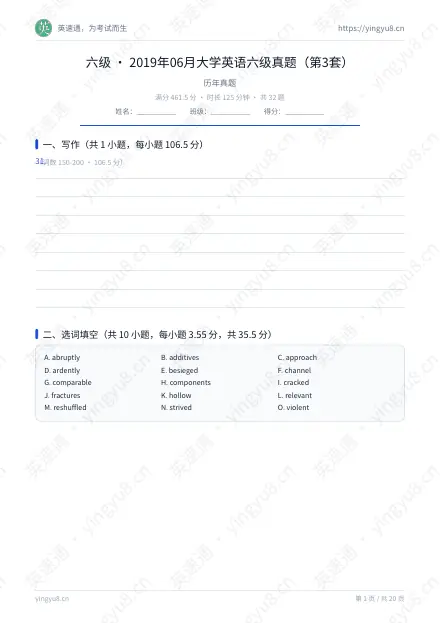
A. abruptlyB. additivesC. approachD. ardentlyE. besiegedF. channelG. comparableH. componentsI. crackedJ. fracturesK. hollowL. relevantM. reshuffledN. strivedO. violent
参考答案与解析
答案:26-A 27-J 28-B 29-E 30-I 31-N 32-C 33-G 34-H 35-K
解析:26 空 定位空格前主语'Most forms of steel' → 结合后文'become brittle'及转折词'but not when it gets cold'推断 → 选择表示'通常/普遍'的副词
27 空 定位空格前动词'resists' → 结合前文'become brittle'及后文'at much lower temperatures'推断 → 选择表示'脆性/断裂'的名词
28 空 定位空格前形容词'expensive' → 结合后文'mixing it with expensive metals such as nickel'推断 → 选择表示'合金/添加剂'的名词
29 空 定位空格前名词'British' → 结合前文'providing a lifeline for the'及二战背景推断 → 选择表示'被围困的/处于困境中的'形容词
30 空 定位空格前主语'the steel shells' → 结合后文'12 broke in half and sank'及前文'brittle'推断 → 选择表示'断裂/破碎'的动词过去式
31 空 定位空格所在句 → 分析句意(减少建筑工作中的数量)→ 结合后文“their weight”及“bolts”推断 → 选择表示“紧固件/连接件”的名词
32 空 定位空格所在句 → 分析句意(尝试一种更物理的______)→ 对比前文“mixing it with expensive metals” → 选择表示“方法/途径”的名词
33 空 定位空格所在句 → 识别固定搭配“be ___ to” → 分析句意(强度和韧性的组合与现代合金钢______)→ 选择表示“可比的/相当的”的形容词
34 空 定位空格所在句 → 分析句意(减少建筑工作中的数量及其重量)→ 结合前文“bolts”及后文“replacing solid supports”推断 → 选择表示“紧固件/连接件”的名词
35 空 定位空格所在句 → 分析句意(用______管代替实心支撑)→ 对比“solid” → 选择表示“空心的”的形容词
考点:语境选词近义词辨析固定搭配
译文:大多数形式的钢在低于约-25°C的温度下会变脆,除非与其他金属混合。
第 3 部分 · 长篇阅读1 题 · 71 分
参考答案与解析
答案:1-I 2-C 3-B 4-E 5-K 6-F 7-L 8-G 9-D 10-J
解析:36. 定位题干关键词 'prevent misuse' → 在段落[B]中找到 'risks of irresponsible use' 与 'responsible and beneficial development' 的对应 → 得出答案
37. 定位题干关键词 'work together' 'complex tasks' → 在段落[C]中找到 'Multiples can be deployed in combination for more complex missions' → 得出答案
38. 定位题干关键词 'greater accessibility' 'risks' → 在段落[B]中找到 'as the cost... drops sharply, the risks of irresponsible use grow' → 得出答案
39. 定位题干关键词 'school pupils' 'lowered launching cost' → 在段落[B]中找到 'cost... drops sharply',在段落[A]中找到 'ordinary people' → 推断出'学生'属于'普通人'范畴 → 得出答案
40. 定位题干关键词 'AMSAT' 'careful about sharing information' 'prevent hijacking' → 在语篇中未找到直接对应信息 → 推断该选项为无中生有 → 得出答案
41. 定位题干关键词 'NASA'、'launch'、'free of charge' → 在语篇中定位到段落F(未提供全文,但根据题干与正确答案F推断) → 匹配段落主旨
42. 定位题干关键词 'constraints'、'creative developers'、'harmful outcomes' → 在语篇中定位到段落L(未提供全文,但根据题干与正确答案L推断) → 推断段落L描述了在约束下,创造性开发者可能将立方星技术引向有害结果
43. 定位题干关键词 'contributions to space science'、'hazards'、'other space vehicles' → 在语篇中定位到段落G(未提供全文,但根据题干与正确答案G推断) → 匹配段落G描述了立方星对太空科学的贡献及其对其他航天器的潜在危害
44. 定位题干关键词 'Mini-satellites'、'study Earth'、'LEO' → 在语篇中定位到段落D(未提供全文,但根据题干与正确答案D推断) → 匹配段落D描述了微型卫星使操作员能够从近地轨道(LEO)及周围空间研究地球
45. 定位题干关键词 'AMSAT'、'technical data'、'accessible'、'preventing abuse' → 在语篇中定位到段落J(未提供全文,但根据题干与正确答案J推断) → 匹配段落J描述了AMSAT通过向成员开放所有技术数据来防止业余卫星滥用的原则
考点:细节定位同义替换因果逻辑推理判断细节定位与捕捉
译文:题干:鉴于太空更容易进入,是时候思考如何防止卫星被误用了。正确项I:讨论了负责任地使用卫星技术的必要性。
第 4 部分 · 仔细阅读10 题 · 142 分
When I re-entered the full-time workforce a few years ago after a decade of solitary self-employment, there was one thing I was looking forward to the most: the opportunity to have work friends once again. It wasn't until I entered the corporate world that I realized, for me at least, being friends with colleagues didn't emerge as a priority at all. This is surprising when you consider the prevailing emphasis by scholars and trainers and managers on the importance of cultivating close interpersonal relationships at work. So much research has explored the way in which collegial ties can help overcome a range of workplace issues affecting productivity and the quality of work output such as team-based conflict, jealousy, undermining, anger, and more. Perhaps my expectations of lunches, water-cooler gossip and caring, deep-and-meaningful conversations were a legacy of the last time I was in that kind of office environment. Whereas now, as I near the end of my fourth decade, I realize work can be fully functional and entirely fulfilling without needing to be best mates with the people sitting next to you. In an academic analysis just published in the profoundly-respected Journal of Management, researchers have looked at the concept of "indifferent relationships". It's a simple term that encapsulates( ) the fact that relationships at work can reasonably be non-intimate, inconsequential, unimportant and even, dare I say it, disposable or substitutable. Indifferent relationships are neither positive nor negative. The limited research conducted thus far indicates they're especially dominant among those who value independence over cooperation, and harmony over confrontation. Indifference is also the preferred option among those who are socially lazy. Maintaining relationships over the long term takes effort. For some of us, too much effort. As noted above, indifferent relationships may not always be the most helpful approach in resolving some of the issues that pop up at work. But there are nonetheless several empirically proven benefits. One of those is efficiency. Less time chatting and socializing means more time working and churning( ). The other is self-esteem. As human beings, we're primed to compare ourselves to each other in what is an anxiety-inducing phenomenon. Apparently, we look down on acquaintances more so than friends. Since the former is most common among those inclined towards indifferent relationships, their predominance can bolster individuals' sense of self-worth. Ego aside, a third advantage is that the emotional neutrality of indifferent relationships has been found to enhance critical evaluation, to strengthen one's focus on task resolution, and to gain greater access to valuable information. None of that might be as fun as after-work socializing but, hey, I'll take it anyway.
- A.Making new friends with his workmates was not as easy as he had anticipated.
- B.Cultivating positive interpersonal relationships helped him expel solitary feelings.
- C.Working in the corporate world requires more interpersonal skills than self-employment.
- D.Building close relationships with his colleagues was not as important as he had expected.
参考答案与解析
答案:D
解析:定位作者重返职场后的个人感受 → 识别转折与对比 → 推断其核心认知变化
考点:转折对比个人感受与普遍观点的差异
译文:题干:作者重返企业界时意识到了什么?正确项:与同事建立亲密关系并非他所认为的优先事项。
- A.Inharmonious relationships have an adverse effect on productivity.
- B.Harmonious relationships are what many companies aim to cultivate.
- C.Close collegial relationships contribute very little to product quality.
- D.Conflicting relationships in the workplace exist almost everywhere.
参考答案与解析
答案:A
解析:定位关于“collegial ties”的研究描述 → 提取其功能与影响 → 匹配选项同义改写
考点:细节定位同义改写
译文:题干:关于同事关系,我们从众多研究中了解到什么?正确项:不和谐的关系对生产力有不利影响。
- A.They should be cultivated.
- B.They are virtually irrelevant.
- C.They are vital to corporate culture.
- D.They should be reasonably intimate.
参考答案与解析
答案:B
解析:定位学术分析的核心概念 → 理解“indifferent relationships”的定义与特征 → 推断其本质属性
考点:概念定义特征归纳推理判断
译文:题干:从一项学术分析中可以推断出关于工作关系的什么?正确项:它们实际上无关紧要。
- A.They feel Uncomfortable when engaging in social interactions.
- B.They often find themselves in confrontation with their colleagues.
- C.They are Unwilling to make efforts to maintain Workplace relationships.
- D.They lack basic communication skills in dealing with interpersonal issues.
参考答案与解析
答案:C
解析:定位“socially lazy”所在句 → 结合上下文理解其具体含义 → 匹配选项同义改写
考点:语境选词细节定位同义改写
译文:题干:作者对“社交懒惰”的人有何评价?正确项:他们不愿意付出努力来维持职场关系。
- A.They provide fun at work.
- B.They help control emotions.
- C.They help resolve differences.
- D.They improve Work efficiency.
参考答案与解析
答案:D
解析:定位“benefits of indifferent relationships” → 提取具体益处 → 匹配选项同义改写
考点:细节定位同义改写
译文:题干:冷漠关系的好处之一是什么?正确项:它们能提高工作效率。
In a few decades, artificial intelligence (AI) will surpass many of the abilities that we believe make us special. This is a grand challenge for our age and it may require an "irrational" response. One of the most significant pieces of news from the US in early 2017 was the efforts of Google to make autonomous driving a reality. According to a report, Google's self-driving cars clocked 1,023,330 km, and required human intervention 124 times. That is one intervention about every 8,047 km of autonomous driving. But even more impressive is the progress in just a single year: human interventions fell from 0.8 times per thousand miles to 0.2, a 400% improvement. With such progress, Google's cars will easily surpass my own driving ability later this year. Driving once seemed to be a very human skill. But we said that about chess, too. Then a computer beat the human world champion, repeatedly. The board game Go took over from chess as a new test for human thinking in 2016, when a computer beat one of the world's leading professional Go players. With computers conquering what used to be deeply human tasks, what will it mean in the future to be human? I worry about my six-year-old son. What will his place be in a world where machines beat us in one area after another? He'll never calculate faster, never drive better, or even fly more safely. Actually, it all comes down to a fairly simple question: What's so special about us? It can't be skills like arithmetic, which machines already excel in. So far, machines have a pretty hard time emulating creativity, arbitrary enough not to be predicted by a computer, and yet more than simple randomness. Perhaps, if we continue to improve information-processing machines, we'll soon have helpful rational assistants. So we must aim to complement the rationality of the machine, rather than to compete with it. If I'm right, we should foster a creative spirit because a dose of illogical creativity will complement the rationality of the machine. Unfortunately, however, our education system has not caught up to the approaching reality. Indeed, our schools and universities are structured to mould pupils to be mostly obedient servants of rationality, and to develop outdated skills in interacting with outdated machines. We need to help our children learn how to best work with smart computers to improve human decision-making. But most of all we need to keep the long-term perspective in mind: that even if computers will outsmart us, we can still be the most creative. Because if we aren't, we won't be providing much value in future ecosystems, and that may put in question the foundation for our existence.
- A.Computers are performing lots of creative tasks.
- B.Many abilities will cease to be unique to human beings.
- C.Computers may become more rational than humans.
- D.Many human skills are fast becoming outdated.
参考答案与解析
答案:B
解析:定位首段核心观点 → 提炼作者对AI超越人类能力的担忧 → 同义替换为‘人类独特性将丧失’
考点:主旨概括同义改写
译文:题干:作者对AI应用最大的担忧是什么?正确项:许多能力将不再是人类独有的。
- A.Google's experimental driverless cars require little human intervention.
- B.Google's cars have surpassed his driving ability in just a single year.
- C.Google has made huge progress in autonomous driving in a short time.
- D.Google has become a world leader in the field of autonomous driving.
参考答案与解析
答案:C
解析:定位‘even more impressive’信号词 → 提取‘progress in just a single year’核心信息 → 同义替换为‘短期内巨大进步’
考点:信号词捕捉细节定位同义改写
译文:题干:作者在AI领域最印象深刻的是什么?正确项:谷歌在自动驾驶领域短期内取得了巨大进步。
- A.It is rational.
- B.It is predictable.
- C.It is human specific.
- D.It is yet to be emulated by AI.
参考答案与解析
答案:D
解析:定位‘creativity’关键词 → 提取‘machines have a pretty hard time emulating’ → 同义替换为‘尚未被AI模仿’
考点:细节定位语境理解
译文:题干:关于创造力,我们从文章中了解到什么?正确项:它尚未被AI模仿。
- A.Cultivate original thinking.
- B.Learn to work independently.
- C.Compete with smart machines.
- D.Understand how AI works.
参考答案与解析
答案:A
解析:定位‘education system’段落 → 提取‘foster a creative spirit’建议 → 同义替换为‘培养原创思维’
考点:推理判断同义改写
译文:题干:在AI时代,学校应帮助孩子做什么?正确项:培养原创思维。
- A.By constantly outsmarting computers.
- B.By adopting a long-term perspective.
- C.By rationally compromising with AI.
- D.By providing value with our creativity.
参考答案与解析
答案:D
解析:定位全文结论部分 → 提取‘foster a creative spirit... complement the rationality’ → 推理出‘以创造力提供价值’
考点:推理判断主旨概括
译文:题干:人类如何证明我们未来的存在是合理的?正确项:通过我们的创造力提供价值。
第 5 部分 · 写作1 题 · 107 分
参考答案与解析
参考范文
In the journey of learning, two elements stand out as indispensable: motivation and methods. Motivation supplies the inner drive to keep going, while sound methods ensure that our efforts actually pay off. In my view, neither can be neglected if we hope to learn well. On the one hand, motivation is the engine of learning. It gives us a clear direction and the persistence to push through difficulties. A student who longs to become a doctor, for instance, will happily review anatomy late into the night, whereas one without any goal soon gives up. On the other hand, effective methods make learning far more efficient. By planning our time, taking notes and reviewing regularly, we absorb more in less time; blind hard work, by contrast, often wastes precious hours. In conclusion, motivation and methods are equally important and mutually reinforcing: motivation is the engine that starts the journey, and methods are the road that leads to the destination. For us students, the wise choice is to fuel our passion while constantly refining how we study.
第 6 部分 · 汉译英1 题 · 107 分
参考答案与解析
参考译文
Chinese is now the language spoken by the largest number of people as their native language in the world. An important difference between Chinese and Western languages lies in that it is composed of characters rather than letters. Among the writing systems still in use today, Chinese is the oldest. In China, people from different regions may not understand each other's dialects, but since Chinese characters share a unified written form, they have almost no difficulty communicating with one another. Throughout history, Chinese has played an important role in uniting the Chinese nation. Today, with the rapid growth of China's economy and the increase of its global influence, more and more people from other countries are beginning to learn Chinese.
常见问题
2019年06月大学英语六级真题(第3套)的答案和解析在哪看?
答案与解析就在本页:每道题下方「参考答案与解析」展开即看,含参考答案、解题思路与考点,免登录直接阅读。
六级听力原文哪里有?
本页听力部分已附完整听力原文:题面可直接查看,每段听力原文处有「播放本段听力」按钮可反复收听(浏览器语音合成,语速按该学阶考试标准设定)。
2019年06月大学英语六级真题(第3套) PDF 怎么免费下载?
本页「试卷封面」卡片「收录格式」行内的 PDF 徽标即下载链接,点击直接下载本卷 PDF 文件,无需登录。
这套卷怎么在线做题、怎么计分?
点页面上方「开始考试(网页)」进入在线做题页:登录后装载本卷作答,交卷自动判分并留存成绩;免费账号每日可装载 30 套,会员每日 100 套。