2020年12月大学英语六级真题(第3套)及答案解析
2020年12月大学英语六级真题(第3套) · 完整收录
- 年份考次
- 2020 年 · 12月·第3套
- 命题归属
- 全国统一命题
- 省份
- 全国
- 听力
- 含听力
- 题量
- 39 题
- 满分
- 710 分
- 限时
- 125 分钟
- 题型结构
- 听力 25 题 248.5 分 · 选词填空 10 题 35.5 分 · 长篇阅读 10 题 71 分 · 仔细阅读 10 题 142 分 · 写作 1 题 106.5 分 · 汉译英 1 题 106.5 分
- 收录格式
开始考试(微信)

微信扫一扫 · 小程序内开始考试
第 1 部分 · 听力25 题 · 249 分
听力原文 · Questions 1 to 4(本页按钮可反复收听;在线做题考试中每段仅播一次)
M: Good morning, Safe House Insurance. My name is Paul. How can I help you today? W: Morning. I wouldn't say that it's good from where I am standing. This is Miss Wilson and this is the third time I've called this week since receiving your letter about our insurance claim. I'm getting a little fed up with my calls about my claim being completely disregarded. M: Miss Wilson, thank you for calling back. Can I take some details to help me look at your claim?
- A.Her house has not been repaired in time.
- B.She has failed to reach the manager again.
- C.Her claim has been completely disregarded.
- D.She has not received any letter from the man.
参考答案与解析
答案:C
解析:定位女士首次抱怨的核心句 → 提取‘calls being completely disregarded’ → 同义替换为‘claim has been completely disregarded’
考点:细节定位与捕捉同义替换
译文:题干:这位女士在抱怨什么?正确项:她的理赔申请被完全无视了。
- A.The ground floor of their cottage was flooded.
- B.Their caravan was washed away by the flood.
- C.Their entire house was destroyed by the flood.
- D.The roof of their cottage collapsed in the flood.
参考答案与解析
答案:A
解析:定位女士描述灾情的句子 → 提取‘entire ground floor...was submerged’ → 同义替换为‘ground floor...was flooded’
考点:细节定位与捕捉同义替换
译文:题干:这位女士的家庭遇到了什么问题?正确项:他们小屋的底层被淹了。
- A.The woman's misreading of the insurance company's letter.
- B.The woman's ignorance of the insurance company's policy.
- C.The woman's inaccurate description of the whole incident.
- D.The woman's failure to pay her house insurance in time.
参考答案与解析
答案:D
解析:定位男士解释‘bizarre technical detail’的句子 → 提取‘you hadn't paid house insurance the month before’ → 同义替换为‘failure to pay...in time’
考点:细节定位与捕捉同义替换
译文:题干:根据男士的说法,所谓的‘莫名其妙的技术细节’是什么原因造成的?正确项:这位女士未能按时支付房屋保险。
- A.File a lawsuit against the insurance company.
- B.Talk to the manager of Safe House Insurance.
- C.Consult her lawyer about the insurance policy.
- D.Revise the terms and conditions of the contract.
参考答案与解析
答案:A
解析:定位对话结尾女士的威胁性话语 → 提取‘You will be hearing from my lawyer’ → 推断其意图是提起诉讼
考点:细节定位与捕捉意图推断
译文:题干:对话结束时,这位女士说她会做什么?正确项:对保险公司提起诉讼。
听力原文 · Questions 5 to 8(本页按钮可反复收听;在线做题考试中每段仅播一次)
W: How do you feel about the future of artificial intelligence? Personally, I feel quite optimistic about it. M: AI? I'm not so optimistic actually. In fact, it's something we should be concerned about. M: AI?
- A.They work in different fields of AI technology.
- B.They disagree about the future of AI technology.
- C.They differ greatly in their knowledge of modern technology.
- D.They are both worried about the negative impact of technology.
参考答案与解析
答案:B
解析:对比男女双方对AI未来的核心态度词 → 女方‘optimistic’ vs 男方‘not so optimistic’/‘concerned’ → 推断双方观点对立
考点:观点态度推理判断
译文:题干:从对话中我们了解到关于说话者的什么信息?正确项:他们对AI技术的未来持不同看法。
- A.Simply writing AI software.
- B.Stimulating and motivating.
- C.Less time-consuming and focusing on creation.
- D.More demanding and requiring special training.
参考答案与解析
答案:C
解析:定位女士观点 → 识别同义替换(require less of our time and allow us to be centered on creative tasks) → 得出答案
考点:细节定位同义改写
译文:题干:根据女士的说法,新型工作会是什么样子?正确项:耗时更少,专注于创造。
- A.There could be jobs nobody wants to do.
- B.Digital life could replace human civilization.
- C.Humans would be tired of communicating with one another.
- D.Old people would be taken care of solely by unfeeling robots.
参考答案与解析
答案:B
解析:定位男士观点 → 识别直接陈述(There's a risk that human civilization could be replaced...) → 得出答案
考点:细节定位直接信息
译文:题干:男士预见的风险是什么?正确项:数字生命可能取代人类文明。
- A.Life will become like a science fiction film.
- B.It will take away humans' jobs altogether.
- C.Chips will be inserted in human brains.
- D.It will be smarter than human beings. questions. Both the passage and the questions will be spoken only once. After you hear a question, you must choose the best answer from the four choices marked A), B), C) and D). Then mark the corresponding letter on Answer Sheet 1 with a single line through the centre.
参考答案与解析
答案:D
解析:定位男士对AI技术的担忧 → 综合其多处负面表述(make jobs pointless, replace civilization, become tired of communicating) → 推断其核心关切是AI的智能超越人类 → 得出答案
考点:推理判断观点综合
译文:题干:男士对AI技术的担忧是什么?正确项:它会比人类更聪明。
听力原文 · Questions 9 to 11(本页按钮可反复收听;在线做题考试中每段仅播一次)
To achieve financial security, how much you save is always more important than the amount you earn or how shrewdly you invest. If you are under 30 years old, your goal should be to save 20% of your monthly income after tax deductions. This is irrespective of how much you earn. Approximately 50% should be reserved for essentials like food and accommodation. The remaining 30% is for recreation and entertainment. But for many young people, it'll be difficult to designate such a large proportion of their income for savings. If you find it hard to save any money at all, start by cutting all unnecessary spending. Allocate a tiny amount of 1 or 2 percent for savings, and gradually increase that amount. Always keep that 20% goal in mind to prevent yourself from becoming complacent. It can be challenging to stick to such a strict plan, but if you adopt the right mindset, you should be able to make it work for you. So, what should you be doing with the money that you're saving? Some must be kept easily accessible in case you need some cash in an emergency. The largest proportion should be invested in retirement plans, either through your employer or privately. And you can keep some money for high-risk but potentially lucrative investments. Dividends can be reinvested or used to purchase something you like. By following this plan, you should hopefully be able to enjoy your life now, and still be financially secure in the future. tax deductions. Save one-fifth of their net monthly income.
- A.Restrain themselves from high-risk investments.
- B.Save one-fifth of their net monthly income.
- C.Invest shrewdly in lucrative businesses.
- D.Try to earn as much money as possible.
参考答案与解析
答案:B
解析:定位针对30岁以下人群的建议 → 识别同义替换(save 20% of your monthly income after tax deductions ↔ Save one-fifth of their net monthly income) → 得出答案
考点:细节定位同义改写
译文:题干:30岁以下的人被建议做什么以实现财务安全?正确项:储蓄其税后月收入的五分之一。
- A.Start by doing something small.
- B.Ask a close friend for advice.
- C.Try to stick to their initial plan.
- D.Cut 20% of their daily spending.
参考答案与解析
答案:A
解析:定位‘发现难以遵循建议’的应对措施 → 识别同义替换(start by cutting all unnecessary spending. Allocate a tiny amount of 1 or 2 percent... ↔ Start by doing something small) → 得出答案
考点:细节定位同义改写
译文:题干:如果人们发现难以遵循演讲者关于财务计划的建议,他们应该怎么做?正确项:从小事做起。
- A.An optimistic attitude.
- B.An ambitious plan.
- C.A proper mindset.
- D.A keen interest.
参考答案与解析
答案:C
解析:定位关键句 'if you adopt the right mindset' → 同义替换为 'a proper mindset' → 得出答案
考点:细节定位同义替换
译文:题干:讲者认为实现财务安全最重要的是什么?正确项:正确的心态。
听力原文 · Questions 12 to 15(本页按钮可反复收听;在线做题考试中每段仅播一次)
I work in advertising and I like to keep up with current trends, mainly because I'm aware that we live in an image-obsessed world. However, when I first started my job, occasionally I'd catch a glimpse of myself in the lifts, and find myself thinking that I looked a total mess. Was I being held back by my choice of clothing? The short answer is yes, especially when clients are quick to judge you on your style rather than your work. But no one can be unique with their outfit every day. I mean, that's why uniforms were invented. So, here's what I did. I created my own uniform. To do this, I chose an appropriate outfit. Then I bought multiple items of the same style in different shades. Now, I never worry about what I'm wearing in the morning even if I do get a bit tired of just wearing the same classic pieces. Overall, when it comes to work, you have to ask yourself: will looking smarter enhance my ability to do my job? For some, this question may not be an issue at all. Especially if you work remotely and rarely see your colleagues or clients face to face. But if your job involves interacting with other people, the answer to this is often yes. So rather than fighting the system, I think we should just do whatever helps us to achieve our goals at work. If that means playing it safe with your image, then let's face it. It's probably worth it. and find myself thinking that I looked a total mess.
- A.She was uninterested in advertising.
- B.She found her outfit inappropriate.
- C.She was unhappy with fashion trends.
- D.She often checked herself in a mirror.
参考答案与解析
答案:B
解析:定位 'find myself thinking that I looked a total mess' → 推理出她认为自己的着装不合适 → 得出答案
考点:细节定位推理判断
译文:题干:我们了解到讲者刚开始工作时怎样?正确项:她发现自己的着装不合适。
- A.To save the trouble of choosing a unique outfit every day.
- B.To meet the expectations of fashion-conscious clients.
- C.To keep up with the current trends.
- D.To save the expenses on clothing.
参考答案与解析
答案:A
解析:定位 'no one can be unique with their outfit every day. I mean, that's why uniforms were invented' → 同义替换为 'save the trouble of choosing a unique outfit every day' → 得出答案
考点:细节定位同义替换
译文:题干:根据讲者,制服为什么被发明?正确项:为了省去每天选择独特着装的麻烦。
- A.It enhances people's ability to work independently.
- B.It helps people succeed in whatever they are doing.
- C.It matters a lot in jobs involving interaction with others.
- D.It boosts one's confidence when looking for employment.
参考答案与解析
答案:C
解析:定位 'if your job involves interacting with other people, the answer to this is often yes' → 推理出穿着体面在涉及人际互动的工作中很重要 → 得出答案
考点:细节定位推理判断
译文:题干:关于穿着体面,讲者说了什么?正确项:它在涉及与他人互动的工作中很重要。
- A.Design their own uniform to appear unique.
- B.Wear classic pieces to impress their clients.
- C.Fight the ever-changing trends in fashion.
- D.Do whatever is possible to look smart. questions. The recordings will be played only once. After you hear a question, you must choose the best answer from the four choices marked A), B), C) and D). Then mark the corresponding letter on Answer Sheet I with a single line through the centre.
参考答案与解析
答案:D
解析:定位结论句 'do whatever helps us to achieve our goals at work' → 同义替换为 'do whatever is possible to look smart' → 得出答案
考点:主旨归纳同义替换
译文:题干:在一个注重形象的世界里,讲者建议人们做什么?正确项:尽一切可能让自己看起来体面。
听力原文 · Questions 16 to 18(本页按钮可反复收听;在线做题考试中每段仅播一次)
Did you know that Americans have approximately three times the amount of space we had 50 years ago? Therefore, you'd think we'd have sufficient room for all of our possessions. On the contrary, the personal storage business is now a growing industry. We've got triple the space, but we've become such enthusiastic consumers that we require even more. This phenomenon has resulted in significant credit card debt, enormous environmental footprints, and perhaps not coincidentally, our happiness levels have failed to increase over the same half century. I'm here to suggest an alternative: having less might actually be a preferable decision. Many of us have experienced, at some stage, the pleasure of possessing less. I propose that less stuff and less space can not only help you economize, but also simplify your life. I recently started an innovative project to discover some creative solutions that offered me everything I required. By purchasing an apartment that was 40 square meters instead of 60, I immediately saved $200,000. Smaller space leads to reduced utility bills, and also a smaller carbon footprint. Because it is designed around an edited collection of possessions, limited to my favorite stuff, I'm really excited to live there. How can we live more basically? Firstly, we must ruthlessly cut the unnecessary objects out of our lives. To stem consumption, we should think before we buy, and ask ourselves, "Will it truly make me happier?" Obviously, we should possess some great stuff, but we want belongings that we're going to love for years. Secondly, we require space efficiency. We want appliances that are designed for use most of the time, not for occasional use. Why own a six-burner stove when you rarely use even three burners? Finally, we need multifunctional spaces and housewares. I combined a movable wall with transforming furniture to get more out of my limited space. Consider my coffee table. It increases in size to accommodate ten. My office is tucked away, easily hidden. My bed simply pops out of the wall. For guests, I can relocate the movable wall and utilize the foldable guest beds I installed. I'm not saying we should all live in tiny apartments, but consider the benefits of an edited life. When you return home and walk through your front door, take a moment to ask yourselves, "Could I do with a little life editing? Would that give me more freedom and more time?" even more.
- A.Their obsession with consumption.
- B.Their failure to accumulate wealth.
- C.The ever-increasing costs of housing.
- D.The deterioration of the environment.
参考答案与解析
答案:A
解析:定位因果关系 → 识别‘enthusiastic consumers’与‘happiness levels have failed to increase’的关联 → 同义替换为‘obsession with consumption’
考点:因果关系定位同义替换
译文:题干:是什么阻碍了美国人幸福感的提升?正确项:他们对消费的痴迷。
- A.Things that are rare to find.
- B.Things that cost less money.
- C.Things that boost efficiency.
- D.Things that we cherish most.
参考答案与解析
答案:D
解析:定位建议部分 → 提取‘belongings that we're going to love for years’ → 同义替换为‘cherish most’
考点:细节定位同义替换
译文:题干:根据演讲者,我们应该拥有什么样的东西?正确项:我们最珍视的东西。
- A.They serve multiple purposes.
- B.They benefit the environment.
- C.They are mostly durable.
- D.They are easily disposable.
参考答案与解析
答案:A
解析:定位演讲者家中物品描述 → 提取‘movable wall’、‘transforming furniture’、‘coffee table increases’、‘bed pops out’等 → 归纳为‘serve multiple purposes’
考点:细节归纳同义替换
译文:题干:关于演讲者家中的物品,我们了解到什么?正确项:它们服务于多种用途。
听力原文 · Questions 19 to 21(本页按钮可反复收听;在线做题考试中每段仅播一次)
Now, believe it or not, people sometimes lie in order to maintain a good, honest reputation—even if it hurts them to do so. At least, this is what a team of scientists is suggesting, with evidence to prove it. Picture this scenario: You often drive for work and can be compensated for up to 400 miles per month. Most people at your company drive about 300 miles each month. But this month, you drove 400 miles. How many miles do you think you'd claim in your expense report? The scientists asked this exact question as part of the study we're discussing today. With surprising results, they found that 12% of respondents reported the distance they drove as less than the actual figure, giving an average answer of 384 miles. In other words, they lied about the number of miles, even though they would forfeit money they were owed. The researchers believe this was to seem honest, with the assumption being that others would be suspicious of a high expense claim. But why would people fabricate numbers to their own detriment? The researchers explain that many people care a great deal about their reputation and how they'll be judged by others. If they care enough, their concern about appearing honest and not losing the respect of others may be greater than their desire to actually be honest. The researchers assert that the findings suggest that when people obtain very favorable outcomes, they anticipate other people's suspicious reactions and prefer lying and appearing honest to telling the truth and appearing as selfish liars. So why is this research important? Well, experts generally agree there are two main types of lie-selfish lies and lies that are meant to benefit others. The first, as you may predict, is for selfish gain, such as submitting a fraudulent claim to an insurance company, while the second involves lying to help others or not offend others, for example, telling a friend whose outfit you don't like that they look great. But the researchers are suggesting a third type of lying—lying to maintain a good reputation. Now this hypothesis is new and some skeptics argue that this isn't a whole new category of lie. But the findings seem intuitive to me. After all, one of the main motivations for lying is to increase our worth in the eyes of others. So it seems highly likely that people will lie to seem honest. as less than the actual figure, giving an average answer of 384 miles.
- A.All respondents were afraid of making a high expense claim.
- B.A number of respondents gave an average answer of 400 miles.
- C.Over 10% of the respondents lied about the distance they drove.
- D.Most of the respondents got compensated for driving 384 miles.
参考答案与解析
答案:C
解析:定位研究结果 → 提取‘12% of respondents reported... less than the actual figure’ → 同义替换为‘Over 10%... lied’
考点:数字信息捕捉同义替换
译文:题干:一个科学家团队在他们的研究中发现了什么?正确项:超过10%的受访者谎报了他们驾驶的距离。
- A.They responded to colleagues' suspicion.
- B.They cared about other people's claims.
- C.They wanted to protect their reputation.
- D.They endeavored to actually be honest.
参考答案与解析
答案:C
解析:定位原因解释 → 提取‘care a great deal about their reputation’ → 同义替换为‘protect their reputation’
考点:原因定位同义替换
译文:题干:根据研究人员,为什么人们会编造对自己不利的数字?正确项:他们想保护自己的声誉。
- A.They seem positive.
- B.They seem intuitive.
- C.They are illustrative.
- D.They are conclusive.
参考答案与解析
答案:B
解析:定位说话者对研究发现的评价 → 识别“But the findings seem intuitive to me”中的主观态度词 → 同义替换得出答案
考点:观点态度识别同义替换
译文:题干:说话者如何看待研究者的发现?正确项:它们似乎很直观。
听力原文 · Questions 22 to 25(本页按钮可反复收听;在线做题考试中每段仅播一次)
Why do old people dislike new music? As I've grown older, I often hear people my age say things like "They just don't make good music like they used to". Why does this happen? Luckily, psychology can give us some insights into this puzzle. Musical tastes begin to crystallize as early as age 13 or 14. By the time we're in our early 20s, these tastes get locked into place pretty firmly. In fact, studies have found that by the time we turn 33, most of us have stopped listening to new music. Meanwhile, popular songs released when you're in your early teens are likely to remain quite popular among your age group through the rest of your life. There could be a biological explanation for this, as there's evidence that the brain's ability to make subtle distinctions between different chords, rhythms and melodies deteriorates with age. So to older people, newer, less familiar songs might all "sound the same". But there may be some simpler reasons for older people's aversion to newer music. One of the most researched laws of social psychology is something called the "mere exposure effect", which, in essence, means that the more we're exposed to something, the more we tend to like it. This happens with people we know, the advertisements we see and the songs we listen to. When you're in your early teens, you probably spend a fair amount of time listening to music or watching music videos. Your favorite songs and artists become familiar, comforting parts of your routine. For many people over 30, job and family obligations increase, so there's less time to spend discovering new music. Instead, many will simply listen to old, familiar favorites from that period of their lives when they had more free time. Of course, those teen years weren't necessarily carefree. They're famously confusing, which is why so many TV shows and movies revolve around high school turmoil. Psychology research has shown that the emotions that we experience as teens seem more intense than those that come later. And we also know that intense emotions are associated with stronger memories and preferences. Both of these might explain why the songs we listen to during this period become so memorable and beloved. So there's nothing wrong with your parents because they don't like your music. Rather it's all part of the natural order of things. things like "They just don't make good music like they used to".
- A.Deterioration in the quality of new music.
- B.Insights into the features of good music.
- C.Older people's changing musical tastes.
- D.Older people's aversion to new music.
参考答案与解析
答案:D
解析:把握开篇设问“Why do old people dislike new music?” → 梳理全文围绕此现象的解释 → 概括主旨
考点:主旨大意概括开篇设问定位
译文:题干:说话者在这次谈话中主要讨论什么?正确项:老年人对新音乐的厌恶。
- A.They no longer listen to new music.
- B.They find all music sounds the same.
- C.They can make subtle distinctions about music.
- D.They seldom listen to songs released in their teens.
参考答案与解析
答案:A
解析:定位“by the time we turn 33”这一时间点 → 捕捉紧随其后的研究发现 → 同义替换
考点:细节定位同义替换
译文:题干:研究发现大多数人在33岁时会怎样?正确项:他们不再听新音乐。
- A.The more you are exposed to something, the more familiar it'll be to you.
- B.The more you are exposed to something, the deeper you'll understand it.
- C.The more you experience something, the longer you'll remember it.
- D.The more you experience something, the better you'll appreciate it.
参考答案与解析
答案:D
解析:定位“one of the most researched laws of social psychology” → 识别“mere exposure effect”及其定义 → 匹配选项
考点:细节定位定义匹配
译文:题干:从社会心理学研究最多的定律之一我们了解到什么?正确项:你接触某物越多,就越会欣赏它。
- A.Teenagers' memories are more lasting.
- B.Teenagers' emotions are more intense.
- C.Teenagers are much more sensitive.
- D.Teenagers are much more sentimental.
参考答案与解析
答案:B
解析:定位问题“为什么青少年时期的歌令人难忘且喜爱” → 关联“emotions...more intense”与“intense emotions are associated with stronger memories and preferences” → 推理得出原因
考点:推理判断因果关联
译文:题干:什么可能解释青少年时期听的歌令人难忘且深受喜爱这一事实?正确项:青少年的情绪更强烈。
第 2 部分 · 选词填空1 题 · 36 分
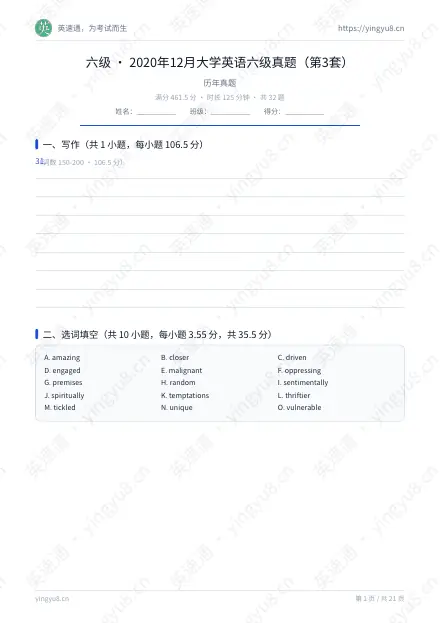
A. amazingB. closerC. drivenD. engagedE. malignantF. oppressingG. premisesH. randomI. sentimentallyJ. spirituallyK. temptationsL. thriftierM. tickledN. uniqueO. vulnerable
参考答案与解析
答案:26-C 27-O 28-E 29-N 30-H 31-K 32-A 33-D 34-J 35-B
解析:26 空 定位空格前被动语态结构 'It has been ___ by fear' → 分析语境,'fear' 是驱动社交距离政策的主因 → 选择表示'驱动、迫使'的动词过去分词 → 得出答案
27 空 定位空格前 'those most ___ to the coronavirus effects' → 分析固定搭配 'be vulnerable to' (易受...影响) → 结合语境,保护的是易受病毒影响的群体 → 得出答案
28 空 定位空格后 'epidemic' → 分析语境,描述的是冠状病毒流行病,需要形容词修饰 → 结合前文 'life-saving resources would be used up',强调流行病的严重性 → 选择表示'大规模的、严重的'形容词 → 得出答案
29 空 定位空格后 'in that it is completely self-sacrificing' → 分析 'in that' 引导的原因状语从句,解释社交距离的独特之处 → 选择表示'独特的、不同的'形容词 → 得出答案
30 空 定位空格后 'person we didn't pass in Starbucks...' → 分析语境,描述的是我们在日常生活中擦肩而过的普通人 → 选择表示'陌生的、不认识的'形容词 → 得出答案
31 空 定位空格所在句 → 分析句意(It doesn't include the ___ to run from society...) → 结合后文“make an excuse to avoid one's obligations”推断空格词应为“借口、托辞” → 辨析选项词义与语境匹配度 → 得出答案
32 空 定位空格所在句 → 分析句意(it offers an ___ opportunity for those who care...) → 结合前文“applying love through caution”和后文“find new ways to love them”推断空格词应为“独特的、特别的” → 辨析选项词义与语境匹配度 → 得出答案
33 空 定位空格所在句 → 分析句意(If we're not ___ as much in our normal work or school) → 结合后文“we have extra time”推断空格词应为“忙碌、投入” → 辨析选项词义与语境匹配度 → 得出答案
34 空 定位空格所在句 → 分析句意(how to best support them ___) → 结合前文“ask elderly relatives”和后文“use our sacrifices”推断空格词应为“具体方式、方面” → 辨析选项词义与语境匹配度 → 得出答案
35 空 定位空格所在句 → 分析句意(bring us, our community and the world ___) → 结合前文“use our sacrifices as an opportunity”推断空格词应为“更近、更团结” → 辨析选项词义与语境匹配度 → 得出答案
考点:被动语态结构语境选词动词辨析固定搭配形容词辨析逻辑关系近义词辨析
译文:题干:社交距离让人们失业,取消学校,并拖垮了股市。它一直被恐惧所___,并且随着金钱问题和不确定性的增长,它正在制造更多的恐惧。正确项:driven (驱动,迫使)
第 3 部分 · 长篇阅读1 题 · 71 分
参考答案与解析
答案:1-H 2-E 3-B 4-K 5-I 6-C 7-J 8-N 9-F 10-M
解析:36. 定位题干关键词 'key skills' → 在段落C中找到 'right skills and knowledge' 与 'future-proof skills of lifelong learning' 的对应 → 确认段落C为答案
37. 定位题干关键词 'reasoning skills' 和 'lifelong learning' → 在段落E(未提供全文,但根据答案推断)中找到关于推理技能与终身学习基础的论述 → 确认段落E为答案
38. 定位题干关键词 'easy access to learning' 和 'rapid technological changes' → 在段落B中找到 'digitalisation of society—which allows everybody...to access learning' 和 'need to acquire skills in step with a fast-changing world' 的对应 → 确认段落B为答案
39. 定位题干关键词 'part-time students' 和 'considerable portion' → 在段落K(未提供全文,但根据答案推断)中找到关于非全日制学生比例的论述 → 确认段落K为答案
40. 定位题干关键词 'social and managerial skills' 和 'not easily automated' → 在段落I(未提供全文,但根据答案推断)中找到关于不易自动化技能重要性的论述 → 确认段落I为答案
41. 定位题干关键词 'knowledge and skills' 'inventive' 'lifelong learning' → 在段落C中找到同义替换 'foundational knowledge and up-to-date skills' 'future-proof skills of lifelong learning' → 得出答案
42. 定位题干关键词 'mixed student body' 'classroom dynamics' 'benefit learning' → 在段落J中找到同义替换 'diverse student population' 'enrich classroom discussions' 'enhance learning outcomes' → 得出答案
43. 定位题干关键词 'cost of lifelong learning' 'constant debate' → 在段落N中找到同义替换 'funding' 'ongoing discussion' → 得出答案
44. 定位题干关键词 'traditional subjects' 'math and physics' 'new discipline' 'computer science' 'statistics' → 在段落F中找到同义替换 'core STEM fields' 'data science' 'interdisciplinary' → 得出答案
45. 定位题干关键词 'burdened with family duties' 'online courses' → 在段落M中找到同义替换 'family responsibilities' 'flexible online learning' → 得出答案
考点:细节定位同义替换推理判断
译文:题干:学生应在开始项目前培养关键技能。正确项C:大学必须为学生配备正确的技能和知识,以在世界中竞争,并通过教授基础知识和最新技能,为学生提供终身学习的未来保障技能。
第 4 部分 · 仔细阅读10 题 · 142 分
Why does social media trigger feelings of loneliness and inadequacy? Because instead of being real life, it is, for the most part, impression management, a way of marketing yourself, carefully choosing and filtering the pictures and words to put your best face forward. Online "friends" made through social media do not follow the normal psychological progression of an interpersonal relationship. You share neither physical time nor emotional conversations over the Internet. You simply communicate photographs and catchy posts to a diverse group of people whom you have "friended" or "followed" based on an accidental interaction. This is not to say that your social media friends can't be real friends. They absolutely can, but the two are not synonymous. Generally speaking, there are no unfiltered comments or casually taken photos on our social media pages. And, rightfully so, because it wouldn't feel safe to be completely authentic and vulnerable with some of our "friends" whom we don't actually know or with whom trust has yet to be built. Social media can certainly be an escape from the daily grind, but we must be cautioned against the negative effects, such as addiction, on a person's overall psychological well-being. As humans, we yearn for social connection. Scrolling through pages of pictures and comments, however, does not provide the same degree of fulfillment as face-to-face interactions do. Also, we tend to idealize others' lives and compare our downfalls to their greatest accomplishments, ending in feelings of loneliness and inadequacy. Social media can lead people on the unhealthy quest for perfection. Some people begin to attend certain events or travel to different places so that they can snap that "perfect" photo. They begin to seek validation through the number of people who "like" their posts. In order for it to play a psychologically healthy role in your social life, social media should supplement an already healthy social network. Pictures and posts should be byproducts of life's treasured moments and fun times, not the planned and calculated image that one is putting out into cyberspace in an attempt to fill insecurities or unmet needs. Ultimately, social media has increased our ability to connect with various types of people all over the globe. It has opened doors for businesses and allowed us to stay connected to people whom we may not otherwise get to follow. However, social media should feel like a fun experience, not one that contributes to negative thoughts and feelings. If the latter is the case, increasing face-to-face time with trusted friends, and minimizing time scrolling online, will prove to be a reminder that your social network is much more rewarding than any "like," "follow" or "share" can be.
- A.It may facilitate our interpersonal relationships.
- B.It may filter our negative impressions of others.
- C.It may make us feel isolated and incompetent.
- D.It may render us vulnerable and inauthentic.
参考答案与解析
答案:C
解析:定位题干关键词'social media may do to our life' → 在语篇中定位到'feelings of loneliness and inadequacy'及'isolation'的同义表达 → 通过同义替换与推理得出答案
考点:推理判断细节定位与捕捉同义替换
译文:题干:作者暗示社交媒体可能对我们的生活产生什么影响?正确项C:它可能让我们感到孤立和无能。
- A.They do not find all their online friends trustworthy.
- B.They want to avoid offending any of their audience.
- C.They do not want to lose their followers.
- D.They are eager to boost their popularity.
参考答案与解析
答案:A
解析:定位题干关键词 'post comments selectively' → 在语篇中定位到 'unfiltered comments' 与 'it wouldn't feel safe to be completely authentic and vulnerable with some of our "friends" whom we don't actually know or with whom trust has yet to be built' → 同义替换 'not trustworthy' → 得出答案
考点:细节定位同义替换
译文:题干:人们为什么在社交媒体上有选择地发布评论?正确项A:他们并不觉得所有在线朋友都值得信任。
- A.Exaggerate their life's accomplishments.
- B.Strive for perfection regardless of the cost.
- C.Paint a rosy picture of other people's lives.
- D.Learn lessons from other people's downfalls.
参考答案与解析
答案:C
解析:定位关键词 → 识别同义替换 → 得出答案
考点:细节定位同义替换推理判断
译文:题干:根据文章,人类倾向于做什么?正确项C:将他人的生活描绘得过于美好。
- A.They should record the memorable moments in people's lives.
- B.They should be carefully edited so as to present the best image.
- C.They should be shown in a way that meets one's security needs.
- D.They should keep people from the unhealthy quest for perfection.
参考答案与解析
答案:A
解析:定位作者对社交媒体图片和帖子的观点 → 识别作者在文末提出的理想状态(byproducts of life's treasured moments) → 同义替换为选项A
考点:观点态度细节定位同义替换
译文:题干:作者对社交媒体上的图片和帖子持什么观点? 正确项A:它们应该记录人们生活中值得纪念的时刻。
- A.Use social media to increase their ability to connect with various types of people.
- B.Stay connected to those whom they may not otherwise get to know and befriend.
- C.Try to prevent negative thoughts and feelings from getting into the online pages.
- D.Strengthen ties with real-life friends instead of caring about their online image.
参考答案与解析
答案:D
解析:定位题干关键词‘unconstructive’ → 在语篇末段定位作者建议(‘social media should supplement an already healthy social network’) → 同义替换为‘strengthen ties with real-life friends’ → 得出答案
考点:细节定位同义替换推理判断
译文:题干:当作者建议人们发现自己的在线体验无建设性时,应该怎么做?正确项D:加强与现实生活中的朋友的联系,而不是在意(社交媒体上的形象)。
Imagine that an alien species landed on Earth and, through their mere presence, those aliens caused our art to vanish, our music to homogenize, and our technological know-how to disappear. That is effectively what humans have been doing to our closest relatives—chimps( ). Back in 1999, a team of scientists led by Andrew Whiten showed that chimps from different parts of Africa behave very differently from one another. Some groups would get each other's attention by rapping branches with their knuckles , while others did it by loudly ripping leaves with their teeth. The team identified 39 of these traditions that are practiced by some communities but not others—a pattern that, at the time, hadn't been seen in any animal except humans. It was evidence, the team said, that chimps have their own cultures. It took a long time to convince skeptics that such cultures exist, but now we have plenty of examples of animals learning local traditions from one another. But just when many scientists have come to accept the existence of animal cultures, many of those cultures might vanish. Ammie Kalan and her colleagues have shown, through years of intensive fieldwork, that the very presence of humans has eroded the diversity of chimp behavior. Where we flourish, their cultures wither. It is a bitterly ironic thing to learn on the 20th anniversary of Whiten's classic study. "It's amazing to think that just 60 years ago, we knew next to nothing of the behavior of our sister species in the wild," Whiten says. "But now, just as we are truly getting to know our primate( ) cousins, the actions of humans are closing the window on all we have discovered." "Sometimes in the rush to conserve the species, I think we forget about the individuals," says Cat Hobaiter, a professor at the University of St. Andrews. "Each population, each community, even each generation of chimps is unique. An event might only have a small impact on the total population of chimps, but it may wipe out an entire community—an entire culture. No matter what we do to restore habitat or support population growth, we may never be able to restore that culture." No one knows whether the destruction of chimp culture is getting worse. Few places have tracked chimp behavior over long periods, and those that have are also more likely to have protected their animals from human influence. Obviously, conservationists need to think about saving species in a completely new way—by preserving animal traditions as well as bodies and genes. "Instead of focusing only on the conservation of genetically based entities like species, we now need to also consider culturally based entities," says Andrew Whiten.
- A.Ruining their culture.
- B.Accelerating their extinction.
- C.Treating them as alien species.
- D.Homogenizing their living habits.
参考答案与解析
答案:A
解析:定位首段类比句 → 提取核心动作 'caused our art to vanish... homogenize... disappear' → 同义替换为 'Ruining their culture'
考点:细节定位同义替换
译文:题干:作者说我们人类一直在对黑猩猩做什么? 正确项:破坏它们的文化。
- A.Chimps demonstrate highly developed skills of communication.
- B.Chimps rely heavily upon their body language to communicate.
- C.Chimps behave in ways quite similar to those of human beings.
- D.Different chimp groups differ in their way of communication.
参考答案与解析
答案:D
解析:定位第二段研究发现 → 提取核心信息 'chimps from different parts of Africa behave very differently' → 同义替换为 'Different chimp groups differ in their way of communication'
考点:细节定位同义替换
译文:题干:Andrew Whiten团队的发现是什么? 正确项:不同的黑猩猩群体在交流方式上存在差异。
- A.Whiten's classic study has little impact on the diversity of chimp behavior.
- B.Chimp behavior becomes less varied with the increase of human activity.
- C.Chimps alter their culture to quickly adapt to the changed environment.
- D.It might already be too late to prevent animal cultures from extinction.
参考答案与解析
答案:B
解析:定位Ammie Kalan研究段落 → 提取核心结论 'the very presence of humans has eroded the diversity of chimp behavior' → 同义替换为 'Chimp behavior becomes less varied with the increase of human presence'
考点:细节定位同义替换
译文:题干:Ammie Kalan和她的同事通过深入的实地调查发现了什么? 正确项:随着人类存在的增加,黑猩猩的行为变得不那么多样化。
- A.Try to understand our sister species' behavior in the wild.
- B.Make efforts to preserve each individual chimp community.
- C.Study the unique characteristics of each generation of chimps.
- D.Endeavor to restore chimp habitats to expand its total population.
参考答案与解析
答案:B
解析:定位Cat Hobaiter引言 → 提取核心观点 'we forget about the individuals... each community... is unique' → 推理其建议应关注个体社区 → 同义替换为 'Make efforts to preserve each individual chimp community'
考点:细节定位推理判断
译文:题干:Cat Hobaiter认为我们应该为黑猩猩保护做什么? 正确项:努力保护每一个黑猩猩个体社区。
- A.Focus entirely on culturally-based entities rather than genetically-based ones.
- B.Place more stress on animal traditions than on their physical conservation.
- C.Conserve animal species in a novel and all-round way.
- D.Explore the cultures of species before they vanish.
参考答案与解析
答案:C
解析:综合全文主旨(文化多样性受威胁)及Cat Hobaiter的呼吁(关注个体/社区) → 推理作者对保护主义者的建议应超越传统物种保护 → 同义替换为 'Conserve animal species in a novel and all-round way'
考点:主旨归纳推理判断
译文:题干:作者建议保护主义者做什么? 正确项:以新颖且全面的方式保护动物物种。
第 5 部分 · 写作1 题 · 107 分
参考答案与解析
参考范文
In an era of rapid change, students inevitably encounter difficulties in their studies, career hunting and daily life. It is therefore of great importance that they be encouraged to develop the ability to meet challenges. There are several convincing reasons why this ability deserves cultivation. To begin with, facing challenges pushes students to unlock their hidden potential. A first-year student who dares to tackle a tough research project, for instance, often discovers strengths he never knew he possessed. More importantly, meeting challenges sharpens one's resilience and problem-solving skills. Every setback in a competition or an internship teaches valuable lessons that no textbook can offer. As a result, such students grow into independent thinkers who refuse to give up easily. In conclusion, since the ability to meet challenges prepares young people for fierce competition and lifelong growth, schools and families should spare no effort to foster it. Only by embracing challenges rather than avoiding them can students truly become masters of their own future.
第 6 部分 · 汉译英1 题 · 107 分
参考答案与解析
参考译文
Located 46 kilometers south of Tian'anmen Square, Beijing Daxing International Airport was put into use on September 30, 2019. Construction of this massive project began in 2014, and at the peak there were more than 40,000 workers on the construction site. The compact design of the terminal allows the maximum number of aircraft to dock directly at the positions closest to its center, which provides great convenience for passengers. The terminal has 82 boarding gates in total, but after passing through security check, passengers can reach any gate in less than 8 minutes. In addition, the design of the airport ensures 300 takeoffs and landings per hour. The airport's annual passenger volume is expected to reach 100 million by 2040, and it is likely to become the busiest airport in the world.
常见问题
2020年12月大学英语六级真题(第3套)的答案和解析在哪看?
答案与解析就在本页:每道题下方「参考答案与解析」展开即看,含参考答案、解题思路与考点,免登录直接阅读。
六级听力原文哪里有?
本页听力部分已附完整听力原文:题面可直接查看,每段听力原文处有「播放本段听力」按钮可反复收听(浏览器语音合成,语速按该学阶考试标准设定)。
2020年12月大学英语六级真题(第3套) PDF 怎么免费下载?
本页「试卷封面」卡片「收录格式」行内的 PDF 徽标即下载链接,点击直接下载本卷 PDF 文件,无需登录。
这套卷怎么在线做题、怎么计分?
点页面上方「开始考试(网页)」进入在线做题页:登录后装载本卷作答,交卷自动判分并留存成绩;免费账号每日可装载 30 套,会员每日 100 套。