2017年高考英语新高考卷真题及答案解析
2017年高考英语新高考卷真题 · 完整收录
- 年份考次
- 2017 年
- 命题归属
- 全国统一命题
- 省份
- 全国
- 听力
- 含听力
- 题量
- 35 题
- 满分
- 150 分
- 限时
- 120 分钟
- 题型结构
- 第一节 听力理解 5 题 7.5 分 · 第二节 听力理解 15 题 22.5 分 · 第一节 阅读理解 10 题 25 分 · 第二节 七选五 5 题 10 分 · 第一节 完形填空 20 题 30 分 · 第二节 语法填空 10 题 15 分 · 第一节应用文写作 1 题 15 分 · 第二节 读后续写 1 题 25 分
- 收录格式
开始考试(微信)

微信扫一扫 · 小程序内开始考试
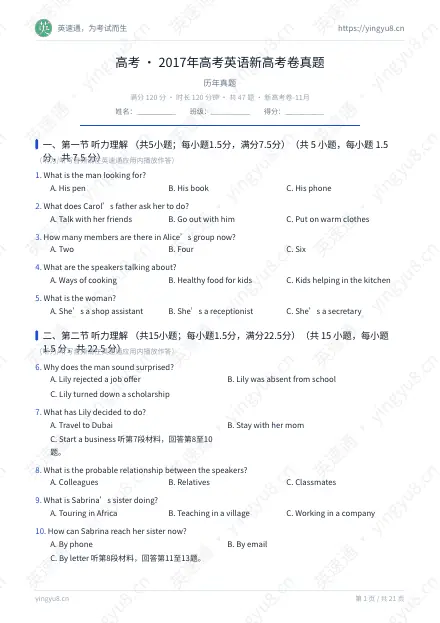
第 1 部分 · 第一节 听力理解 (共5小题;每小题1.5分,满分7.5分)5 题 · 8 分
听力原文 · Question 1(本页按钮可反复收听;在线做题考试中每段仅播一次)
M: I'm sorry, Lily, I really need to leave for the job interview soon. W: Take it easy. Are you ready? M: Almost. But I can't find my pen anywhere. Have you seen it? W: Your pen? No. Is it in your bag? M: I've checked. It's not there. W: Maybe it's on the desk, next to your book. M: Oh, yes! Here it is, under the book. Thanks!
- A.His pen
- B.His book
- C.His phone
参考答案与解析
答案:A
解析:识别对话场景(寻找物品) → 捕捉关键名词(pen) → 排除干扰项
考点:场景词汇与人物关系细节定位与捕捉
译文:题干:这位男士在找什么? 正确项:他的钢笔。
听力原文 · Question 2(本页按钮可反复收听;在线做题考试中每段仅播一次)
W: Hi Tom. The school sports meet starts at eight thirty. Carol looks happy today. M: Yes, but her father called her this morning. He said the wind is strong and the air is cold. W: So what did he tell her to do? M: He asked her to wear her thick coat and scarf before she leaves home. W: Good idea. She should also take a warm cup of tea. M: Right. And she will meet her friends at the school gate later.
- A.Talk with her friends
- B.Go out with him
- C.Put on warm clothes
参考答案与解析
答案:C
解析:定位人物(Carol's father) → 捕捉其具体要求(put on warm clothes) → 排除其他人物行为
考点:细节定位与捕捉指代与衔接
译文:题干:Carol的父亲让她做什么? 正确项:穿上保暖的衣服。
听力原文 · Question 3(本页按钮可反复收听;在线做题考试中每段仅播一次)
W: Tom, I heard you joined Alice's volunteer team. How is it going? M: It is going well, but our team has changed a lot. At first, only Alice and I were in it. W: So it was just the two of you at the beginning? M: Yes. Then two more students came, and now Alice's team has twice as many people as before. W: That sounds much better for the community work. M: Sure. With more hands, we can help more old people in the neighborhood.
- A.Two
- B.Four
- C.Six
参考答案与解析
答案:B
解析:定位数字信息(Alice's group members) → 区分初始数量与当前数量 → 进行简单运算或信息更新
考点:数字时间语音细节定位与捕捉
译文:题干:Alice的小组现在有多少名成员? 正确项:四名。
听力原文 · Question 4(本页按钮可反复收听;在线做题考试中每段仅播一次)
W: So, Tom, how did your first day at the after-school program go? M: It was great. The children were really excited to make fruit salad with me. W: Nice. Did they just watch you do everything? M: No, they washed the apples, cut the bananas, and mixed everything in a big bowl. W: That sounds like a fun way for them to learn and help. M: Yes, and they even cleaned the table after we finished.
- A.Ways of cooking
- B.Healthy food for kids
- C.Kids helping in the kitchen
参考答案与解析
答案:C
解析:综合对话双方发言 → 提炼核心话题(孩子参与厨房活动) → 排除片面或无关选项
考点:主旨大意谋篇布局
译文:题干:说话者在谈论什么? 正确项:孩子们在厨房帮忙。
听力原文 · Question 5(本页按钮可反复收听;在线做题考试中每段仅播一次)
W: Good morning. This is the front desk of the City Learning Centre. How may I help you? M: Hi, I'd like to ask about evening classes. Is this the right number? W: Yes, it is. I'm here to greet visitors and answer questions about our courses. M: Great. Could you tell me when the new term starts? W: It begins on the tenth of September. Would you like me to send you a course list? M: Yes, please. My name is Tom. W: Certainly, Tom. I'll pass your name to Mr. Smith, who deals with new students. M: Thank you very much. W: You're welcome. Have a nice day.
- A.She’s a shop assistant
- B.She’s a receptionist
- C.She’s a secretary
参考答案与解析
答案:B
解析:识别对话场景(服务场所) → 捕捉人物身份线索(接待、问候) → 排除其他职业特征
考点:场景词汇与人物关系细节定位与捕捉
译文:题干:这位女士是做什么的? 正确项:她是一名接待员。
第 2 部分 · 第二节 听力理解 (共15小题;每小题1.5分,满分22.5分)15 题 · 23 分
听力原文 · Question 6(本页按钮可反复收听;在线做题考试中每段仅播一次)
W: Tom, you look shocked. What happened on your trip? M: I met Lily in the train station. She told me she gave up a free place to study music in Vienna. W: Really? Why would she do that? M: She said she wants to travel around Asia first. I still can't believe it. W: That is surprising. She worked so hard for it. M: I know. Mr. Smith will be puzzled too.
- A.Lily rejected a job offer
- B.Lily was absent from school
- C.Lily turned down a scholarship
参考答案与解析
答案:C
解析:捕捉语气词(如‘really?’)与语调变化 → 关联对话中提及的‘scholarship’与‘turned down’ → 推断惊讶原因
考点:语气推断同义替换
译文:题干:男士为什么听起来很惊讶?正确项:C. 莉莉拒绝了奖学金。
听力原文 · Question 7(本页按钮可反复收听;在线做题考试中每段仅播一次)
W: Tom, what did you think of the talk on city life? M: It was interesting. Lily told me she had planned to go to Dubai for a holiday. W: Really? But she changed her mind? M: Yes. Her mother was not well, so Lily decided to remain by her side at home. W: That sounds like a wise choice. Family comes first. M: I agree. She will put off the trip for now.
- A.Travel to Dubai
- B.Stay with her mom
- C.Start a business 听第7段材料,回答第8至10题。
参考答案与解析
答案:B
解析:定位对话中关于‘plan’或‘decision’的陈述 → 捕捉‘stay with my mom’或同义表达 → 排除其他选项
考点:细节定位同义替换
译文:题干:莉莉决定做什么?正确项:B. 和她妈妈待在一起。
听力原文 · Question 8(本页按钮可反复收听;在线做题考试中每段仅播一次)
W: Tom, the office is moving to a new building next month. M: I know. I still need a place near it. My old flat is too far. W: My neighbour Lily is leaving. Her flat is small but clean. M: Is the rent high? I share my pay with my family, so I must be careful. W: About seven hundred a month. I can ask her for you after work. M: That would help a lot. Thanks, Lily. W: No problem. We sit in the same room all day, so I know your situation.
- A.Colleagues
- B.Relatives
- C.Classmates
参考答案与解析
答案:A
解析:分析对话双方的称呼、话题(如工作、项目)与语气 → 推断人物关系 → 匹配‘Colleagues’(同事)
考点:场景推断关系识别
译文:题干:说话者之间可能是什么关系?正确项:A. 同事。
听力原文 · Question 9(本页按钮可反复收听;在线做题考试中每段仅播一次)
W: Tom, do you know where Sabrina's sister is these days? M: She left the city last year. Now she lives in a small village in Africa. W: What is she doing there? M: She is helping children learn to read and write. She loves her work. W: That sounds meaningful. M: Yes. Sabrina misses her, but they talk every weekend.
- A.Touring in Africa
- B.Teaching in a village
- C.Working in a company
参考答案与解析
答案:B
解析:定位对话中关于‘sister’的描述 → 捕捉‘teaching’与‘village’等关键词 → 匹配选项B
考点:细节定位关键词匹配
译文:题干:萨布丽娜的姐姐在做什么?正确项:B. 在一个村庄教书。
听力原文 · Question 10(本页按钮可反复收听;在线做题考试中每段仅播一次)
W: Tom, my sister has a new smart watch, but she lost it again. M: Can you call her on the phone, Sabrina? W: No, her phone is broken. I tried email too, but she never checks it. M: Then how can you reach her now? W: I will write to her. The post office is still the best way. M: That is slow, but it will work. W: Yes, I sent a letter this morning. She should get it in three days.
- A.By phone
- B.By email
- C.By letter 听第8段材料,回答第11至13题。
参考答案与解析
答案:C
解析:定位对话中关于‘reach’或‘contact’的陈述 → 捕捉‘letter’或‘mail’等关键词 → 推断联系方式
考点:细节定位推理判断
译文:题干:萨布丽娜现在如何联系她的姐姐?正确项:C. 通过信件。
听力原文 · Question 11(本页按钮可反复收听;在线做题考试中每段仅播一次)
W: Tom, try this soup. I made it from my grandmother's recipe. M: Thanks, Lily. It smells great. W: So, what do you think? M: Well, it's hot and the color is nice. But to be honest, I can't taste any salt or spice. W: Really? Let me try some. Hmm, you're right. I forgot to add anything. M: That's okay. We can add some salt together.
- A.Tasteless
- B.Just fine
- C.Thick
参考答案与解析
答案:A
解析:定位Maria对汤的评价 → 捕捉其负面态度词 → 得出答案
考点:观点态度细节定位
译文:Maria觉得这汤怎么样?A. 没味道 B. 还行 C. 太稠
听力原文 · Question 12(本页按钮可反复收听;在线做题考试中每段仅播一次)
W: Karl, this chicken soup smells great. What is your secret? M: Thanks, Lily. I always taste it before serving. If it feels a little flat, one thing can be added. W: Let me guess. Do you put in some white grains from the sea? M: No, that is not my choice. I never use it in this soup. W: Then how about those round vegetables that make people cry? M: Not those either. I leave them out completely. W: So what do you use? M: The ground black spice from a small shaker. It gives a nice warm taste.
- A.Salt
- B.Onions
- C.Pepper
参考答案与解析
答案:C
解析:定位Karl的建议 → 识别其推荐的具体添加物 → 得出答案
考点:细节定位
译文:Karl说可以往汤里加什么?A. 盐 B. 洋葱 C. 胡椒
听力原文 · Question 13(本页按钮可反复收听;在线做题考试中每段仅播一次)
W: Good evening. Are you ready to order, or would you like a few more minutes? M: A few more minutes, please. I'm still thinking about what to have. W: Of course. Would you like something to drink first? M: Just some water, thanks. I had a long day at the job planning meeting. W: I understand. Take your time. The fish is very good tonight.
- A.At home
- B.At a restaurant
- C.At a friend’s house 听第9段材料,回答第14至16题。
参考答案与解析
答案:B
解析:捕捉对话中的场景关键词(如点餐、服务) → 推断对话发生地点 → 得出答案
考点:场景词汇推理判断
译文:说话者在哪里?A. 在家 B. 在餐厅 C. 在朋友家
听力原文 · Question 14(本页按钮可反复收听;在线做题考试中每段仅播一次)
W: Hi Tom, the water in our club room is still cold. M: That's bad. Did you tell Mr. Smith? W: Yes. He said a worker will drop by after lunch today. M: Good. So we can take showers before the game tomorrow. W: Right. And Lily will bring some hot tea for us later. M: Great. I'll wait here until the man arrives. W: Okay. Let's get the room ready first.
- A.This afternoon
- B.Tomorrow
- C.At the weekend
参考答案与解析
答案:A
解析:定位关于热水检查时间的对话 → 捕捉具体时间信息 → 得出答案
考点:数字时间语音细节定位
译文:什么时候会有人来检查热水?A. 今天下午 B. 明天 C. 周末
听力原文 · Question 15(本页按钮可反复收听;在线做题考试中每段仅播一次)
W: Tom, how did you and Lily find that flat near the park? M: We saw a small ad in the city paper last week. W: Really? I thought your friend Jack told you about it. M: No, Jack only helped us move in. The paper gave us the first lead. W: And the house agency never called you back? M: Right, they didn't. So we called the number in the ad ourselves.
- A.From a friend
- B.From a newspaper
- C.From a house agency
参考答案与解析
答案:B
解析:定位学生得知公寓信息的来源 → 识别具体渠道 → 得出答案
考点:细节定位
译文:学生们是怎么知道这个公寓的?A. 从朋友那里 B. 从报纸上 C. 从房屋中介
听力原文 · Question 16(本页按钮可反复收听;在线做题考试中每段仅播一次)
W: Hi Tom, I need your advice about the fridge in the students' flat. M: What happened, Lily? W: It stopped working two days ago, and the food inside went bad. M: That sounds terrible. Can Mr. Smith repair it? W: He said the old one is too old to fix, so the students bought a new fridge themselves. M: So what will you do now? W: I will give them the money for the new one, since it was my duty to provide it. M: That is fair. They will be glad to hear that. W: Yes, I will pay them back this afternoon.
- A.Pay the students for the new one
- B.Get someone to fix the old one
- C.Order one on the Internet 听第10段材料,回答第17至20题。
参考答案与解析
答案:A
解析:定位问题解决方式 → 匹配‘pay for a new one’ → 得出答案
考点:细节定位同义替换
译文:题干:女士将如何解决冰箱的问题?正确项:为新的冰箱付钱给学生们。
听力原文 · Question 17(本页按钮可反复收听;在线做题考试中每段仅播一次)
W: Welcome back to School Talk. Today we have a special visitor, Mr. Smith, a teacher from a nearby high school. M: Thank you, Lily. I was asked to come here and share some ideas about choosing courses. W: So, as someone invited to speak today, what should students think about first? M: They should follow their interests and ask teachers for advice. Also, they must check the course requirements carefully. W: Great advice. Thank you for joining us, Mr. Smith.
- A.an invited guest
- B.A news reporter
- C.A radio host
参考答案与解析
答案:A
解析:定位说话者身份描述 → 匹配‘invited guest’ → 得出答案
考点:细节定位身份识别
译文:题干:说话者是谁?正确项:一位受邀嘉宾。
听力原文 · Question 18(本页按钮可反复收听;在线做题考试中每段仅播一次)
W: Tom, you look different since your trip to Italy. M: Really? What do you mean? W: You seem to have put on a lot of weight. M: Yes, the food there was too good. I ate pizza and ice cream every day. W: So that's why your clothes look so tight now. M: I know. I need to buy new trousers before we go hiking. W: Well, at least you enjoyed the food. M: True, but I should start running again.
- A.He speaks faster
- B.He becomes heavier
- C.He cooks more often
参考答案与解析
答案:B
解析:定位个人变化描述 → 匹配‘become heavier’ → 得出答案
考点:细节定位同义替换
译文:题干:说话者在哪方面发生了变化?正确项:他变得更重了。
听力原文 · Question 19(本页按钮可反复收听;在线做题考试中每段仅播一次)
W: How was the talk you went to last night? M: Really interesting. The speaker came from a small town in the north. W: Was it hard for you to follow him? M: At first, yes. He spoke in a way I had never heard before, and I had to train my ears to catch the meaning. W: So what was the biggest problem for you there? M: Getting used to the way people there talk. That took me a while. W: I see. And the other things? M: Oh, those were fine. The meals were tasty, and the warm afternoons felt just like home.
- A.The food
- B.The weather
- C.The language
参考答案与解析
答案:C
解析:定位需要适应的新事物 → 匹配‘language’ → 得出答案
考点:细节定位同义替换
译文:题干:对说话者来说,需要适应什么不同的东西?正确项:语言。
听力原文 · Question 20(本页按钮可反复收听;在线做题考试中每段仅播一次)
W: Tom, you lived in Paris for a year, right? M: Yes, I rented a small flat there. W: What did you think of the French people? M: Well, they were polite, but they did not seem warm. W: Really? Could you say more? M: They seldom smiled at me or said hello first. W: That sounds a bit cold. M: Yes, a little cold, though kind when I asked for help.
- A.A bit cold
- B.Generous
- C.Easy-going
参考答案与解析
答案:A
解析:定位对法国人的评价 → 匹配‘a bit cold’ → 得出答案
考点:观点态度同义替换
译文:题干:说话者认为法国人怎么样?正确项:有点冷淡。
第 3 部分 · 第一节 阅读理解 (共10小题;每小题2.5分,满分25分)10 题 · 25 分
阅读下列短文,从每题所给的A、B、C和D四个选项中,选出最佳选项,并在答题纸上将该项涂黑。 A When I was in fourth grade, I worked part-time as a paperboy. Mrs. Stanley was one of my customers. She’d watch me coming down her street, and by the time I’d biked up to her doorstep, there’d be a cold drink waiting. I’d sit and drink while she talked. Mrs.Stanley talked mostly about her dead husband, "Mr. Stanley and I went shopping this morning." she'd say. The first time she said that, soda(汽水) went up my nose. I told my father how Mrs. Stanley talked as if Mr. Stanley were still alive. Dad said she was probably lonely, and that I ought to sit and listen and nod my head and smile, and maybe she’d work it out of her system. So that’s what I did, and it turned out Dad was right. After a while she seemed content to leave her husband over at the cemetery(墓地). I finally quit delivering newspapers and didn’t see Mrs. Stanley for several years. Then we crossed paths at a church fund-raiser(募捐活动). She was spooning mashed potatoes and looking happy. Four years before, she’d had to offer her paperboy a drink to have someone to talk with. Now she had friends. Her husband was gone, but life went on. I live in the city now, and my paperboy is a lady named Edna with three kids. She asks me how I’m doing. When I don’t say “find,” she sticks around to hear my problems. She’s lived in the city most of her life, but she knows about community. Community isn’t so much a place as it is a state of mind. You find it whenever people ask how you’re doing because they care, and not because they’re getting paid to do so. Sometimes it’s good to just smile, nod your head and listen.
- A.He was talking fast
- B.He was shocked
- C.He was in a hurry
- D.He was absent-minded
参考答案与解析
答案:B
解析:定位细节‘soda went up my nose’ → 结合前文Mrs. Stanley谈论已故丈夫的异常行为 → 推断作者因震惊而呛到
考点:细节定位情感推断
译文:题干:为什么有一次汽水呛到了作者的鼻子?正确项:他感到震惊。
- A.He enjoyed the drink
- B.He wanted to be helpful
- C.He took the chance to rest
- D.He tried to please his dad
参考答案与解析
答案:B
解析:定位第三段父亲建议‘sit and listen and nod... maybe she’d work it out’ → 结合作者后续行为‘So that’s what I did’ → 推断作者听从建议是为了帮助Mrs. Stanley
考点:细节定位意图推断
译文:题干:根据第三段,作者为什么坐着听Mrs. Stanley说话?正确项:他想帮忙。
- A.recover from her sadness
- B.move out of the neighborhood
- C.turn to her old friends
- D.speak out about her past
参考答案与解析
答案:A
解析:定位短语‘work it out of her system’ → 结合上下文‘talked as if Mr. Stanley were still alive’及后文‘seemed content to leave her husband over at the cemetery’ → 推断短语意为‘从悲伤中恢复’
考点:语境选词上下文推理
译文:题干:以下哪项可以替换划线短语‘work it out of her system’?正确项:从她的悲伤中恢复。
- A.Open up to others
- B.Depend on each other
- C.Pay for others’ help
- D.Care about one another B It’s surprising how much simple movements of the body can affect the way we think. Using expansive gestures with open arms makes us feel more powerful, crossing your arms makes you more determined and lying down can bring more insights(领悟). So if moving the body can have these effects, what about the clothes we wear? We’re all well aware of how dressing up in different ways can make us feel more attractive, sporty or professional, depending on the clothes we wear, but can the clothes actually change cognitive (认知的)performance or is it just a feeling? Adam and Galinsky tested the effect of simply wearing a white lab coat on people’s powers of attention. The idea is that white coats are associated with scientists, who are in turn though to have close attention to detail. What they found was that people wearing white coats performed better than those who weren’t. Indeed, they made only half as many errors as those wearing their own clothes on the Stroop Test( one way of measuring attention). The researchers call the effect “enclothed cognition,” suggesting that all manner of different clothes probably affect our cognition in many different ways. This opens the way for all sorts of clothes-based experiments. Is the writer who wears a fedora more creative? Is the psychologist wearing little round glasses and smoking a cigar more insightful? Does a chef’s hat make the resultant food taste better? From now on I will only be editing articles for PsyBlog while wearing a white coat to help keep the typing error count low. Hopefully you will be doing your part by reading PsyBlog in a cap and gown.(学位服).
参考答案与解析
答案:D
解析:定位末段‘Community isn’t so much a place as it is a state of mind... because they care’ → 结合全文事例(倾听、关心) → 归纳社区成员应互相关心
考点:主旨归纳细节支撑
译文:题干:作者认为社区中的人应该做什么?正确项:互相关心。
- A.Body movements change the way people think
- B.How people dress has an influence on their feelings
- C.What people wear can affect their cognitive performance
- D.People doing different jobs should wear different clothes
参考答案与解析
答案:C
解析:通读全文 → 识别核心主题:通过倾听、关心等简单行为建立社区联系 → 对比选项,C项‘穿着影响认知表现’与主题完全无关
考点:主旨大意选项对比
译文:题干:本文的主旨是什么?正确项:人们穿着什么会影响他们的认知表现。
- A.insights
- B.movements
- C.attention
- D.appearance
参考答案与解析
答案:C
解析:定位实验名称 → 在语篇中寻找对应实验描述 → 根据实验目的(测试衣服对穿着者的影响)推断测试维度 → 选择最符合语境的抽象名词
考点:细节定位语境选词
译文:题干:Adam和Galinsky的实验测试了衣服对穿着者___________的影响。正确项C:注意力。
- A.Academic
- B.Humorous
- C.Formal
- D.Hopeful C There are energy savings to be made from all recyclable materials, sometimes huge savings. Recycling plastics and aluminum, for instance, uses only 5% to 10% as much energy as producing new plastic or smelting (提炼)aluminum. Long before most of us even noticed what we now call “the environment,” Buckminster Fuller said, “Pollution is nothing but the resources(资源)we are not harvesting. We allow them to be left around because we’ve been ignorant of their value.” To take one example, let’s compare the throwaway economy(经济)with a recycling economy as we feed a cat for life. Say your cat weight 5kg and eats one can of food each day. Each empty can of its food weighs 40g. In a throwaway economy, you would throw away 5,475 cans over the car’s 15-year lifetime. That’s 219kg of steel-more tan a fifth of a ton and more than 40 times the cat’s weight. In a recycling economy, we would make one set of 100 cans to start with, then replace them over and over again with recycled cans. Since almost 3% of the metal is lost during reprocessing, we’d have to make an extra 10 cans each year. But in all, only 150 cans will be used up over the cat’s lifetime-and we’ll still have 100 left over for the next cat. Instead of using up 219kg of steel, we’ve use only 6kg. And because the process of recycling steel is less polluting than making new steel, we’ve also achieved the following significant savings; in energy use—47% to 74%; in air pollution—85%; in water pollution—35%; in water use—40%.
参考答案与解析
答案:B
解析:定位最后一段 → 分析段落内容(作者与送报员Edna的互动及对社区的感悟) → 推断作者语气(积极、有希望) → 选择最匹配的语气形容词
考点:观点态度推断
译文:题干:作者在最后一段听起来是怎样的?正确项B:幽默的。
- A.It is becoming more serious
- B.It destroys the environment
- C.It benefits the economy
- D.It is the resources yet to be used
参考答案与解析
答案:D
解析:定位人名Buckminster Fuller → 在语篇中寻找其言论 → 理解其关于污染的观点(污染是未被使用的资源) → 选择同义改写项
考点:细节定位词义猜测
译文:题干:Buckminster Fuller关于污染说了什么?正确项D:它是尚未被使用的资源。
- A.50.
- B.100.
- C.150
- D.250
参考答案与解析
答案:C
解析:定位数字计算相关语句 → 提取关键数据(猫的寿命15年,每年消耗罐头数量) → 进行乘法运算 → 选择计算结果
考点:细节定位数字运算
译文:题干:在循环经济中,一只猫15年的寿命会用掉多少个罐头?正确项C:150个。
- A.To promote the idea of recycling
- B.To introduce an environmentalist
- C.To discuss the causes of pollution
- D.To defend the throwaway economy.
参考答案与解析
答案:A
解析:通读全文 → 概括核心主题(通过个人经历阐述社区关怀的重要性) → 对比选项与主题的匹配度 → 选择最能概括写作目的的选项
考点:主旨大意篇章结构
译文:题干:作者写这篇文章的目的是什么?正确项A:推广回收的理念。
第 4 部分 · 第二节 七选五 (共5小题;每小题2分,满分10分)1 题 · 10 分
A. Are you confused?B. Practice makes perfect.C. What’s your motivation?D. Memory is sometimes a tricky thing.E. Marking helps you remember what you read.F. But other books require a bit more work on your partG. You can do the same thing when you are reading the text!
参考答案与解析
答案:31-D 32-A 33-F 34-G 35-B
解析:31 空 根据空格后名词 'impact' 的语义,选择能表达 '产生影响' 的动词搭配 → take on (承担) 不符合语境,排除 → take up (占据) 不符合语境,排除 → take in (吸收) 不符合语境,排除 → take over (接管) 不符合语境,排除 → take on (呈现,产生) 符合语境,得出答案
32 空 分析句子结构,空格处需要一个定语从句修饰 'the book' → 从句缺少主语,需要关系代词 → which 指代 'the book',在从句中作主语 → that 也可指代 'the book',但此处非限制性定语从句,排除 → who 指代人,排除 → where 指代地点,排除 → 得出答案
33 空 根据时间状语 'yesterday' 判断时态 → 过去发生的动作,用一般过去时 → went 是 go 的过去式,符合语境 → has gone 是现在完成时,表示对现在的影响,不符合 'yesterday' → will go 是一般将来时,不符合 'yesterday' → goes 是一般现在时,不符合 'yesterday' → 得出答案
34 空 根据语境 'the beautiful scenery' 选择合适的形容词 → amazing (令人惊叹的) 符合语境 → boring (无聊的) 与 'beautiful' 矛盾,排除 → confusing (令人困惑的) 与 'beautiful' 矛盾,排除 → disappointing (令人失望的) 与 'beautiful' 矛盾,排除 → 得出答案
35 空 分析句子结构,空格处需要非谓语动词作状语 → 逻辑主语是 'I',与 'finish' 是主动关系 → finishing 是现在分词,表示主动 → finished 是过去分词,表示被动,排除 → to finish 是不定式,表示目的,但此处表示伴随,排除 → finish 是动词原形,不能作状语,排除 → 得出答案
考点:动词搭配 take on语境选词定语从句关系代词选择时态与语态一般过去时近义词辨析非谓语动词现在分词作状语
译文:题干:这项新政策将对当地经济产生重大影响。正确项:take on (呈现,产生)
第 5 部分 · 第一节 完形填空(共20小题;每小题1.5分,满分30分)1 题 · 30 分
参考答案与解析
答案:50-C 51-B 52-C 4-B 5-C 6-B 7-A 8-B 9-C 10-A 11-C 12-B 13-A 14-B 15-A 16-A 17-B 18-C 19-A 20-B
解析:2 空 定位空格前动词took → 分析四个选项与of的搭配 → 结合语境(司机心脏病发作后接管巴士)→ 识别take control of为固定搭配 → 得出答案
3 空 定位空格前动词had → 分析四个短语动词的含义 → 结合语境(从机场接学生)→ 识别pick up有“接人”之意 → 得出答案
4 空 定位空格前不定式to → 分析四个动词的含义 → 结合语境(学生前往伯恩茅斯与寄宿家庭会面)→ 识别meet有“会面”之意 → 得出答案
5 空 定位空格前不定式to → 分析四个动词的含义 → 结合语境(学生前往伯恩茅斯参加课程)→ 识别take a course为固定搭配 → 得出答案
6 空 定位空格所在句 → 根据上下文(语言学校、学生、课程)推断职业 → 选择最符合语境的选项
7 空 定位空格所在句 → 识别固定搭配 'take the driving test' → 根据否定词 'not' 推断结果 → 选择最符合逻辑的动词
8 空 定位空格所在句 → 根据上下文(老师、学生、巴士)推断动作 → 选择最符合逻辑的动词短语
9 空 定位空格所在句 → 根据上下文(司机倒伏、无意识)推断感知动词 → 选择最符合逻辑的选项
10 空 定位空格所在句 → 根据上下文(司机无意识、未恢复)推断动词 → 选择最符合逻辑的选项
11 空 定位空格前动词短语 'took' → 结合语境 'of a bus' 判断为固定搭配 → 选择表示 '接管' 的 'ran over'(此处为 'take over' 的变体,意为接管控制)
12 空 定位空格前 'had' 构成过去完成时 → 结合语境 '从机场接学生' → 判断为 '准备/安排' 课程 → 选择 'prepared'
13 空 定位空格前 'Police' 作主语 → 结合语境 '对老师快速反应的评价' → 判断为 '赞扬' → 选择 'praised'
14 空 定位空格前 'The driver didn't' → 结合语境 '他失去意识' → 判断为 '没有反应' → 选择 'reacted'
15 空 定位空格前 'a terrible' → 结合语境 '如果他没有快速反应,可能会发生可怕的...' → 判断为 '事故' → 选择 'accident'
16 空 定位空格前动词短语 'took ___ of a bus' → 结合语境(司机心脏病发作,老师接管巴士)→ 识别固定搭配 'take control of' → 选择 'control'。
17 空 定位空格所在句 'I was ___ that no one else was hurt' → 结合后文 'but I hoped that the driver would ___' → 分析转折关系(庆幸无人受伤,但希望司机康复)→ 选择表达庆幸、宽慰情绪的 'happy'。
18 空 定位空格所在句 'I hoped that the driver would ___' → 结合前文 'The bus driver never regained consciousness and died' → 分析时序与逻辑(司机已去世,但Harvold当时希望他能___)→ 选择符合当时希望司机康复的 'survive'。
19 空 定位空格所在句 'the school is going to send Harvold on a weekend ___ to Dublin' → 结合语境(学校为感谢他而给予奖励)→ 分析选项与 'weekend' 及 'to Dublin' 的搭配 → 选择 'trip'(旅行)。
20 空 定位空格所在句 'thanking him for his ___' → 结合全文(他接管巴士,挽救学生生命)→ 分析学校感谢他的原因 → 选择 'bravery'(勇敢)。
21 空 定位空格所在句 → 分析上下文逻辑(感谢与奖励) → 推断奖励性质 → 选择最符合语境的形容词
考点:固定搭配 take control of语境选词短语动词辨析动词辨析固定搭配 take a course近义词辨析固定搭配动词搭配 take over转折逻辑时序逻辑主旨概括
译文:当司机心脏病发作后,一位年轻的英语老师接管了巴士,挽救了30名学生的生命。
第 6 部分 · 第二节 语法填空 (共10小题;每小题1.5分,满分15分)1 题 · 15 分
参考答案与解析
答案:56-an 57-which 58-months 59-for 60-effective 61-really 62-sounds 63-reading 64-their 65-learned/learnt
解析:56 空 识别空格位于名词前,且该名词为抽象概念,需填入不定冠词 → 根据抽象名词泛指用法 → 得出答案
57 空 识别空格引导非限制性定语从句,先行词为物 → 根据非限制性定语从句关系代词用法 → 得出答案
58 空 识别空格位于数词后,且该数词大于一 → 根据名词复数规则 → 得出答案
59 空 识别空格位于动词短语中,且该动词为take → 根据固定搭配take on → 得出答案
60 空 识别空格位于名词前,且该名词为抽象概念 → 根据语境需要形容词修饰 → 得出答案
61 空 分析句子结构,判断空格处需要副词修饰形容词或动词 → 根据语境选择表示程度的副词 → 得出答案
62 空 分析句子主语和时态 → 主语为第三人称单数,且描述客观事实或习惯 → 使用一般现在时第三人称单数形式 → 得出答案
63 空 分析句子结构,判断空格处需要非谓语动词 → 根据逻辑主语与动词的主动/被动关系 → 选择现在分词形式 → 得出答案
64 空 分析空格处需要代词 → 根据指代对象(复数名词)和所有格关系 → 选择形容词性物主代词 → 得出答案
65 空 分析句子时态和语态 → 根据上下文判断动作发生在过去 → 使用过去分词构成被动语态或完成时态 → 得出答案
考点:抽象名词泛指非限制性定语从句关系代词名词复数动词搭配 take on语境选词副词修饰功能程度副词用法主谓一致一般现在时第三人称单数非谓语动词作定语/状语现在分词表主动物主代词指代一致过去分词被动语态/完成时态
译文:题干与正确项的中文译文:需要一种有效的方法来解决这个问题。
第 7 部分 · 第一节应用文写作(满分15分)1 题 · 15 分
参考答案与解析
参考范文
第一部分 听力(共20小题;每小题1.5分,满分30分) 1.A 2.C 3.B 4.C 5.B 6. C 7.B 8. A 9. B 10. C 11. A 12. C 13. B 14. A 15. B 16. A 17. A 18. B 19. C 20. A 第二部分 阅读理解 第一节(共10小题;每小题2.5分,满分25分) 21.B 22. B 23. A 24. D 25. C 26. C 27. B 28. D 29. C 30. A 第二节(共5小题;每小题2分,满分10分) 31.D 32. A 33. F 34. G 35. B 第三部分 语言运用 第一节(共20小题;每小题1.5分,满分30分) 36. A 37. B 38. D 39. C 40. D 41. C 42. A 43. B 44. C 45. D 46. D 47. C 48. B 49. B 50. C 51. A 52. A 53. B 54. A 55. D 第二节(共10小题;每小题1.5分,满分15分) 56. an 57. which 58. months 59. for 60. effective 61. really 62. sounds 63. reading 64. their 65. learned/learnt 第四部分写作 第一节(满分15分) One Possible Version Dear Mr. Hall, I’m writing to invite you to come to my home to celebrate the Spring Festival on January 19. It’s traditionally a time for family reunion, so my parents and my brother will all be there. We’ll make dumplings together and have a big dinner. We’ll also play card games and watch the Spring Festival Gala on TV. You may even get a gift from my parents. If you’re able to come, I’ll go and pick you up at your place. Best, Li Hua
第 8 部分 · 第二节 读后续写(满分25分)1 题 · 25 分
参考答案与解析
参考范文
第一部分 听力(共20小题;每小题1.5分,满分30分) 1.A 2.C 3.B 4.C 5.B 6. C 7.B 8. A 9. B 10. C 11. A 12. C 13. B 14. A 15. B 16. A 17. A 18. B 19. C 20. A 第二部分 阅读理解 第一节(共10小题;每小题2.5分,满分25分) 21.B 22. B 23. A 24. D 25. C 26. C 27. B 28. D 29. C 30. A 第二节(共5小题;每小题2分,满分10分) 31.D 32. A 33. F 34. G 35. B 第三部分 语言运用 第一节(共20小题;每小题1.5分,满分30分) 36. A 37. B 38. D 39. C 40. D 41. C 42. A 43. B 44. C 45. D 46. D 47. C 48. B 49. B 50. C 51. A 52. A 53. B 54. A 55. D 第二节(共10小题;每小题1.5分,满分15分) 56. an 57. which 58. months 59. for 60. effective 61. really 62. sounds 63. reading 64. their 65. learned/learnt 第四部分写作 第一节(满分15分) One Possible Version Dear Mr. Hall, I’m writing to invite you to come to my home to celebrate the Spring Festival on January 19. It’s traditionally a time for family reunion, so my parents and my brother will all be there. We’ll make dumplings together and have a big dinner. We’ll also play card games and watch the Spring Festival Gala on TV. You may even get a gift from my parents. If you’re able to come, I’ll go and pick you up at your place. Best, Li Hua
常见问题
2017年高考英语新高考卷真题的答案和解析在哪看?
答案与解析就在本页:每道题下方「参考答案与解析」展开即看,含参考答案、解题思路与考点,免登录直接阅读。
高考听力原文哪里有?
本页听力部分已附完整听力原文:题面可直接查看,每段听力原文处有「播放本段听力」按钮可反复收听(浏览器语音合成,语速按该学阶考试标准设定)。
2017年高考英语新高考卷真题 PDF 怎么免费下载?
本页「试卷封面」卡片「收录格式」行内的 PDF 徽标即下载链接,点击直接下载本卷 PDF 文件,无需登录。
这套卷怎么在线做题、怎么计分?
点页面上方「开始考试(网页)」进入在线做题页:登录后装载本卷作答,交卷自动判分并留存成绩;免费账号每日可装载 30 套,会员每日 100 套。