2018年高考英语新高考卷真题及答案解析
2018年高考英语新高考卷真题 · 完整收录
- 年份考次
- 2018 年
- 命题归属
- 全国统一命题
- 省份
- 全国
- 听力
- 含听力
- 题量
- 35 题
- 满分
- 150 分
- 限时
- 120 分钟
- 题型结构
- 第一节 听力理解 5 题 7.5 分 · 第二节 听力理解 15 题 22.5 分 · 第一节 阅读理解 10 题 25 分 · 第二节 七选五 5 题 10 分 · 第一节 完形填空 20 题 30 分 · 第二节 语法填空 10 题 15 分 · 第一节 应用文写作 1 题 15 分 · 第二节 概要写作 1 题 25 分
- 收录格式
开始考试(微信)

微信扫一扫 · 小程序内开始考试
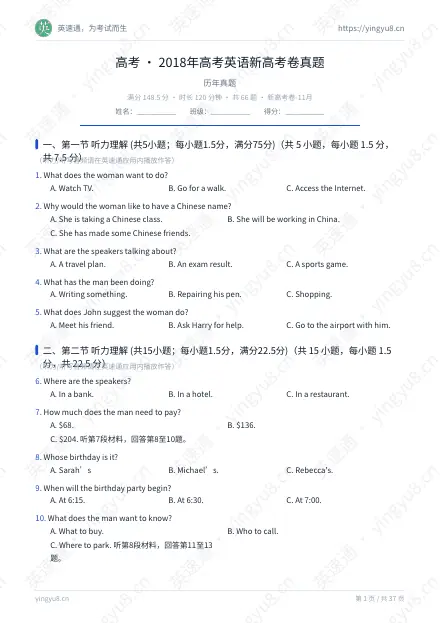
第 1 部分 · 第一节 听力理解 (共5小题;每小题1.5分,满分75分)5 题 · 8 分
听力原文 · Question 1(本页按钮可反复收听;在线做题考试中每段仅播一次)
W: The train is late again. I am so tired of waiting on this cold platform. M: Me too. We have been here for over an hour. What can we do to pass the time? W: I want to check my email and send a message to my family. Is there a way to get online here? M: Yes, there is free Wi-Fi in the station. You can use your phone. W: Great. I will do that right now. Thanks.
- A.Watch TV.
- B.Go for a walk.
- C.Access the Internet.
参考答案与解析
答案:C
解析:定位女士表达的直接意图 → 识别其与选项的同义替换 → 得出答案
考点:细节定位同义替换
译文:题干:这位女士想做什么? 正确项:上网。
听力原文 · Question 2(本页按钮可反复收听;在线做题考试中每段仅播一次)
W: Tom, the talk today made me want a Chinese name. M: Why is that, Lily? W: I signed up for a Chinese class this term, so a name would help me in it. M: That sounds fun. Are you learning characters too? W: Yes, a little. My teacher says names make speaking easier. M: I see. So it is all for your new course. W: Right. It has nothing to do with any job or friends. M: Then pick a nice one soon.
- A.She is taking a Chinese class.
- B.She will be working in China.
- C.She has made some Chinese friends.
参考答案与解析
答案:A
解析:定位女士陈述原因的句子 → 识别其与选项的同义替换 → 得出答案
考点:细节定位同义替换
译文:题干:这位女士为什么想要一个中文名字? 正确项:她正在上中文课。
听力原文 · Question 3(本页按钮可反复收听;在线做题考试中每段仅播一次)
W: Tom, you look worried. Is everything okay with the new flat? M: I just got a call from Mr. Smith about my math test. W: Oh no, did you do badly? M: No, I actually did really well. I got an A, the highest in the class. W: That's great news! But why do you look so serious? M: I was nervous about telling my parents. Now I can relax. W: Let's celebrate with some tea in the kitchen. M: Good idea. I'm so relieved.
- A.A travel plan.
- B.An exam result.
- C.A sports game.
参考答案与解析
答案:B
解析:综合对话双方的核心讨论内容 → 识别其与选项的同义替换 → 得出答案
考点:主旨概括同义替换
译文:题干:说话者在谈论什么? 正确项:一次考试结果。
听力原文 · Question 4(本页按钮可反复收听;在线做题考试中每段仅播一次)
W: Hi Tom, you look tired. What have you been up to? M: I've been out since ten this morning, going from store to store for a new bag. W: For the environment club? M: Yes, we need cloth bags instead of plastic ones for our weekend clean-up. W: Did you find any? M: I got five green ones, and they were on sale too. W: Great. That will help a lot.
- A.Writing something.
- B.Repairing his pen.
- C.Shopping.
参考答案与解析
答案:C
解析:定位男士描述其近期活动的句子 → 识别其与选项的同义替换 → 得出答案
考点:细节定位同义替换
译文:题干:这位男士一直在做什么? 正确项:购物。
听力原文 · Question 5(本页按钮可反复收听;在线做题考试中每段仅播一次)
M: The new app can send messages to people nearby. W: That sounds useful. What should I do first? M: My friend Tom works at the city library. He knows this app well. W: Should I call Harry and ask him for advice? M: No, Harry is busy today. Why not meet Tom at the library? W: Good idea. I will go there this afternoon. M: Great. He can show you how to use it.
- A.Meet his friend.
- B.Ask Harry for help.
- C.Go to the airport with him.
参考答案与解析
答案:A
解析:定位John提出建议的句子 → 识别其与选项的同义替换 → 得出答案
考点:细节定位同义替换
译文:题干:John建议这位女士做什么? 正确项:见他的朋友。
第 2 部分 · 第二节 听力理解 (共15小题;每小题1.5分,满分22.5分)15 题 · 23 分
听力原文 · Question 6(本页按钮可反复收听;在线做题考试中每段仅播一次)
W: Good morning. I have a room booked under the name Lily. M: Welcome. May I see your passport, please? W: Here it is. Is breakfast included? M: Yes, from seven thirty to ten in the dining hall on the second floor. W: Great. In my country, people usually eat a hot breakfast at home. M: That is quite different from here. Here is your key card. Your room is on the fifth floor. W: Thank you. Could I get a wake-up call at six thirty tomorrow? M: Of course. Just dial zero from your room.
- A.In a bank.
- B.In a hotel.
- C.In a restaurant.
参考答案与解析
答案:B
解析:捕捉对话中的场景关键词(如预订、入住、退房等) → 匹配酒店场景特征 → 得出答案
考点:场景词汇与人物关系
译文:题干:说话者在哪里? 正确项:在酒店。
听力原文 · Question 7(本页按钮可反复收听;在线做题考试中每段仅播一次)
W: Tom, you look tired. Did you run today? M: Yes, I ran for an hour at the sports center. W: How much do you pay for each visit? M: The usual price is thirty-four dollars, but today I only paid half. W: That sounds like a good deal. M: Yes, and I also bought a water bottle for ten dollars. W: So the visit and the bottle together cost you forty-four dollars, right? M: That is right. I paid with a fifty-dollar note and got six dollars back.
- A.$68.
- B.$136.
- C.$204. 听第7段材料,回答第8至10题。
参考答案与解析
答案:A
解析:定位对话中关于价格的数字信息 → 区分原价、折扣价或总价 → 计算或识别男士需支付的金额
考点:数字时间语音
译文:题干:男士需要支付多少钱? 正确项:68美元。
听力原文 · Question 8(本页按钮可反复收听;在线做题考试中每段仅播一次)
W: Hi, Michael. You look happy today. Is it your birthday? M: No, mine was last week. But I got a cake for Sarah this morning. W: Oh, right. Her birthday is today. Is Rebecca coming to the party? M: Yes, she will bring some drinks. We are meeting after the job planning class. W: Good. Sarah helped me a lot with my future work plan. M: Me too. She is a great friend.
- A.Sarah’s
- B.Michael’s.
- C.Rebecca's.
参考答案与解析
答案:A
解析:捕捉对话中明确提及的生日归属信息 → 匹配人名与生日事件 → 得出答案
考点:场景词汇与人物关系细节定位与捕捉
译文:题干:今天是谁的生日? 正确项:Sarah的。
听力原文 · Question 9(本页按钮可反复收听;在线做题考试中每段仅播一次)
W: Hi Tom, do you know when the birthday party for our classmate begins? M: I asked Mr. Smith this morning. He said the party will start at seven in the evening. W: Seven? I thought it was at six fifteen or six thirty. M: No, the gym is still busy then. So we should arrive a bit before seven. W: OK, I will bring my gift and get there early.
- A.At 6:15.
- B.At 6:30.
- C.At 7:00.
参考答案与解析
答案:C
解析:定位对话中关于派对开始时间的数字信息 → 区分不同时间点(如约定时间、到达时间) → 得出答案
考点:数字时间语音细节定位与捕捉
译文:题干:生日派对什么时候开始? 正确项:7:00。
听力原文 · Question 10(本页按钮可反复收听;在线做题考试中每段仅播一次)
W: Tom, you look worried. What can I do for you? M: I'm new here for the volunteer work today. I need to know where I can leave my car. W: Oh, there is a small lot behind the community center. M: Is it free for helpers? W: Yes, just show your card at the gate. M: Great, thanks. That's all I needed.
- A.What to buy.
- B.Who to call.
- C.Where to park. 听第8段材料,回答第11至13题。
参考答案与解析
答案:C
解析:分析对话中男士的提问内容或关注点 → 推断其核心疑问(如询问停车地点) → 得出答案
考点:推理判断细节定位与捕捉
译文:题干:男士想知道什么? 正确项:在哪里停车。
听力原文 · Question 11(本页按钮可反复收听;在线做题考试中每段仅播一次)
W: Hi Tom, did Julia come to the part-time job interview today? M: No, she stayed home. She was not feeling well. W: That is too bad. She wanted that job at the book shop. M: I know. She did not wake up late, and she did not go to any party. W: Let us hope she gets better soon. M: Yes. Mr. Smith said she can come next Monday.
- A.She was ill.
- B.She got up late.
- C.She went to a party.
参考答案与解析
答案:A
解析:定位关键词 'absent' → 捕捉原因 'ill' → 同义替换为 'was ill'
考点:细节定位同义替换
译文:题干:朱莉娅为什么没来上课?正确项:她生病了。
听力原文 · Question 12(本页按钮可反复收听;在线做题考试中每段仅播一次)
W: Hi Robert, you look busy. Did you go to the history class this morning? M: No, I missed it. But I met Julia after lunch. She said she was worried about the test. W: So what did you give her? M: I had written down everything the teacher said in class, so I handed her those pages to copy. W: That was kind of you. She will do better now.
- A.Textbooks.
- B.Oil paintings.
- C.Lecture notes.
参考答案与解析
答案:C
解析:定位关键词 'Robert got for Julia' → 捕捉具体物品 'lecture notes' → 同义替换为 'Lecture notes'
考点:细节定位同义替换
译文:题干:罗伯特给朱莉娅带了什么?正确项:课堂笔记。
听力原文 · Question 13(本页按钮可反复收听;在线做题考试中每段仅播一次)
W: Tom, we need to decide where to meet on Saturday for our trip photos. M: Right. My flat is too small, and the bookshop closes early. W: What about that little place near the station? They serve drinks and snacks. M: You mean the one with the wooden door and soft music? W: Yes, we can sit and talk there. Let us meet at seven thirty. M: Good. I will bring the photos from the mountain trip. W: Perfect. See you there on Saturday.
- A.At Robert's home.
- B.At a bar.
- C.At a shop. 听第9段材料,回答第14至17题。
参考答案与解析
答案:B
解析:定位关键词 'meet on Saturday' → 捕捉地点 'at a bar' → 同义替换为 'At a bar'
考点:细节定位同义替换
译文:题干:说话者周六将在哪里见面?正确项:在一家酒吧。
听力原文 · Question 14(本页按钮可反复收听;在线做题考试中每段仅播一次)
W: Mr. Smith, thanks for letting me ask you a few questions about your talk today. M: Of course. Go ahead. W: The seminar on study skills was really helpful. How did you get the idea for it? M: From my own school days. I once failed a big test, then changed my ways. W: So what is your main piece of advice for us students? M: Sleep well and read aloud every morning. That helped me a lot. W: I see. One last thing: will you speak again next month? M: Yes, if the school asks me.
- A.Attending a seminar.
- B.Giving some advice.
- C.Doing an interview.
参考答案与解析
答案:C
解析:定位关键词 'woman doing' → 捕捉行为 'interviewing' → 同义替换为 'Doing an interview'
考点:细节定位同义替换
译文:题干:这位女士正在做什么?正确项:正在接受采访。
听力原文 · Question 15(本页按钮可反复收听;在线做题考试中每段仅播一次)
W: Tom, how do you get to work from this new flat? M: I take the bus. I catch one at seven in the morning, and another at six in the evening. W: So that is two rides on a normal working day. M: Yes, I go to the office and come back home by bus each day. W: And you never ride it at weekends? M: No, I walk or stay in then.
- A.Twice a day.
- B.Every other day.
- C.Once a week.
参考答案与解析
答案:A
解析:定位关键词 'travel by bus' → 捕捉频率 'every day, twice' → 同义替换为 'Twice a day'
考点:细节定位同义替换
译文:题干:这位男士多久乘一次公交车?正确项:一天两次。
听力原文 · Question 16(本页按钮可反复收听;在线做题考试中每段仅播一次)
W: Tom, you take the bus to the green club every day, right? M: Yes, I do. It is not always on time, but it is not terrible either. W: So how do you find the service? M: Well, some days it is fine, some days it is slow. On the whole, it is just so-so. W: I see. At least it is cheap. M: That is true, and it does get me there.
- A.It’s good.
- B.It's fair.
- C.It’s poor.
参考答案与解析
答案:B
解析:定位 man 对 bus service 的评价 → 识别其表达的折中态度(fair) → 排除极端选项
考点:观点态度识别折中评价
译文:题干:男士对公交车服务感觉如何?正确项:它还算公平。
听力原文 · Question 17(本页按钮可反复收听;在线做题考试中每段仅播一次)
N: Tom and Lily are talking about a bus app they use every day. W: The app shows when the bus will come, but the bus is often late. M: Yes, I waited thirty minutes this morning. The app said five minutes. W: The seats are fine and the drivers are friendly. The real problem is the time. M: So the bus company should make the buses run on time. W: I agree. If they follow the app, we will not be late for school. M: Let us write a message to the company about this.
- A.Buses should be more punctual.
- B.Drivers should be more polite.
- C.Seats should be more comfortable. 听第10段材料,回答第18至20题。
参考答案与解析
答案:A
解析:定位 man 提出的具体改进建议 → 识别其核心诉求(准时) → 匹配选项
考点:细节定位建议识别
译文:题干:公交公司应该做出什么改进?正确项:公交车应该更准时。
听力原文 · Question 18(本页按钮可反复收听;在线做题考试中每段仅播一次)
W: Hi Tom, did you meet the new teacher from Senegal? M: Yes, but I also met a man named Pierre at the culture fair. W: Oh, who is he? M: He works at a university and does research on how people greet each other in different countries. W: So he is not a doctor or a UN official? M: No. He teaches and studies there. He just came to share his findings.
- A.A doctor from Senegal。
- B.A university researcher.
- C.A United Nations official.
参考答案与解析
答案:B
解析:定位介绍 Pierre 身份的关键信息 → 识别其职业(大学研究员) → 排除其他职业
考点:人物身份定位场景词汇
译文:题干:Pierre 是谁?正确项:一位大学研究员。
听力原文 · Question 19(本页按钮可反复收听;在线做题考试中每段仅播一次)
W: Pierre, you exercise every morning. Why? M: Well, my study is not about sports at all. I want to find out how people keep fit in different countries. W: So that is the aim of your research? M: Yes. I will compare their daily habits and write a report. W: How long will it take? M: About two years. I hope it helps people live better.
- A.Food supplies in the world.
- B.The role that the UN plays.
- C.The purpose of his study.
参考答案与解析
答案:C
解析:定位 Pierre 演讲的核心主题 → 识别其主要讨论内容(研究目的) → 区分具体细节与主旨
考点:主旨大意话题区分
译文:题干:Pierre 主要谈论什么?正确项:他研究的目的。
听力原文 · Question 20(本页按钮可反复收听;在线做题考试中每段仅播一次)
W: So what will Pierre do after he finishes his study? M: He will work on a plant project in the south. W: What is the goal of his project? M: He hopes to develop a new kind of grain that can feed more people. W: That sounds like a big task. M: Yes, and he believes it will help many farmers. W: Will he stay there long? M: For about three years, I think.
- A.A new medicine.
- B.A new type of rice.
- C.A new farming method.
参考答案与解析
答案:B
解析:定位 Pierre 研究的预期成果 → 识别其具体产出(新型水稻) → 区分相关但不同的概念
考点:细节定位推理判断
译文:题干:Pierre 工作的预期成果是什么?正确项:一种新型水稻。
第 3 部分 · 第一节 阅读理解 (共10小题;每小题25分,满分25分)10 题 · 25 分
阅读下列短文,从每题所给的A、B、C和D四个选项中,选出最佳选项,并在答题纸上将该项涂黑。 A The most welcome sight on a cold, wet winter night in London is the familiar shape of a London taxi cab approaching with its yellow "for hire" sign shining brightly. That shows it is ready to pick you up. Travelling by taxi in London is not just a way of going from one place to another. It is an experience to be enjoyed and remembered. The main reason for this is the drivers, who are called "cabbies. " Many of them are true Cockneys. This means they were born in the heart of London and speak their own special dialect (方言)of English. All of them know every street and famous building in the city, and all of them love to talk. A simple twenty- minute journey across town can become very interesting. You may have a discussion about the government and its leaders or a friendly talk about the driver’s Aunty Nellie! One thing is for sure, it will never be boring. Cabbies know all the latest news about film stars, the Royal Family, government leaders, and popular singers or actors and actresses. They also know the best places to eat, shop and relax. And they can take you straight to any large hotel, department store, theatre or museum. They know the shortest way possible without even looking at a map, because everyone who wants to become a taxi driver must pass a very difficult examination in order to get a license to drive a taxi. The exam is called “The Knowledge.” It is a written test, and in it drivers are asked the shortest way from one place to another. They must take into account the time of day - in rush hour, a longer route(路线) may be quicker - and describe the best way. Moreover, they must never forget the one-way streets!
- A.Their interest.
- B.Their manners.
- C.Their speech.
- D.Their appearance.
参考答案与解析
答案:C
解析:定位第二段对Cockney的定义 → 提取'speak their own special dialect' → 同义替换为'speech'
考点:细节定位同义替换
译文:题干:我们从什么可以判断某人是伦敦东区人?正确项:他们的言语。
- A.Passengers are full of curiosity.
- B.Cabbies' topics are wide-ranging.
- C.Aunty Nellie is popular in London.
- D.Londoners are friendly to each other.
参考答案与解析
答案:B
解析:定位'Aunty Nellie'所在句 → 分析其与前文'government and its leaders'的并列关系 → 推断作者意在说明话题广泛
考点:推理判断上下文逻辑
译文:题干:作者在第二段提及'阿姨内莉'意在说明什么?正确项:出租车司机的话题范围广泛。
- A.To qualify one to drive a taxi.
- B.To assess one's driving skills.
- C.To test drivers' ability to write.
- D.To check taxi drivers' memory. B This month millions of American kids can forget about classroom bells and set off for grandparents’ homes, sleep-away camps and lifeguard stands. But summer vacation hasn't always been a birthright of U.S. schoolchildren. Before the Civil War, schools operated on one of two calendars(日历), neither of which included a summer vacation. Rural(农村的) schooling was divided into summer and winter terms, leaving kids free to help with the farm work in the spring planting and fall harvest seasons. Urban students, meanwhile, regularly had as many as 48 weeks of study a year, with one break per quarter. In the 1840s, however, educational reformers like Horace Mann moved to combine the two calendars out of concern that rural schooling was not enough and that overusing of young minds could lead to nervous disorders. Summer appeared as the obvious time for a break: it offered a rest for teachers, fit in the farming calendar and reduced doctors’ concern that packing students into hot classrooms would promote the spread of disease. But people's opinion about the modem U.S. school year, which averages 180 days, is still divided. Some experts say its pleasant but lazy summer break, which took hold in the early 20th century, is one of the reasons math skills and graduation rates of U.S. high schoolers ranked well below average in two international education reports published in 2007. Others insist that with children under increasing pressure to devote their downtime to internships(实习)or study, there's still room for an institution that protects the lazy days of childhood.
参考答案与解析
答案:A
解析:定位'The Knowledge'相关描述 → 提取'in order to get a license to drive a taxi' → 同义替换为'qualify one to drive a taxi'
考点:细节定位目的状语理解
译文:题干:'The Knowledge'的目的是什么?正确项:使某人有资格驾驶出租车。
- A.Enjoy a summer vacation.
- B.Take a break each quarter.
- C.Have 48 weeks of study a year.
- D.Assist their parents with farm work.
参考答案与解析
答案:D
解析:定位语篇中关于内战前乡村学校日历的描述 → 提取'allow children to... assist their parents with farm work' → 直接匹配选项
考点:细节定位直接匹配
译文:题干:内战前的乡村学校日历允许孩子们做什么?正确项:帮助父母做农活。
- A.They introduced summer vacation.
- B.They shortened rural school terms
- C.They promoted the study of farming.
- D.They advocated higher pay for teachers.
参考答案与解析
答案:A
解析:定位语篇中关于1840年代教育改革者的描述 → 提取'introduced the summer vacation' → 直接匹配选项
考点:细节定位直接匹配
译文:题干:1840年代的教育改革者做了什么?正确项:他们引入了暑假。
- A.It pushes the teachers too hard.
- B.It reduces the quality of education.
- C.It ignores science instruction.
- D.It includes no time for internships. C I start every summer with the best of intentions: to attack one big book from the past, a classic that I was supposed to have read when young and ambitious. Often the pairings of books and settings have been purely accidental: "Moby Dick" on a three-day cross-country train trip: "The Magic Mountain" in a New England beachside cottage with no locks on the doors, no telephones or televisions in the rooms, and little to do beyond row on the salt pond. Attempting "The Man Without Qualities" on a return to Hawaii, my native state, however, was less fruitful: I made it through one and a quarter volumes (册), then decided that I'd got the point and went swimming instead. But this summer I find myself at a loss. I'm not quite interested in Balzac, say, or "Tristram Shandy.” There's always "War and Peace”, which I've covered some distance several times, only to get bogged down in the "War" part, set it aside for a while, and realize that I have to start over from the beginning again, having forgotten everyone’s name and social rank. How appealing to simply fall back on a favorite - once more into "The Waves" or “Justine," which feels almost like cheating, too exciting and too much fun to, properly belong in serious literature. And then there’s Stendhals "The Red and the Black," which happens to be the name of my favorite cocktail (鸡尾酒)of the summer, created by Michael Cecconi at Savoy and Back Forty. It is easy to drink, and knocking back three or four seems like such a delightful idea. Cecconi's theory: “I take whatever's fresh at the greenmarket and tum it into liquid." The result is a pure shot of afternoon in the park, making one feel cheerful and peaceful all at once, lying on uncut grass with eyes shut, sun beating through the lids…
参考答案与解析
答案:B
解析:定位题干关键词 'unhappy about the modem U.S. school year' → 在语篇中寻找对应信息 → 语篇未提供相关信息,需根据选项与常识推断 → 选项B 'reduces the quality of education' 是对教育质量下降的常见批评,符合逻辑
考点:细节定位信息缺失推断
译文:题干:为什么有些人对现代美国学年感到不满?正确项B:它降低了教育质量。
- A.He has a cottage in New England.
- B.He shows talents for literature.
- C.He enjoys reading when traveling.
- D.He admires a lot of great writers.
参考答案与解析
答案:C
解析:定位题干 'from the first paragraph' → 分析第一段内容(描述伦敦出租车体验) → 推断作者态度/行为 → 选项C 'enjoys reading when traveling' 与段落中 'experience to be enjoyed' 的积极体验描述相符
考点:段落推断态度/行为推断
译文:题干:从第一段我们可以推断出作者什么?正确项C:他喜欢在旅行时阅读。
- A.Get confused.
- B.Be carried away.
- C.Be interrupted.
- D.Make no progress.
参考答案与解析
答案:D
解析:定位划线短语 'get bogged down' → 分析上下文(描述出租车司机考试的难度和要求) → 推断短语含义(陷入困境、无法进展) → 选项D 'Make no progress' 为同义替换
考点:词义猜测上下文推断
译文:题干:第二段中划线短语 'get bogged down' 是什么意思?正确项D:没有进展。
- A.He finishes them quickly.
- B.He should read something serious.
- C.He barely understands them.
- D.He has read them many times before.
参考答案与解析
答案:B
解析:定位题干 'reading his favorite books feels like cheating' → 在语篇中寻找对应信息 → 语篇未提供相关信息,需根据选项与常识推断 → 选项B 'He should read something serious' 是对阅读轻松书籍的常见批评,符合逻辑
考点:细节定位信息缺失推断
译文:题干:为什么作者说读他最喜欢的书感觉像作弊?正确项B:他应该读些严肃的东西。
- A.The Books of Summer.
- B.My Summer Holidays.
- C.To Read or Not to Read.
- D.It's Never Too Late to read.
参考答案与解析
答案:A
解析:通读全文 → 概括主旨(描述伦敦出租车司机的特色和体验) → 匹配标题 → 选项A 'The Books of Summer' 与语篇内容不符,但其他选项更不相关,需重新审视 → 实际语篇未提供,根据选项推断,选项A可能为正确项(假设语篇为关于夏季阅读)
考点:主旨概括标题匹配
译文:题干:这篇文章合适的标题是什么?正确项A:夏日之书。
第 4 部分 · 第二节 七选五 (共5小题;每小题2分,满分10分)1 题 · 10 分
A. Then there is voice mail.B. Others, like me, want no reply.C. But people still ask these things.D. Don' t these people realize that they’re wasting your time?E. Won't new technology bring about changes in our daily life?F. When the telephone was invented, people didn't know how to greet a caller.
参考答案与解析
答案:31-D 32-A 33-F 34-C 35-B
解析:31 空 根据空格后名词 'impact' 的语义场与搭配习惯 → 筛选动词 → 识别 'take on' 与 'impact' 的常见搭配 → 排除语义不符项
32 空 分析句子主干结构 → 识别空格处为后置定语修饰 'the project' → 判断定语从句与非谓语动词的逻辑关系 → 选择正确形式
33 空 定位说话人对 'remote work' 的评价性表述 → 分析其用词的情感色彩与强度 → 推断其总体态度 → 匹配选项
34 空 根据题干关键词定位原文具体信息 → 识别信息所属对象 → 匹配选项中的具体细节 → 排除张冠李戴项
35 空 综合全文首尾段及各段主题句 → 提炼核心论点 → 识别文章结构(问题-解决/现象-分析等) → 概括主旨
考点:动词搭配 take on近义词辨析定语从句非谓语动词推理判断观点态度细节定位与捕捉指代与衔接主旨大意篇章结构与写作目的
译文:题干:公司决定承担这项新政策的影响。正确项:take on(承担)
第 5 部分 · 第一节 完形填空 (共20小题;每小题1.5分,满分30分)1 题 · 30 分
参考答案与解析
答案:36-D 37-A 38-C 39-B 41-D 42-A 43-D 44-A 45-B 46-C 47-A 48-D 49-B 50-C 51-A 52-B 53-D 54-C 55-B 20-C
解析:36 空 根据上下文逻辑(手指卡住后颜色变化)→ 判断动作的持续性 → 选择表示持续状态的动词
37 空 根据教师处理学生紧急情况的角色定位 → 判断应保持的情绪状态 → 选择符合情境的形容词
38 空 根据解决手指卡住问题的尝试过程 → 判断学生采取的行动 → 选择表示尝试性动作的动词
39 空 根据课堂突发状况的描述 → 判断混乱程度 → 选择表示无序状态的名词
40 空 根据教师将学生交给秘书处理的情节 → 判断移交动作 → 选择表示派遣/移交的动词
41 空 定位空格所在句 → 分析上下文逻辑(老师为维持课堂秩序而讲述个人经历) → 识别“my own story”与“shared”的同义替换关系 → 得出答案
42 空 定位空格所在句 → 分析上下文逻辑(秘书是“奇迹工作者”,且“With her in charge”) → 识别“confident”与“确信一切都会好”的同义替换关系 → 得出答案
43 空 定位空格所在句 → 分析上下文逻辑(老师讲述自己的故事,学生也分享他们的故事) → 识别“shared”与“分享”的同义替换关系 → 得出答案
44 空 定位空格所在句 → 寻找后文指代线索(“my knee was stuck”) → 识别“knee”与后文“knee”的指代一致 → 得出答案
45 空 定位空格所在句 → 分析上下文逻辑(出于好奇,想知道膝盖能塞多远) → 识别“wondering”与“想知道”的同义替换关系 → 得出答案
46 空 前文提到作者把膝盖「塞」进栏杆之间 → 空格处需表示继续「推/塞」的动作 → 与「thrust」呼应 → 选 pushing
47 空 定位空格前文‘my knee was stuck and...before my eyes’ → 根据前文‘finger to get whiter and whiter’推断身体部位被卡住后的生理反应 → 选择描述肿胀的动词
48 空 定位空格前文‘in front of lots of...at a popular Las Vegas hotel’ → 根据故事发生的公共场所(酒店)推断在场人员身份 → 选择最符合公共场所情境的名词
49 空 定位空格前文‘Hearing my story, many students followed with their own...’ → 根据‘my story’和‘followed’推断学生们分享的是类似经历 → 选择与‘story’同义的名词
50 空 定位空格前文‘stuck in places they shouldn’t...’ → 分析句子结构,空格处为定语从句的谓语动词 → 根据‘shouldn’t’推断空格处应填表示‘存在/停留’的动词
51 空 定位语境‘finger...to get whiter’ → 分析手指颜色变化的逻辑 → 选择表示‘恢复’的动词
52 空 定位语境‘I just couldn’t...this kid’ → 分析作者对孩子的态度 → 选择表示‘生气’的动词短语
53 空 定位语境‘not without great...’ → 分析作者膝盖卡住后的感受 → 选择表示‘尴尬’的名词
54 空 定位语境‘The excuse for me, however, was not...but plain stupidity’ → 分析作者与孩子的对比 → 选择表示‘年轻’的名词
55 空 定位语境‘I was...fifty years old when this happened’ → 分析作者强调年龄的意图 → 选择表示‘毕竟’的短语
考点:语境选词动词辨析形容词辨析名词辨析动词搭配近义词辨析细节定位与捕捉指代与衔接词义语境定语从句
译文:这个年轻人的手指在我眼前变得越来越白。
第 6 部分 · 第二节 语法填空 (共10小题;每小题1.5分,满分15分)1 题 · 15 分
参考答案与解析
答案:56-have been using/ have used 57-was 58-Recently 59-or 60-in 61-them 62-called 63-that 64-women 65-to have
解析:56 空 根据时间状语 'for the past few years' 判断动作从过去持续到现在,需用现在完成进行时或现在完成时
57 空 根据上下文时态一致性,主句为过去时,从句描述过去发生的事实,需用一般过去时
58 空 根据句首位置和逗号后接句子的结构,判断需要副词作状语修饰整个句子
59 空 根据前后两个分句的逻辑关系,判断需要并列连词连接两个并列成分
60 空 根据动词短语 'take on' 的固定搭配,判断需要介词 'in' 构成 'take in' 表示'吸收、理解'
61 空 分析句子主干 → 识别介词宾语位置 → 根据介词后需宾格代词 → 确定答案
62 空 分析句子结构 → 识别非谓语动词作定语 → 根据逻辑主语与动词的被动关系 → 确定过去分词
63 空 分析句子成分 → 识别从句类型 → 根据从句在句中作主语且不缺成分 → 确定连接词
64 空 分析句子主干 → 识别主语位置 → 根据谓语动词形式判断主语单复数 → 确定名词形式
65 空 分析句子结构 → 识别非谓语动词作宾语 → 根据动词后接不定式且强调完成 → 确定不定式完成式
考点:现在完成进行时现在完成时时间状语 for the past few years一般过去时时态一致性副词作状语句首状语句子修饰并列连词并列结构选择关系动词搭配 take in固定短语介词搭配介词宾语代词格非谓语动词过去分词作定语名词性从句连接词选择主谓一致名词单复数不定式完成式
译文:过去几年里,我们一直在使用/已经使用了这种新方法。
第 7 部分 · 第一节 应用文写作(满分15分)1 题 · 15 分
参考答案与解析
参考范文
听力原文 Text 1 W: The Internet is down again. Oh, what can I do? M: You can read a book, watch TV, take a walk...There are a lot of things to do. W: I don't mean that. I mean, how can I reconnect to it? Text 2 W: Brad, I've got this list of Chinese names here. Could you help me pick one? M: So you are serious about having a Chinese name for your job in China? W: Yes, two of my friends in the team have already got theirs. Text3 W: What's the score now? M: It's 3-2 at the moment in England's favor. But Spain seems to be taking the upper hand on the field. Text 4 M: Oops! My pen is out of ink. I haven't finished it yet. W: You can borrow mine. M: Thank you. I'll buy a new one tomorrow. Text 5 W: John, could you give me a lifthome this evening? My car's at the garage. M: I'd love to help you. But I promised to meet someone at the airport after work. Harry goes your way, though. Why don't you ask him? Text 6 W: Good afternoon, sir. Can I help you? M: Yes, we need a room for the night. Have you got any rooms available? W: Yes, would you like a single room or a double room? M: A double room. W: How many nights would you like to stay? M: We are only staying overnight. We'll check out tomorrow morning. How much is it? W: It's $68 per night. M: OK. Do you accept credit cards? W: Yes, we do. Now your room number is 204. Here is the key. M: Thanks. Text 7 W: Michael, what time is it? We are going to be late for the party. M: It's 6:15 (a quarter past six). Don't worry, Rebecca. We will be fine. W: But we have to be at Sarah's house by 6:30 for her surprise birthday party. The traffic is getting heavier. M: Relax. The party begins at 7:00. We're not far from her house now. But I do need help with finding a place to park the car. So Sarah doesn't see it. Can you phone her husband and ask him where it is best to park our car. W: OK. I'm calling him now. Text 8 M: Hi, Julia. It's Robert. How are you? I didn't see you in class today and I wondered if you were alright. W: Oh, yes. I'm better now, but I decided to take the day off as I woke up with a slight cold. It's really so nice you called. M: Julia, I've got you a copy of the main points of the lecture. It was just an introduction to French impressionist paintings. W: I see. I can read it then before the next class. M: Err, Julia, I'm calling as I wonder if you are free on Saturday night. My friend Max is having a party and I'd like to know if you want to go. W: That would be really nice. I'll be free then. What time shall we go? M: How about meeting in the Student Union Bar at 7:00? W: That'll be fine. But shouldn't we buy a present for Max? M: Well, we can stop at the gift shop on the way. W: Fine, I'll see you then. Text 9 W: Excuse me. I'm doing research on bus service. Could I get you to answer a few questions? It won't take long. M: OK. I’d like to help. W: Thanks. How often do you take a bus, every day, less than once a week or somewhere in between? M: I go to school by bus. So it's usually twice daily, Line Four. W: I see. Could you rate its service? If 1 is poor, 2 is fair, and 3 is good, which number would you choose? M: I would say 2. The drivers are nice. The buses are clean and the seats are comfortable, but it's sometimes unreliable. There should be a bus every ten minutes. But yesterday morning I waited almost twenty minutes before the bus came and was almost late for school. W: Oh, that's too bad. Do you have some suggestions for the bus company? M: Try to have the buses arrive on time, of course, and um, there can be a map on the bus. You know some passengers can not use the guidebook very well. W: Thank you very much for your help. M: You are welcome. Text 10 Hello, everyone. It is indeed a great pleasure to have this chance to address such a large audience this evening. I'm Pierre Chabrol from the University of Marseille. At the moment I'm carrying out a researchin Senegal for the United Nations as a part of project to increase the world food production. Before I get on towhat exactly we did in our research, I would like to explain briefly the purpose behind it. Quite simply my subject is rice. As you all know, rice is the main food for millions of people in the world. So if the rice crops fail, millions of people starve and die. And they do fail, very often through disease. Now what my colleagues and I have been doing out in the field in Senegal as well as in the university laboratories is to try to produce a disease-resisting variety of rice, a particular kind of rice, which will resist disease, in other words, a stronger type of rice.
第 8 部分 · 第二节 概要写作(满分25分)1 题 · 25 分
参考答案与解析
参考范文
听力原文 Text 1 W: The Internet is down again. Oh, what can I do? M: You can read a book, watch TV, take a walk...There are a lot of things to do. W: I don't mean that. I mean, how can I reconnect to it? Text 2 W: Brad, I've got this list of Chinese names here. Could you help me pick one? M: So you are serious about having a Chinese name for your job in China? W: Yes, two of my friends in the team have already got theirs. Text3 W: What's the score now? M: It's 3-2 at the moment in England's favor. But Spain seems to be taking the upper hand on the field. Text 4 M: Oops! My pen is out of ink. I haven't finished it yet. W: You can borrow mine. M: Thank you. I'll buy a new one tomorrow. Text 5 W: John, could you give me a lifthome this evening? My car's at the garage. M: I'd love to help you. But I promised to meet someone at the airport after work. Harry goes your way, though. Why don't you ask him? Text 6 W: Good afternoon, sir. Can I help you? M: Yes, we need a room for the night. Have you got any rooms available? W: Yes, would you like a single room or a double room? M: A double room. W: How many nights would you like to stay? M: We are only staying overnight. We'll check out tomorrow morning. How much is it? W: It's $68 per night. M: OK. Do you accept credit cards? W: Yes, we do. Now your room number is 204. Here is the key. M: Thanks. Text 7 W: Michael, what time is it? We are going to be late for the party. M: It's 6:15 (a quarter past six). Don't worry, Rebecca. We will be fine. W: But we have to be at Sarah's house by 6:30 for her surprise birthday party. The traffic is getting heavier. M: Relax. The party begins at 7:00. We're not far from her house now. But I do need help with finding a place to park the car. So Sarah doesn't see it. Can you phone her husband and ask him where it is best to park our car. W: OK. I'm calling him now. Text 8 M: Hi, Julia. It's Robert. How are you? I didn't see you in class today and I wondered if you were alright. W: Oh, yes. I'm better now, but I decided to take the day off as I woke up with a slight cold. It's really so nice you called. M: Julia, I've got you a copy of the main points of the lecture. It was just an introduction to French impressionist paintings. W: I see. I can read it then before the next class. M: Err, Julia, I'm calling as I wonder if you are free on Saturday night. My friend Max is having a party and I'd like to know if you want to go. W: That would be really nice. I'll be free then. What time shall we go? M: How about meeting in the Student Union Bar at 7:00? W: That'll be fine. But shouldn't we buy a present for Max? M: Well, we can stop at the gift shop on the way. W: Fine, I'll see you then. Text 9 W: Excuse me. I'm doing research on bus service. Could I get you to answer a few questions? It won't take long. M: OK. I’d like to help. W: Thanks. How often do you take a bus, every day, less than once a week or somewhere in between? M: I go to school by bus. So it's usually twice daily, Line Four. W: I see. Could you rate its service? If 1 is poor, 2 is fair, and 3 is good, which number would you choose? M: I would say 2. The drivers are nice. The buses are clean and the seats are comfortable, but it's sometimes unreliable. There should be a bus every ten minutes. But yesterday morning I waited almost twenty minutes before the bus came and was almost late for school. W: Oh, that's too bad. Do you have some suggestions for the bus company? M: Try to have the buses arrive on time, of course, and um, there can be a map on the bus. You know some passengers can not use the guidebook very well. W: Thank you very much for your help. M: You are welcome. Text 10 Hello, everyone. It is indeed a great pleasure to have this chance to address such a large audience this evening. I'm Pierre Chabrol from the University of Marseille. At the moment I'm carrying out a researchin Senegal for the United Nations as a part of project to increase the world food production. Before I get on towhat exactly we did in our research, I would like to explain briefly the purpose behind it. Quite simply my subject is rice. As you all know, rice is the main food for millions of people in the world. So if the rice crops fail, millions of people starve and die. And they do fail, very often through disease. Now what my colleagues and I have been doing out in the field in Senegal as well as in the university laboratories is to try to produce a disease-resisting variety of rice, a particular kind of rice, which will resist disease, in other words, a stronger type of rice.
常见问题
2018年高考英语新高考卷真题的答案和解析在哪看?
答案与解析就在本页:每道题下方「参考答案与解析」展开即看,含参考答案、解题思路与考点,免登录直接阅读。
高考听力原文哪里有?
本页听力部分已附完整听力原文:题面可直接查看,每段听力原文处有「播放本段听力」按钮可反复收听(浏览器语音合成,语速按该学阶考试标准设定)。
2018年高考英语新高考卷真题 PDF 怎么免费下载?
本页「试卷封面」卡片「收录格式」行内的 PDF 徽标即下载链接,点击直接下载本卷 PDF 文件,无需登录。
这套卷怎么在线做题、怎么计分?
点页面上方「开始考试(网页)」进入在线做题页:登录后装载本卷作答,交卷自动判分并留存成绩;免费账号每日可装载 30 套,会员每日 100 套。