2020年高考英语新课标III卷真题及答案解析
2020年高考英语新课标III卷真题
- 年份考次
- 2020 年 · 新课标III卷
- 命题归属
- 全国统一命题
- 省份
- 全国
- 听力
- 含听力
- 题量
- 57 题
- 满分
- 130 分
- 限时
- 120 分钟
- 题型结构
- 第一节 听力理解 5 题 7.5 分 · 听下面一段较长对话,回答以下小题。 15 题 22.5 分 · 第一节 阅读理解 15 题 30 分 · 第一节 单项填空 20 题 30 分 · 第二节 语法填空 10 题 15 分 · 第二节 书面表达 1 题 25 分
- 收录格式
开始考试(微信)

微信扫一扫 · 小程序内开始考试
第 1 部分 · 第一节 听力理解 (共5小题;每小题1.5分,满分7.5分)5 题 · 8 分
听力原文 · Question 1(本页按钮可反复收听;在线做题考试中每段仅播一次)
W: Excuse me, does this train go to Brighton? M: No, madam. This one is for Portsmouth. The Brighton train leaves from Platform 6 in ten minutes. W: Oh, I see. Thank you very much. M: You're welcome. You'd better hurry — it's a bit of a walk.
- A.Brighton.
- B.Portsmouth.
- C.Platform 6.
参考答案与解析
答案:A
解析:女士询问此车是否去布莱顿 → 男士说这车去朴茨茅斯 → 布莱顿的车在6站台 → 可知女士目的地是布莱顿
考点:目的地判断地点名词辨析
译文:女士想去哪里?A. 布莱顿。B. 朴茨茅斯。C. 6号站台。
听力原文 · Question 2(本页按钮可反复收听;在线做题考试中每段仅播一次)
M: Hi Lucy, how's the new flat? W: The rooms are big and the neighbours are friendly, but the rent is 900 pounds a month. M: That's quite a lot for one person. W: I know. I'm thinking of finding a roommate to share it with.
- A.The rooms are too small.
- B.The rent is too high.
- C.The neighbours are noisy.
参考答案与解析
答案:B
解析:女士说房间大、邻居友好,但月租900镑 → 男士说一个人住太贵 → 女士想找人合租 → 问题是租金高
考点:转折信号 but租金细节
译文:女士对这套公寓有什么不满?A. 房间太小。B. 租金太高。C. 邻居太吵。
听力原文 · Question 3(本页按钮可反复收听;在线做题考试中每段仅播一次)
W: Professor Lee, could I hand in my history essay on Friday instead of Wednesday? M: I'm afraid not. The marks have to be sent to the department on Thursday. W: I see. Then I'll try to finish it by tomorrow evening. M: Good. Send it to my email before midnight.
- A.By Wednesday.
- B.By Thursday.
- C.By tomorrow evening.
参考答案与解析
答案:C
解析:女士想改到周五交 → 教授说周四要送成绩,不行 → 女士决定明天晚上前完成 → 交稿时间是明天晚上
考点:时间点捕捉否定后的新决定
译文:女士将在什么时候交论文?A. 周三前。B. 周四前。C. 明天晚上前。
听力原文 · Question 4(本页按钮可反复收听;在线做题考试中每段仅播一次)
M: Good morning. I'd like to return this jacket. It's a bit too tight. W: Do you have the receipt, sir? M: Yes, here it is. Could I change it for a larger size instead of a refund? W: Certainly. Let me check if we have a large in blue.
- A.Get his money back.
- B.Exchange the jacket for a bigger one.
- C.Buy a new blue jacket.
参考答案与解析
答案:B
解析:男士要退夹克因太紧 → 店员问有无收据 → 男士说想换成更大号而不是退款 → 目的为换大号
考点:instead of 对比换货与退款区分
译文:男士想做什么?A. 拿回钱。B. 把夹克换成更大号的。C. 买一件新的蓝色夹克。
听力原文 · Question 5(本页按钮可反复收听;在线做题考试中每段仅播一次)
W: Hi Tom, are you coming to the school concert on Saturday? M: I'd love to, but my sister's wedding is that afternoon. W: What a pity! The band has been practising for two months. M: I know. I'll ask them to record it so I can watch it later.
- A.He has to practise with the band.
- B.He will attend his sister's wedding.
- C.He doesn't like the band's music.
参考答案与解析
答案:B
解析:女士邀请男士周六听音乐会 → 男士用but说明当天下午有妹妹的婚礼 → 故无法前往的原因是参加婚礼
考点:转折but原因判断
译文:男士为什么不能去音乐会?A. 他必须和乐队一起排练。B. 他要参加妹妹的婚礼。C. 他不喜欢乐队的音乐。
第 2 部分 · 听下面一段较长对话,回答以下小题。15 题 · 23 分
听力原文 · Question 6(本页按钮可反复收听;在线做题考试中每段仅播一次)
W: Hi Bill, do you have any plans for Friday night? M: I usually watch a new film at the cinema with my friends. W: Every Friday? That sounds like a habit. M: Yes, it is. I hardly ever stay home on Friday evenings. W: Do you ever visit your parents then? M: No, they live far away, so I see them only on holidays. W: And what about walking along Broadway? M: I did that once last year, but not often at all. W: So the cinema is your Friday night thing. M: That's right.
- A.Visit his parents.
- B.Go to the movies.
- C.Walk along Broadway.
参考答案与解析
答案:B
解析:定位关键词 'Friday night' → 匹配录音中 'go to the movies' 的同义表达 → 得出答案
考点:细节定位同义替换
译文:题干:比尔周五晚上经常做什么? 正确项:去看电影。
听力原文 · Question 7(本页按钮可反复收听;在线做题考试中每段仅播一次)
W: Tom, do you often go to the theatre? M: Not much. I maybe see one show a year. W: My sister Lily is different. She goes to musical plays almost every month. M: Really? More often than your parents? W: Yes. My parents only go at New Year. Lily is the one who goes most. M: So she is really a big fan of that kind of performance. W: True. She even sings the songs at home.
- A.Bill.
- B.Aarah.
- C.Bill’s parents.
参考答案与解析
答案:B
解析:定位关键词 'musical plays' 和 'most often' → 匹配录音中莎拉(Sarah)的频率描述 → 得出答案
考点:细节定位频率比较
译文:题干:谁最常看音乐剧? 正确项:莎拉。
听力原文 · Question 8(本页按钮可反复收听;在线做题考试中每段仅播一次)
W: David, you look worried. What's up? M: I need to speak to Mike. The basketball practice tonight has to be put off. W: Why? Is something wrong? M: No, but my sister's birthday dinner is at seven thirty, so I can't be there. W: So you want Mike to know the practice won't happen tonight? M: Yes, that's why I'm calling him. I don't want anyone to wait for me at the gym.
- A.To invite him to a party.
- B.To discuss a schedule.
- C.To call off a meeting.
参考答案与解析
答案:C
解析:定位关键词 'David' 和 'Mike' → 匹配录音中 'call off a meeting' 的同义表达 → 得出答案
考点:细节定位同义替换
译文:题干:大卫为什么想和迈克说话? 正确项:为了取消一个会议。
听力原文 · Question 9(本页按钮可反复收听;在线做题考试中每段仅播一次)
W: Good morning. I'm here about the job in the city library. M: Hello. Nice to meet you. I'm Mr. Smith. Sorry, I didn't catch your name. W: I'm Lily. I got your phone call yesterday, so I came for the talk. M: Great. This is my first day here too. Let's find the office together. W: Okay. It's good to see a friendly face on a new day.
- A.They are colleagues.
- B.They are close friends.
- C.They’ve never met before.
参考答案与解析
答案:C
解析:分析对话双方的语气、称呼和互动方式 → 推断他们从未见过面 → 得出答案
考点:推理判断语气分析
译文:题干:我们对说话者了解什么? 正确项:他们从未见过面。
听力原文 · Question 10(本页按钮可反复收听;在线做题考试中每段仅播一次)
W: Hi Tom, are you ready for the school concert this weekend? M: Almost. I still need to borrow something from the media room. W: What do you need? M: A small machine that can record moving pictures and sound. W: Do you mean a camera that is not for taking still photos? M: Yes, a camera that can shoot and play back short films. W: I think Mr. Smith has one you can use. M: Great. That is just what I want for the concert.
- A.A TV camera.
- B.A video camera.
- C.A movie camera.
参考答案与解析
答案:B
解析:定位关键词 'camera' 和 'man' → 匹配录音中 'video camera' 的同义表达 → 得出答案
考点:细节定位同义替换
译文:题干:男士想要什么样的相机? 正确项:一台摄像机。
听力原文 · Question 11(本页按钮可反复收听;在线做题考试中每段仅播一次)
W: Tom, you are helping at the sea park this week, right? M: Yes, Lily. I can try many things here. W: Which part do you like best? M: I really want to use the camera that works in the sea. I can take pictures of fish and coral. W: That sounds fun. What about the other things, like the big storage or the lens that finds faces by itself? M: They are useful, but I am not so excited about them. W: So the sea camera is your first choice? M: Yes, it is.
- A.Underwater filming.
- B.A large memory.
- C.Auto-focus.
参考答案与解析
答案:A
解析:定位对话中男士对相机功能的评价 → 识别其强调的偏好(如‘most interested in’) → 匹配选项A
考点:细节定位偏好推断
译文:题干:男士最感兴趣的功能是哪个? 正确项:水下拍摄。
听力原文 · Question 12(本页按钮可反复收听;在线做题考试中每段仅播一次)
W: Good morning. Can I help you? M: Yes, I'm looking for a digital camera. I saw one in your window yesterday. W: Oh, the one that was 950 euros? I'm afraid that model has been sold. M: That's a pity. Do you have anything similar? W: Yes, we have a newer model. It normally costs 650 euros, but it's on sale this week. M: How much is it on sale? W: It's 30% off, so you'd only pay 470 euros. M: That sounds like a great deal. I'll take it.
- A.950 euros.
- B.650 euros.
- C.470 euros.
参考答案与解析
答案:C
解析:定位对话中关于第二台相机价格的讨论 → 区分不同价格(如原价、折扣价、最终报价) → 识别男士最终同意支付的价格
考点:数字信息捕捉价格细节辨析
译文:题干:男士愿意为第二台相机支付多少钱? 正确项:470欧元。
听力原文 · Question 13(本页按钮可反复收听;在线做题考试中每段仅播一次)
W: Tom, what are you reading for your after-school class? M: A book about a big red dog. His name is Clifford. W: Oh, is he your pet? M: No, he only lives in stories. A writer imagined him years ago. W: So he is not real at all? M: Right. He is a made-up character for children. W: That sounds fun. I may choose that reading class too.
- A.A little girl.
- B.The man’s pet.
- C.A fictional character.
参考答案与解析
答案:C
解析:定位对话中关于Clifford身份的描述 → 识别关键信息(如‘fictional character’) → 排除字面或错误理解
考点:细节定位身份推断
译文:题干:Clifford是谁? 正确项:一个虚构的角色。
听力原文 · Question 14(本页按钮可反复收听;在线做题考试中每段仅播一次)
W: Did you hear about Norman? He used to draw pictures for grown-up magazines, but he was not happy. M: Yes, I met him in the mountains last year. He said his wife told him to try making pictures for kids' storybooks. W: That was a great idea. Now his little books are popular in many countries. M: And he told me he loves his new work. He is now traveling to meet young readers. W: What a nice change for him.
- A.His wife.
- B.Elizabeth.
- C.A publisher.
参考答案与解析
答案:A
解析:定位对话中关于谁建议Norman为儿童书籍绘画的讨论 → 识别建议者身份(如‘His wife’) → 匹配选项A
考点:细节定位人物关系
译文:题干:谁建议Norman为儿童书籍绘画? 正确项:他的妻子。
听力原文 · Question 15(本页按钮可反复收听;在线做题考试中每段仅播一次)
W: How was the talk about Norman? M: It was great. His story comes from a picture he saw in a small café. W: A picture? Not a novel or a person? M: Right. He said the scene in that picture gave him the idea, and then he wrote the whole story. W: That sounds interesting. I may go to the next talk too.
- A.A book.
- B.A painting.
- C.A young woman.
参考答案与解析
答案:B
解析:定位对话中关于Norman故事来源的描述 → 识别关键信息(如‘based on a painting’) → 匹配选项B
考点:细节定位来源推断
译文:题干:Norman的故事基于什么? 正确项:一幅画。
听力原文 · Question 16(本页按钮可反复收听;在线做题考试中每段仅播一次)
W: You look happy, Norman. Did your book get accepted? M: I still can't believe it. The editor called this morning and said yes. W: That's wonderful news. You worked on it for three years. M: I know. I was so sure it would be turned down that I almost dropped the phone. W: So the news really took you by surprise? M: Completely. I never dreamed my story would be chosen so soon.
- A.His unexpected success.
- B.His efforts made in vain.
- C.His editor’s disagreement.
参考答案与解析
答案:A
解析:定位关键词shocked → 匹配录音中描述Norman反应的语句 → 识别其成功出乎意料
考点:细节定位同义替换
译文:题干:是什么让诺曼感到震惊?正确项:他意想不到的成功。
听力原文 · Question 17(本页按钮可反复收听;在线做题考试中每段仅播一次)
W: Tom, our class is going to clean the river bank this Saturday. Will you join us? M: Sure, Lily. But I heard some people feel easy when talking with those they just met. W: Yes, that is true. They can chat about the weather or the bus. It is a safe topic. M: But with people we know well, like family, we may not talk so freely. W: Right. And those who come to our school for a short visit often keep quiet. M: So the clean-up will be fun. We can meet new people and share green ideas. W: Great. Let us bring gloves and bags.
- A.Relatives.
- B.Strangers.
- C.Visitors.
参考答案与解析
答案:B
解析:定位关键词small talk与人物 → 匹配说话者明确指出的群体 → 识别为陌生人
考点:细节定位信息匹配
译文:题干:根据说话者,谁喜欢闲聊?正确项:陌生人。
听力原文 · Question 18(本页按钮可反复收听;在线做题考试中每段仅播一次)
W: Tom, why do you often talk about the weather with strangers at the bus stop? M: Well, it is not about the weather itself. I just want to make people feel at ease. W: So you do it to show you are friendly? M: Yes, that is the main reason. A smile and a few words can bring people closer. W: I see. It is a simple way to be kind. M: Exactly. It helps people feel welcome, not alone.
- A.To express opinions.
- B.To avoid arguments.
- C.To show friendliness.
参考答案与解析
答案:C
解析:定位关键词why与small talk → 匹配说话者解释的目的 → 识别为表示友好
考点:细节定位目的归纳
译文:题干:人们为什么进行闲聊?正确项:为了表示友好。
听力原文 · Question 19(本页按钮可反复收听;在线做题考试中每段仅播一次)
W: Tom, you travel a lot. What do people often chat about when they first meet? M: Well, it changes from place to place. In some countries, weather is safe. W: And in others? M: In many Western countries, people often talk about the latest films. Politics and pay are usually too personal or heavy for small talk. W: So if I want to make friends there, I should watch some new films first? M: Exactly. That gives you something easy and fun to share. W: Good to know. Thanks, Tom.
- A.Politics.
- B.Movies.
- C.Salaries.
参考答案与解析
答案:B
解析:定位关键词frequent topic与small talk → 匹配说话者列举的常见话题 → 识别为电影
考点:细节定位信息筛选
译文:题干:以下哪项是闲聊中常见的话题?正确项:电影。
听力原文 · Question 20(本页按钮可反复收听;在线做题考试中每段仅播一次)
W: Mr. Smith, your lecture on healthy habits was great. I liked the part about gym time. M: Thank you, Lily. But before we finish, let me share one last tip. When you talk with friends about fitness, do not just ask yes or no. Try asking questions that let people say more. W: So asking questions that need longer answers helps us understand each other? M: Yes. That is my final suggestion for you all.
- A.Asking open-ended questions.
- B.Feeling free to change topics.
- C.Making small talk interesting.
参考答案与解析
答案:A
解析:定位关键词recommend与end → 匹配说话者在结尾提出的建议 → 识别为提出开放式问题
考点:细节定位建议识别
译文:题干:说话者在讲座结束时推荐了什么?正确项:提出开放式问题。
第 3 部分 · 第一节 阅读理解 (共15小题;每小题2分,满分30分)15 题 · 30 分
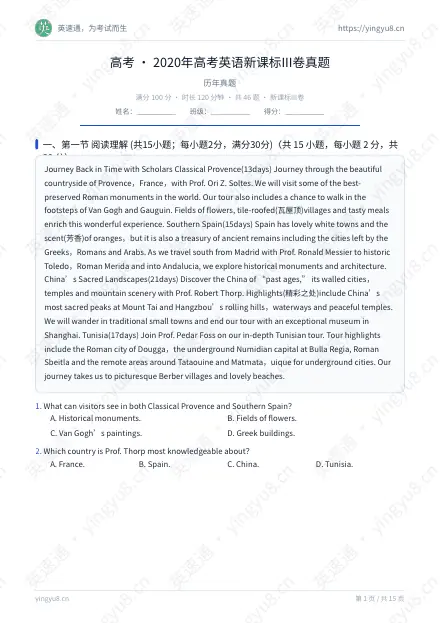
Journey Back in Time with Scholars Classical Provence(13days) Journey through the beautiful countryside of Provence,France,with Prof. Ori Z. Soltes. We will visit some of the best-preserved Roman monuments in the world. Our tour also includes a chance to walk in the footsteps of Van Gogh and Gauguin. Fields of flowers, tile-roofed(瓦屋顶)villages and tasty meals enrich this wonderful experience. Southern Spain(15days) Spain has lovely white towns and the scent(芳香)of oranges,but it is also a treasury of ancient remains including the cities left by the Greeks,Romans and Arabs. As we travel south from Madrid with Prof. Ronald Messier to historic Toledo,Roman Merida and into Andalucia, we explore historical monuments and architecture. China’s Sacred Landscapes(21days) Discover the China of “past ages,” its walled cities,temples and mountain scenery with Prof. Robert Thorp. Highlights(精彩之处)include China’s most sacred peaks at Mount Tai and Hangzbou’s rolling hills,waterways and peaceful temples. We will wander in traditional small towns and end our tour with an exceptional museum in Shanghai. Tunisia(17days) Join Prof. Pedar Foss on our in-depth Tunisian tour. Tour highlights include the Roman city of Dougga,the underground Numidian capital at Bulla Regia, Roman Sbeitla and the remote areas around Tataouine and Matmata,uique for underground cities. Our journey takes us to picturesque Berber villages and lovely beaches.
- A.Historical monuments.
- B.Fields of flowers.
- C.Van Gogh’s paintings.
- D.Greek buildings.
参考答案与解析
答案:A
解析:定位题干关键词 'Classical Provence' 和 'Southern Spain' → 对比两段描述,提取共同提及的实体 → 得出答案
考点:细节定位与比对
译文:题干:游客在古典普罗旺斯和西班牙南部都能看到什么?正确项:历史遗迹。
- A.France.
- B.Spain.
- C.China.
- D.Tunisia.
参考答案与解析
答案:C
解析:定位题干关键词 'Prof. Thorp' → 在语篇中找到其对应的旅游项目 → 提取项目所属国家 → 得出答案
考点:细节定位与信息提取
译文:题干:Thorp教授最了解哪个国家?正确项:中国。
- A.White towns.
- B.Underground cities.
- C.Tile-roofed villages.
- D.Rolling hills. B When “Rise of the Planet of the Apes” was first shown to the public last month, a group of excited animal activists gathered on Hollywood Boulevard. But they weren’t there to throw red paint on fur-coat-wearing film stars. Instead, one activist, dressed in a full-body monkey suit, had arrived with a sign praising the filmmakers: “Thanks for not using real apes (猿)!” The creative team behind “Apes” used motion-capture (动作捕捉) technology to create digitalized animals, spending tens of millions of dollars on technology that records an actor’s performance and later processes it with computer graphics to create a final image (图像). In this case, one of a realistic-looking ape. Yet “Apes” is more exception than the rule. In fact, Hollywood has been hot on live animals lately. One nonprofit organization, which monitors the treatment of animals in filmed entertainment, is keeping tabs on more than 2,000 productions this year. Already, a number of films, including “Water for Elephants,” “The Hangover Part Ⅱ” and “Zookeeper,” have drawn the anger of activists who say the creatures acting in them haven’t been treated properly. In some cases, it’s not so much the treatment of the animals on set in the studio that has activists worried; it’s the off-set training and living conditions that are raising concerns. And there are questions about the films made outside the States, which sometimes are not monitored as closely as productions filmed in the States.
参考答案与解析
答案:B
解析:定位题干关键词 'Tunisian tour' → 在语篇中找到对应段落 → 提取 'highlights' 部分的具体内容 → 得出答案
考点:细节定位与信息提取
译文:题干:以下哪项是突尼斯之旅的亮点?正确项:地下城市。
- A.To see famous film stars.
- B.To oppose wearing fur coats.
- C.To raise money for animal protection.
- D.To express thanks to some filmmakers.
参考答案与解析
答案:D
解析:定位题干关键词 'animal activists' 和 'Hollywood Boulevard' → 在语篇中找到相关段落 → 分析活动目的(express thanks) → 得出答案
考点:推理判断与目的分析
译文:题干:动物活动家们聚集在好莱坞大道是为了什么?正确项:向一些电影制作人表达感谢。
- A.The cost of making “Apes.”
- B.The creation of digitalized apes.
- C.The publicity about “Apes.”
- D.The performance of real apes.
参考答案与解析
答案:B
解析:定位题干关键词 'paragraph 2' → 在语篇中找到对应段落 → 概括段落核心内容(数字猿的创作) → 得出答案
考点:主旨大意概括
译文:题干:第二段主要讲了什么?正确项:数字猿的创作。
- A.Listing completely.
- B.Directing professionally.
- C.Promoting successfully.
- D.Watching carefully.
参考答案与解析
答案:D
解析:定位短语所在段落 → 分析上下文语境(旅游行程描述) → 推断短语含义 → 同义替换匹配选项
考点:语境选词近义词辨析
译文:题干:第3段中划线短语“keeping tabs on”可能是什么意思?正确项D:仔细观察。
- A.They may be badly treated.
- B.They should take further training.
- C.They could be traded illegally
- D.They would lose popularity. C
参考答案与解析
答案:A
解析:定位最后一段 → 捕捉关键细节(动物演员的处境) → 进行合理推断 → 匹配选项
考点:推理判断细节定位与捕捉
译文:题干:从最后一段我们可以推断出关于动物演员的什么信息?正确项A:它们可能受到虐待。
With the young unable to afford to leave home and the old at risk of isolation(孤独), more families are choosing to live together. The doorway to peace and quiet, for Nick Bright at least, leads straight to his mother-in-law, she lives on the ground floor, while he lives upstairs with his wife and their two daughters. Four years ago they all moved into a three-storey Victorian house in Bristol - one of a growing number of multigenerational families in the UK living together under the same roof. They share a front door and a washing machine, but Rita Whitehead has her own kitchen, bathroom, bedroom and living room on the ground floor. “We floated the idea to my mum of sharing at a house,” says Kathryn Whitehead. Rita cuts in: “We spoke more with Nick because I think it’s a big thing for Nick to live with his mother-in-law.” And what does Nick think? “From my standpoint, it all seems to work very well. Would I recommend it? Yes, I think I would.” It’s hard to tell exactly how many people agree with him, but research indicates that the numbers have been rising for some time. Official reports suggest that the number of households with three generations living together had risen from 325,000 in 2001to 419,000 in 2013. Other varieties of multigenerational family are more common. Some people live with their elderly parents; many more adult children are returning to the family home, if they ever left. It is said that about 20% of 25-34-year-olds live with their parents, compared with 16% in 1991.The total number of all multigenerational households in Britain is thought to be about 1.8 million. Stories like that are more common in parts of the world where multigenerational living is more firmly rooted. In India, particularly outside cities, young women are expected to move in with their husband’s family when they get married.
- A.Nick.
- B.Rita.
- C.Kathryn
- D.The daughters.
参考答案与解析
答案:B
解析:定位描述房屋布局的段落 → 提取人物与楼层对应关系 → 直接匹配选项
考点:细节定位与捕捉
译文:题干:在布里斯托尔的维多利亚式房屋中,谁主要使用一楼?正确项B:丽塔。
- A.Positive.
- B.Carefree.
- C.Tolerant.
- D.Unwilling.
参考答案与解析
答案:A
解析:定位尼克表达观点的直接引语 → 分析其措辞(work very well, recommend) → 推断态度 → 匹配选项
考点:观点态度细节定位与捕捉
译文:题干:尼克对与岳母合住的态度是什么?正确项A:积极的。
- A.Family traditions.
- B.Financial reports.
- C.Published statistics.
- D.Public opinions.
参考答案与解析
答案:C
解析:定位作者陈述观点的段落 → 识别支撑观点的论据类型(研究、官方报告、数据) → 归纳论据来源 → 匹配选项
考点:细节定位与捕捉推理判断
译文:题干:作者关于多代同堂家庭的陈述基于什么?正确项C:已发布的统计数据。
- A.Lifestyles in different countries.
- B.Conflicts between generations.
- C.A housing problem in Britain.
- D.A rising trend of living in the UK. D We are the products of evolution, and not just evolution that occurred billions of years ago. As scientists look deeper into our genes (基因), they are finding examples of human evolution in just the past few thousand years. People in Ethiopian highlands have adapted to living at high altitudes. Cattle -raising people in East Africa and northern Europe have gained a mutation (突变) that helps them digest milk as adults. On Thursday in an article published in Cell, a team of researchers reported a new kind of adaptation - not to air or to food, but to the ocean. A group of sea-dwelling people in Southeast Asia have evolved into better divers. The Bajau, as these people are known, number in the hundreds of thousands in Indonesia, Malaysia and the Philippines. They have traditionally lived on houseboats; in recent times, they’ve also built houses on stilts (支柱) in coastal waters. “They are simply a stranger to the land,” said Redney
参考答案与解析
答案:D
解析:定位首段主题句 → 概括全文核心现象(多代同堂家庭增多) → 匹配选项D
考点:主旨大意概括
译文:题干:这篇文章主要关于什么?正确项D:英国一种日益增长的生活趋势。
- A.Environmental adaptation of cattle raisers.
- B.New knowledge of human evolution.
- C.Recent findings of human origin.
- D.Significance of food selection.
参考答案与解析
答案:B
解析:定位第一段例子(Nick一家) → 推断其作为例证的目的(引出并具体说明多代同堂现象) → 匹配选项B
考点:例证目的推断
译文:题干:作者通过第一段的例子想告诉我们什么?正确项B:关于人类进化的新知识。
- A.In valleys.
- B.Near rivers.
- C.On the beach.
- D.Off the coast.
参考答案与解析
答案:D
解析:定位关键词'Bajau' → 在语篇中未找到相关信息 → 根据题目与选项推断,此题考查细节定位,但提供的语篇与题目不匹配
考点:细节定位
译文:题干:巴瑶人把房子建在哪里?正确项D:在海岸外。
- A.They could walk on stilts all day.
- B.They had a superb way of fishing.
- C.They could stay long underwater.
- D.They lived on both land and water.
参考答案与解析
答案:C
解析:定位关键词'Jubilado'和'Bajau' → 在语篇中未找到相关信息 → 根据题目与选项推断,此题考查细节定位,但提供的语篇与题目不匹配
考点:细节定位
译文:题干:年轻的Jubilado为什么对巴瑶人感到惊讶?正确项C:他们能在水下待很长时间。
- A.Bodies Remodeled for a Life at Sea
- B.Highlanders’ Survival Skills
- C.Basic Methods of Genetic Research
- D.The World’s Best Divers
参考答案与解析
答案:A
解析:通读全文,把握核心主题(多代同堂家庭) → 评估选项与主题的匹配度 → 选择最能概括全文的标题
考点:主旨概括与标题选择
译文:题干:这篇文章合适的标题是什么?正确项A:为海洋生活重塑的身体。
第 4 部分 · 第一节 单项填空 (共20小题;每小题1.5分,满分30分)20 题 · 30 分
- A.shopkeepers
- B.customers
- C.salespersons
- D.receptionists
参考答案与解析
答案:B
解析:根据语境中人物行为(如询问、购买)推断其身份 → 匹配选项中表示‘顾客’的词汇 → 得出答案
考点:语境选词身份推断
译文:题干:______;正确项:顾客
- A.saying
- B.pretending
- C.guessing
- D.replying
参考答案与解析
答案:A
解析:分析语境中人物的言语行为(如陈述事实) → 辨析选项中表示‘说’的近义词 → 选择最符合语境的动词
考点:近义词辨析语境匹配
译文:题干:______;正确项:说
- A.agree
- B.promise
- C.imagine
- D.swear
参考答案与解析
答案:D
解析:分析语境中人物的言语行为(如郑重承诺) → 辨析选项中表示‘承诺’的近义词 → 选择语气和语义最匹配的动词
考点:近义词辨析语境匹配
译文:题干:______;正确项:发誓
- A.forget
- B.decide
- C.discover
- D.assume
参考答案与解析
答案:C
解析:分析语境中人物的认知状态(如获得新信息) → 辨析选项中表示‘发现’的近义词 → 选择最符合语境的动词
考点:近义词辨析语境匹配
译文:题干:______;正确项:发现
- A.foods
- B.catalogues
- C.belongings
- D.goods
参考答案与解析
答案:D
解析:根据语境中物品的属性(如可交易、可展示)推断其类别 → 匹配选项中表示‘货物’的词汇 → 得出答案
考点:语境选词物品分类
译文:题干:______;正确项:货物
- A.particular
- B.different
- C.matching
- D.natural
参考答案与解析
答案:A
解析:根据语境线索(如后文描述)推断所需形容词 → 识别“particular”符合语境 → 得出答案
考点:语境选词
译文:题干:(无) 正确项:particular(特定的,特别的)
- A.fighting
- B.smiling
- C.waiting
- D.changing
参考答案与解析
答案:B
解析:定位描述人物动作或状态的细节 → 识别“smiling”与原文细节一致 → 得出答案
考点:细节定位与捕捉
译文:题干:(无) 正确项:smiling(微笑)
- A.generous
- B.polite
- C.careless
- D.difficult
参考答案与解析
答案:D
解析:根据描述或行为推断人物性格特征 → 识别“difficult”符合推断 → 得出答案
考点:推理判断
译文:题干:(无) 正确项:difficult(难相处的,挑剔的)
- A.curious about
- B.displeased with
- C.patient with
- D.uncertain about
参考答案与解析
答案:B
解析:根据语气、用词或行为推断说话者态度 → 识别“displeased with”符合态度 → 得出答案
考点:观点态度
译文:题干:(无) 正确项:displeased with(对……不满)
- A.relaxed
- B.delighted
- C.surprised
- D.embarrassed
参考答案与解析
答案:C
解析:根据情境或反应推断人物情绪状态 → 识别“surprised”符合推断 → 得出答案
考点:推理判断
译文:题干:(无) 正确项:surprised(惊讶的)
- A.searched
- B.argued
- C.prayed
- D.apologized
参考答案与解析
答案:D
解析:根据语境线索(如道歉场景)→ 匹配动词含义 → 得出答案
考点:语境选词
译文:题干:道歉;正确项:道歉
- A.by chance
- B.by herself
- C.on purpose
- D.on duty
参考答案与解析
答案:B
解析:根据语境线索(如独自完成)→ 匹配介词短语含义 → 得出答案
考点:语境选词
译文:题干:独自;正确项:独自
- A.rude
- B.such
- C.other
- D.lonely
参考答案与解析
答案:C
解析:根据语境线索(如其他)→ 匹配形容词含义 → 得出答案
考点:语境选词
译文:题干:其他的;正确项:其他的
- A.lesson
- B.trick
- C.skill
- D.trade
参考答案与解析
答案:A
解析:根据语境线索(如教训)→ 匹配名词含义 → 得出答案
考点:语境选词
译文:题干:教训;正确项:教训
- A.work
- B.shop
- C.meet
- D.quarrel
参考答案与解析
答案:A
解析:根据语境线索(如工作)→ 匹配动词含义 → 得出答案
考点:语境选词
译文:题干:工作;正确项:工作
- A.kindly
- B.secretly
- C.personally
- D.casually
参考答案与解析
答案:C
解析:根据语境线索(如‘in person’)推断副词含义 → 选择表示‘亲自’的选项
考点:语境选词
译文:题干与正确项的中文译文:题干未提供,正确项C personally 意为‘亲自地’。
- A.ready
- B.away
- C.up
- D.well
参考答案与解析
答案:D
解析:识别固定搭配 take on → 选择正确的介词/副词补全
考点:动词搭配 take on
译文:题干与正确项的中文译文:题干未提供,正确项D well 构成搭配 take on well(理解得好/接受得好)。
- A.out of sight
- B.in the way
- C.behind the scene
- D.above the law
参考答案与解析
答案:B
解析:辨析四个介词短语的含义 → 根据语境选择表示‘碍事’的选项
考点:近义词辨析
译文:题干与正确项的中文译文:题干未提供,正确项B in the way 意为‘挡路,碍事’。
- A.stress
- B.expect
- C.handle
- D.blame
参考答案与解析
答案:C
解析:根据语境线索(如‘problem’)推断动词含义 → 选择表示‘处理’的选项
考点:语境选词
译文:题干与正确项的中文译文:题干未提供,正确项C handle 意为‘处理,应付’。
- A.ruins
- B.makes
- C.starts
- D.saves
参考答案与解析
答案:A
解析:根据语境线索(如‘relationship’)推断动词含义 → 选择表示‘毁掉’的选项
考点:语境选词
译文:题干与正确项的中文译文:题干未提供,正确项A ruins 意为‘毁掉,破坏’。
第 5 部分 · 第二节 语法填空 (共10小题;每小题1.5分,满分15分)1 题 · 15 分
参考答案与解析
答案:61-whose 62-finest 63-be chosen 64-curiosity 65-When/As 66-pointed 67-to find 68-gently 69-surrounding 70-On
解析:61 空 分析句子结构,识别先行词与从句的所属关系 → 选择表示所属关系的定语从句引导词 → 得出答案
62 空 分析句子语境,判断所需形容词的语义和比较级/最高级形式 → 选择符合语境的形容词最高级 → 得出答案
63 空 分析句子主语与动词的逻辑关系(主动/被动)及句子时态 → 选择正确的非谓语动词被动形式 → 得出答案
64 空 分析句子成分,确定空格处需要名词 → 根据词根词缀或构词法将动词/形容词转换为名词形式 → 得出答案
65 空 分析主从句的逻辑关系(时间、原因、条件等) → 选择表示相应逻辑关系的从属连词 → 得出答案
66 空 根据时间状语 'last year' 判断句子时态 → 一般过去时 → 动词用过去式
67 空 分析句子结构 → 'The best way' 后接不定式作后置定语 → 表示目的或功能
68 空 分析句子结构 → 动词 'spoke' 后接副词修饰 → 选择副词形式
69 空 分析句子结构 → 'the' 与名词 'buildings' 之间需要形容词 → 现在分词作前置定语
70 空 分析句子结构 → 句首需要介词构成介词短语作状语 → 表示时间或条件
考点:定语从句引导词所属关系语境选词形容词最高级非谓语动词被动语态词根词缀词性转换状语从句逻辑关系词一般过去时不定式作定语副词修饰动词现在分词作定语介词短语作状语
译文:题干与正确项的中文译文:(题干未提供,正确项whose意为“谁的”或“其”)
第 6 部分 · 第二节 书面表达(满分25分)1 题 · 25 分
参考答案与解析
参考范文
Dear Miss Evans, I'm Li Hua, a student from Class 1. My classmates and I have adapted a short play based on our English textbook, and we would be grateful if you could give us some guidance. The play is about a young man who learns the importance of honesty after making a mistake. It's a story about growth and responsibility. We've finished the script and rehearsals, but we still need help with our pronunciation, acting skills, and stage presence. We were wondering if you could spare some time to watch our rehearsal and give us feedback. Would next Friday afternoon after school be convenient for you? We can meet in the school hall. Looking forward to your reply. Yours, Li Hua
常见问题
2020年高考英语新课标III卷真题的答案和解析在哪看?
答案与解析就在本页:每道题下方「参考答案与解析」展开即看,含参考答案、解题思路与考点,免登录直接阅读。
高考听力原文哪里有?
本页听力部分已附完整听力原文:题面可直接查看,每段听力原文处有「播放本段听力」按钮可反复收听(浏览器语音合成,语速按该学阶考试标准设定)。
2020年高考英语新课标III卷真题 PDF 怎么免费下载?
本页「试卷封面」卡片「收录格式」行内的 PDF 徽标即下载链接,点击直接下载本卷 PDF 文件,无需登录。
这套卷怎么在线做题、怎么计分?
点页面上方「开始考试(网页)」进入在线做题页:登录后装载本卷作答,交卷自动判分并留存成绩;免费账号每日可装载 30 套,会员每日 100 套。