2024年高考英语新课标I卷真题及答案解析
2024年高考英语新课标I卷真题 · 完整收录
- 年份考次
- 2024 年 · 新课标I卷
- 命题归属
- 全国统一命题
- 省份
- 全国
- 听力
- 含听力
- 题量
- 40 题
- 满分
- 150 分
- 限时
- 120 分钟
- 题型结构
- 第一节 听力理解 5 题 7.5 分 · 第二节 听力理解 15 题 22.5 分 · 第一节 阅读理解 15 题 37.5 分 · 第二节 七选五 5 题 12.5 分 · 第一节 完形填空 15 题 15 分 · 第二节 语法填空 10 题 15 分 · 第一节 应用文写作 1 题 15 分 · 第二节 读后续写 1 题 25 分
- 收录格式
开始考试(微信)

微信扫一扫 · 小程序内开始考试
第 1 部分 · 第一节 听力理解 (共5小题;每小题1.5分,满分7.5分)5 题 · 8 分
听力原文 · Question 1(本页按钮可反复收听;在线做题考试中每段仅播一次)
W: Hi, Kate. Are you heading to the airport? M: No, Tom. I'm just here to see my friend off. She's flying to London for a year abroad. W: That's so exciting for her. Give her my best wishes. M: I will. She's boarding the flight now.
- A.Boarding a flight.
- B.Arranging a trip.
- C.Seeing a friend off.
参考答案与解析
答案:C
解析:听到「see my friend off」→ 明确凯特在机场送别朋友 → 排除登机与安排旅行
考点:细节信息送别场景
译文:题干:凯特正在做什么?A. 登机。B. 安排一次旅行。C. 给朋友送行。
听力原文 · Question 2(本页按钮可反复收听;在线做题考试中每段仅播一次)
W: Do you still remember that old song we used to sing in college? M: Of course! It was a hit back then, but hardly anyone knows it now. W: I heard it on the radio this morning and it brought back so many memories. M: Same here. Let's listen to it again tonight.
- A.A pop star.
- B.An old song.
- C.A radio program.
参考答案与解析
答案:B
解析:首句点出「old song」→ 后续围绕这首歌的回忆展开 → 判断话题为一首老歌
考点:主旨大意老歌回忆
译文:题干:两位说话人在谈论什么?A. 一位流行歌星。B. 一首老歌。C. 一个广播节目。
听力原文 · Question 3(本页按钮可反复收听;在线做题考试中每段仅播一次)
W: Mark invited us to an art show today. Shall we go? M: I'd love to, but I promised to visit my aunt this afternoon. W: How about tomorrow then? The show lasts all week. M: Perfect. Let's meet at the gallery tomorrow morning.
- A.Go to an art show.
- B.Meet the man's aunt.
- C.Eat out with Mark.
参考答案与解析
答案:B
解析:男士用「but」转折拒绝今天看展 → 说明今天要去探望姑妈 → 明天再看展
考点:转折信号细节信息
译文:题干:两位说话人今天要做什么?A. 去看艺术展。B. 见男士的姑妈。C. 和马克一起吃饭。
听力原文 · Question 4(本页按钮可反复收听;在线做题考试中每段仅播一次)
W: Good morning. This is Lucy from Green Store. How can I help you? M: Hi, Lucy. I placed an order yesterday, but I'd like to change the delivery date. W: No problem. Could you tell me your order number? M: Sure, it's 5678. I'll be out of town this weekend.
- A.Cancel an order.
- B.Ask for a receipt.
- C.Reschedule a delivery.
参考答案与解析
答案:C
解析:男士说「change the delivery date」→ 即要求改期配送 → 对应reschedule a delivery
考点:细节信息改期配送
译文:题干:男士想做什么?A. 取消订单。B. 索要收据。C. 改期配送。
听力原文 · Question 5(本页按钮可反复收听;在线做题考试中每段仅播一次)
W: Excuse me. When is the next train to Bedford? M: Let me check. The 9:45 one has just left. The next one leaves at 10:15. W: And how long does the journey take? M: About 45 minutes. You can buy a ticket at the machine over there.
- A.At 9:45.
- B.At 10:15.
- C.At 11:00.
参考答案与解析
答案:B
解析:听到9:45已发车 → 下一班为10:15 → 排除已过时间与更晚班次
考点:数字听辨时间信息
译文:题干:下一班去贝德福德的火车什么时候发车?A. 9:45。B. 10:15。C. 11:00。
第 2 部分 · 第二节 听力理解 (共15小题;每小题1.5分,满分22.5分)15 题 · 23 分
听力原文 · Questions 6 to 7(本页按钮可反复收听;在线做题考试中每段仅播一次)
W: Look outside! The sky is completely gray. I think a storm is coming. M: Yes, the weather report said it would be stormy today. I hope my car parked under the tree will be safe. W: Oh, that's dangerous. Branches might fall on it. You'd better move it to the open parking lot now. M: Good idea. I don't want my car to be damaged. W: By the way, are we still going hiking this afternoon? M: No way. It's too risky in stormy weather. Let's stay at home and watch a movie instead. W: Sounds perfect. I'll make some popcorn. M: Great. I'll move my car first and be back in ten minutes.
- A.Stormy.
- B.Sunny.
- C.Foggy.
参考答案与解析
答案:A
解析:定位天气话题 → 抓取关键词 stormy → 排除晴天与雾天
考点:天气词汇捕捉细节信息
译文:题干:今天天气怎么样?A. 暴风雨的。B. 晴朗的。C. 有雾的。
- A.Plant a tree.
- B.Move his car.
- C.Check the map.
参考答案与解析
答案:B
解析:定位车的话题 → 理解W的建议move it → 结合M的回应推断其行动
考点:建议与回应推理判断
译文:题干:这位男士打算做什么?A. 种一棵树。B. 移动他的车。C. 查看地图。
听力原文 · Questions 8 to 10(本页按钮可反复收听;在线做题考试中每段仅播一次)
W: Hi, Dave. It's Kathy. Guess what? I'm calling from California! M: California? Are you on vacation there? W: No, I've just moved here. My husband got a new job in San Francisco, so we sold our house in Chicago and came here last month. M: That's a big change! How do you like it so far? W: It's sunny and beautiful, but I still miss my friends back home. By the way, how are Tom and Fiona? Are they still living next door to you? M: Yes, they are. Tom and Fiona are brother and sister, you know, and they share that apartment. W: Right. I remember they're both teachers at the same school. Oh, Dave, I also want to thank you for calling on my mother last week. She told me you brought her some flowers. That was really kind of you. M: You're welcome. I know you worry about her, but she's doing fine. I'll tell her you called. W: Thanks, Dave. I'll send you a postcard from California. Bye!
- A.She is on vacation there.
- B.She has just moved there.
- C.She is doing business there.
参考答案与解析
答案:B
解析:听男士问是否在加州度假 → 女士明确否认 → 抓住「just moved here」和卖房搬家信息 → 确定是刚搬去加州
考点:细节捕捉否定信号
译文:Kathy现在为什么在加州?A. 她在那里度假。B. 她刚刚搬到那里。C. 她在那里做生意。
- A.Husband and wife.
- B.Brother and sister.
- C.Father and daughter.
参考答案与解析
答案:B
解析:听到问题问Tom和Fiona关系 → 定位男士回答 → 直接听到「brother and sister」 → 确定兄妹关系
考点:人物关系直接信息
译文:Tom和Fiona之间是什么关系?A. 夫妻。B. 兄妹。C. 父女。
- A.Finding her a new job.
- B.Sending her a present.
- C.Calling on her mother.
参考答案与解析
答案:C
解析:听到Kathy说「want to thank you」 → 抓住感谢原因「for calling on my mother last week」 → 确定是看望她母亲
考点:感谢原因细节定位
译文:Kathy因为什么感谢Dave?A. 帮她找新工作。B. 给她寄礼物。C. 看望她母亲。
听力原文 · Questions 11 to 13(本页按钮可反复收听;在线做题考试中每段仅播一次)
W: Jack, you grew up in the countryside, right? How did you get to school when you were a child? M: I walked. The school was only about ten minutes away from my home. There was no school bus, and my parents were too busy to drive me. W: That sounds healthy. These days, many parents drive their kids to school even when the school is close. M: I know. I don't really approve of that. I mean, a short walk is good for children. It helps them stay active and learn to be independent. W: I see your point. But I also understand why some parents do it. They just want to keep their kids safe from traffic. M: That's true. But some parents are too worried. They never let their children go anywhere alone. W: Yes, that's the real problem. Some parents protect their children too much. Kids need some freedom to grow.
- A.By bike.
- B.On foot.
- C.By bus.
参考答案与解析
答案:B
解析:题干问Jack童年上学方式 → 男士说「I walked」 → 距离仅十分钟且无校车、父母没空开车送 → 得出步行
考点:细节捕捉交通方式
译文:题干:Jack小时候怎样去上学? A. 骑自行车。 B. 步行。 C. 坐公交车。
- A.Disapproving.
- B.Encouraging.
- C.Understanding.
参考答案与解析
答案:A
解析:题干问Jack对家长开车送孩子上学的态度 → 男士说「I don't really approve of that」 → 并说明短距离步行有益 → 态度为不赞同
考点:态度判断否定表达
译文:题干:Jack对家长开车送孩子上学的态度是什么? A. 不赞同。 B. 鼓励。 C. 理解。
- A.Overprotecting their children.
- B.Pushing their children too hard.
- C.Having no time for their children.
参考答案与解析
答案:A
解析:题干问女士认为部分家长的问题 → 男士说有些家长「too worried」「never let children go anywhere alone」 → 女士回应「protect their children too much」 → 即过度保护
考点:问题定位同义转换
译文:题干:女士认为一些家长存在什么问题? A. 过度保护孩子。 B. 逼孩子太紧。 C. 没时间陪孩子。
听力原文 · Questions 14 to 17(本页按钮可反复收听;在线做题考试中每段仅播一次)
M: Marie, I saw your kitchen garden videos online. They're really popular. What made you start posting them? W: Well, at first I just wanted to keep records of my progress. I planted a few things and wanted to see how they grew over time. M: So you didn't plan to become famous? W: Not at all. But then people started asking questions and I thought, why not share more? M: That's great. What would you recommend for beginners? W: Strawberries. They bear a lot of fruit soon, so beginners feel encouraged quickly. M: Do they need special care? W: Not really. They're quite easy to grow. That's why I suggest them. M: What about other plants? Any difficulties? W: Carrots are difficult for me. They need deep soil and I don't have enough space. M: What about herbs? W: Herbs are easy. I grow basil and mint all the time. M: And pears? W: Pears need a lot of space and time. I don't grow them in my kitchen garden. M: Any final advice for people interested in kitchen gardening? W: Just keep focused. Don't try to grow everything at once. Start small and stay with it. M: That's wise advice. Thank you, Marie.
- A.To keep records of her progress.
- B.To sell home-grown vegetables.
- C.To motivate her fellow gardeners.
参考答案与解析
答案:A
解析:定位at first → 听到keep records of my progress → 对应选项A
考点:细节信息时间定位
译文:14. Marie最初为什么把她的厨房园艺发到网上?A. 记录她的进展。B. 卖自家种的蔬菜。C. 激励她的园艺伙伴。
- A.They need no special care.
- B.They can be used in cooking.
- C.They bear a lot of fruit soon.
参考答案与解析
答案:C
解析:定位beginners → 听到bear a lot of fruit soon → 对应选项C
考点:细节信息因果关系
译文:15. Marie为什么推荐初学者种草莓?A. 它们不需要特别照料。B. 它们可以用于烹饪。C. 它们很快结出大量果实。
- A.Herbs.
- B.Carrots.
- C.Pears.
参考答案与解析
答案:B
解析:定位difficult → 听到Carrots are difficult → 对应选项B
考点:细节信息否定排除
译文:16. 对Marie来说什么难以种植?A. 香草。B. 胡萝卜。C. 梨。
- A.Aim high.
- B.Keep focused.
- C.Stay optimistic.
参考答案与解析
答案:B
解析:定位advice → 听到keep focused → 对应选项B
考点:观点态度建议归纳
译文:17. Marie对那些对厨房园艺感兴趣的人有什么建议?A. 志存高远。B. 保持专注。C. 保持乐观。
听力原文 · Questions 18 to 20(本页按钮可反复收听;在线做题考试中每段仅播一次)
W: Good evening, listeners. Tonight we have a very special guest, the famous sports writer Johnson. Welcome to our program. M: Thank you. It is great to be here. W: So, Johnson, many people know you from your popular magazine column, Life of Johnson. Is that right? M: Yes. I have been writing that column for quite a long time now. But I am also busy with my sports writing. W: And you are best known for your humorous writing, aren't you? M: I suppose so. People seem to enjoy the funny side of my stories, though I also write seriously about sports. W: Speaking of sports, when did you join Sports Times? M: Let me think. I joined Sports Times in 1985, after working for a small local paper for a few years. W: So you have been with the paper for many years. M: That's right. And I still enjoy every minute of it. W: Thank you, Johnson, for sharing your story with us. M: My pleasure.
- A.A magazine column.
- B.A TV series.
- C.A historical novel.
参考答案与解析
答案:A
解析:定位主持人对 Life of Johnson 的介绍 → 听到 magazine column 这一表述 → 确认其为杂志专栏而非电视剧或小说
考点:原话细节同义转述
译文:「Life of Johnson」是什么?A. 一个杂志专栏。B. 一部电视剧。C. 一部历史小说。
- A.His acting talent.
- B.His humorous writing.
- C.His long sports career.
参考答案与解析
答案:B
解析:听主持人询问 Johnson 最出名之处 → 捕捉 best known for humorous writing → 对应 B 项幽默写作
考点:原话细节固定搭配
译文:Johnson 因什么而著名?A. 他的表演天赋。B. 他的幽默写作。C. 他漫长的体育生涯。
- A.In 1981.
- B.In 1983.
- C.In 1985.
参考答案与解析
答案:C
解析:听到问题 when did you join Sports Times → 捕捉年份 1985 → 对应 C 项
考点:数字捕捉时间定位
译文:Johnson 何时加入 Sports Times?A. 1981 年。B. 1983 年。C. 1985 年。
第 3 部分 · 第一节 阅读理解 (共15小题;每小题2.5分,满分37.5分)15 题 · 38 分
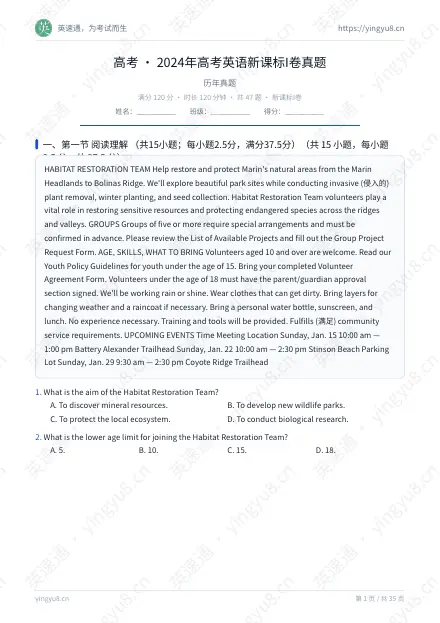
HABITAT RESTORATION TEAM Help restore and protect Marin's natural areas from the Marin Headlands to Bolinas Ridge. We'll explore beautiful park sites while conducting invasive (侵入的) plant removal, winter planting, and seed collection. Habitat Restoration Team volunteers play a vital role in restoring sensitive resources and protecting endangered species across the ridges and valleys. GROUPS Groups of five or more require special arrangements and must be confirmed in advance. Please review the List of Available Projects and fill out the Group Project Request Form. AGE, SKILLS, WHAT TO BRING Volunteers aged 10 and over are welcome. Read our Youth Policy Guidelines for youth under the age of 15. Bring your completed Volunteer Agreement Form. Volunteers under the age of 18 must have the parent/guardian approval section signed. We'll be working rain or shine. Wear clothes that can get dirty. Bring layers for changing weather and a raincoat if necessary. Bring a personal water bottle, sunscreen, and lunch. No experience necessary. Training and tools will be provided. Fulfills (满足) community service requirements. UPCOMING EVENTS Time Meeting Location Sunday, Jan. 15 10:00 am — 1:00 pm Battery Alexander Trailhead Sunday, Jan. 22 10:00 am — 2:30 pm Stinson Beach Parking Lot Sunday, Jan. 29 9:30 am — 2:30 pm Coyote Ridge Trailhead
- A.To discover mineral resources.
- B.To develop new wildlife parks.
- C.To protect the local ecosystem.
- D.To conduct biological research.
参考答案与解析
答案:C
解析:定位首段主题句 → 提取核心动作(restore and protect) → 同义替换为选项C
考点:细节定位同义替换
译文:题干:栖息地恢复团队的目标是什么?正确项C:保护当地生态系统。
- A.5.
- B.10.
- C.15.
- D.18.
参考答案与解析
答案:B
解析:定位年龄要求段落 → 提取具体数字(10 and over) → 得出答案
考点:细节定位数字信息捕捉
译文:题干:加入栖息地恢复团队的最低年龄限制是多少?正确项B:10岁。
- A.Bring their own tools.
- B.Work even in bad weather.
- C.Wear a team uniform.
- D.Do at least three projects. B “I am not crazy,” says Dr. William Farber, shortly after performing acupuncture (针灸) on a rabbit. “I am ahead of my time.” If he seems a little defensive, it might be because even some of his coworkers occasionally laugh at his unusual methods. But Farber is certain he’ll have the last laugh. He’s one of a small but growing number of American veterinarians (兽医) now practicing “holistic” medicine-combining traditional Western treatments with acupuncture, chiropractic (按摩疗法) and herbal medicine. Farber, a graduate of Colorado State University, started out as a more conventional veterinarian. He became interested in alternative treatments 20 years ago when he suffered from terrible back pain. He tried muscle-relaxing drugs but found little relief. Then he tried acupuncture, an ancient Chinese practice, and was amazed that he improved after two or three treatments. What worked on a veterinarian seemed likely to work on his patients. So, after studying the techniques for a couple of years, he began offering them to pets. Leigh Tindale’s dog Charlie had a serious heart condition. After Charlie had a heart attack, Tindale says, she was prepared to put him to sleep, but Farber’s treatments eased her dog’s suffering so much that she was able to keep him alive for an additional five months. And Priscilla Dewing reports that her horse, Nappy, “moves more easily and rides more comfortably” after a chiropractic adjustment. Farber is certain that the holistic approach will grow more popular with time, and if the past is any indication, he may be right: Since 1982, membership in the American Holistic Veterinary Medical Association has grown from 30 to over 700. “Sometimes it surprises me that it works so well,” he says. “I will do anything to help an animal. That’s my job.”
参考答案与解析
答案:B
解析:定位工作条件段落 → 提取关键信息(rain or shine) → 同义替换为选项B
考点:细节定位同义替换
译文:题干:志愿者被期望做什么?正确项B:即使在恶劣天气下也工作。
- A.He’s odd.
- B.He’s strict.
- C.He’s brave.
- D.He’s rude.
参考答案与解析
答案:A
解析:定位Farber同事的评价 → 提取关键引语(I am not crazy) → 推断其认为Farber古怪
考点:推理判断观点态度
译文:题干:Farber的一些同事对他有什么看法?正确项A:他很古怪。
- A.He was trained in it at university.
- B.He was inspired by another veterinarian.
- C.He benefited from it as a patient.
- D.He wanted to save money for pet owners.
参考答案与解析
答案:C
解析:定位Farber尝试针灸的原因 → 提取关键信息(benefited from it as a patient) → 同义替换为选项C
考点:推理判断细节定位
译文:题干:为什么Farber决定尝试在宠物身上使用针灸?正确项C:他自己作为病人从中受益。
- A.Steps of a chiropractic treatment.
- B.The complexity of veterinarians’ work.
- C.Examples of rare animal diseases.
- D.The effectiveness of holistic medicine.
参考答案与解析
答案:D
解析:定位段落 → 概括段落核心信息 → 匹配选项
考点:主旨大意
译文:题干:第3段主要讲了什么?正确项:整体医学的有效性。
- A.To prove Farber’s point.
- B.To emphasize its importance.
- C.To praise veterinarians.
- D.To advocate animal protection. C Is comprehension the same whether a person reads a text onscreen or on paper? And are listening to and viewing content as effective as reading the written word when covering the same material? The answers to both questions are often “no”. The reasons relate to a variety of factors, including reduced concentration, an entertainment mindset (心态) and a tendency to multitask while consuming digital content. When reading texts of several hundred words or more, learning is generally more successful when it’s on paper than onscreen. A large amount of research confirms this finding. The benefits of print reading particularly shine through when experimenters move from posing simple tasks — like identifying the main idea in a reading passage — to ones that require mental abstraction — such as drawing inferences from a text. The differences between print and digital reading results are partly related to paper’s physical properties. With paper, there is a literal laying on of hands, along with the visual geography of distinct pages. People often link their memory of what they’ve read to how far into the book it was or where it was on the page. But equally important is the mental aspect. Reading researchers have proposed a theory called “shallowing hypothesis (假说)”. According to this theory, people approach digital texts with a mindset suited to social media, which are often not so serious, and devote less mental effort than when they are reading print. Audio (音频) and video can feel more engaging than text, and so university teachers increasingly turn to these technologies — say, assigning an online talk instead of an article by the same person. However, psychologists have demonstrated that when adults read news stories, they remember more of the content than if they listen to or view identical pieces. Digital texts, audio and video all have educational roles, especially when providing resources not available in print. However, for maximizing learning where mental focus and reflection are called for, educators shouldn’t assume all media are the same, even when they contain identical words.
参考答案与解析
答案:A
解析:定位提及处 → 分析其在论证中的作用 → 推断作者意图
考点:推理判断篇章结构
译文:题干:作者为什么提到美国整体兽医医学协会?正确项:为了证明Farber的观点。
- A.Seem unlikely to last.
- B.Seem hard to explain.
- C.Become ready to use.
- D.Become easy to notice.
参考答案与解析
答案:D
解析:定位短语 → 分析上下文语境 → 推断熟词僻义
考点:熟词僻义词义猜测
译文:题干:第2段中划线短语“shine through”是什么意思?正确项:变得容易注意到。
- A.Readers treat digital texts lightly.
- B.Digital texts are simpler to understand.
- C.People select digital texts randomly.
- D.Digital texts are suitable for social media.
参考答案与解析
答案:A
解析:定位假设内容 → 提取核心假设 → 匹配选项
考点:细节定位与捕捉推理判断
译文:题干:浅化假设假定了什么?正确项:读者对待数字文本很轻率。
- A.They can hold students' attention.
- B.They are more convenient to prepare.
- C.They help develop advanced skills.
- D.They are more informative than text.
参考答案与解析
答案:A
解析:定位原因表述 → 提取具体原因 → 匹配选项
考点:细节定位与捕捉推理判断
译文:题干:为什么大学教师越来越多地使用音频和视频?正确项:它们能吸引学生的注意力。
- A.Students should apply multiple learning techniques.
- B.Teachers should produce their own teaching material.
- C.Print texts cannot be entirely replaced in education.
- D.Education outside the classroom cannot be ignored. D
参考答案与解析
答案:C
解析:定位末段 → 提取核心信息(户外活动、自然区域、志愿者角色)→ 推断作者隐含观点(户外教育/实践的重要性)→ 匹配选项
考点:段落主旨推断隐含观点识别
译文:题干:作者在最后一段暗示了什么? 正确项:C. 印刷文本在教育中不能被完全取代。
In the race to document the species on Earth before they go extinct, researchers and citizen scientists have collected billions of records. Today, most records of biodiversity are often in the form of photos, videos, and other digital records. Though they are useful for detecting shifts in the number and variety of species in an area, a new Stanford study has found that this type of record is not perfect. “With the rise of technology it is easy for people to make observations of different species with the aid of a mobile application,” said Barnabas Daru, who is lead author of the study and assistant professor of biology in the Stanford School of Humanities and Sciences. “These observations now outnumber the primary data that comes from physical specimens (标本), and since we are increasingly using observational data to investigate how species are responding to global change, I wanted to know: Are they usable?” Using a global dataset of 1.9 billion records of plants, insects, birds, and animals, Daru and his team tested how well these data represent actual global biodiversity patterns. “We were particularly interested in exploring the aspects of sampling that tend to bias (使有偏差) data, like the greater likelihood of a citizen scientist to take a picture of a flowering plant instead of the grass right next to it,” said Daru. Their study revealed that the large number of observation-only records did not lead to better global coverage. Moreover, these data are biased and favor certain regions, time periods, and species. This makes sense because the people who get observational biodiversity data on mobile devices are often citizen scientists recording their encounters with species in areas nearby. These data are also biased toward certain species with attractive or eye-catching features. What can we do with the imperfect datasets of biodiversity? “Quite a lot,” Daru explained. “Biodiversity apps can use our study results to inform users of oversampled areas and lead them to places — and even species — that are not well-sampled. To improve the quality of observational data, biodiversity apps can also encourage users to have an expert confirm the identification of their uploaded image.”
- A.They are becoming outdated.
- B.They are mostly in electronic form.
- C.They are limited in number.
- D.They are used for public exhibition.
参考答案与解析
答案:B
解析:定位首段 → 捕捉关键句(‘most records... are often in the form of photos, videos, and other digital records’)→ 同义替换(digital records → electronic form)→ 得出答案
考点:细节定位同义替换
译文:题干:关于现在收集的物种记录,我们知道什么? 正确项:B. 它们大多是电子形式的。
- A.Threatened species.
- B.Physical specimens.
- C.Observational data.
- D.Mobile applications.
参考答案与解析
答案:C
解析:定位研究目的句(‘I wanted to know: Are they usable?’)→ 结合研究方法(‘tested how well these data represent...’)→ 归纳研究焦点(观测数据的可用性与偏差)→ 匹配选项
考点:研究目的定位信息归纳
译文:题干:Daru的研究关注什么? 正确项:C. 观测数据。
- A.Mistakes in data analysis.
- B.Poor quality of uploaded pictures.
- C.Improper way of sampling.
- D.Unreliable data collection devices.
参考答案与解析
答案:C
解析:定位偏差原因句(‘aspects of sampling that tend to bias data’)→ 提取具体例子(公民科学家偏好拍摄开花植物)→ 归纳原因(采样方式不当)→ 匹配选项
考点:因果推断细节归纳
译文:题干:根据研究,是什么导致了偏差? 正确项:C. 不当的采样方式。
- A.Review data from certain areas.
- B.Hire experts to check the records.
- C.Confirm the identity of the users.
- D.Give guidance to citizen scientists.
参考答案与解析
答案:D
解析:定位建议句(‘Biodiversity apps can use our study results to inform users... and lead them to places...’)→ 提取核心动作(告知用户、引导用户)→ 同义替换(inform/lead → give guidance)→ 得出答案
考点:建议定位同义替换
译文:题干:Daru对生物多样性应用的建议是什么? 正确项:D. 给公民科学家提供指导。
第 4 部分 · 第二节 七选五 (共5小题;每小题2.5分,满分12.5分)1 题 · 13 分
A. I don't often use this dictionary.B. It takes no account of the context.C. But I still don't want to replace them.D. But a dictionary can be a pleasure to read.E. Of course, a dictionary is not only for spelling.F. That means good grammar and no spelling mistakes.G. Dictionaries don't always give you enough information.
参考答案与解析
答案:36-F 37-B 38-E 39-A 40-D
解析:36 空 根据空格前后语境(描述一种行为或状态)→ 分析选项词义与搭配 → 选择最符合语境的动词
37 空 分析句子结构,识别空格处需要定语从句或非谓语动词作定语 → 判断从句引导词或非谓语形式 → 选择语法正确的选项
38 空 定位题干关键词在语篇中的对应信息 → 分析信息间的逻辑关系(因果、转折等)→ 进行合理推断
39 空 识别语篇中表达观点态度的关键词(如形容词、副词、情态动词)→ 判断作者或说话人的立场 → 选择匹配的态度词
40 空 通览语篇,把握各段落主旨 → 分析段落间的逻辑关系(总分、并列、转折)→ 归纳全文核心观点
考点:语境选词动词搭配定语从句非谓语动词推理判断细节定位观点态度情态强度主旨大意篇章结构
译文:题干与正确项的中文译文:根据上下文,此处需要填入一个表示特定动作或状态的动词,F选项在语义和搭配上最贴合。
第 5 部分 · 第一节 完形填空 (共15小题;每小题1分,满分15分)1 题 · 15 分
参考答案与解析
答案:41-C 42-A 43-D 44-C 45-B 46-D 47-C 48-B 49-B 50-A 51-D 52-A 53-D 54-B 55-C
解析:41 空 定位首段因果逻辑 → 朋友完成马拉松激励了我 → 选择表示‘赢得’的动词
42 空 定位因果逻辑 → 被激励后开始跑步 → 选择表示‘经常性’的副词
43 空 定位固定搭配 → ‘train for’表示为比赛训练 → 结合‘super’马拉松语境
44 空 定位转折逻辑 → ‘To be honest’引出真实感受 → 后文‘boredom’和‘demotivated’暗示负面情绪
45 空 定位比较结构 → ‘making my ... seem small’ → 与女孩的‘super’马拉松形成对比
46 空 根据前文‘the only... I’d ever run again is if a big dog was running after me’的假设条件,推断此处需填入表示‘原因/理由’的名词 → 同义替换 → 得出答案
47 空 根据前文‘I decided that the only reason I’d ever run again is if a big dog was running after me!’的放弃跑步的结论,以及后文‘I got a good bike and rode a lot’的转向骑行,推断此处需填入表示‘转向/开始从事’的动词短语 → 同义替换 → 得出答案
48 空 根据后文‘until I flew to San Diego...’的时间转折,以及‘I got a good bike and rode a lot’的背景,推断此处需填入表示‘想象/梦想’的动词,与‘of’搭配 → 同义替换 → 得出答案
49 空 根据前文‘While she was at work one day’的姐姐不在家的语境,以及后文‘went for a ride’的骑行行为,推断此处需填入表示‘借用’的动词 → 同义替换 → 得出答案
50 空 根据后文‘The roads there went through large valleys...’对圣地亚哥道路状况的具体描述,推断此处需填入表示‘问题/难题’的名词,作为冒号后内容的概括 → 同义替换 → 得出答案
51 空 定位空格所在句 → 分析上下文逻辑(前文描述骑行遇到的困难,后文提到被当地骑行者超越)→ 选择表示“挑战”的词
52 空 定位空格所在句 → 分析上下文逻辑(前文描述骑行路线困难,后文提到被当地骑行者超越)→ 选择表示“通过/经过”的词
53 空 定位空格所在句 → 分析上下文逻辑(前文描述骑行遇到困难并被超越,后文提到作者心态变化)→ 选择表示“有吸引力的”的词
54 空 定位空格所在句 → 分析上下文逻辑(前文描述作者经历挫折后的反思,后文提到接受自己的目标)→ 选择表示“成熟”的词
55 空 定位空格所在句 → 分析上下文逻辑(前文描述作者经历挫折后的反思,后文提到“它们必须是我自己的”)→ 选择表示“目标”的词
考点:动词搭配语境选词副词辨析固定搭配近义词辨析名词辨析固定搭配 the only reason固定搭配 dream of熟词僻义
译文:题干:我青少年时期,一位邻居朋友(赢得)了一场马拉松比赛。正确项:won(赢得)
第 6 部分 · 第二节 语法填空 (共10小题;每小题1.5分,满分15分)1 题 · 15 分
参考答案与解析
答案:56-engineering 57-functional 58-to give 59-closed 60-walks 61-the 62-favourites 63-as 64-that 65-richness
解析:56 空 根据空前冠词 'an' 判断空处需填入以元音音素开头的名词 → 结合语境 'a degree in...' 判断为学科名称 → 词根 'engine' + 后缀 '-ering' 构成名词 'engineering'
57 空 根据空前系动词 'is' 判断空处需填入形容词作表语 → 结合语境 'The device is...' 判断描述设备特性 → 选择符合语境的形容词 'functional'(实用的,功能性的)
58 空 分析句子结构,'The purpose of the meeting is...' 中 'is' 为系动词,后接表语 → 表语需说明会议目的,常用 'to do' 不定式结构 → 选择 'to give'
59 空 分析句子结构,'The shop...' 为主语,'at 9 pm' 为时间状语 → 描述商店在特定时间点的状态,需用一般过去时 → 选择 'closed'(关闭的,过去分词作形容词)
60 空 分析句子结构,'Every morning, he...' 中 'he' 为主语,为第三人称单数 → 一般现在时态下,谓语动词需与主语保持人称和数的一致 → 选择 'walks'
61 空 识别空格位于名词性从句中作主语 → 判断从句缺少主语 → 选择连接代词 that
62 空 识别空格位于名词所有格 's' 后 → 判断需要名词形式 → 根据词根 'favourite' 构成名词 'favourites'
63 空 识别空���引导时间状语从句 → 判断从句表示‘当...时’ → 选择连词 as
64 空 识别空格位于同位语从句中 → 判断从句解释抽象名词 → 选择连接词 that
65 空 识别空格位于形容词 'rich' 后 → 判断需要名词形式 → 根据词根 'rich' 加后缀 '-ness' 构成名词 'richness'
考点:词根词缀冠词与名词搭配语境选词系表结构非谓语动词不定式作表语时态与语态过去分词作形容词主谓一致一般现在时第三人称单数名词性从句连接代词 that名词所有格状语从句时间连词 as同位语从句名词后缀 -ness
译文:他获得了工程学学位。
第 7 部分 · 第一节 应用文写作 (满分15分)1 题 · 15 分
参考答案与解析
参考范文
Dear Chris, I’m writing to share with you an art class I had in a park last Friday. It was a unique and memorable experience. For the class, I chose to paint the beautiful lake and willow trees. Using watercolors, I tried to capture the gentle breeze and the sunlight dancing on the water. The finished piece isn't perfect, but it holds the peaceful feeling of that afternoon. This outdoor class was refreshing. Being surrounded by nature made me feel relaxed and inspired. It was wonderful to create art in such a lively setting, which was quite different from our usual classroom. I truly enjoyed it. Yours, Li Hua
第 8 部分 · 第二节 读后续写 (满分25分)1 题 · 25 分
参考答案与解析
参考范文
At this moment, Gunter pointed towards the waiting bus and then at his watch, his expression a mix of urgency and understanding. He waved his hand dismissively at the card machine, as if to say, "Forget it for now." Without a moment's hesitation, he grabbed a piece of paper from the dashboard, scribbled something on it, and handed it to me. It was his phone number. "Go!" he urged, his voice firm but kind. "You will miss your bus. We can settle this later." I grabbed my bag, thanked him profusely, and sprinted towards the bus. As I found my seat and the bus pulled away, I looked back to see Gunter still parked there, giving me a final, reassuring wave. That simple act of trust from a stranger in a foreign land warmed my heart on that cold, wet night. I made sure to call him the next day, not only to repay the fare but to thank him again for his incredible kindness, a memory I would carry with me always.
常见问题
2024年高考英语新课标I卷真题的答案和解析在哪看?
答案与解析就在本页:每道题下方「参考答案与解析」展开即看,含参考答案、解题思路与考点,免登录直接阅读。
高考听力原文哪里有?
本页听力部分已附完整听力原文:题面可直接查看,每段听力原文处有「播放本段听力」按钮可反复收听(浏览器语音合成,语速按该学阶考试标准设定)。
2024年高考英语新课标I卷真题 PDF 怎么免费下载?
本页「试卷封面」卡片「收录格式」行内的 PDF 徽标即下载链接,点击直接下载本卷 PDF 文件,无需登录。
这套卷怎么在线做题、怎么计分?
点页面上方「开始考试(网页)」进入在线做题页:登录后装载本卷作答,交卷自动判分并留存成绩;免费账号每日可装载 30 套,会员每日 100 套。