2021年江苏省宿迁市中考英语真题及答案解析
2021年江苏省宿迁市中考英语真题
- 年份考次
- 2021 年
- 命题归属
- 市级统一命题
- 省份
- 江苏
- 市
- 宿迁市
- 题量
- 42 题
- 满分
- 94 分
- 限时
- 120 分钟
- 题型结构
- 单项选择 14 题 14 分 · 完形填空 15 题 15 分 · 阅读理解 15 题 30 分 · 根据句意及所给中文提示、首字母或英文解释,写出句中所缺单词,每空限填词。 10 题 10 分 · 根据短文内容,用括号内所给词的正确时态或形式填空,使短文完整。 10 题 10 分 · 书面表达 1 题 15 分
- 收录格式
开始考试(微信)

微信扫一扫 · 小程序内开始考试
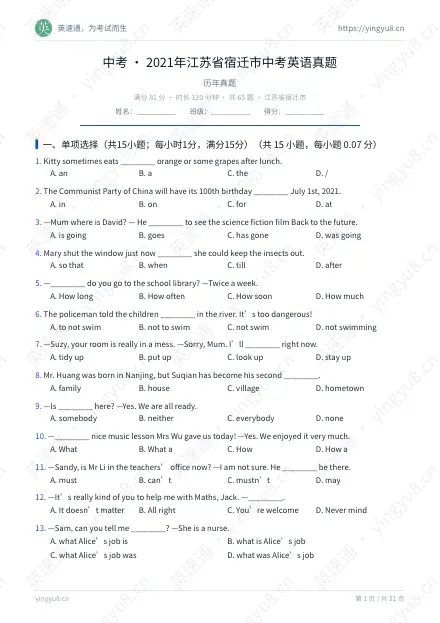
第 1 部分 · 单项选择(共15小题;每小时1分,满分15分)14 题 · 14 分
- A.an
- B.a
- C.the
- D./
参考答案与解析
答案:A
解析:识别名词orange → 判断其发音以元音音素开头 → 选择不定冠词an
考点:不定冠词a/an的用法元音音素开头的名词前用an
译文:Kitty午饭后有时会吃一个橙子或一些葡萄。
- A.in
- B.on
- C.for
- D.at
参考答案与解析
答案:B
解析:识别时间状语July 1st, 2021 → 判断为具体某一天 → 选择介词on
考点:介词in/on/at的用法具体某一天前用on
译文:中国共产党将于2021年7月1日迎来其100岁生日。
- A.is going
- B.goes
- C.has gone
- D.was going
参考答案与解析
答案:C
解析:分析对话场景(询问某人去向)→ 判断动作已完成且结果与现在相关 → 选择现在完成时
考点:现在完成时的用法have gone to表示去了某地(未返回)
译文:—妈妈,大卫在哪儿?—他去看科幻电影《回到未来》了。
- A.so that
- B.when
- C.till
- D.after
参考答案与解析
答案:A
解析:分析前后句逻辑关系(关窗 → 为了挡虫子)→ 判断为目的状语从句 → 选择so that
考点:目的状语从句的引导词so that引导目的状语从句
译文:玛丽刚才关上了窗户,以便把虫子挡在外面。
- A.How long
- B.How often
- C.How soon
- D.How much
参考答案与解析
答案:B
解析:根据答语 'Twice a week'(频率) → 推断问句询问频率 → 选择对应疑问词组 'How often'
考点:疑问词组辨析语境选词
译文:—你多久去一次学校图书馆?—一周两次。
- A.to not swim
- B.not to swim
- C.not swim
- D.not swimming
参考答案与解析
答案:B
解析:识别动词 'told' → 回忆 tell sb. (not) to do sth. 结构 → 否定形式为 'not to do' → 选择 'not to swim'
考点:非谓语动词不定式否定结构
译文:警察告诉孩子们不要在河里游泳。太危险了!
- A.tidy up
- B.put up
- C.look up
- D.stay up
参考答案与解析
答案:A
解析:根据语境 'room is in a mess'(房间很乱) → 推断需要整理房间 → 匹配动词短语 'tidy up'(整理)
考点:动词搭配语境选词
译文:—苏西,你的房间真是一团糟。—对不起,妈妈。我马上就整理。
- A.family
- B.house
- C.village
- D.hometown
参考答案与解析
答案:D
解析:根据 'born in Nanjing' 与 'second ________' 的对比 → 推断宿迁成为他的第二故乡 → 选择 'hometown'
考点:近义词辨析语境选词
译文:黄先生出生在南京,但宿迁已经成为他的第二故乡。
- A.somebody
- B.neither
- C.everybody
- D.none
参考答案与解析
答案:C
解析:根据答语 'We are all ready'(我们都准备好了) → 推断问句询问'所有人'是否在场 → 选择 'everybody'
考点:主谓一致语境选词
译文:—所有人都在这里吗?—是的。我们都准备好了。
- A.What
- B.What a
- C.How
- D.How a
参考答案与解析
答案:B
解析:识别感叹句结构 → 判断中心词为名词短语 → 选择What引导词
考点:感叹句结构What与How引导词辨析
译文:—吴老师今天给我们上的音乐课真好啊!—是的。我们非常喜欢。
- A.must
- B.can’t
- C.mustn’t
- D.may
参考答案与解析
答案:D
解析:识别情态动词表推测 → 根据语境判断不确定语气 → 选择may
考点:情态动词表推测may表可能性
译文:—桑迪,李老师现在在教师办公室吗?—我不确定。他可能在那里。
- A.It doesn’t matter
- B.All right
- C.You’re welcome
- D.Never mind
参考答案与解析
答案:C
解析:识别感谢场景 → 匹配固定应答表达 → 选择You're welcome
考点:感谢与应答固定搭配日常交际用语
译文:—杰克,你帮我学数学真是太好了。—不客气。
- A.what Alice’s job is
- B.what is Alice’s job
- C.what Alice’s job was
- D.what was Alice’s job
参考答案与解析
答案:A
解析:识别宾语从句 → 判断从句语序 → 选择陈述语序
考点:宾语从句语序陈述语序规则
译文:—山姆,你能告诉我爱丽丝的工作是什么吗?—她是一名护士。
- A.every dog has its day
- B.put all your eggs in one basket
- C.a miss is as good as a mile
- D.actions speak louder than words
参考答案与解析
答案:D
解析:理解上下文逻辑 → 分析转折关系 → 匹配谚语含义
考点:谚语理解转折逻辑推理
译文:—爸爸从不说他擅长烹饪,但事实上他很擅长。他总是为我们做美味的饭菜,那就是行动胜于言语。
第 2 部分 · 完形填空(共15小题;每小题1分,满分15分)1 题 · 15 分
参考答案与解析
答案:16-A 17-B 18-C 19-B 20-D 21-B 22-C 23-B 24-D 25-A 26-B 27-A 28-C 29-A 30-D
解析:16 空 根据后文‘tears in his eyes’和‘recite the poem’的语境,推断手中物品应与学习相关 → 结合‘in his hand’的常见搭配 → 得出答案
17 空 根据‘will get a prize’(会得到奖品)的语境,推断背诵得‘最好’才能获奖 → 结合‘best’与‘worst’的语义对立 → 得出答案
18 空 根据前文‘tears in his eyes’和‘The boys say that I can’t’的语境,推断声音应是‘悲伤的’ → 结合‘sad’与‘happy’的语义对立 → 得出答案
19 空 根据‘Don’t mind what they _____’的句型,推断空格处应填入表示‘说’的动词 → 结合‘say’与‘make’的词性及搭配差异 → 得出答案
20 空 根据‘try _____ the prize’的语境,推断空格处应填入表示‘为了’的介词 → 结合‘for’与‘at’的介词搭配差异 → 得出答案
21 空 定位空格所在句 → 分析上下文逻辑(尝试背诵的目的) → 识别固定搭配(get the prize) → 得出答案
22 空 定位空格所在句 → 回溯前文Mrs Bell的比喻(蜗牛) → 识别指代关系(run a race with the snail) → 得出答案
23 空 定位空格所在句 → 分析上下文逻辑(轮流背诵的场景) → 识别固定搭配(it's one's turn) → 得出答案
24 空 定位空格所在句 → 分析上下文逻辑(男孩们嘲笑Tom的原因) → 识别近义词辨析(fail与succeed的反义关系) → 得出答案
25 空 定位空格所在句 → 分析上下文逻辑(Tom背诵的结果与男孩们预期的反差) → 识别近义词辨析(even与never的语义强度) → 得出答案
26 空 定位前文‘get a prize’ → 后文‘gave Tom the _____’形成同义复现 → 得出答案
27 空 分析句子结构‘tell us _____ you could recite...’ → 判断空格引导宾语从句 → 从句‘you could recite the poem so well’是方式状语完整 → 需要疑问副词 → 得出答案
28 空 定位后文‘Don’t laugh!’ → 推断前文‘a loud _____’是笑声 → 得出答案
29 空 分析句子‘I may not try _____ the prize’ → 识别固定搭配‘try for’(争取) → 选项中无‘for’ → 推断‘give up’(放弃)符合‘may not try’的否定尝试语境 → 得出答案
30 空 定位前文‘Tom in a _____ voice’ → 结合‘The boys say that I can’t’的沮丧语境 → 辨析选项:cheer(欢呼)与沮丧相反,voice(声音)太泛,sound(声音)太泛,whisper(低语)符合沮丧、不自信的语气 → 得出答案
考点:语境选词名词搭配近义词辨析固定搭配介词搭配指代与衔接上下文连贯同义复现名词性从句疑问副词选择逻辑衔接
译文:他手里拿着一本书,眼里含着泪水。
第 3 部分 · 阅读理解(共两节,满分30分)15 题 · 30 分
Apps can teach you things or let you have fun. The following are some apps that you may use in your daily life. Kindle Do you love to read? Do you wish that you could bring all of your books with you everywhere you go? Kindle allows you to do so. This app has over a million free e-books to download. With Kindle, you can read anything from comic books and novels to magazines and newspapers. Calm Calm is an app that can help you relax and sleep better. It has a lot of features to help you relax. For example, it has calming sounds like ocean waves and rain. RunKeeper Sometimes the hardest part of exercising is getting started. If you want to get started, you’d better try RunKeeper. It is a good app that can help you exercise. Are you ready to start? If so, RunKeeper will always be with you. Pocket If you don’t have enough time to read news stories or watch videos, Pocket can help you save all of them online. Then you can read them or watch them when you are free. You can view them offline, too. Besides, it can also help you organize the things you have saved.
- A.One.
- B.Two.
- C.Three.
- D.Four.
参考答案与解析
答案:B
解析:定位各应用功能描述 → 筛选与阅读相关的应用(Kindle, Pocket) → 计数得出答案
考点:细节定位与计数
译文:题干:有多少个应用可以帮助你阅读?正确项:两个。
- A.read news stories
- B.watch videos
- C.organize the things you have saved
- D.relax and sleep better
参考答案与解析
答案:D
解析:定位Pocket应用的功能描述 → 逐项比对选项与原文信息 → 找出未提及的功能
考点:细节定位与排除
译文:题干:应用“Pocket”不能帮助你______。正确项:放松和睡得更好。
- A.Kindle.
- B.Pocket.
- C.RunKeeper.
- D.Calm. B When your town has winter, the earth’s axis(轴) is pointing away from the sun. Your town doesn’t get as much light or heat from the sun. The days are shorter and colder. Winter and summer happen because the earth is tilted(倾斜) as it revolves around the sun. The northern end of the earth’s axis points towards the sun in summer. You have more hours of light in summer. Your part of the earth is towards the sun for more hours each day. When the part of the earth where you live is towards the sun, you have hotter days. In winter, when your part of the earth points away from the sun, you have colder days. You have learned about winter and summer. There are two more seasons in the year. One comes after winter and before summer. The other season comes after summer and before winter. Can you name them? That’s right. Spring comes between winter and summer and autumn comes after summer but before winter. The four seasons are spring, summer, autumn and winter. Spring and autumn are apposite seasons. Which season do you like best? You have thought about the four seasons of the year. Each season is different. The seasons are made by the northern end of the axis pointing towards or away from the sun. Your part of the world gets more heat from the sun when the northern end of the axis points to the sun. When the axis points away from the sun, you get less heat. Now you know why winter is colder than summer. The axis is pointing away from the sun in winter. It is pointing towards the sun in summer.
参考答案与解析
答案:C
解析:定位各应用功能描述 → 筛选与锻炼相关的应用(RunKeeper) → 匹配选项
考点:细节定位与匹配
译文:题干:以下哪个应用可能帮助你锻炼?正确项:RunKeeper。
- A.Moves.
- B.Turns.
- C.Jumps.
- D.Sites.
参考答案与解析
答案:A
解析:定位划线词所在语境(地球轴指向) → 结合常识与上下文推断词义 → 选择同义替换
考点:词义猜测与同义替换
译文:题干:第2段中划线单词“revolves”的意思是什么?正确项:移动。
- A.How four seasons happen.
- B.How the weather changes.
- C.When the earth’s axis points towards the sun.
- D.When the earth’s axis points away from the sun.
参考答案与解析
答案:A
解析:通读全文 → 概括各段落核心信息(介绍四个应用) → 归纳文章主旨
考点:主旨大意概括
译文:题干:这篇文章主要讲了什么?正确项:四季是如何发生的。
- A.A film guide.
- B.A storybook.
- C.A science magazine.
- D.A book review. C If you walk through a park in the morning or in the evening, you might see a lot of people doing these slow and beautiful movements— Carry the tiger over the mountain and White crane spreads its wings. In fact, they are doing Taichi. Taichi is an ancient martial art (武术). It is a common kind of exercise in China. More than 100 million people in over 150 countries practice Taichi at present. Recently UNESCO (联合国教科文组织) has added Taichi to its Intangible Cultural Heritage List (非物质文化遗产名录). Many taichi fans were happy to hear of it. “This will make taichi more popular around the world. Hopefully, more people will become healthier by practicing it.” said Chen Bin. He is a Taichi master from the village of Chenjiagou, Henan Province. This village is the birthplace of Chen-style Taichi. It’s true that doing Taichi is good for our health. It can make us walk and move more freely, and it can also make us stronger. During slow movements, we can focus on (专注) our hands and feet. We can control them better. Slow movements also help us to take deep and long breaths. Taichi also focuses on the harmony (和谐) between yin (阴) and yang (阳). It shows how the ancient Chinese people saw the world. The world is full of yin and yang: dark and light, soft and hard, female and male. But they don’t oppose (对立) each other absolutely (绝对地). As we see in the picture, a white spot is in the black area and a black spot is in the white area. After a dark night, the sun will rise. Leaves fall in autumn but grow in spring. Everything keeps changing — that is how we should see the world. Taichi carries traditional Chinese philosophy (哲学), such as being in harmony with nature and using softness to beat hardness. It has become a symbol of Chinese culture.
参考答案与解析
答案:C
解析:分析篇章整体结构(总-分)与各段落核心信息(介绍四款App)→ 推断文本类型为应用推荐/介绍 → 匹配选项C(科学杂志)
考点:篇章结构分析文本类型推断
译文:题干:这篇文章可能来自哪里? 正确项C:一本科学杂志。
- A.About 10 million.
- B.Less than 150 thousand.
- C.At most 100 thousand.
- D.More than 100 million.
参考答案与解析
答案:D
解析:定位语篇中关于太极拳练习人数的具体数字信息 → 识别“more than 100 million” → 匹配选项D
考点:细节定位数字信息捕捉
译文:题干:现在世界上有多少人练习太极拳? 正确项D:超过一亿。
- A.Slow and beautiful.
- B.Slow and exciting.
- C.Fast and free.
- D.Strong and tiring.
参考答案与解析
答案:A
解析:定位描述太极拳动作特征的语句(如“slow and beautiful”)→ 进行同义替换 → 匹配选项A
考点:细节定位同义替换
译文:题干:以下哪个词最能描述太极拳的动作? 正确项A:缓慢而优美。
- A.Because it is a symbol of Chinese culture.
- B.Because it is from the village of Chenjiagou.
- C.Because it can make us walk more freely.
- D.Because it can use softness to beat hardness.
参考答案与解析
答案:A
解析:定位解释太极拳入选非物质文化遗产原因的语句 → 提取核心原因(中国文化象征) → 匹配选项A
考点:推理判断原因定位
译文:题干:为什么太极拳最近被列入非物质文化遗产名录? 正确项A:因为它是中国文化的象征。
- A.To ask people to do Taichi in their fiee time.
- B.To introduce an ancient martial art—taichi.
- C.To teach people how to do Taichi correctly.
- D.To explain why Taichi is good for our health.
参考答案与解析
答案:B
解析:分析篇章整体结构(总-分)与各段落核心信息(介绍四款App)→ 推断作者写作目的为介绍App → 匹配选项B(介绍一项古老武术——太极拳)
考点:篇章结构分析写作目的推断
译文:题干:作者写这篇文章的目的是什么? 正��项B:介绍一项古老的武术——太极拳。
Dr. Dolittle lived in a small town called Puddleby. Everyone in the town knew him. The dog and children ran after him. He lived in a small house, but he had a large garden. He kept many animals in his garden. His favorite animals were Dab-Dab, a duck; Jip, a dog; Gub-Gub, a baby pig and Polynesia, a parrot. He also kept some fish, rabbits, cats, a squirrel, a cow and a baby cow, a horse, chickens and so on. Dr. Dolittle didn’t have many patients. Most people didn’t like all of his animals, so when they were ill, they went to a doctor in another town. “But you don’t have any money,” his sister told him. “You need patients.” “I have a patient,” Dr. Dolittle answered, “The cat’s-meat-man. He’s the man who sells me meat for the cat.” “He doesn’t pay you enough to live on,” his sister told him. “Then I’ll sell everything I have,” he said. And he did. He sold most of his furniture. He also sold most of his clothes. Then he had enough money to buy food for himself and his animals. One day, the cat’s-meat-man said to him, “Why don’t you stop being a doctor for people and become a doctor for animals instead? I’m sure that you know a lot about animals-more than most vets. You wrote a wonderful book about cats. I’d send all the people with sick dogs or cats to you.” When the cat’s-meat-man left, Polynesia, the parrot, flew onto the table. “He’s right, Doctor,” Polynesia said. “You should become an animal doctor.” “There are a lot of vets,” Dr. Dolittle said. “Perhaps there are a lot of vets. But you’d be the best vet of all. I’m not the only animal that can talk. All the animals can talk. Each kind of animal has its own language. I’ll teach you mine if you like.” “Yes, please,” Dr. Dolittle said. He opened a drawer (抽屉) and took out a notebook and pencil. “Will you teach me the parrot’s ABCs first?” he asked. Polynesia agreed to teach Dr. Dolittle parrot language. Later that day, Jip came into the room. Polynesia said, “He’s talking to you, Doctor.” “I don’t think he is,” Dr. Dolittle said. “He’s just scratching (挠) himself.” “Dogs talk with their ears, their noses, and their tails,” Polynesia told him. They don’t always make a noise. Do you see how he is moving his nose now?” “Yes.” “He is telling us that it has stopped raining, and he wants to ask you a question.” Every day, Dr. Dolittle learned the languages of the animals. When people found out he was now an animal doctor, they brought their sick pets to him. One day, a horse said to him, “You’re a much better animal doctor than the vet. You knew I couldn’t see well, and you made glasses for me.” The horse was very pleased. He could see very well. He told all his friends how clever Dr. Dolittle was, and they told all their friends. Soon, many animals came to see him. He had a different door for each animal, and he wrote the name of each kind of animal above each door. HORSES, COWS,... Before long, every animal that lived in or near the town became the doctor’s patient. He was very happy, and he liked his life very much. (Adapted from The Story of Dr. Dolittle)
- A.①④
- B.②④
- C.①③
- D.②③
参考答案与解析
答案:D
解析:定位原文列举Dr. Dolittle最爱动物的句子 → 提取具体动物名称 → 匹配选项组合
考点:细节定位与捕捉
译文:题干:杜立德医生最喜欢的动物是什么?正确项:②一只小猪,一只鹦鹉;④一只鸭子,一只狗。
- A.Because Dr. Dolittle was impolite to them.
- B.Because they didn’t like all of Dr. Dolittle’s animals.
- C.Because the doctor in another town was very famous.
- D.Because Dr. Dolittle was busy looking after his animals.
参考答案与解析
答案:B
解析:定位原文解释人们去看其他医生的原因 → 提取因果关系 → 匹配选项
考点:细节定位与捕捉
译文:题干:为什么大多数人生病时会去另一个镇上看医生?正确项:因为他们不喜欢杜立德医生所有的动物。
- A.Dr. Dolittle learned the languages of the animals.
- B.Dr. Dolittle sold most of his furniture and clothes.
- C.Animals in or near the town became Dr. Dolittle’s patients.
- D.Polynesia flew onto the table and taught Dr. Dolittle parrot language.
参考答案与解析
答案:B
解析:通读全文梳理事件发展顺序 → 对比选项事件在文中的先后位置 → 确定正确顺序
考点:细节定位与捕捉谋篇布局
译文:题干:故事中杜立德医生经历的正确顺序是什么?正确项:B. 杜立德医生卖掉了大部分家具和衣服。
- A.A parrot.
- B.A cow.
- C.A horse.
- D.A duck.
参考答案与解析
答案:C
解析:定位原文中建议杜立德医生成为动物医生的角色 → 提取该角色身份 → 匹配选项
考点:细节定位与捕捉
译文:题干:谁告诉所有朋友杜立德医生是个聪明的动物医生?正确项:C. 一匹马。
- A.Dr. Dolittle only talked to his parrot.
- B.Dr. Dolittle had much money at first.
- C.Dr. Dolittle was very happy in the end.
- D.Dr. Dolittle was liked by everyone in the town. 第二节(共5小题;每小题1分,满分5分) 阅读下面短文,从短文后的选项中选出可以填入空白处的最佳选项。选项中有两项为多余选项。 Pollution is one of the biggest problems in the world today. In many places, rubbish is thrown into lakes and rivers. ____46____ In some cities, the air is filled with pollution. ____47____ If it is not cleaned up, more people will be hurt. ____48____ Land and water pollution kills many animals every year. If we do not act to improve the environment, more living things will be killed by pollution. ____49____ We should separate rubbish into different groups. In this way, it can be recycled and reused. We had better plant more trees. ____50____ What’s more, we shouldn’t put the waste into lakes or rivers. If we can do these, we will make the world a better place to live in. This makes some old people and children ill. As well as people, animals are also harmed by pollution. We can make our lakes and rivers cleaner and cleaner. It’s time for all of us to take action right away! A.
- E.Because of this these places have already been polluted.
- F.Trees reduce dust and help keep the air clean.
- G.A few of us should take action to protect the environment.
参考答案与解析
答案:C
解析:综合全文情节发展 → 推断人物最终状态或故事主旨 → 匹配选项
考点:推理判断
译文:题干:从文章中我们可以学到什么?正确项:C. 杜立德医生最后非常开心。
第 4 部分 · 根据句意及所给中文提示、首字母或英文解释,写出句中所缺单词,每空限填词。(共10小题;每小题1分,满分10分)10 题 · 10 分
参考答案与解析
答案:progress
解析:根据中文提示“进步”和固定搭配“make progress”,直接确定答案为progress
考点:make progress 固定搭配
译文:这学期我在物理方面取得了很大进步。
参考答案与解析
答案:satisfy##meet
解析:根据中文提示“满足”和动词搭配“satisfy/meet one's needs”,直接确定答案为satisfy或meet
考点:satisfy/meet one's needs 固定搭配
译文:江先生对这个机器人很满意。它能满足他所有的需求。
参考答案与解析
答案:camera##cameras
解析:根据中文提示“照相机”和名词“camera”,直接确定答案为camera或cameras
考点:camera 名词拼写
译文:— 艾米,明天能借你的照相机吗?— 没问题。
参考答案与解析
答案:themselves
解析:根据中文提示“他们自己”和固定搭配“enjoy oneself”,结合主语“The children”为复数,确定答案为themselves
考点:enjoy oneself 固定搭配反身代词与主语一致
译文:看!孩子们在操场上玩得很开心。他们多快乐啊!
参考答案与解析
答案:medicine
解析:根据中文提示“医学”和名词“medicine”,直接确定答案为medicine
考点:medicine 名词拼写
译文:现代医学发展迅速。因此,许多疾病可以被预防或治愈。
参考答案与解析
答案:step
解析:识别固定搭配 'one small step for a man' → 直接填写名词 'step'
考点:固定搭配 'one small step'
译文:尼尔·阿姆斯特朗说:'对一个人来说是一小步,对全人类来说是一大飞跃。'
参考答案与解析
答案:(e)asily
解析:根据前文 'clever and hard-working' 推断他解决问题的方式 → 结合首字母 'e' 和副词位置 → 填写 'easily'
考点:语境推断词性判断(副词)
译文:安德鲁既聪明又勤奋。他经常能非常容易地解决一些问题。
参考答案与解析
答案:(c)hoice
解析:识别固定句型 'have no choice but to do sth.' → 结合首字母 'c' → 填写 'choice'
考点:固定句型 'have no choice but to'
译文:这项任务太难了。露西别无选择,只能向他人求助。
参考答案与解析
答案:matches
解析:识别括号内提示 'go well with' 的同义表达 → 选择动词 'matches' 并注意主谓一致(Your jacket 为单数)
考点:同义替换 'go well with' = 'match'主谓一致
译文:你看起来真精神!你的夹克和蓝色牛仔裤很相配。
参考答案与解析
答案:wonders##wondered
解析:分析宾语从句 'how many students would like to go' 的时态 → 主句动词需与从句时态呼应 → 填写 'wonders' 或 'wondered'
考点:宾语从句时态呼应动词过去式/一般现在时
译文:老师想知道有多少学生愿意去动物园。
第 5 部分 · 根据短文内容,用括号内所给词的正确时态或形式填空,使短文完整。(共10小题;每小题1分,满分10分)1 题 · 10 分
参考答案与解析
答案:61-was put 62-first 63-rules 64-to keep 65-drivers 66-is 67-officer 68-rainy 69-had 70-safer
解析:61 空 分析句子主语与谓语动词的逻辑关系 → 判断主语是动作的承受者 → 选用被动语态的一般过去时
62 空 分析空格在句中的成分 → 判断其作定语修饰名词 → 根据语序和逻辑关系确定使用序数词
63 空 分析句子主语 → 判断主语为复数名词 → 根据主谓一致原则确定谓语动词形式
64 空 分析句子结构 → 判断空格在句中作目的状语 → 根据逻辑关系确定使用不定式表目的
65 空 分析句子主语 → 判断主语为复数名词 → 根据主谓一致原则确定谓语动词形式
66 空 分析句子主语与谓语的时态一致性 → 判断主句时态为一般现在时 → 得出答案
67 空 分析句子语境与词性要求 → 判断需要名词形式 → 得出答案
68 空 分析句子语境与词性要求 → 判断需要形容词形式 → 得出答案
69 空 分析句子时态逻辑 → 判断需要过去完成时 → 得出答案
70 空 分析句子比较结构 → 判断需要形容词比较级 → 得出答案
考点:被动语态一般过去时序数词作定语主谓一致名词复数不定式作目的状语时态与语态语境选词近义词辨析
译文:这座桥建于19世纪。
第 6 部分 · 书面表达(满分15分)1 题 · 15 分
参考答案与解析
参考范文
31. How many apps can help you to read? A. One. B. Two. C. Three. D. Four. 32. The app “Pocket” can’t help you to ________. A. read news stories B. watch videos C. organize the things you have saved D. relax and sleep better 33. Which of the following apps may help you exercise? A. Kindle. B. Pocket. C. RunKeeper. D. Calm. 【
常见问题
2021年江苏省宿迁市中考英语真题的答案和解析在哪看?
答案与解析就在本页:每道题下方「参考答案与解析」展开即看,含参考答案、解题思路与考点,免登录直接阅读。
2021年江苏省宿迁市中考英语真题 PDF 怎么免费下载?
本页「试卷封面」卡片「收录格式」行内的 PDF 徽标即下载链接,点击直接下载本卷 PDF 文件,无需登录。
这套卷怎么在线做题、怎么计分?
点页面上方「开始考试(网页)」进入在线做题页:登录后装载本卷作答,交卷自动判分并留存成绩;免费账号每日可装载 30 套,会员每日 100 套。