2023年四川省自贡市中考英语真题及答案解析
2023年四川省自贡市中考英语真题 · 完整收录
- 年份考次
- 2023 年
- 命题归属
- 市级统一命题
- 省份
- 四川
- 市
- 自贡市
- 听力
- 含听力
- 题量
- 54 题
- 满分
- 145 分
- 限时
- 120 分钟
- 题型结构
- 听下面一段材料,回答第6小题。 1 题 1 分 · 听下面一段材料,回答第7小题。 1 题 1 分 · 听下面一段材料,回答第8小题。 1 题 1 分 · 听下面一段材料,回答第9小题。 1 题 1 分 · 听下面一段材料,回答第10小题。 1 题 1 分 · 听下面一段材料,回答第11至12题。 2 题 2 分 · 听下面一段材料,回答第13至15题。 3 题 3 分 · 听下面一段独白,回答第16至20题。 5 题 5 分 · 第一节 单项填空 10 题 10 分 · 第二节 完形填空 15 题 30 分 · 第一节 阅读理解 15 题 30 分 · 第二节 阅读填空 5 题 10 分 · 第一节 单词填空 10 题 10 分 · 第二节 语法填空 10 题 15 分 · 第三节 书面表达 1 题 25 分
- 修复记录
- 归因补全
- 收录格式
开始考试(微信)

微信扫一扫 · 小程序内开始考试
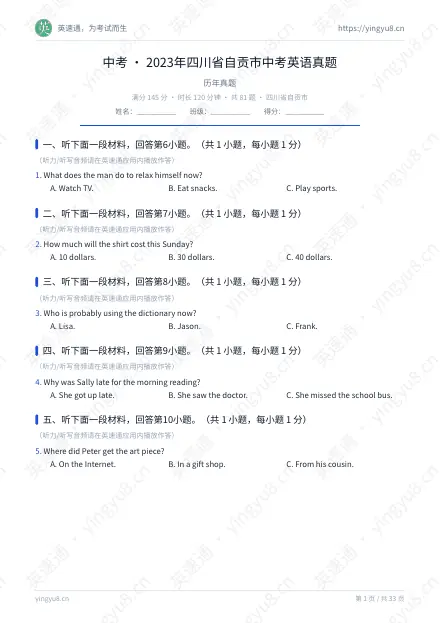
第 1 部分 · 听下面一段材料,回答第6小题。1 题 · 1 分
听力原文 · Question 6(本页按钮可反复收听;在线做题考试中每段仅播一次)
W: Tom, you look tired after the match. M: Yes, I played basketball for two hours. W: Do you still go running to relax? M: No, not now. I just sit on the sofa and turn on the TV. W: So you don't eat ice cream or take a walk like before? M: No. I only do that one thing when I want to relax. W: That sounds easy and fun. M: Yes, it really helps me feel better.
- A.Watch TV.
- B.Eat snacks.
- C.Play sports.
参考答案与解析
答案:A
解析:定位关键词 'relax' → 捕捉对话中关于放松方式的直接陈述 → 识别同义替换 'watch TV' 与 'now' 的时间限定
考点:细节定位同义替换时间限定
译文:题干:这位男士现在如何放松自己? 正确项A:看电视。
第 2 部分 · 听下面一段材料,回答第7小题。1 题 · 1 分
听力原文 · Question 7(本页按钮可反复收听;在线做题考试中每段仅播一次)
W: Look at this nice shirt, Tom. It was thirty dollars last week. M: Yes, but this Sunday is a big sale day. It will be forty dollars then. W: Forty dollars? That is more than before! M: I know. The old price is gone. Only the new price works on Sunday. W: So on Sunday, I need to pay forty dollars for it. M: Right. Not ten, not thirty. Just forty on that day.
- A.10 dollars.
- B.30 dollars.
- C.40 dollars.
参考答案与解析
答案:C
解析:定位价格信息 → 识别折扣计算(原价40美元,周日折扣10美元) → 得出答案
考点:数字语音识别简单运算
译文:这件衬衫这个星期天要多少钱?
第 3 部分 · 听下面一段材料,回答第8小题。1 题 · 1 分
听力原文 · Question 8(本页按钮可反复收听;在线做题考试中每段仅播一次)
W: Good morning. What can I do for you? M: I'd like to change this dictionary. It's too heavy for my school bag. W: Of course. Do you want a smaller one or your money back? M: A smaller one, please. The cover is the same, right? W: Yes. Here you are. That's six dollars. M: Thanks a lot. May I use the big copy on the desk for a minute? W: Sorry, it's taken. The boy whose name begins with J is looking up a word in it now.
- A.Lisa.
- B.Jason.
- C.Frank.
参考答案与解析
答案:B
解析:定位对话中提及字典当前使用者的语句 → 识别指代关系('he'指代Jason) → 得出答案
考点:细节定位指代关系
译文:题干:谁现在可能正在使用这本字典? 正确项:B. Jason.
第 4 部分 · 听下面一段材料,回答第9小题。1 题 · 1 分
听力原文 · Question 9(本页按钮可反复收听;在线做题考试中每段仅播一次)
W: Tom, you look worried. What happened? M: It's about Sally. She was late for the morning reading today. W: Really? Did she get up late? M: No. She had a bad toothache last night, so her mother took her to see the doctor this morning. W: I see. Is she feeling better now? M: Yes, much better. She came to school after that, but the reading had already started. W: That's why she was late. I'm glad she's fine now.
- A.She got up late.
- B.She saw the doctor.
- C.She missed the school bus.
参考答案与解析
答案:B
解析:定位关键词 'late' → 捕捉因果关系 'because she had to see the doctor' → 同义替换 'saw the doctor' → 得出答案
考点:细节定位因果关系同义替换
译文:题干:Sally为什么晨读迟到了?正确项B:她去看了医生。
第 5 部分 · 听下面一段材料,回答第10小题。1 题 · 1 分
听力原文 · Question 10(本页按钮可反复收听;在线做题考试中每段仅播一次)
W: Hi, Peter. That picture on the wall looks lovely. M: Thank you. I got it from my aunt's son. He gave it to me last week. W: That is so nice. Are you taking it on your trip? M: Yes. I will put it in my bag and show it to my friends in Beijing. W: When are you leaving? M: On Friday morning. My train leaves at seven thirty.
- A.On the Internet.
- B.In a gift shop.
- C.From his cousin.
参考答案与解析
答案:C
解析:定位关键词 'art piece' → 听辨直接信息 'from my cousin' → 匹配选项
考点:细节定位与捕捉
译文:题干:Peter从哪里得到这件艺术品? 正确项:从他的表亲那里。
第 6 部分 · 听下面一段材料,回答第11至12题。2 题 · 2 分
听力原文 · Questions 11 to 12(本页按钮可反复收听;在线做题考试中每段仅播一次)
W: Tom, you look happy. Did you see a film with Dale today? M: Yes, we saw one about a smart dog. Dale said it was fun and he laughed a lot. W: So what does Dale think of the movie? M: He thinks it is interesting. W: Good. What time does it start? I want to see it too. M: It starts at six thirty. We must go now. W: OK. Let's meet at the gate at six. M: See you then.
- A.Interesting.
- B.Exciting.
- C.Wonderful.
参考答案与解析
答案:A
解析:定位Dale对电影的评价 → 识别其表达态度的形容词 → 匹配选项
考点:观点态度识别同义替换
译文:Dale认为这部电影怎么样?A. 有趣的。 B. 令人兴奋的。 C. 精彩的。
- A.At 7:00.
- B.At 6:30.
- C.At 6:00.
参考答案与解析
答案:B
解析:定位电影开始时间的对话 → 识别并区分提及的多个时间点 → 确认最终开始时间
考点:数字时间语音信息筛选
译文:电影什么时候开始?A. 7:00。 B. 6:30。 C. 6:00。
第 7 部分 · 听下面一段材料,回答第13至15题。3 题 · 3 分
听力原文 · Questions 13 to 15(本页按钮可反复收听;在线做题考试中每段仅播一次)
W: Good evening, sir. Are you ready to order? M: Yes. I'd like some noodles and a glass of orange juice, please. W: Sure. Would you like anything else? M: No, thanks. By the way, I'm just visiting this city. W: Really? How long have you been here? M: I arrived the day before yesterday, so this is my second day. W: I hope you're enjoying your stay. Have you been to any nice places? M: Yes. I went to a lovely garden with lights, and a big place with rides. I also visited a building about making salt. W: Which one did you enjoy most? M: The one with rides was the most fun. I loved it. W: Great. Your food will be ready soon. M: Thank you.
- A.Tourist and guide.
- B.Teacher and student.
- C.Waiter and customer.
参考答案与解析
答案:C
解析:捕捉对话场景关键词(如点餐、服务用语) → 推断人物关系 → 得出答案
考点:场景词汇与人物关系
译文:题干:两位说话者之间是什么关系? 正确项:服务员与顾客。
- A.For two days.
- B.For three days.
- C.For four days.
参考答案与解析
答案:A
解析:定位时间相关表达(如 arrived, staying for) → 提取并计算具体天数 → 得出答案
考点:数字时间语音
译文:题干:这位男士在自贡待了多久? 正确项:两天。
- A.The Lantern Park.
- B.The Fun Times Park.
- C.The Salt History Museum.
参考答案与解析
答案:B
解析:捕捉表达喜好或评价的形容词/副词(如 best, favorite, really enjoyed) → 关联具体地点 → 得出答案
考点:观点态度细节定位与捕捉
译文:题干:这位男士最喜欢哪个地方? 正确项:欢乐时光公园。
第 8 部分 · 听下面一段独白,回答第16至20题。5 题 · 5 分
听力原文 · Questions 16 to 20(本页按钮可反复收听;在线做题考试中每段仅播一次)
N: Let's listen to Paul, a boy in our class, talking about his future. N: I'm Paul. I often think about what I will do when I grow up. I hope to look after sick people in their own houses, so families won't need to go far away when someone is ill. That is my biggest dream. N: Where will I do this job? The place I plan to spend my life in is the capital of our country, Beijing. It is big and busy, and there will be plenty of work for me there. N: At school I am not the best at everything. My strongest subject is the one that studies our own language and books. I read and write very well, but I find it hard to learn new words of other languages. N: My teacher told us about the year two thousand and forty. She said young people then will be able to enter a university by having their lessons over the Internet, sitting at home with a computer. N: She also said the cities will be quite different. There will be more places to look after people who have grown old, because there will be more old people than now.
- A.A car engineer.
- B.A home doctor.
- C.A computer programmer.
参考答案与解析
答案:B
解析:定位关键词 'want to be' → 匹配录音中 'I want to be a home doctor' → 得出答案
考点:细节定位职业词汇
译文:保罗想成为什么? A.汽车工程师 B.家庭医生 C.计算机程序员
- A.In Chengdu.
- B.In Shanghai.
- C.In Beijing.
参考答案与解析
答案:C
解析:定位关键词 'work' → 匹配录音中 'I will work in Beijing' → 得出答案
考点:细节定位地点名词
译文:保罗将在哪里工作? A.在成都 B.在上海 C.在北京
- A.Chinese.
- B.English.
- C.Science.
参考答案与解析
答案:A
解析:定位关键词 'strong in' → 匹配录音中 'I am strong in Chinese' → 得出答案
考点:细节定位学科名词
译文:保罗在学校哪门科目很强? A.语文 B.英语 C.科学
- A.They can go to college for free.
- B.They can go to college without exams.
- C.They can go to college by taking online courses.
参考答案与解析
答案:C
解析:定位关键词 'teenagers in 2040' → 匹配录音中 'take online courses to go to college' → 得出答案
考点:细节定位未来预测
译文:2040年青少年会怎样? A.他们可以免费上大学 B.他们可以免试上大学 C.他们可以通过在线课程上大学
- A.There will be more parks.
- B.There will be more bus drivers.
- C.There will be more hospitals for the old.
参考答案与解析
答案:C
解析:定位关键词 'cities in 2040' → 匹配录音中 'more hospitals for the old' → 得出答案
考点:细节定位未来预测
译文:2040年的城市会是什么样子? A.会有更多的公园 B.会有更多的公交车司机 C.会有更多的老年医院
第 9 部分 · 第一节 单项填空(共10小题;每小题1分,满分10分)10 题 · 10 分
- A.fruit
- B.drink
- C.job
参考答案与解析
答案:A
解析:根据答语'Apples'及谚语'An apple a day...' → 推断问句询问水果类别 → 选择'fruit'
考点:语境选词常识推理
译文:— 你最喜欢什么水果?— 苹果。一天一苹果,医生远离我。
- A.is
- B.are
- C.have
参考答案与解析
答案:B
解析:定位主语'Most of us' → 判断其为复数概念 → 选择复数动词'are'
考点:主谓一致代词指代
译文:— 你端午节有什么计划?— 我们大多数人正准备包粽子。
- A.sounds
- B.feels
- C.tastes
参考答案与解析
答案:C
解析:根据宾语'fried chicken'(炸鸡)→ 判断感官动词需与味觉相关 → 选择'tastes'
考点:感官动词辨析固定搭配
译文:— 你想吃点炸鸡吗?— 不,谢谢。我觉得它尝起来美味但不健康。
- A.How long
- B.How often
- C.How soon
参考答案与解析
答案:B
解析:根据答语'Once a week'(频率)→ 判断问句询问频率 → 选择'How often'
考点:状语从句疑问词辨析
译文:— 你多久去一次养老院帮忙?— 一周一次。我们应该更多地关心老人。
- A.did
- B.had done
参考答案与解析
答案:A
解析:定位时间状语'at that time'及上文'at seven o'clock last night' → 判断为过去进行时 → 选择'was doing'
考点:时态与语态过去进行时
译文:— 昨晚七点你为什么不接我电话?— 那时我正在厨房洗碗,所以没听见。
- A.depends on
- B.gives away
- C.leads to
参考答案与解析
答案:A
解析:根据语境“Success ________ hard work”判断,需要表示“成功依赖于努力工作”的动词短语 → 辨析选项含义 → 选择表示“取决于”的固定搭配
考点:动词搭配 depend on近义词辨析
译文:—怀特女士,我很难过没通过考试。—继续努力。成功取决于努力工作。
- A.borrow
- B.lend
- C.keep
参考答案与解析
答案:C
解析:根据答句“Sorry, you can’t. You must follow our rules.”判断,问句是请求延长借阅时间 → 辨析 borrow/lend/keep 的语义和用法 → 选择表示“保留、持有”的延续性动词
考点:近义词辨析 borrow/lend/keep语境选词
译文:—我能再借这本书两天吗?—对不起,不行。你必须遵守我们的规定。
- A.answering
- B.to answer
- C.answer
参考答案与解析
答案:B
解析:根据句型“be told not to do sth”判断,需要不定式作宾语补足语 → 分析选项的非谓语形式 → 选择不定式否定形式
考点:非谓语动词不定式SVO主干结构
译文:—迈克,我们被告知过马路时不要接电话。—对不起,我不会再这样做了。
- A.where
- B.how
- C.when
参考答案与解析
答案:B
解析:根据答句“By high-speed train”判断,问句询问的是交通方式 → 分析宾语从句的连接词 → 选择表示方式的连接词
考点:名词性从句连接词语境选词
译文:—我想知道你昨天是怎么到自贡的。—乘高铁。
- A.I hope not
- B.Don’t say that
- C.That’s all right
参考答案与解析
答案:C
解析:根据语境“I’m sorry to trouble you”判断,需要选择合适的道歉回应语 → 辨析选项的语用功能 → 选择表示“没关系”的固定应答
考点:语境选词近义词辨析
译文:—史密斯先生,很抱歉打扰您。—没关系。
第 10 部分 · 第二节 完形填空(共15小题;A篇每小题2分,B篇每小题1分,满分20分)1 题 · 30 分
参考答案与解析
答案:11-A 12-B 13-C 14-A 15-B 16-B 17-C 18-A 19-C 20-C 21-A 22-A 23-B 24-C 25-B
解析:11 空 定位空格后虚拟语气句式 'we wouldn't have any food' → 识别表示条件的介词 → 选择 'Without' 构成 'Without bees' 表示假设条件
12 空 定位空格前主语 'they' 指代 bees → 分析蜜蜂与花粉的动作关系 → 识别 'carry pollen' 为蜜蜂传播花粉的固定搭配
13 空 定位空格后列举的负面因素 'Losing natural homes, getting sick and higher temperatures' → 推断这些是蜜蜂面临的'问题' → 选择 problems
14 空 定位空格前后句意:前句描述蜜蜂数量下降的困境,后句描述人们制定拯救计划 → 识别转折/积极回应关系 → 选择 Luckily 表示'幸运的是'
15 空 定位空格后并列动作 'and look after the queen bee' → 分析机器人蜜蜂的功能是'喂养'蜂王 → 选择 feed
16 空 定位空格前文‘a group of kids riding bikes’与‘one adult with them, also on a bike’ → 推断群体共同特征为‘骑车者’ → 得出答案
17 空 定位空格后文‘to play soccer and eat breakfast’ → 推断‘在8点见面’是进行后续活动的前提 → 得出答案
18 空 定位空格前文‘start our ride’与‘bike bus’主题 → 推断骑行前需检查‘自行车’ → 得出答案
19 空 定位空格前文‘makes about 8 stops along the way’与后文‘to ____ children’ → 推断停车目的是‘接上’孩子 → 得出答案
20 空 定位空格前文‘with students in different grades’ → 推断与不同年级学生‘交谈’是社交互动 → 得出答案
21 空 分析空格前后句逻辑关系 → 前句为结果(获得关注),后句为原因(被发布到网上) → 选择表示时间/原因的连词
22 空 定位评价性语境 → 前句'What a simple idea it is!'表达积极评价 → 选择与'simple'语义一致的褒义形容词
23 空 定位主语指代 → 前文主语为'parents'(家长),后文动作'giving up cars'(放弃开车)的执行者应与之对应 → 选择与'parents'语义关联最紧密的选项
24 空 分析并列结构 → 空格与'fight climate change'和'reduce school drop-off traffic'并列,构成三个积极结果 → 选择与'fight'和'reduce'语义强度和方向一致的动词
25 空 定位结果描述 → 前文描述自行车巴士的积极影响(享受上学、与不同年级学生交流) → 选择与积极影响语义一致的形容词
考点:虚拟语气条件句介词 without 表假设动词搭配 carry pollen近义词辨析 help/carry/make语境推断近义词辨析 habits/interests/problems语篇逻辑衔接副词表态度并列结构推断动词辨析 wash/feed/use语境选词近义词辨析时间状语从句因果逻辑褒贬一致指代一致性并列结构
译文:题干:______ 蜜蜂,我们将没有任何食物! 正确项:没有
第 11 部分 · 第一节 阅读理解(共15小题;每小题2分,满分30分)15 题 · 30 分
Farming Experience Camp Are you looking for an exciting and meaningful summer camp? Come to our farming experience camp! Schedule July 3rd July 4th July5th July 6th 9:00-10:30 Opening Ceremony About Vegetables About Animals About Fruits 10:30-11:00 Break and Snack 11:00-12:00 Team Preparation Science Role Play: Let’s be little farmers. Art and Creativity 12:00-14:00 Lunch and Break 14:00-15:30 Team Building Activities Planting Vegetables Looking after Animals Picking Fruits Camp information: Language English Age 13-15 years old Fee ¥400/ person (more than two persons: ¥300/person) Email summercamp@163.com
- A.Pick fruits.
- B.Make cakes.
- C.Milk cows.
参考答案与解析
答案:A
解析:定位日程表中14:00-15:30的活动 → 匹配选项A的Picking Fruits → 得出答案
考点:细节定位与捕捉
译文:题干:孩子们在夏令营可以做什么?正确项:采摘水果。
- A.¥600.
- B.¥900.
- C.¥1,200.
参考答案与解析
答案:B
解析:定位费用信息 → 理解“more than two persons: ¥300/person”条件 → 计算3人费用 → 得出答案
考点:细节定位与捕捉数字运算
译文:题干:如果三个孩子去夏令营,费用是多少?正确项:900元。
- A.To educate kids to protect the animals.
- B.To help farmers to sell vegetables and fruits.
- C.To call on more students to join in the summer camp. B There was a rich man who had many banana trees in a village. After a good harvest (丰收), he decided to give some bananas to the nearest temple as an offering to God. He asked one servant to take the bananas to the temple. The servant got very hungry and ate two bananas on the way. When he reached the temple, he gave the remaining bananas to the temple. That night, the rich man had a strange dream. In his dream, God visited him and said, “The two bananas you gave me were very good.” The rich man woke up suddenly and was surprised by his dream. The next morning, he asked the servant whether all the bananas had reached the temple or not. The servant told him he had eaten two bananas. The rich man was disappointed but wasn’t angry. Instead, he realized that helping the poor was the only way to reach God. From that day on, the rich man started helping people in need in the village. He gave away food, clothes and money to the poor, and he even built a school for the children. His kind actions inspired others to do the same. Great changes took place in the whole village soon. Everyone was happy, and there was no more poverty. They learned that the true path (道路) to happiness was through kindness.
参考答案与解析
答案:C
解析:通读全文(标题、开头、日程、信息) → 归纳文本为宣传广告 → 匹配选项C的号召加入 → 得出答案
考点:主旨大意
译文:题干:这篇文章的目的是什么?正确项:号召更多学生加入夏令营。
- A.God visited the servant.
- B.God got only two bananas.
- C.God liked the bananas very much.
参考答案与解析
答案:C
解析:定位故事中富人梦到上帝的情节 → 推断上帝对香蕉的反应(喜欢) → 匹配选项C → 得出答案
考点:推理判断
译文:题干:为什么富人对他的梦感到惊讶?正确项:上帝非常喜欢那些香蕉。
- A.He planted banana trees for God.
- B.He asked others to help the villagers.
- C.He offered the children a place to get educated.
参考答案与解析
答案:C
解析:定位故事结尾富人的行为 → 推断其性格(乐于助人) → 匹配选项C → 得出答案
考点:推理判断
译文:题干:关于这个富人,我们可以说什么?正确项:他为孩子们提供了一个受教育的地方。
- A.The rich man had a dream.
- B.The servant ate two bananas.
- C.The rich man knew the only way to reach God.
- D.The servant was asked to send bananas to the temple.
参考答案与解析
答案:B
解析:定位故事中关于仆人行为的细节 → 匹配选项描述 → 得出答案
考点:细节定位与捕捉
译文:题干:根据故事,正确的顺序是什么?正确项:仆人吃了两根香蕉。
- A.Asking the rich for help is useful.
- B.Being kind to others makes us happy.
- C.Giving more bananas to God is helpful. C The character, Hua Mulan, introduces Chinese culture to the world in Disney’s 1998 cartoon movie and its new live-action (真人拍摄的) movie. She becomes a world star. In the movies, Mulan dresses herself like a boy and takes her father’s place to fight in the army. She wins the respect of the whole nation and turns into a great soldier. According to Alex Xin, an art researcher at Peking University, Mulan in the western world has changed over the past twenty years, from a heroine in westerners’ eyes to an authentic (地道的) Chinese girl. “When you check the 1998 cartoon, Mulan was described as a fighter for women’s rights, but it missed the point, as the original (最初的) story was mainly about traditional family value. I’m glad that the new film has included this important point, showing that after twenty years. Westerners now have a better understanding of Chinese culture,” Alex Xin said. As one of the oldest countries in the world, China has a long history and wonderful culture. Chinese culture is deep and difficult to understand for foreigners. But by introducing traditional Chinese culture in popular styles such as film, it is much easier for foreigners to understand China.
参考答案与解析
答案:B
解析:定位故事中村庄变化的描述 → 推断其背后的寓意 → 得出答案
考点:推理判断
译文:题干:我们可以从村庄的变化中学到什么?正确项:善待他人让我们快乐。
- A.In 2018.
- B.In 2008.
- C.In 1998.
参考答案与解析
答案:A
解析:定位语篇中关于电影制作时间的具体信息 → 匹配选项 → 得出答案
考点:细节定位与捕捉
译文:题干:这部新的真人电影是什么时候制作的?正确项:在2018年。
- A.Mulan.
- B.The 1998 cartoon.
- C.The western world.
参考答案与解析
答案:B
解析:定位第三段中划线词“it”的上下文 → 分析其指代对象 → 得出答案
考点:指代与衔接
译文:题干:第三段中划线的单词“it”指的是什么?正确项:1998年的动画片。
- A.Westerners think it’s difficult to understand Chinese culture.
- B.The 1998 cartoon was mainly about the traditional family value.
- C.Westerners can understand Chinese culture better through the new film.
参考答案与解析
答案:C
解析:定位Alex的言论 → 推断其表达的观点或意图 → 得出答案
考点:推理判断
译文:题干:我们可以从Alex的话中学到什么?正确项:西方人可以通过电影更好地理解中国文化。
- A.Mulan, a World Star
- B.Mulan, a Lovely Girl
- C.Mulan, a Brave Fighter
- D.Many of us have learned that chatting with a friend, relative or classmate can improve our mood (心情). And failing to communicate with others can also affect the health of our minds and bodies. Now experts in the US have found that a good conversation just once a day could be enough to boost people’s happiness and lower their stress levels. The researchers looked at five types of conversation that past research has found to make people feel closer. These included things like sharing jokes, listening to others’ opinions, discussing recent experiences, offering real praise and showing care for others. The researchers asked over 900 people at five US universities to have one of these five types of conversation each day. Then these people reported how their chats affected their stress, well-being and other feelings that day. The researchers also looked at how the number of daily chats affected the people’s well-being. And they found that while one good chat was enough to improve someone’s mood, those who chose to have more of these conversations had better days. “This means the more that you listened to your friends, the more that you showed care, the more that you took time to value others’ opinions, the better you felt at the end of the day,” one of the researchers said. The researchers also said that meeting for a chat was better for people’s well-being than using a phone or social mediums (媒介).
参考答案与解析
答案:A
解析:通读全文 → 识别文本为夏令营宣传广告 → 概括核心信息(活动内容、时间、费用) → 匹配最佳标题
考点:主旨大意概括广告文体识别
译文:题干:这篇文章的最佳标题是什么? 正确项:A. 农耕体验营
- A.Increase.
- B.Discover.
- C.Create.
参考答案与解析
答案:A
解析:定位划线词所在句 → 分析上下文语境(提升心情) → 辨析选项词义 → 选择最符合语境的同义词
考点:语境选词近义词辨析
译文:题干:第2段中划线单词“boost”的意思是什么? 正确项:A. 增加。
- A.By surfing the Internet.
- B.By pointing out others’ mistakes.
- C.By talking about our school trip yesterday.
参考答案与解析
答案:C
解析:定位第3段关于降低压力的描述 → 提取具体方法(谈论昨天的学校旅行) → 匹配选项
考点:细节定位与捕捉
译文:题干:根据第3段,我们如何降低压力? 正确项:C. 通过谈论我们昨天的学校旅行。
- A.Exchanging ideas with others is useful.
- B.Different conversations have different influences.
- C.The number of daily chats can influence our mood.
参考答案与解析
答案:C
解析:定位第4段研究者的话 → 理解其核心观点(日常聊天数量影响情绪) → 推断出选项C的结论
考点:推理判断
译文:题干:从第4段研究者的话中我们可以推断出什么? 正确项:C. 每日聊天的数量会影响我们的情绪。
- A.Good chats improve our mood.
- B.The change of mood is very important.
- C.Five types of conversation affect our mood.
参考答案与解析
答案:A
解析:通读全文 → 识别文本为关于聊天与情绪关系的说明文 → 概括核心论点(好的聊天改善情绪) → 匹配最佳主旨
考点:主旨大意概括
译文:题干:这篇文章主要讲了什么? 正确项:A. 好的聊天改善我们的情绪。
第 12 部分 · 第二节 阅读填空(共5小题;每小题2分,满分10分)1 题 · 10 分
A. No fire in forestsB. We should protect othersC. So do not draw on trees or rocksD. But juice boxes do not look nice thereE. It is nice to see animal friends in natureF. If your pet is also there, don’t let him trouble others
参考答案与解析
答案:41-D 42-C 43-E 44-A 45-F
解析:41 空 根据空格前后语境(描述一种持续的状态或动作)→ 识别选项中动词的语义与搭配 → 选择最符合语境的动词
42 空 分析句子结构,识别空格处需要定语从句 → 判断从句的引导词和成分 → 选择语法正确的选项
43 空 理解空格处所需表达的精确含义 → 辨析选项中近义词的细微差别(如感情色彩、使用对象、正式程度)→ 选择最贴切的词
44 空 分析句子的时间状语或上下文时态线索 → 确定空格处动词应使用的时态和语态 → 选择正确的动词形式
45 空 分析句子主干,判断空格处非谓语动词的逻辑主语和与谓语动词的时间/逻辑关系 → 选择正确的非谓语形式(不定式、动名词、分词)
考点:语境选词动词辨析定语从句关系代词/副词选择近义词辨析语义精确度时态与语态动词形式非谓语动词逻辑主语
译文:题干与正确项的中文译文:(由于题干和选项内容缺失,无法提供具体译文)
第 13 部分 · 第一节 单词填空(共10小题;每小题1分,满分10分)10 题 · 10 分
参考答案与解析
答案:Blue
解析:根据首字母B和语境'天空或海洋的颜色' → 联想颜色词汇 → 得出答案Blue
考点:语境选词颜色词汇
译文:晴朗的日子里,______是天空或海洋的颜色。
参考答案与解析
答案:(e)arly
解析:根据首字母e和语境'为了赶公交车必须起床' → 联想时间副词 → 得出答案early
考点:语境选词时间副词
译文:我必须早上______起床去赶公交车,否则上学就会迟到。
参考答案与解析
答案:(m)oon
解析:根据首字母m和语境'中秋节赏' → 联想天文名词 → 得出答案moon
考点:语境选词天文名词
译文:中秋节赏______是一个传统。
参考答案与解析
答案:(c)ook
解析:根据首字母c和语境'为妈妈准备一顿饭' → 联想烹饪动词 → 得出答案cook
考点:语境选词烹饪动词
译文:汤姆想在他妈妈生日那天为她______一顿饭。
参考答案与解析
答案:(p)ollution
解析:根据首字母p和语境'政府采取行动减少水' → 联想环境问题名词 → 得出答案pollution
考点:语境选词环境名词
译文:政府已采取行动减少水______。所以伏羲河变得更干净了。
参考答案与解析
答案:(a)llowed
解析:根据句意'学生不被___在课堂上吃东西'及后文'遵守校规',推断需要表示'允许'的动词,且与'be'构成被动语态,锁定固定搭配'be allowed to do'。
考点:固定搭配 be allowed to do
译文:学生不被允许在课堂上吃东西。我们应该遵守校规。
参考答案与解析
答案:(f)ix
解析:根据句意'让我们帮助小孩___好自行车的坏轮子',推断需要表示'修理'的动词,且与'up'构成短语动词,锁定'fix up'。
考点:语境选词 fix up
译文:让我们帮助小孩修好自行车的坏轮子。
参考答案与解析
答案:(o)vercome
解析:根据句意'只要我们共同努力,永不放弃,就能___所有困难',推断需要表示'克服'的动词,且与'can'后接动词原形,锁定'overcome'。
考点:语境选词 overcome
译文:只要我们共同努力,永不放弃,就能克服所有困难。
参考答案与解析
答案:(s)easons
解析:根据句意'一年有四个___,它们是春、夏、秋、冬',推断需要表示'季节'的名词,且与'four'搭配需用复数,锁定'seasons'。
考点:语境选词 seasons
译文:一年有四个季节。它们是春天、夏天、秋天和冬天。
参考答案与解析
答案:(g)reet
解析:根据句意'中国人通过握手___彼此,而日本人鞠躬',推断需要表示'问候'的动词,且与'each other'搭配,锁定'greet'。
考点:语境选词 greet
译文:中国人通过握手互相问候,而日本人鞠躬。
第 14 部分 · 第二节 语法填空(共10小题;每小题1.5分,满分15分)1 题 · 15 分
参考答案与解析
答案:56-of 57-products 58-called 59-but 60-a 61-is enjoyed 62-communication 63-has become 64-successfully 65-most
解析:56 空 识别固定搭配 take on → 匹配介词 of → 得出答案
57 空 分析句子主语为复数名词 → 判断谓语动词需用复数形式 → 得出答案
58 空 分析空格在句中作后置定语 → 判断需用非谓语动词 → 得出答案
59 空 分析前后分句为转折关系 → 选择转折连词 → 得出答案
60 空 分析空格后为单数可数名词 → 判断需用不定冠词 → 得出答案
61 空 分析句子主语与谓语动词的逻辑关系 → 判断主语是动作的承受者 → 选择被动语态的现在时形式
62 空 分析句子成分 → 判断空格处需要名词性成分 → 根据动词 'improve' 的搭配要求选择名词形式
63 空 分析句子时间状语 → 判断动作从过去持续到现在 → 选择现在完成时
64 空 分析句子成分 → 判断空格处修饰动词 → 选择副词形式
65 空 分析句子结构 → 判断比较级或最高级的使用场景 → 根据语境选择最高级形式
考点:动词搭配 take on主谓一致非谓语动词状语从句SVO 主干被动语态时态判断词性转换动词后接名词现在完成时时间状语判断副词修饰动词最高级比较结构
译文:题干与正确项的中文译文:承担(责任)
第 15 部分 · 第三节 书面表达(满分25分)1 题 · 25 分
参考答案与解析
参考范文
July 3rd July 4th July5th July 6th 9:00-10:30 Opening Ceremony About Vegetables About Animals About Fruits 10:30-11:00 Break and Snack 11:00-12:00 Team Preparation Science Role Play: Let’s be little farmers. Art and Creativity 12:00-14:00 Lunch and Break 14:00-15:30 Team Building Activities Planting Vegetables Looking after Animals Picking Fruits Camp information: Language English Age 13-15 years old Fee ¥400/ person (more than two persons: ¥300/person) Email summercamp@163.com 26. What can kids do in the summer camp? A. Pick fruits. B. Make cakes. C. Milk cows. 27. How much will it cost if three kids go to the summer camp? A. ¥600. B. ¥900. C. ¥1,200. 28. What is the purpose of the text? A. To educate kids to protect the animals. B. To help farmers to sell vegetables and fruits. C. To call on more students to join in the summer camp. 【
常见问题
2023年四川省自贡市中考英语真题的答案和解析在哪看?
答案与解析就在本页:每道题下方「参考答案与解析」展开即看,含参考答案、解题思路与考点,免登录直接阅读。
中考听力原文哪里有?
本页听力部分已附完整听力原文:题面可直接查看,每段听力原文处有「播放本段听力」按钮可反复收听(浏览器语音合成,语速按该学阶考试标准设定)。
2023年四川省自贡市中考英语真题 PDF 怎么免费下载?
本页「试卷封面」卡片「收录格式」行内的 PDF 徽标即下载链接,点击直接下载本卷 PDF 文件,无需登录。
这套卷怎么在线做题、怎么计分?
点页面上方「开始考试(网页)」进入在线做题页:登录后装载本卷作答,交卷自动判分并留存成绩;免费账号每日可装载 30 套,会员每日 100 套。